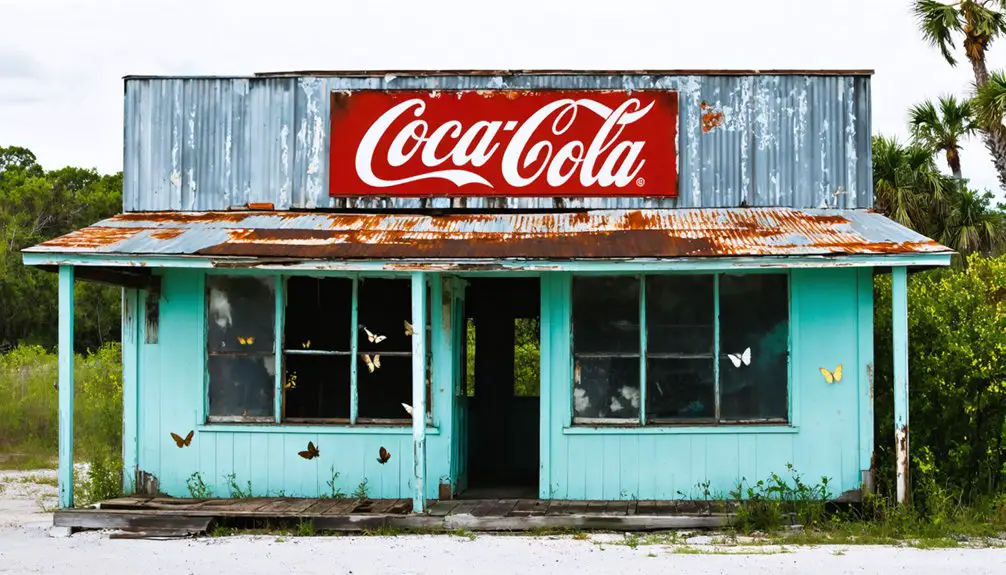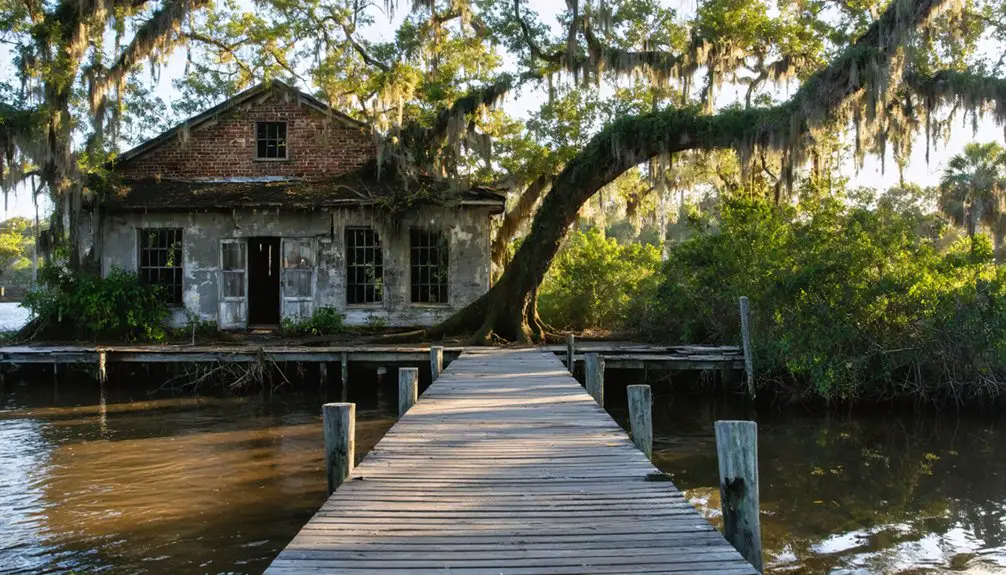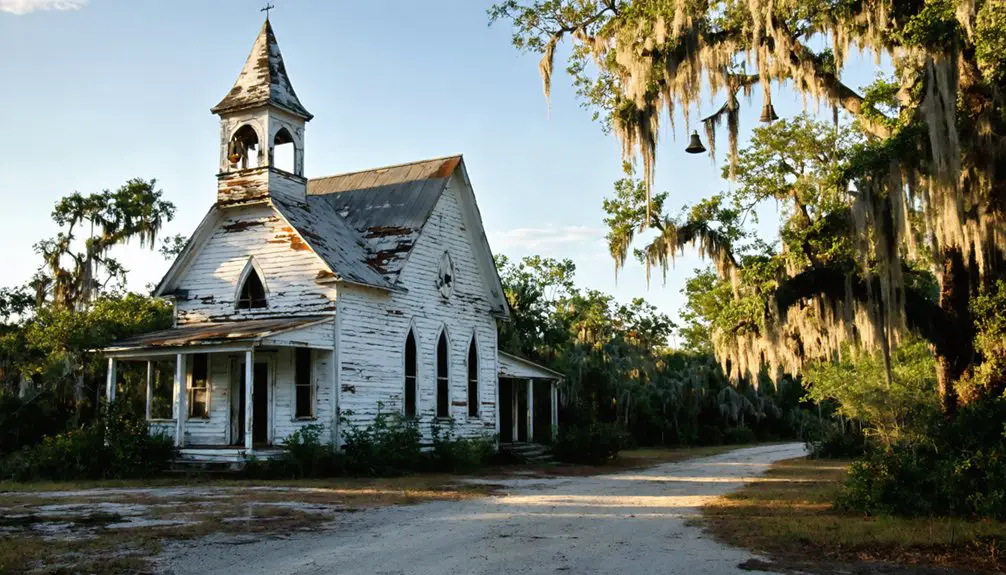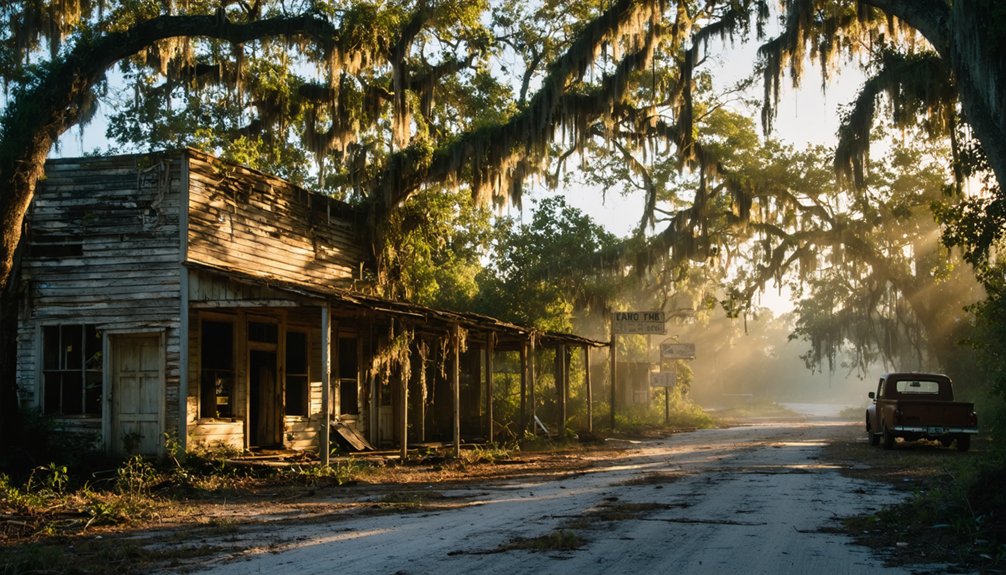
Florida contains between 250 and 257 documented ghost towns, placing it second nationwide behind only Texas. You’ll find these abandoned settlements scattered across courthouse ledgers, old property deeds, and preservation archives, though no single repository holds a complete inventory. The count fluctuates because definitions vary—some include hurricane-swept coastal ruins, while others demand standing structures or railroad stops. From phosphate mining camps to Civil War outposts, these forgotten communities reveal how quickly Florida’s landscape reclaims what humans leave behind.
Key Takeaways
- Florida has documented over 250 ghost towns, with counts varying between 200 and 257 depending on definitional criteria.
- Florida ranks second nationally for ghost towns, behind Texas with 511 and ahead of California with 346 verified locations.
- No single archive provides a complete inventory; documentation exists across courthouse ledgers, maps, property deeds, and preservation websites.
- Many settlements disappeared due to phosphate mining collapses, timber industry decline, hurricanes, floods, and military base deactivations.
- Notable examples include Brewster, Ellaville, Ruby, Indian Key, Fort Dade, and Coleman, representing diverse abandonment causes.
The Official Count: Florida’s 250+ Abandoned Settlements
Florida’s landscape harbors over 250 documented ghost towns, though archival records suggest the actual number likely exceeds this count by dozens more settlements lost to memory and overgrown by subtropical vegetation. You’ll find these abandoned communities scattered across every region—from Escambia County’s Fort Pickens on the Panhandle to Palm Beach County’s Juno along the Atlantic coast.
County records reveal settlements like Newnansville in Alachua and Kerr City in Marion, their coordinates precisely logged yet their structures vanished. Coastal erosion has claimed waterfront communities, while inland sites face botanical reclamation—native palms and invasive species gradually consuming what pioneers built. Polk County alone contains multiple abandoned settlements including Acron at 29°0.1’N 81°31.2’W and Brewster at 27°45.1’N 81°58.4’W, their precise geographical coordinates preserved in historical records even as the towns themselves disappeared. Modern Florida cities now face their own abandonment crisis, with boarded-up commercial areas transforming once-thriving urban centers into contemporary ghost towns.
The Wikipedia roster names barely half these locations, leaving countless others documented only in courthouse ledgers, surveyor maps, and fading property deeds awaiting rediscovery.
How Florida Ranks Among America’s 4,530+ Ghost Towns
Among America’s 4,530+ documented ghost towns, Texas claims the highest count with 511 abandoned settlements, yet Florida secures second place with 257 verified locations—a distinction that reflects the state’s volatile boom-and-bust cycles spanning three centuries.
This ranking positions Florida above California’s 346 ghost towns, underscoring patterns that shaped your state’s landscape:
- Phosphate mining collapses in Brewster and Ellaville
- Port abandonment following railroad route changes
- Hurricane devastation across coastal settlements
- Military deactivations at strategic fortifications
Today’s environmental restoration projects reclaim former settlements swallowed by the Everglades, while urban redevelopment transforms abandoned military installations into heritage sites. Modern construction offers no immunity, as evidenced by Alifaya’s transformation into a ghost town after Hurricane Ian damaged foundations, leaving behind personal belongings and family photos as haunted reminders of nature’s power to instantly convert living spaces into abandoned time capsules.
Fort Jefferson’s 1935 designation as a National Monument exemplifies how preservation efforts convert Florida’s abandoned infrastructure into accessible historical archives, documenting three centuries of failed conquest attempts. Michigan’s 128 ghost towns, including the industrial ruins at Fayette, demonstrate how abandoned industry sites across the nation transition from functional communities to preserved historical landmarks.
Why the Numbers Keep Changing: Definition Debates
You’ll find wildly different counts for Florida’s ghost towns—ranging from 200 to over 250—because historians can’t agree on what qualifies as “ghost.”
The debate hinges on whether you’re counting only completely abandoned settlements with visible ruins, or including towns absorbed by larger communities and those reduced to vine-covered chimneys.
Archival records complicate matters further, as many late 19th-century settlements left minimal documentation before disappearing beneath Florida’s aggressive vegetation and subsequent development. Historic maps from 1910 to 1932 show the same locations under different names or missing entirely, revealing how rapidly settlements appeared, renamed themselves, and vanished from official records.
Some of these locations retain their eerie character, with visitors reporting shadow figures darting through the remnants of forgotten streets and buildings.
What Qualifies as “Ghost”
When historians and researchers tally Florida’s ghost towns, the count shifts from around 200 to well over 250 depending on who’s defining the term. You’ll find the classification hinges on specific criteria that separates authentic ghost towns from merely dwindling communities:
- Established purpose – A legitimate reason for the settlement’s founding
- Growth period – Documented expansion and economic activity
- Population decline – Marked decrease leading to abandonment
- Physical evidence – Remaining infrastructure or complete absorption by another town
The debate centers on economic cessation as the common thread. Ghost town legends emerge from hurricane devastation, crop failures, and environmental contamination that prevented repopulation. Many towns collapsed during the Florida land sale bust prior to the 1929 Great Depression, further complicating the classification of abandoned settlements. Sites that reflect past economic activities like phosphate mining, salt production, and clay extraction often meet the criteria for ghost town designation.
Unlike Hollywood’s dramatic abandoned architecture, Florida’s remnants appear subtly—old chimneys rising from palmetto scrub, foundations beneath sandy beaches, or historical layers sandwiched between modern developments.
Incomplete Documentation Across Sources
Because Florida’s ghost towns vanished beneath layers of sand, cypress, and subsequent development, no single archive holds a complete inventory. You’ll find Wikipedia offering coordinates for Fruitcrest and Gamble Plantation while admitting incompleteness. Florida Backroads Travel enumerates thirty-plus sites like Acron and Aladdin City without claiming exhaustive coverage.
The Journal of Florida Studies documents over two hundred settlements, yet acknowledges countless others lie unrecognized beneath I-95 corridors and modern suburbs. Hurricanes erased places like Tuckersville before proper records existed.
Urban legends fill gaps where documentation failed, while preservation efforts struggle against a state whose rapid growth continuously buries its past. GhostTowns.com provides more detail than most sources, listing approximately 250 sites, but even commercial databases can’t capture every lumber camp or phosphate village that disappeared between the 1880s and 1920s.
County-by-County Breakdown of Forgotten Communities
Florida’s ghost towns cluster most prominently across the state’s midsection and northern tier, where nineteenth-century timber operations, phosphate mining, and steamboat landings once promised prosperity.
You’ll find these abandoned settlements concentrated where extractive industries exhausted resources and moved on.
Documentation reveals significant concentrations in:
- Lake County – Maritime settlements along steamboat routes, now preserved through historical society mapping projects
- Marion County – Timber boom towns that vanished when sawmills shuttered
- Hillsborough County – Phosphate mining communities abandoned after economic collapse
- Madison County – Agricultural settlements depleted by soil exhaustion
While preservation efforts remain fragmented, local legends keep many settlements alive in regional memory.
County historical societies provide your best archival evidence, though all-encompassing statewide documentation doesn’t exist. The Kinseekers Genealogical Society maintains detailed records of Lake County’s abandoned communities, including a specialized ghost towns map that correlates township, range, and section data with historical land records.
Natural disasters like hurricanes accelerated abandonment across Florida’s coastal counties, permanently displacing entire communities.
Each county maintains independent records of its forgotten communities.
Phosphate Mining Towns That Vanished
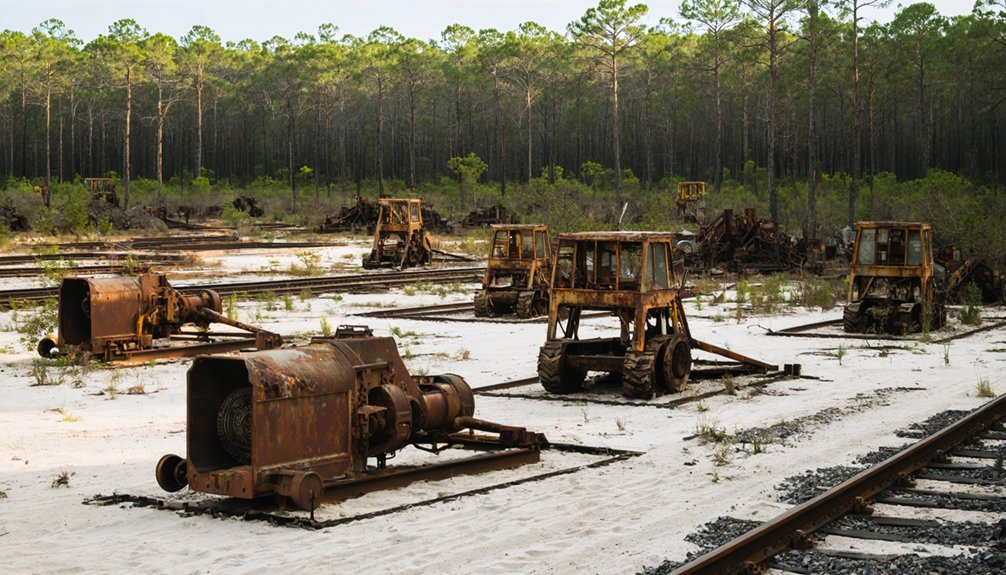
You’ll find Florida’s phosphate boom created entire communities that disappeared as quickly as the mineral deposits ran out. Towns like Archer rode waves of extraction prosperity in the late 1800s, while Ruby’s mining operations carved temporary settlements from Central Florida wilderness before economic collapse erased them from maps.
These company towns existed solely to serve phosphate extraction, leaving behind scattered foundations and cemetery markers as the only evidence of their brief industrial lives.
Archer’s Phosphate Industry Boom
When phosphate hunters struck rich deposits in western Alachua County during the late 1870s, they transformed the quiet farming settlement of Archer into a bustling industrial center that would define North Central Florida’s economy for decades.
The mining heritage reshaped this 1858 railroad town through:
- Narrow-gauge tram lines crisscrossing the countryside to transport ore
- Steam-powered processing plants dotting the landscape by the dozens
- Railroad extensions like the Savannah, Florida and Western reaching Archer in 1893
- Population explosions as hundreds of miners flooded in seeking opportunity
Archer history reveals phosphate’s critical role in fertilizer production made fortunes overnight.
Henry Plant’s railroad investments and Cummer Lumber’s infrastructure cemented the town’s dominance.
Ruby: The Lost Mine
Deep within the Apalachicola-Chattahoochee-Flint River Basin, Ruby emerged during the late 1800s as a mineral extraction outpost far removed from the phosphate corridors of Central Florida. You’ll find its clay and kaolin mines attracted workers who built homes, established a post office, and created thriving infrastructure around the river’s edge.
Then catastrophe struck. An early 20th-century flood sent violent waters through the town center, killing multiple miners and erasing Ruby’s future. Rain folklore now surrounds this vanished community, where locals claim drowned spirits still call from the riverbanks.
Depleted mines and economic collapse prevented any rebuilding efforts.
Today, Ruby represents Florida’s forgotten extraction communities—where miner legends persist in the basin’s remote wilderness, reminding you how quickly prosperity can vanish beneath rising waters.
Economic Collapse and Abandonment
While Ruby’s demise came from nature’s wrath, Florida’s phosphate towns met their end through calculated exhaustion of the earth itself. You’ll find urban decay scattered across Central Florida’s Bone Valley, where economic nostalgia clings to silent pits and crumbling foundations.
These company towns flourished then vanished following a predictable pattern:
- Archer – Late 1800s phosphate discovery sparked explosive growth before early 1900s depletion
- Brewster – Mid-20th century Polk County operations left abandoned railroad sidings
- Nichols – 400 residents in 120 company houses vanished after 1910s exhaustion
- Oriole – Ghost ranch sites now hidden within Withlacoochee State Forest
The evidence remains stark: processed wet bins, exhausted quarries, and house foundations where miners once believed they’d built permanent communities. Florida’s phosphate legacy proves single-industry dependence breeds inevitable abandonment.
The Great Freeze of 1895 and Lost Citrus Settlements
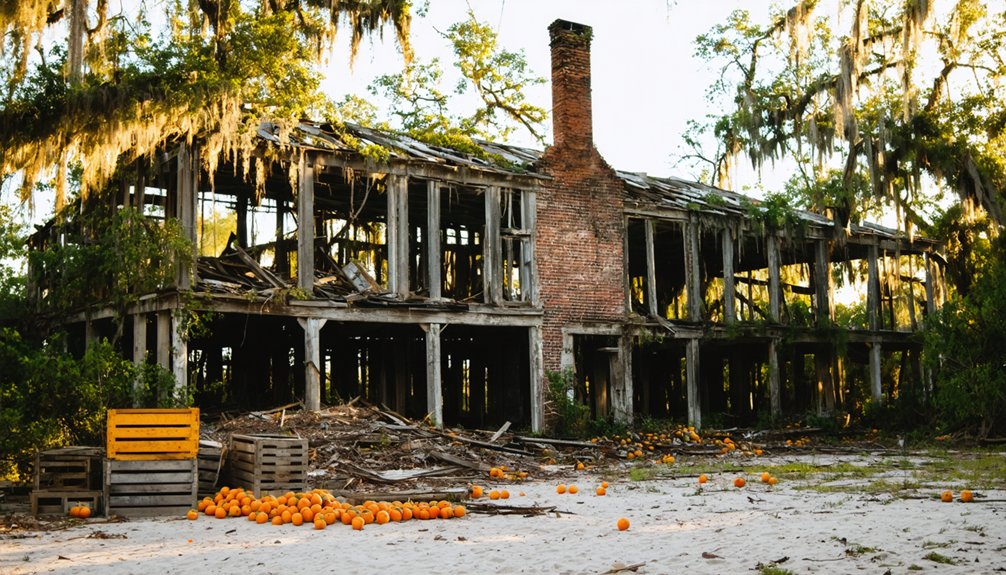
The historical impact reshaped Florida’s landscape entirely. Production collapsed from six million boxes annually to just 100,000.
Entire communities like Earnestville vanished as financially ruined farmers abandoned their land. You’ll find the industry’s center shifted 100 miles southward, with Henry Flagler extending his railroad to Miami after confirming frost-free territory.
Small growers couldn’t survive the seven-year wait for new trees to bear fruit.
Ghost Towns of the Florida Keys and Their Dark Histories
Among Florida’s most haunting abandoned settlements, Indian Key stands as a proof to the violent forces that shaped the region’s early frontier. This 11-acre island housed 140 people before Seminoles attacked in 1840, killing 13 residents and burning the settlement.
Indian Key’s tragic 1840 massacre left 13 dead and an entire frontier settlement in ashes, forever marking Florida’s violent colonial history.
Archaeological evidence reveals the Keys’ darker past through skeletal discoveries and spooky legends surrounding these haunted sites.
The region’s ghostly legacy includes:
- Indian Key’s mysterious bones – At least two skeletons found since 1966, including possible wreckers and victims from the 1840 raid
- Key West’s Bone Island – Named for human remains from tribal warfare dating to 800 CE
- Hurricane devastation – The 1846 storm claimed countless lives
- Pirate settlements – Matecumbe Key and surrounding waters harbor tales of shipwrecks and lawless seafarers
You’ll find cultural evidence throughout these abandoned outposts.
Military Outposts Left to Decay
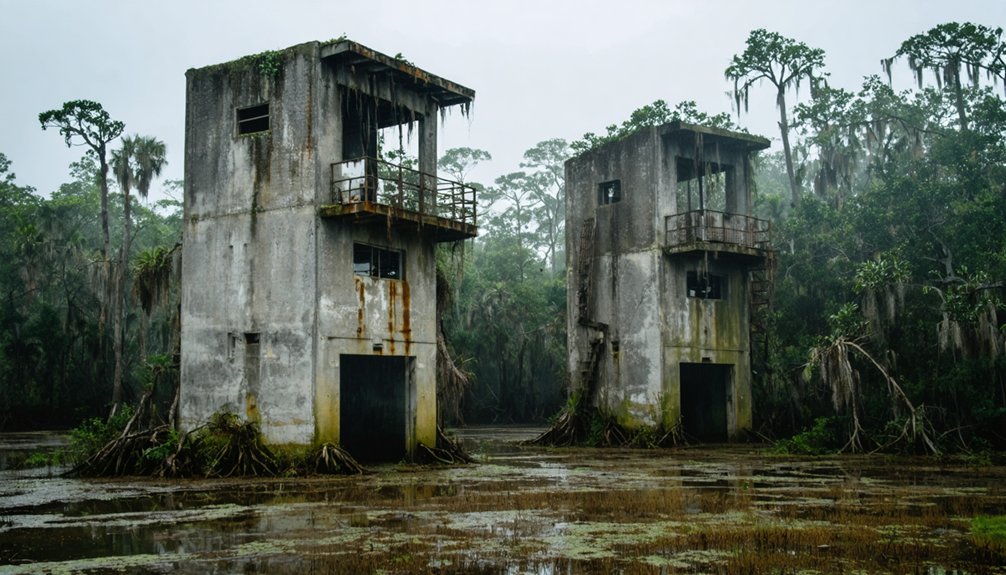
Scattered across Florida’s landscape, military outposts from multiple American conflicts now crumble into memory, their strategic importance faded with the wars they served. You’ll find Fort Dade on Egmont Key, its 1898 concrete bunkers protecting Tampa Bay‘s entrance now surrendered to wildlife.
Carlstrom Field’s abandoned runways in Arcadia whisper of World War training missions long forgotten. Naval Air Station Lee Field transformed into Reynolds Industrial Park, though its museum preserves wartime stories the government once classified.
Most striking is Nike Missile Site HM-69 in the Everglades—Cold War forts built for military surveillance after Cuban tensions. Its intact launchers and radar installations stand as proof of nuclear-age paranoia.
Camp Gordon Johnston’s amphibious training grounds near Carrabelle decay quietly, their strategic secrets now public domain for anyone seeking Florida’s martial past.
Hurricane-Ravaged Communities That Never Recovered
When Florida’s deadliest storms make landfall, some communities face a choice between rebuilding or surrendering to nature’s fury—and increasingly, they’re choosing surrender.
Hurricane-devastated settlements across the Panhandle and Keys reveal stark patterns of permanent abandonment. Historical records document specific markers of communities that couldn’t recover:
- 70% housing destruction rates triggering mass displacement of 20,000+ residents
- Schools shuttered indefinitely, erasing educational infrastructure for entire generations
- Repeated storm strikes preventing reconstruction efforts from gaining momentum
- Ghost town cycles during evacuations that become permanent desertions
Urban exploration of these sites reveals cultural preservation challenges when nature reclaims territory. The Florida Keys’ post-Irma landscape and forgotten Panhandle counties demonstrate how repeated hurricane seasons transform thriving communities into wind-swept remnants accessible only to those documenting vanished coastal life.
Civil War Battlegrounds Turned Ghost Settlements
Florida’s Civil War legacy extends beyond battlefield casualties into settlement patterns that transformed strategic military sites into abandoned communities.
You’ll find Olustee, where 1864’s largest Florida engagement protected Confederate supply routes, now preserved as a state park where archaeological discoveries reveal Confederate earthworks.
Columbus guarded Suwannee River crossings with 500 residents before Union forces targeted its infrastructure, leaving only cemetery stones.
Ellaville thrived post-war under Governor George Drew’s sawmill empire, employing 500 workers before complete abandonment by 1942.
Fort Barrancas defended Pensacola harbor through intense 1861-1862 battles, its ruins standing as testament to coastal warfare.
Coleman emerged as freed slaves built independent communities, their church and homes vanishing while historical preservation efforts maintain cemetery grounds documenting this transformative era in Florida’s freedom narrative.
Frequently Asked Questions
Can You Legally Visit and Explore Florida’s Ghost Towns?
You can legally explore many Florida ghost towns, but legal restrictions vary by location. Public sites like Olustee welcome visitors, while private properties risk trespassing fines. Exploration risks include unstable structures and wilderness hazards requiring careful preparation.
Are Any Florida Ghost Towns Protected as Historical Sites?
Yes, preservation efforts protect several Florida ghost towns. You’ll find Fort Dade, Eldora, and Olustee safeguarded within state and national parks due to their historical significance, ensuring you can freely explore these culturally important sites for generations.
Which Florida Ghost Town Is Considered the Most Haunted?
You’ll find Fort Dade on Egmont Key holds Florida’s most haunted reputation. Urban legends surround its abandoned batteries and haunted structures, with archival evidence documenting 48 vanished buildings. It’s your eerie escape into authentic military ruins and cultural mystery.
Do People Still Live in Any of Florida’s Ghost Towns?
Yes, you’ll find people living in Florida’s abandoned settlements like Juno and Torrey. These ghost town mysteries reveal through archival evidence that some retain minimal populations, blending cultural context of historical abandonment with modern habitation in your exploration.
What’s the Best Time of Year to Visit Florida Ghost Towns?
Ready to escape tourist crowds while exploring abandoned ruins? Visit Florida’s ghost towns during November through March, when seasonal weather brings mild temperatures and dry conditions perfect for accessing remote sites without summer’s oppressive heat or hurricane threats.
References
- https://en.wikipedia.org/wiki/List_of_ghost_towns_in_Florida
- https://blog.batchgeo.com/ghost-towns/
- https://www.loveexploring.com/gallerylist/188219/the-us-state-with-the-most-ghost-towns-revealed
- https://fdc.com/blog/ghost-towns-in-florida/
- https://www.arcadiapublishing.com/products/haunted-florida-ghost-towns-9781467156479
- https://www.geotab.com/ghost-towns/
- https://patchproflorida.com/blog/the-fascinating-history-of-floridas-ghost-towns/
- https://floridatrailblazer.com/tag/ghost-towns/
- https://www.youtube.com/watch?v=doLeKKfuwHU
- https://patch.com/florida/across-fl/these-fl-counties-could-have-ghost-towns-2100-new-study