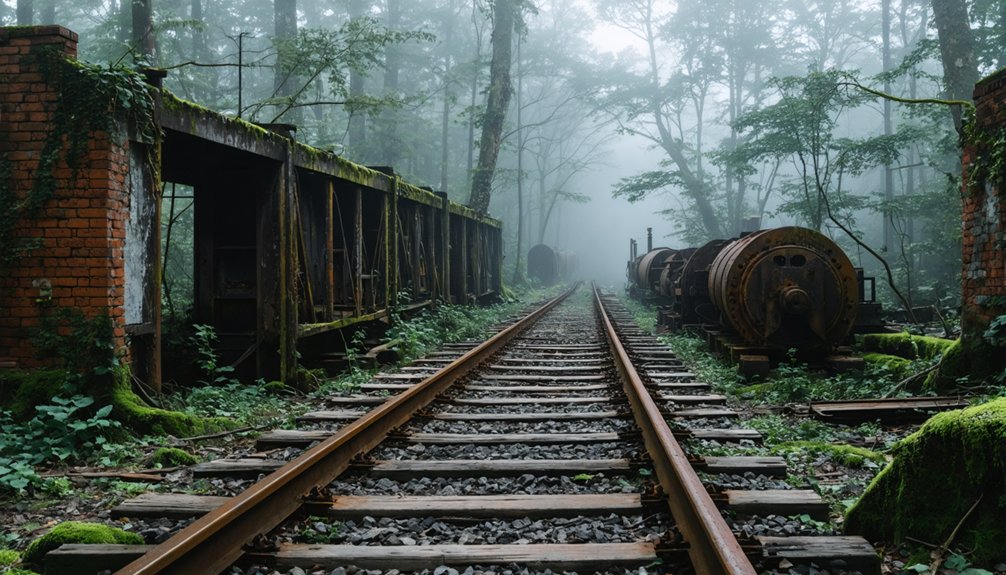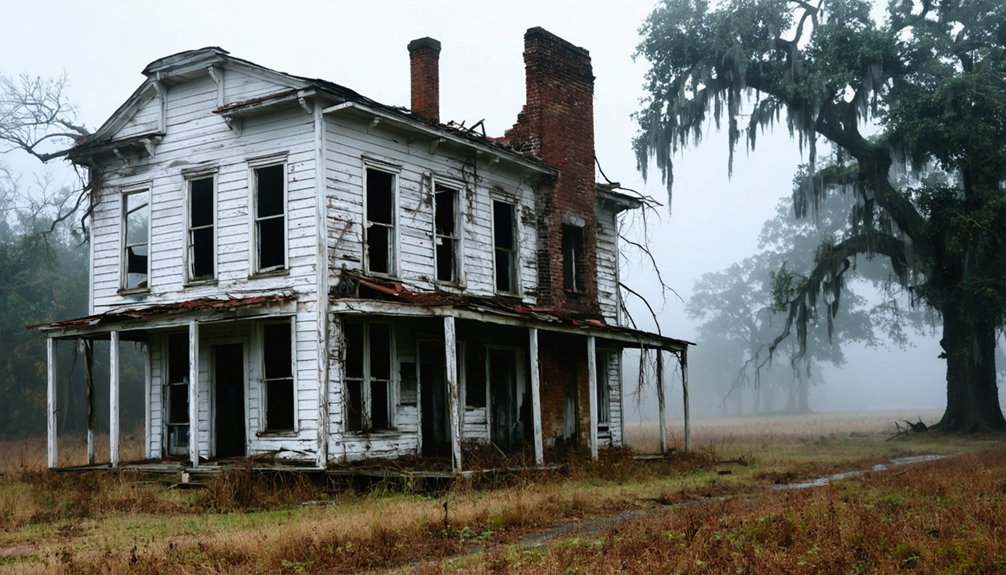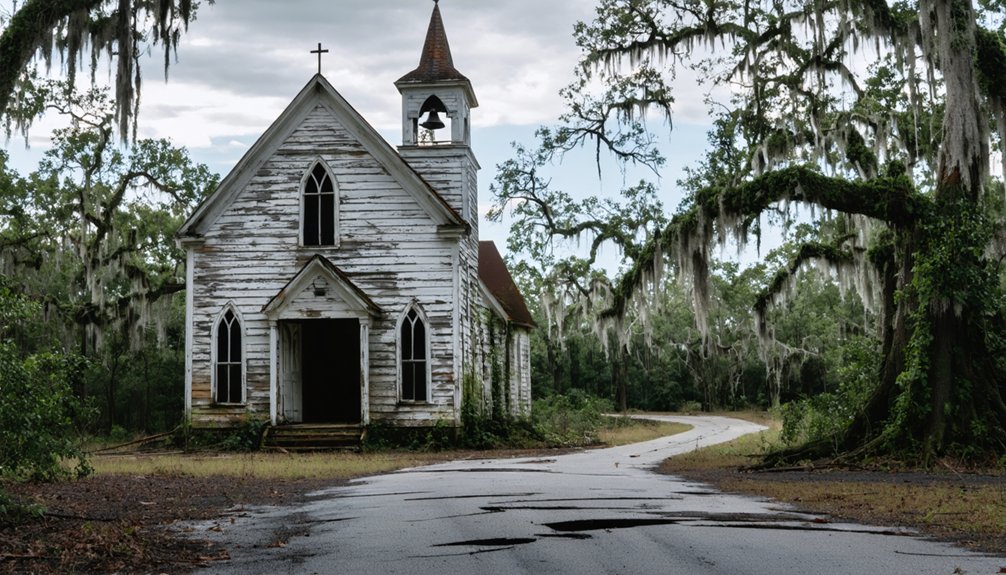
You’ll find between 16 and 34 documented ghost towns in Georgia, depending on how strictly you define “abandoned.” Conservative archival surveys cite 16 fully deserted sites with only ruins remaining, while broader estimates reach 34 when including semi-abandoned communities that’ve lost significant populations since their peaks. This variance stems from inconsistent classification criteria—some counts include settlements reduced to one-fifth of their peak populations, while others require complete desertion. The causes range from Sherman’s devastating 1864 March through mining boom collapses to coastal environmental shifts, and understanding these distinctions reveals fascinating patterns across Georgia’s settlement history.
Key Takeaways
- Conservative estimates cite about 16 documented ghost town sites in Georgia, while broader archival surveys suggest as many as 34 locations.
- Counts vary widely because definitions differ: some require zero inhabitants while others include semi-abandoned communities with small populations.
- Notable Georgia ghost towns include Auraria, Griswoldville, Scull Shoals, Sunbury, and multiple settlements on Cumberland Island.
- Many towns were abandoned due to Civil War destruction, gold rush decline, coastal environmental changes, and floods.
- Historical documentation gaps and lack of official classification standards make exact counts difficult to determine.
Counting Georgia’s Abandoned Settlements
While historians and researchers have attempted to catalog Georgia’s abandoned settlements, no definitive census exists due to varying definitions of what constitutes a “ghost town.” Conservative estimates place the figure at 16 documented sites, yet alternative archival surveys identify as many as 34 distinct locations across the state’s 159 counties.
Wikipedia’s incomplete listings span multiple counties, while nationwide mapping projects document over 3,800 ghost towns, including Georgia’s contributions. Various sources cite dozens of settlements—Allatoona, Auraria, Griswoldville, Troupville—without establishing fixed totals.
This numerical ambiguity stems from overlapping categories: fully abandoned sites reverting to fields, partially standing ruins, and semi-abandoned communities with minimal populations. Among Georgia’s most historically significant ghost towns is Auraria, which emerged during the Georgia gold rush of the 1830s on Cherokee lands before its eventual abandonment. Heritage preservation efforts face challenges separating documented history from urban legends, complicating accurate tallies of these vanished communities.
Contemporary rural decline threatens to create new ghost towns, with Dooly County experiencing nearly 20% population loss between 2010 and 2020, marking it as the state’s top county for demographic decline.
Why the Numbers Vary So Much
You’ll encounter dramatically different ghost town tallies for Georgia because researchers apply conflicting definitions—some count only barren sites with zero inhabitants, while others include semi-abandoned communities retaining small populations.
Historical documentation gaps compound this problem, as many settlements disappeared from official records before systematic surveying began, leaving their existence and abandonment status uncertain. Former postal locations tracked by sources like Jim Forte Postal History reveal now-defunct communities that might otherwise remain undocumented in ghost town inventories.
The threshold separating a “ghost town” from a “declining community” remains fundamentally unresolved across archival sources, with some systems requiring complete desertion while others accept towns that’ve lost four-fifths of their peak population. Complicating matters further, no single official definition exists for ghost town classification, resulting in wildly inconsistent catalogs across different databases and historical societies.
Defining “Ghost Town” Criteria
When you attempt to count Georgia’s ghost towns, you’ll immediately encounter a fundamental problem: scholars and researchers can’t agree on what qualifies as a ghost town in the first place.
Criteria variations range from T. Lindsey Baker’s definition of places “for which the reason for being no longer exists” to stricter standards requiring complete abandonment.
The physical evidence requirement creates further ambiguity—some registries demand substantial buildings, while others accept mere foundations or even demolished sites. These settlements are also referred to as deserted or extinct towns, adding another layer of terminological inconsistency to the classification challenge.
You’ll find population thresholds equally inconsistent: certain sources permit “skeleton populations,” whereas others insist on total depopulation.
Whether abandonment stemmed from economic failure or external disasters like floods also splits classification approaches. Some classifications even include towns abandoned due to environmental contamination, which further complicates the counting process.
This definitional chaos makes comparing ghost town counts across different sources virtually impossible.
Incomplete Historical Documentation
Beyond definitional disagreements lies a more fundamental obstacle: Georgia’s ghost towns often left virtually no paper trail. Archival gaps plague settlements like Scull Shoals, where only a paper mill mention and 1880s flood references survive—no resident registries or financial ledgers exist.
Wrightsborough’s 1768 Quaker grant appears in isolated vignettes rather than systematic colonial archives. Old Ebenezer’s 1736-1738 relocation lives solely in Oglethorpe’s letters and Saltzburger resolutions.
Princeton and White Hall vanished into Athens by the 1940s, visible on a 1938 map but omitted from later surveys.
You’ll find researchers relying heavily on oral history—Palmyra’s planter narratives, Campbellton’s courthouse demolition lore, Constitution’s cemetery dispute preserved in newspaper clippings. Constitution itself was recognized as a “Lost Hamlet” until 1981, when residents and historian Franklin Garrett worked to reconstruct its largely forgotten history. Auraria’s documentation faded after gold seekers moved west, leaving behind only remnants of its mining boom.
Floods, annexations, and time erased what little documentation once existed.
Semi-Abandoned vs. Fully Deserted
Population decline thresholds further complicate counts. Historic communities shrunken to one-fifth their peak population qualify under some definitions but not others.
You’ll find Georgia’s documented ghost towns ranging from barren sites reduced to foundations—like Wrightsboro’s 1810 church and cemetery—to standing structures with occasional visitors. Post-Soviet industrial cities like Chiatura exemplify this ambiguity, transformed from thriving manganese mining centers into depopulated landscapes of rusted cranes and overgrown infrastructure following the 1991 collapse. Administrative absorption into larger municipalities, such as Constitution becoming part of Atlanta in 1952, further blurs whether former settlements should count as ghost towns or simply lost neighborhoods. These varying abandonment states make definitive tallies nearly impossible, explaining why estimates fluctuate markedly across sources.
Most Famous Ghost Towns in Georgia
Georgia’s abandoned settlements tell compelling stories of ambition, prosperity, and eventual decline across three centuries of state history. You’ll find these sites scattered across diverse countryside, each preserving unique chapters of industrial and cultural heritage.
The state’s most significant ghost towns include:
- Scull Shoals – Greene County’s 1792 frontier village housed Georgia’s first paper mill before Oconee River floods and curse rumors triggered abandonment. Visible ruins of walls, banks, and stores remain in Oconee National Forest.
- New Ebenezer – Salzburgers’ 1700s utopian agricultural community in Effingham County now serves as a historic landmark with standing buildings and an active congregation from its founding.
- Auraria – Features churches and stores in various dilapidation states, offering historical preservation opportunities and tourism development potential throughout McDuffie County’s forgotten landscapes.
Georgia’s Ranking Among Other States
When measured against other states, Georgia occupies a modest position in ghost town prevalence, with documented counts ranging from 16 to 34 abandoned settlements depending on definitional criteria.
Georgia’s ghost town count varies between 16 and 34 sites, reflecting differing definitions of what constitutes an abandoned settlement.
You’ll find Georgia tied with North Carolina at 16 sites in national surveys, markedly trailing western states like Texas (511) and California (346), where mining booms created massive population decline.
Florida’s 257 ghost towns dwarf Georgia’s total, while Alabama’s 55 surpass it considerably.
The Peach State’s fertile land and sustained river commerce prevented the dramatic abandonment cycles that plague arid regions.
Unlike western territories dependent on single industries, Georgia’s diversified economy maintained settlements through shifts.
Historical preservation efforts face unique challenges here—many sites remain semi-abandoned rather than fully deserted, complicating documentation and protection initiatives across southeastern states.
Civil War Era Abandoned Towns
Sherman’s March to the Sea carved a path of destruction across Georgia in 1864, leaving numerous settlements permanently abandoned in its wake. You’ll find these war-ravaged sites scattered across the state’s central counties, where urban decay meets historical preservation efforts.
The most significant Civil War-era ghost towns include:
- Griswoldville in Jones County, destroyed during Sherman’s campaign when Union cavalry razed its factories and structures, forcing residents to permanently flee.
- High Falls in Monroe County, where military actions devastated this industrial town, now protected within state park boundaries.
- Scull Shoals in Greene County, whose Civil War-era decline accelerated the abandonment of Georgia’s first paper mill along the Oconee River.
These sites represent tangible evidence of warfare’s lasting impact on Georgia’s settlement patterns and demographic distribution.
Coastal and Island Ghost Towns
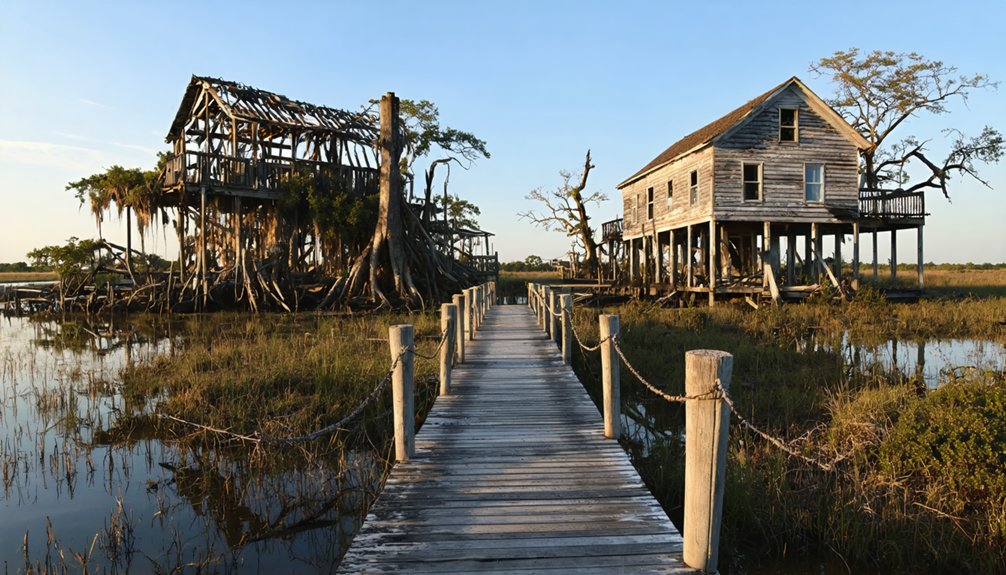
Georgia’s coastal ghost towns reveal how maritime commerce and military needs shaped settlement abandonment from the 1790s through World War II. You’ll find Sunbury’s Fort Morris ruins mark a once-thriving port abandoned after harbor silting redirected trade to Savannah, while Willie disappeared entirely when the military evicted all residents for installation construction in the 1940s.
Cumberland Island’s Dungeness presents the most dramatic coastal ruin—a fire-gutted castle standing skeletal among barrier island wilderness, its 1950s destruction still unexplained.
Cumberland Island’s Abandoned Settlements
Since 1587, Cumberland Island’s shoreline has witnessed successive waves of settlement and abandonment, transforming this barrier island into a layered archaeological palimpsest of vanished communities.
Key abandoned settlements include:
- Mission San Pedro de Mocama (1587-1684): Spanish missionaries abandoned this site after French pirate attacks in 1683-1684, with survivors retreating to St. Augustine. Structures likely were lost to erosion.
- Fort William and Fort St. Andrews: British colonial defenses disappeared after the 1742 Battle of Bloody Marsh, leaving virtually no traces.
- Brick Hill and The Settlement (1862-1930s): Post-Civil War freedmen communities that dissolved when land reverted to white ownership.
Archaeological discoveries face severe preservation challenges from coastal erosion.
The Dungeness ruins—burned in the 1950s—exemplify how each civilization’s remains become substrate for the next, creating freedom from institutional permanence.
Coastal Abandonment Patterns
When Georgia’s coastal ports competed for Atlantic trade dominance in the mid-18th century, environmental forces and disease already conspired to determine which settlements would endure.
You’ll find Sunbury’s decline exemplifies this pattern—harbor silting and yellow fever outbreaks transformed a thriving port rivaling Savannah into abandoned cemetery bluffs by the early 1800s.
Frederica on St. Simons Island faced different pressures: military obsolescence after 1748 prompted evacuation within seven years, leaving tabby fortifications as maritime preservation challenges.
Warsaw and Jacksonborough succumbed to agricultural shifts and floodplain vulnerabilities.
These coastal abandonments weren’t random—they followed predictable environmental triggers: silted harbors restricting navigation, disease vectors in low-lying areas, and economic isolation when trade routes shifted inland.
The remaining colonial architecture at these sites documents how geography ultimately constrained settlement viability along Georgia’s Atlantic periphery.
Mining Towns That Disappeared
The discovery of gold in northern Georgia transformed wilderness into boomtowns almost overnight, yet most of these mining settlements vanished just as quickly as they appeared. Auraria exemplifies this pattern—founded in June 1832 when William Dean built his cabin between the Chestatee and Etowah Rivers. The town’s name derives from the Latin “aurum” for gold.
Thousands flooded the former Cherokee lands following the 1832 Gold Lottery, but prosperity proved fleeting.
The 1832 Gold Lottery drew thousands to Cherokee territories, yet their fortunes would prove as transient as morning fog.
Key factors in Auraria’s collapse:
- County offices and businesses relocated to Dahlonega in 1833 for the federal mint
- Complete abandonment by 1849 as miners departed for California
- Gold operations ceased permanently, leaving only mining relics behind
You’ll find minimal settlement preservation efforts documented for these sites, as Georgia’s gold rush communities typically lacked the infrastructure necessary for long-term survival beyond their initial extractive purposes.
Semi-Abandoned Communities Still Standing
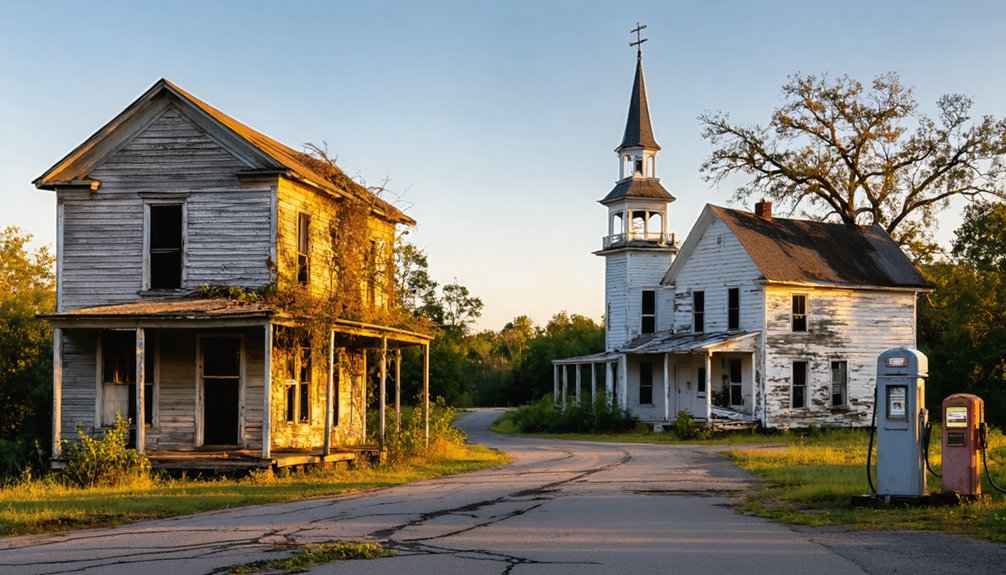
Unlike Georgia’s completely vanished mining settlements, several communities across the state exist in a liminal condition—neither fully abandoned nor functionally viable. You’ll find Sparta’s impressive courthouse presiding over vacant storefronts, its antebellum homes contrasting sharply with a 30% poverty rate.
Grantville, immortalized in “The Walking Dead,” documents rural ruins resulting from interstate highways and industrial agriculture. Banning Mills stands completely deserted in Snake Creek Gorge since 1971, its scattered structures marking Georgia’s first locally-minted currency.
Kite’s population plummeted from 472 to 160, while Wrightsville’s poverty reaches 27.5%. These semi-abandoned towns display characteristic urban decay—thrift stores, title pawns, neglected buildings—with no clear preservation efforts emerging.
Burke County’s Gough maintains half-abandoned streets, exemplifying communities caught between survival and extinction.
Frequently Asked Questions
What Legal Rights Exist to Explore Abandoned Ghost Towns in Georgia?
You’ve got limited legal rights to explore Georgia’s ghost towns. Trespassing laws strictly prohibit unauthorized entry onto private property, regardless of abandonment status. Legal ownership remains enforceable, requiring you to obtain explicit permission before exploring any site.
Can You Purchase Property in Georgia’s Semi-Abandoned Communities?
You can purchase property in Georgia’s semi-abandoned communities, though urban decay complicates transactions. Historical preservation restrictions may apply to certain sites. You’ll find buyable parcels exist, but research zoning laws, ownership records, and structural conditions before committing funds.
Are Ghost Town Tours Available in Georgia for Visitors?
You’ll find limited organized ghost town tours in Georgia, primarily at New Ebenezer’s preserved sites. Most urban exploration opportunities require independent research and respect for historic preservation laws, as formal commercial tours remain underdeveloped statewide.
Which Georgia Ghost Town Is Most Haunted by Paranormal Activity?
Beneath Spanish moss and crumbling facades, Dahlonega stands as Georgia’s most paranormally active ghost town. You’ll find paranormal investigations consistently document Civil War spirits, mining-era apparitions, and ghost town myths validated through cemetery encounters and historic building hauntings since 1828.
How Do Ghost Towns Affect Nearby Property Values in Georgia?
Ghost towns in Georgia markedly depress your nearby property values through neglect and abandonment. Historical preservation efforts can mitigate losses, while environmental impact from deteriorating structures reduces surrounding home prices by approximately 9.4% within 500 feet.
References
- https://www.ghosttowns.com/states/ga/ga.html
- https://www.loveexploring.com/gallerylist/188219/the-us-state-with-the-most-ghost-towns-revealed
- https://en.wikipedia.org/wiki/List_of_ghost_towns_in_Georgia_(U.S._state)
- https://www.youtube.com/watch?v=WBJJx3oCy-c
- https://www.freakyfoottours.com/us/georgia/
- https://www.geotab.com/ghost-towns/
- https://freepages.history.rootsweb.com/~gtusa/usa.htm
- https://www.youtube.com/watch?v=lzP7R2kmjII
- https://www.ajc.com/news/if-people-keep-leaving-were-going-to-be-a-ghost-town/D5RFBBKMUBGGJGBSGMHATHYLJA/
- https://roughdraftatlanta.com/2021/05/23/travels-with-charlie-georgias-ghost-towns-slideshow/