You’ll find approximately 21 ghost towns across Hawaii’s islands, though only 13 have dedicated archival documentation. These abandoned sites range from ancient Hawaiian villages to 20th-century plantation communities, scattered primarily across the Big Island, Molokaʻi, and Maui. Hawaii ranks 21st nationally for ghost town prevalence—far fewer than mainland states like Texas or California. Most vanished due to sugar industry collapse, devastating tsunamis, volcanic eruptions, and economic shifts that transformed entire communities. The stories behind each site reveal Hawaii’s complex history of cultural displacement and natural catastrophe.
Key Takeaways
- Hawaii has approximately 21 ghost towns across its islands, though only 13 have dedicated archival documentation.
- The numerical discrepancy stems from classification challenges and varying abandonment timelines—some gradual, others abrupt.
- Ghost towns span Hawaii’s Big Island, Molokaʻi, Maui, and Lanai, including ancient villages and plantation communities.
- Hawaii ranks 21st among U.S. states for ghost town prevalence, tied with Missouri and West Virginia.
- Most abandonments resulted from industry closures, tsunamis, volcanic eruptions, and socioeconomic shifts throughout Hawaii’s history.
Total Ghost Town Count Across the Hawaiian Islands
While historians continue debating exact figures, approximately 21 ghost towns scatter across the Hawaiian Islands.
Though only 13 have secured dedicated documentation in exhaustive archival records, you’ll find these abandoned settlements spanning Hawaii’s Big Island, Molokaʻi, and Maui. Each represents distinct chapters of displacement and transformation.
The discrepancy between documented and undocumented sites reflects classification challenges—some communities experienced gradual population decline rather than sudden abandonment, while others underwent urban redevelopment that erased their original character.
These ghost towns range from ancient Hawaiian villages predating European contact to 20th-century sugar plantation communities left hollow after industry collapse. Notable among these is Keomoku on Lanai, where the sugar industry decline and an early 1900s plague led to abandonment, leaving behind homes and railroad remnants.
Natural disasters, volcanic destruction, and economic shifts forced residents to abandon their homes, leaving behind archaeological footprints of Hawaii’s complex settlement history across multiple islands. The category page lists all 13 documented ghost towns, providing an organized directory for researchers and tourists interested in exploring these abandoned Hawaiian settlements.
Hawaii’s National Ranking for Abandoned Settlements
Among America’s 50 states, Hawaii occupies a modest 21st position in ghost town prevalence, with its 21 documented abandoned settlements placing it in a three-way tie with Missouri and West Virginia. You’ll find this ranking dramatically lower than Western states like Texas (511), California (346), and Kansas (308), reflecting Hawaii’s distinct settlement patterns.
Unlike mainland boom-and-bust mining towns, Hawaiian ghost settlements emerged from plantation closures, tsunami devastation, and volcanic displacement—events requiring different historical preservation approaches.
Hawaii’s ghost towns tell stories of natural disasters and economic shifts rather than depleted gold mines and abandoned railroad dreams.
The state’s cultural significance extends beyond mere abandonment statistics; each site represents displaced communities rather than exhausted resources. Hawaii’s 13.83% vacancy rate places it at No. 18 nationally, though these vacant properties differ substantially from traditional ghost towns—encompassing second homes, timeshares, and seasonal residences rather than permanently abandoned communities. The 2023 wildfire in Kahului exemplifies modern displacement patterns, forcing residents from their homes and contributing to contemporary ghost settlement dynamics.
While the nation totals nearly 4,000 ghost towns, Hawaii’s limited count demonstrates your islands’ resilience against the wholesale abandonment that characterized continental expansion.
This ranking reveals less about failure and more about sustained habitation.
Ghost Towns Near Honolulu’s Metropolitan Area
You’ll find six documented ghost towns within a 50-mile radius of Honolulu, concentrated primarily in Honolulu County itself. These abandoned settlements trace their origins to Oahu’s sugar plantation era, when the industry’s collapse in the mid-20th century left behind ruins like Kawailoa’s jungle-overtaken homes and the skeletal remains of Waialua Sugar Mill.
Even within the metropolitan uplands, sites like Kalihi Uka preserve haunting remnants of displacement—from the Wilson Tunnel‘s tragic history to destroyed healing ponds that once held sacred significance. These locations represent remnants of historical economic activities that once sustained thriving communities across the islands. On the Big Island, visitors can explore Kaloko-Honokohau National Historic Park, where a prehistoric village once thrived with fishponds, crops, and lava tube shelters across 1160 acres.
Six Towns Within Radius
Within a 50-mile radius of Honolulu’s bustling downtown, six ghost towns stand as weathered monuments to Oahu’s plantation era and early settlement patterns.
You’ll find Apua’s scattered remnants and Iwilei’s industrial ruins challenging conventional narratives of Hawaii’s perpetual paradise. Kawailoa’s jungle-consumed streets reveal what happens when sugar’s economic grip loosens—nature reclaims everything.
Waialee and Waialua Sugar Mill present stark examples of urban decay frozen in time, while Halstead Sugar Mill’s crumbling infrastructure tells stories the tourism industry prefers you don’t hear. The 1946 Pacific tsunami devastated coastal communities like Laupāhoehoe, shattering settlements and forcing survivors to relocate permanently.
These sites resist easy categorization or sanitized historical preservation. They’re accessible testimony to economic abandonment, where you can witness Hawaii’s complex past without filtration.
Each location reveals uncomfortable truths about island development—corporate withdrawal leaves communities stranded, infrastructure deteriorates, and memory fades into vegetation. The Wilson Tunnel construction that began in 1954 destroyed sacred kupua stones, triggering what old Hawaiians believed were spiritual repercussions including drought and deadly cave-ins that claimed five workers.
Oahu’s Abandoned Historical Sites
The metropolitan sprawl of Honolulu conceals what decades of economic transformation left behind—plantation ruins swallowed by jungle, military bunkers frozen in 1940s paranoia, and settlements authorities deemed too exposed to sustain.
Kawailoa Plantation’s empty homes stand testament to sugar’s collapse, while Kalawa Settlement’s ghostly foundations mark where bureaucrats relocated families for “better shelter.” You’ll find lost architectural gems like the Old Waialae Drive-In Theater, where paranormal reports persist near adjacent burial grounds. The theater closed in the 1980s and locals still report sightings of a faceless woman in the deteriorating women’s restroom.
The Kaipapau Bunker remains accessible through evening hikes, offering windward coast views from wartime fortifications. Even Kaimukī’s 16th Avenue Bridge carries residual tragedy. These remote locations offer adventurous exploration opportunities for those equipped with proper gear and navigation tools.
Cultural preservation faces challenges here—these sites document plantation economics, military occupation, and forced relocations that shaped modern Oʻahu, yet jungle reclamation accelerates yearly.
Big Island’s Ancient Villages and Plantation Remnants
Scattered across the Big Island’s volcanic terrain, ancient Hawaiian villages and their remnants offer profound glimpses into pre-contact life that thrived here for centuries before Western arrival.
Hawaii’s volcanic landscape preserves ancient village sites that reveal sophisticated indigenous societies flourishing long before Western contact transformed island life forever.
You’ll discover Kaloko-Honokohau’s 1,160-acre settlement featuring 600-year-old fishponds carved from inland bays, while Lapakahi’s coastal ruins reveal sophisticated ahupua’a land management systems.
Archaeological sites like Puʻuhonua o Hōnaunau preserve the sacred puʻuhonua tradition, where kapu violators found sanctuary behind the Great Wall.
The Waikoloa and Puako petroglyph fields contain thousands of lava rock carvings—some depicting traditional canoes and birds, others showing plantation history influences like horses and English initials.
These abandoned settlements weren’t ghost towns in the Western sense; they’re testimonies to cultural displacement and Hawaii’s complex transformation from indigenous sovereignty to territorial incorporation.
Waipi’o Valley: From Thriving Community to Abandoned Paradise
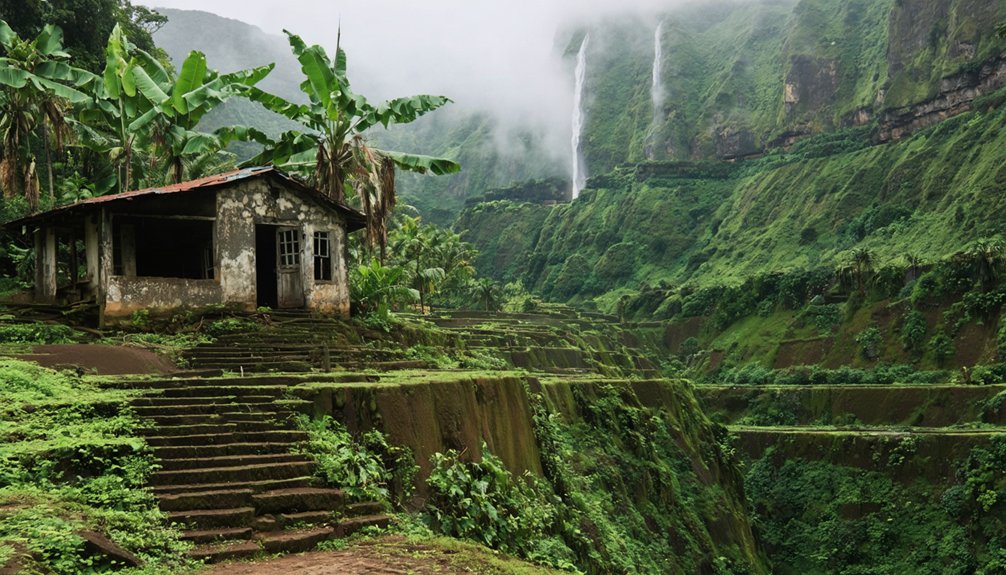
Before Western contact transformed Hawaii’s landscape, Waipi’o Valley sustained between 4,000 and 10,000 inhabitants who cultivated at least 800 acres of irrigated taro terraces along six miles of fertile floodplain.
You’ll find a dramatic collapse followed: diseases and port migrations reduced the population to 1,300 by the 1830s, then just 200 by 1873.
Chinese, Portuguese, Japanese, and Filipino immigrants briefly revitalized the valley through rice farming until the catastrophic 1946 tsunami swept away most structures.
Today, roughly 50 residents remain among jungle-reclaimed heiau temples and ancient platforms.
Cultural heritage survives through traditional wetland taro farming, while preservation efforts focus on removing a dam above Hi’ilawe Falls and protecting archaeological sites that tell Waipi’o’s story of resilience.
Pu’uhonua O Honaunau National Historic Park
While natural disasters emptied Waipi’o Valley, sacred law shaped another site’s abandonment on Hawaiʻi Island. You’ll find Pu’uhonua O Hōnaunau National Historic Park where kapu breakers once fled for their lives.
For centuries, this 180-acre refuge offered absolution to those who violated sacred laws—until 1819 when the kapu system ended.
The site’s 965-foot Great Wall, built without mortar, still separates the sanctuary from royal grounds. Behind it, the Hale o Keawe temple once housed remains of 23 chiefs, guarded by wooden ki’i statues.
After Christian suppression, cultural preservation efforts reconstructed these structures in the 1960s.
Today’s heritage tourism sustains what warfare couldn’t destroy. You’re witnessing one of four sacred sites where Hawaii’s flag flies alone—a living testament to indigenous sovereignty and ancient mercy.
Kalaupapa and Molokai’s Tsunami-Devastated Sites
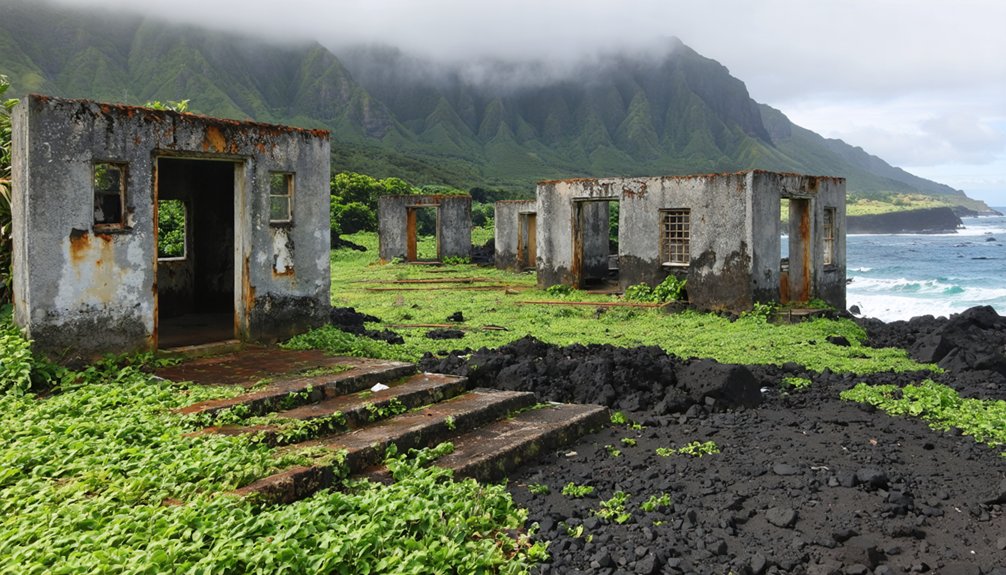
You’ll find Kalaupapa’s isolation wasn’t just enforced by law—the peninsula’s sheer cliffs and remote location made it Hawaii’s most infamous forced settlement, where over 8,000 leprosy patients were exiled between 1866 and 1969.
While the 1946 and 1957 tsunamis devastated other Hawaiian coastlines, Molokai’s documented ghost towns stem from different causes: disease-driven quarantine at Kalaupapa and economic collapse at sites like Keomuku.
These abandoned settlements preserve distinct chapters of displacement—one by medical policy, others by natural disaster and failed industry.
Kalaupapa’s Isolated Leprosy Settlement
In 1866, the Hawaiian legislature under Kamehameha V transformed the Kalaupapa Peninsula into what would become one of the world’s most isolated medical exiles. You’ll find this location was deliberately chosen—ocean on three sides, 1,600-foot cliffs blocking the fourth—creating a natural prison for over 8,500 people diagnosed with leprosy.
The first arrivals found no buildings, no shelter, just caves and rock enclosures. They were legally declared dead upon arrival, yet they persevered. Father Damien’s 1873 arrival brought tangible improvements: homes, medical care, dignity.
Today’s historical preservation efforts maintain Kalaupapa’s cultural significance through its National Historical Park status. Four former patients still call it home, protected by state law guaranteeing lifelong residency—their choice to stay, finally.
1946 and 1957 Tsunamis
On April 1, 1946, a massive tsunami surged 1.7 miles inland through Halawa Valley, obliterating 1,350 years of continuous Hawaiian settlement in a matter of minutes. Waves exceeding 100 feet destroyed homes, the poi factory, and contaminated taro terraces with salt water.
When another tsunami struck in 1957, it destroyed remaining agricultural lands, forcing complete abandonment.
The devastation eliminated generations of self-sufficient living:
- Agricultural collapse – Taro production ceased entirely as salt rendered fertile lands unusable
- Economic destruction – The poi factory and irrigation systems were permanently lost
- Population displacement – Thousands relocated, leaving only a few families today
Historical preservation efforts now focus on the valley’s 17 heiau and ancient terraces. Cultural revival initiatives help descendants reconnect with their ancestral homeland, though most never returned.
Keomuku’s Complete Abandonment
While Halawa Valley suffered nature’s wrath through tsunamis, Molokai’s Keomuku village met its demise through economic collapse and environmental catastrophe.
You’ll find this 1876 sugar plantation settlement completely abandoned after devastating droughts and failed yields forced its mill’s closure around 1890.
What once housed 300 residents plus laborers became a total ghost town when ranching couldn’t sustain the community.
Today’s historical preservation efforts protect crumbling structures and remnants of this forsaken settlement.
Archaeological excavations reveal the harsh realities faced by workers who chose relocation over staying in this remote, failing outpost.
Unlike Kalaupapa’s living ghost town status with remaining residents, Keomuku stands entirely vacant—a memorial to how quickly economic failure and environmental disaster can erase human settlements from Hawaii’s landscape.
Sugar Industry Collapse and Town Depopulation
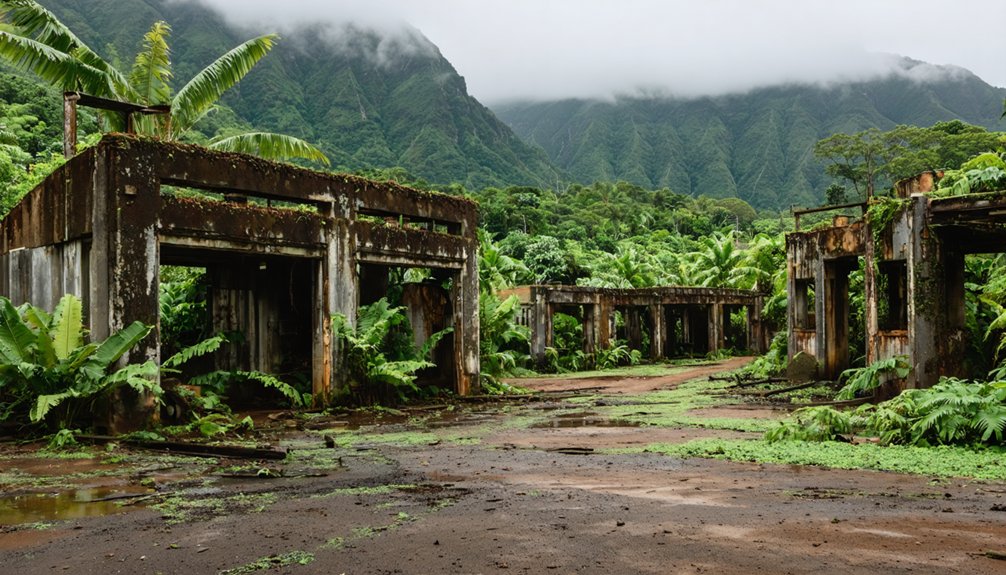
The sugar industry’s dominance across Hawaii began eroding in the 1950s as global market forces and rising labor costs squeezed profit margins that had sustained entire communities for generations.
You’ll find that three critical factors accelerated this collapse:
- Global competition from Cuba and cheaper foreign producers devastated Hawaii’s market share, dropping from one-tenth of U.S. supply in 1980 to complete closure by 2016.
- Rising land values made tourism development more profitable than cane cultivation, converting productive fields into resorts.
- Labor movements through ILWU strikes dismantled the exploitative plantation system, increasing operational costs substantially.
When Maui’s Puʻunēnē mill shuttered in December 2016, 375 workers faced unemployment.
Urban decay consumed once-thriving plantation towns while Cultural loss threatened generations of immigrant heritage that had shaped Hawaii’s multicultural identity.
Natural Disasters That Created Hawaiian Ghost Towns
Beyond economic forces that emptied plantation communities, Hawaii’s volcanic geology and exposed Pacific position subjected settlements to catastrophic natural events that erased entire towns in hours or minutes.
Volcanic eruptions fundamentally reshaped the inhabited landscape. Lava flows from Kīlauea’s Kūpaʻianahā vent completely buried Kaimu and Calapana in 1990, leaving fractured roads terminating at solid walls of volcanic stone. The 1801 Houihoo flow forced Kaupule’s people to flee permanently, their community now hidden beneath hardened lava.
One settlement endured devastation twice—rebuilt after the 1960 eruption only to face Fissure 8’s surge in 2018.
Tsunamis proved equally destructive. The 1946 wave devastated Waipi’o Valley‘s thriving community, prompting mass departure. Molokai settlements emptied after the 1946 and 1957 strikes.
In 2023, wildfire consumed a 12,000-person Maui town, killing 67.
Visiting Preserved Ghost Town Sites Today
You’ll find Hawaii’s ghost towns exist along a spectrum—from fully managed national historic parks like Pu’uhonua o Honaunau with visitor centers and marked trails, to remote sites like Kaunolu where you’re steering 400 stone structures with only your own judgment.
Heritage centers in towns like Honoka’a offer climate-controlled introductions to this history through donated artifacts and immigrant stories, while places like Lapakahi let you walk among 600-year-old fishing village remains with interpretive signs as your guide.
Before you visit any site, you’ll need to understand access restrictions, cultural protocols, and physical challenges—because Kalaupapa requires permits and controlled entry, while drought-abandoned Lapakahi welcomes self-guided exploration across its preserved stone foundations.
National Historic Park Access
Three major parks welcome exploration:
- Kaloko-Honokōhau National Historic Park – 1,160 acres featuring 600-year-old fishponds and lava rock platforms from prehistoric villages.
- Pu’uhonua o Honaunau National Historic Park – 420 acres with the Great Wall and reconstructed temples showing cultural significance through traditional demonstrations.
- Kalaupapa National Historical Park – Former leprosy colonies preserving ghostly building foundations as proof of resilience.
These sites reject typical tourist development, instead offering walking paths through authentic landscapes where virtual tours supplement physical access to Hawaii’s abandoned heritage.
Heritage Centers and Museums
While Hawaii’s ghost towns themselves may have crumbled into the landscape, several heritage centers and museums now safeguard their stories through carefully curated collections and preserved artifacts.
You’ll discover ranching history at Anna Ranch Heritage Center, where 110 acres preserve the 1848 homestead’s cattle culture and frontier etiquette.
Honoka’a Heritage Center occupies a former Ford dealership, chronicling sugar plantation life from 1879 until the industry’s 1994 collapse through immigrant narratives and settlement displays.
Bishop Museum houses over 25 million Pacific Basin treasures, offering heritage storytelling through pre-contact legends and ancestral artifacts.
Mānoa Heritage Center provides a 3.5-acre living classroom connecting abandoned settlements like Kiilae to Hawaii’s broader cultural preservation efforts.
These institutions transform forgotten places into accessible historical records you can explore today.
Safety and Tour Guidelines
Preserving these stories in museum collections matters little if you can’t safely experience the actual sites where history unfolded.
Piloting Hawaii’s ghost towns requires understanding both physical dangers and cultural boundaries that protect these landscapes from becoming mere urban legends.
Essential Guidelines for Visiting Abandoned Sites:
- Secure proper permits – Kalaupapa requires state health department authorization, while Kalaoa Permanent House Site 10,205 mandates guided access only.
- Respect physical hazards – Lava-destroyed villages like Kaimū feature unstable terrain and sharp volcanic rock. Tsunami-affected Hālawa Valley presents flash flood risks.
- Honor cultural protocols – Sacred sites demand quiet observation without artifact removal or boundary violations.
Preservation efforts succeed when you balance exploration with responsibility.
Ranger-led programs at Pu’uhonua o Honaunau and expert-guided Hālawa Valley hikes provide context while protecting both visitors and irreplaceable heritage.
Frequently Asked Questions
What Happened to the Residents Who Lived in These Ghost Towns?
Residents fled catastrophic tsunamis and volcanic eruptions, abandoning livelihoods when sugar plantations collapsed, or faced forced exile to leper colonies. You’ll find lost infrastructure everywhere—from drought-stricken fishing villages to lava-buried homes, each telling stories of displacement and survival.
Are There Any Haunted Legends Associated With Hawaiian Ghost Towns?
While skeptics question supernatural claims, you’ll find haunted legends persist across Hawaiian ghost towns. Keomuku’s temple curse and Kalaupapa’s sorrowful spirits reflect spiritual encounters rooted in cultural beliefs about sacred sites, suffering, and ancestral connections that transcend rational explanation.
Can Visitors Legally Explore All 21 Ghost Towns in Hawaii?
No, you can’t legally explore all 21 sites. Private ownership, Hawaiian history preservation efforts, and safety restrictions limit access to many ghost towns. Some require permits or guided tours, while others welcome independent exploration on public lands.
Which Hawaiian Ghost Town Is the Oldest Documented Settlement?
You’ll find Kaunolu and Keomuku Villages are the oldest documented settlements, both inhabited since the 15th century. Their archaeological significance and historical preservation efforts reveal ancient Hawaiian fishing communities that thrived for centuries before abandonment.
How Do Hawaiian Ghost Towns Compare to Mainland American Ghost Towns?
Unlike mainland mining towns frozen in Wild West urban decay, you’ll find Hawaii’s ghost towns swallowed by jungle and lava, shaped by plantation collapse and natural disasters, where tourism impact now preserves leprosy colonies and sugar-era remnants as heritage sites.
References
- https://www.youtube.com/watch?v=jpyRCKkN1dc
- https://www.loveexploring.com/gallerylist/188219/the-us-state-with-the-most-ghost-towns-revealed
- https://nvtami.com/2023/04/26/big-island-hawaii-ghost-towns/
- https://www.youtube.com/watch?v=tFXNMehIb5s
- https://www.geotab.com/ghost-towns/
- https://patch.com/us/across-america/thousands-u-s-cities-could-be-ghost-towns-2100-new-study
- https://freepages.history.rootsweb.com/~gtusa/usa.htm
- https://en.wikipedia.org/wiki/List_of_ghost_towns_in_Hawaii
- https://freepages.rootsweb.com/~gtusa/history/usa/hi.htm
- https://en.wikipedia.org/wiki/Category:Ghost_towns_in_Hawaii