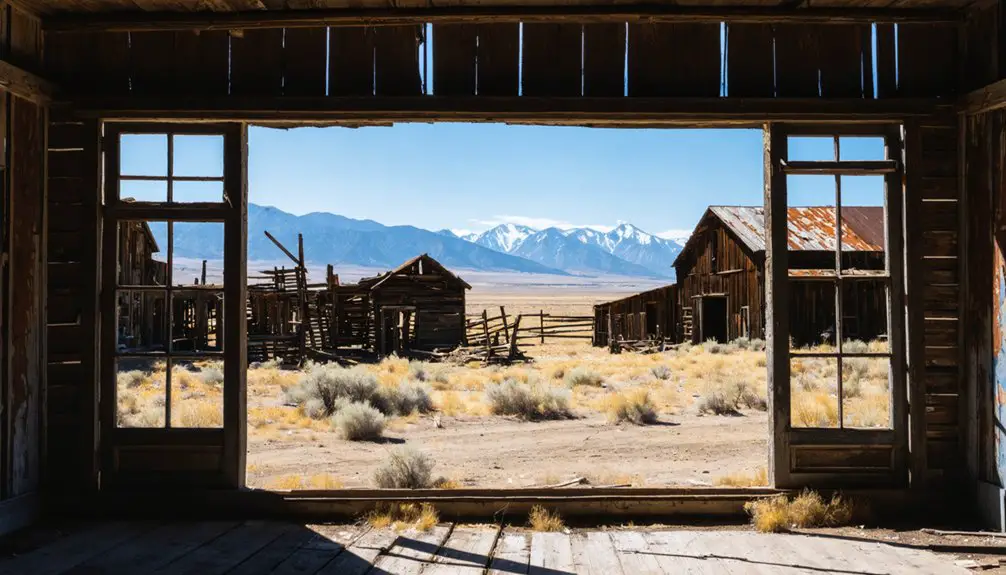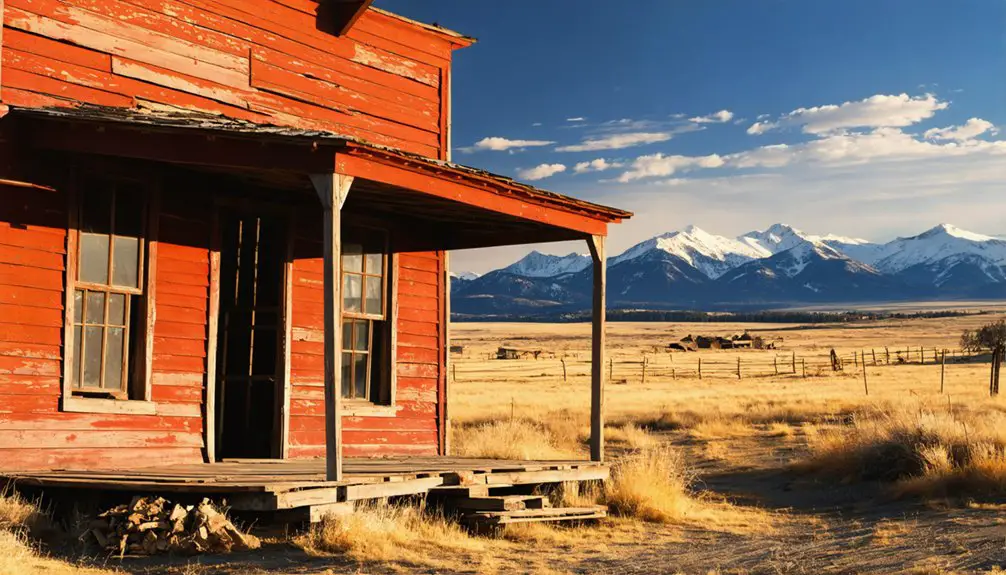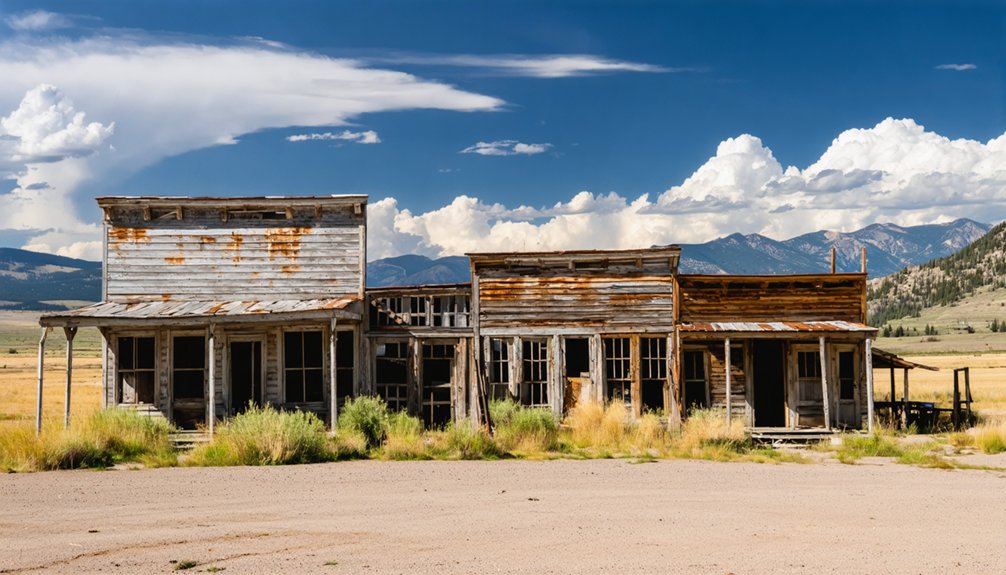
You’ll find over 100 documented ghost towns scattered across Montana‘s 56 counties, though the actual number likely exceeds this as remote settlements continue emerging from historical records. These abandoned communities concentrate heavily in southwest Montana’s mining districts, particularly in Fergus, Meagher, and Jefferson counties, with at least 17 additional sites lining the defunct Milwaukee Road corridor through east-central Montana. Montana ranks among America’s states with the highest number of abandoned settlements, trailing behind Texas’s 400-plus ghost towns but surpassing most others. The following sections reveal what caused these towns’ decline and which sites you can still explore today.
Key Takeaways
- Montana hosts over 100 documented ghost towns, though the actual number is likely higher due to incomplete inventories.
- Ghost towns are scattered across 56 counties, with notable concentrations in southwest Montana’s mining districts.
- East and central Montana contain at least 17 remote ghost towns along the abandoned Milwaukee Road corridor.
- Montana ranks among U.S. states with the highest number of abandoned settlements, though Texas has over 400.
- Most towns emerged from 1870s mining booms but declined due to resource depletion and the 1893 Silver Panic.
The Total Count of Ghost Towns Across Montana
Montana harbors over 100 documented ghost towns scattered across its vast terrain, though this figure represents only a conservative estimate based on incomplete inventories. You’ll find these abandoned settlements throughout the state, with east and central Montana alone containing 17 remote locations.
Over 100 ghost towns dot Montana’s landscape, with incomplete inventories suggesting the true number remains far higher.
Historical demographics reveal dramatic population shifts—towns like Ingomar once housed 2,000 residents before decline. Settlement patterns followed mining booms, railroad construction, and agricultural expansion, creating communities that vanished when resources depleted or transportation routes changed.
Texas provides perspective with over 400 ghost towns, suggesting Montana’s actual count likely exceeds current records. These sites range from fully preserved state parks to scattered foundations, reflecting diverse abandonment timelines. Notable examples include Bannack in Beaverhead County, which stands as one of Montana’s most historically significant ghost towns. Despite having fewer ghost towns than Texas, Montana ranks high nationally in total abandoned settlements among U.S. states.
You’re exploring remnants of Montana’s territorial ambitions, where prosperity proved temporary and nature reclaimed human enterprise.
Famous Ghost Towns Worth Exploring
You’ll find Montana’s most celebrated ghost towns offer distinct experiences that showcase different aspects of mining-era preservation.
Bannack State Park stands as the state’s best-preserved ghost town with over 50 historic structures lining Main Street.
Virginia City operates as a living history museum where actors bring the gold rush period to life through ongoing performances.
Garnet Ghost Town, administered by the Bureau of Land Management and situated at 6,000 feet elevation in the Garnet Mountains, maintains its status as one of Montana’s most authentic preserved mining settlements from the 1890s boom period. At its peak in 1898, Garnet supported approximately 1,000 residents who worked the surrounding gold mines.
Near Helena, Elkhorn State Park features Fraternity Hall from 1893 as one of its two main structures in Montana’s smallest state park.
Bannack State Park Features
Since its designation as a National Historic Landmark, Bannack has maintained over 50 original wooden buildings along Main Street in a state of arrested decay—a deliberate preservation approach that keeps the authentic ghost town atmosphere intact. You’ll explore historical architecture including the 1877 Methodist Church, 1874 Masonic Lodge, schoolhouse, two territorial jails, and the gallows where Sheriff Henry Plummer met his end.
Visitor experiences range from self-guided tours through accessible saloons, hotel rooms, and schoolhouses to gold panning lessons on summer weekends. Winter transforms frozen dredge ponds into skating rinks. The park features trail biking opportunities that let you explore the historic surroundings at your own pace. Bannack Days in July features Old West reenactments that bring the town’s frontier heritage to life with period costumes and historical demonstrations.
You’ll pay $8 for non-resident vehicle entry, while Montana residents enter free with a state pass. The park welcomes leashed pets year-round, letting you explore this preserved 1860s mining camp without commercial tourist development restrictions.
Virginia City Living Museum
Just west of its more famous neighbor, Nevada City stands as an exceptional open-air museum that preserves Montana’s gold rush heritage through one of America’s largest frontier artifact collections. You’ll discover over 1 million artifacts housed within 100+ historic buildings spanning 1863 to the early 1900s, rivaling the Smithsonian’s holdings.
The historical architecture tells authentic stories—14 original structures remain on-site, while others were meticulously relocated beginning in the 1940s when Charles and Sue Bovey rescued endangered Montana buildings.
You can explore freely during mid-May through mid-September, experiencing living history demonstrations every summer weekend. Forty trained interpreters in period clothing demonstrate Gold Rush-era skills like blacksmithing and faro. Visitors can participate in hands-on experiences including tin smithing, basket weaving, and cooking on a wood stove to deepen their understanding of frontier life.
The Nevada City Music Hall houses North America’s largest public collection of automated music machines, preserving frontier entertainment history. The town site features a reconstructed depot and engine house alongside a 1910 Baldwin Steam Locomotive that showcases the era’s transportation technology.
Garnet’s Preserved Mining Legacy
While Nevada City showcases a curated collection of relocated buildings, Garnet offers something rarer—an authentic mining camp preserved where miners actually lived and worked. You’ll find over 30 original structures maintained exactly where they stood during the 1898 boom, when 1,000 residents extracted millions in gold using old mining techniques at the Nancy Hanks mine.
The BLM and Garnet Preservation Association practice arrested decay rather than town reconstruction, stabilizing buildings without restoration. You can explore rentable cabins, saloons, and blacksmith shops that survived the 1912 fire and decades of looting. The town originated in the 1860s during Montana’s Gold Rush, following the discovery at Bannack. Garnet got its name from the ruby-colored garnet stones discovered throughout the mountain range.
It’s Montana’s most intact ghost town—no sanitized tourist trap, but genuine remnants of frontier enterprise. The post office that closed in 1928 still stands, along with the schoolhouse that served mining families before war efforts emptied the camp permanently.
What Caused Montana’s Towns to Become Abandoned
Montana’s ghost towns arose from cyclical mining booms that collapsed once ore deposits ran out, leaving thousands without livelihoods.
You’ll find that world wars pulled workers away for military service and wartime industries, halting any chance of recovery in struggling camps.
Railroad companies also bypassed remote settlements, cutting off the economic lifelines these isolated communities needed to survive beyond their initial resource extraction.
Mining Boom and Bust
The discovery of gold in Grasshopper Creek near Bannack during the 1860s sparked a prospector frenzy that transformed Montana’s landscape virtually overnight. Thriving boomtowns like Virginia City and Helena emerged, displacing Native settlements and ranching histories as miners flooded the territory.
Silver strikes followed in the 1870s, with operations like the Comet mine and Iron Mountain yielding millions in precious metals.
The Silver Panic of 1893 devastated these communities when prices crashed, forcing operations to close and miners to abandon entire towns. Ore depletion accelerated the decline—Garnet’s population plummeted from 1,000 in 1898 to 150 by 1905.
War and Railroad Decline
World wars delivered catastrophic blows to Montana’s mining communities just as they struggled to recover from earlier economic collapses. You’ll find Garnet’s transformation particularly stark—World War I emptied its population of 1,000 residents and 13 saloons when miners departed.
The 1930s gold revival briefly sparked hope, but World War II triggered permanent abandonment. These labor shortages accelerated economic decline across the state’s remote settlements.
Railroad abandonment compounded wartime devastation. When rail access disappeared, towns like Comet lost their lifelines to commercial hubs such as Wicks. You can trace how infrastructure decay followed swiftly—businesses shuttered, populations fled, and satellite communities ghosted entirely. The combination proved insurmountable.
Today, 30 buildings stand in Garnet while Bannack preserves 60 structures, physical evidence of this dual catastrophe that transformed thriving camps into permanent relics.
Where Montana’s Ghost Towns Are Located
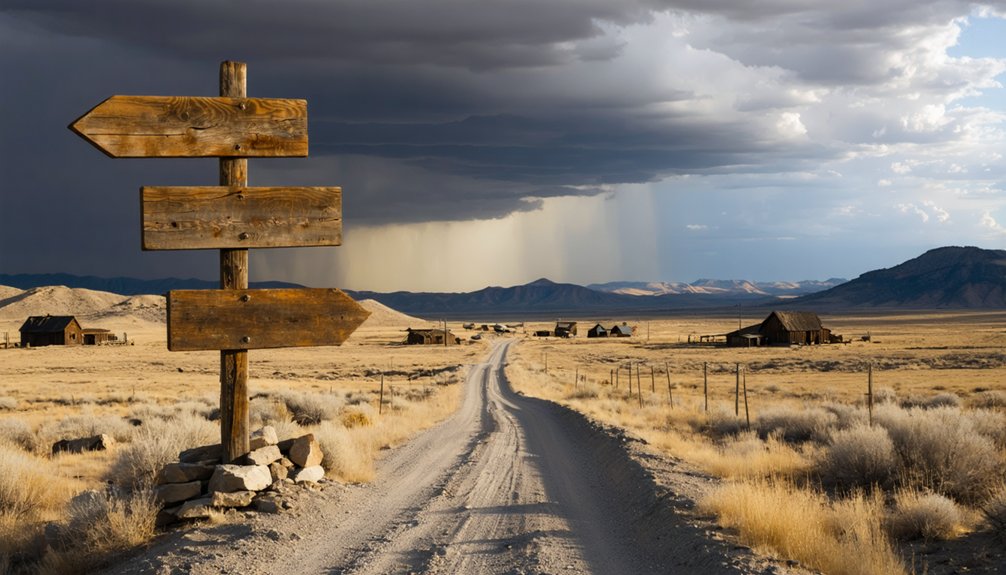
Scattered across Montana’s 56 counties, ghost towns cluster most densely in regions where mining booms once drove rapid settlement and economic activity.
Montana’s ghost towns concentrate where 19th-century mining strikes sparked frenzied development, leaving behind weathered testaments to boom-and-bust economics.
You’ll find significant concentrations in southwest Montana, where Bannack, Virginia City, and Granite showcase the wild west’s boom-and-bust cycles. Mining districts in Fergus, Meagher, and Jefferson counties contain multiple abandoned settlements, with sites like Castle Town perched at 5,978 feet elevation.
Eastern Montana holds 17 remote towns along the abandoned Milwaukee Road corridor, sites that fuel modern ghost stories. Beaverhead, Gallatin, and Phillips counties each host numerous historic settlements.
From Garnet‘s 1,000-person mining camp with 13 saloons to isolated railroad stops like Lenet, these remnants span diverse elevations and topographies, marking Montana’s transformation from territorial frontier to established statehood.
Current Preservation Efforts and Protected Sites
Since 1970, organized preservation initiatives have transformed Montana’s approach to protecting ghost town heritage, establishing formal frameworks that balance public access with structural conservation.
You’ll find Garnet Ghost Town exemplifies successful neighborhood revitalization, where the Bureau of Land Management and Garnet Preservation Association maintain over 30 buildings in arrested decay. Public contributions of $90,000 in artifacts demonstrate grassroots commitment to cultural significance.
Key preservation milestones include:
- Western Montana Ghost Town Preservation Society (1971-2008) secured Elkhorn’s Fraternity Hall and Gillian Hall, later transferring them to Montana Fish, Wildlife and Parks.
- Montana Ghost Town Preservation Society provides ongoing financial assistance and coordinates annual conventions.
- Year-round access programs at Garnet offer self-guided trails, winter cabin rentals, and non-commercialized experiences.
- National partnerships engage the National Trust for Historic Preservation and National Register.
Planning Your Ghost Town Adventure

Understanding preservation frameworks prepares you to experience these sites firsthand, but successful exploration requires strategic planning around Montana’s vast geography and variable access conditions.
You’ll find clustered routes in southwest Montana connecting Helena, Bozeman, Butte, and Missoula, while seventeen remote east central sites demand off-road capability.
Garnet’s 13-mile Range Road loop traverses Reynolds City, Springtown, and Beartown.
Philipsburg to Granite spans less than four miles via Granite Road.
Seasonal weather dramatically affects accessibility—Garnet requires snowmobiles, skis, or snowshoes during winter months, though primitive cabins remain rentable.
Interstate 90 provides convenient access to Coloma, Bearmouth, and Pioneer.
You’ll encounter private property fences at remote locations.
Consider timing visits for annual Garnet Day events.
Base yourself near local cuisine centers in Helena or Missoula for ideal exploration.
Frequently Asked Questions
Can You Legally Take Artifacts From Montana’s Ghost Towns?
You’ll face absolutely devastating consequences if you ignore artifact laws and property ownership rules. No, you can’t legally take artifacts from Montana’s ghost towns without written permission from landowners or proper archaeological permits from state authorities.
Are Montana’s Ghost Towns Safe to Explore With Children?
Tourist-designated sites like Bannack offer safe exploration with historical preservation measures, but most Montana ghost towns present structural hazards and wildlife risks. You’ll find haunted legends entertaining, yet remote locations aren’t recommended for children without proper supervision and safety precautions.
Which Ghost Towns Are Accessible During Winter Months?
Garnet Ghost Town offers you exceptional winter access via snowmobile or skis, featuring rental cabins and incredible photo opportunities. Virginia City and Bannack remain open year-round, though you’ll encounter variable conditions. Most others aren’t accessible for winter hiking.
Do Any Ghost Towns Have Overnight Accommodations Nearby?
“Home is where the heart is,” and you’ll find ghost town hospitality near Virginia City and Nevada City, offering historic lodging options. Garnet provides primitive winter cabins, while Helena-area towns offer convenient base camp accommodations for your independent exploration.
Are Guided Tours Available at Montana’s Ghost Towns?
You’ll find guided tours at Virginia City, Bannack State Park, and Garnet Ghost Town, where historic preservation efforts support organized visitor access. Guided tour logistics vary by site, while places like Granite and Elkhorn offer self-directed exploration instead.
References
- https://xlcountry.com/montana-ghosts-towns/
- https://en.wikipedia.org/wiki/List_of_ghost_towns_in_Montana
- https://bluemountainbb.com/blog/ghost-towns-montana/
- https://www.mountain-home.com/blog/vacation-planning/guide-montana’s-ghost-towns
- https://www.geotab.com/ghost-towns/
- https://www.youtube.com/watch?v=BQH5LghhkVs
- https://visitmt.com/things-to-do/ghost-towns
- https://www.distinctlymontana.com/curious-afterlife-montanas-ghost-towns
- https://explore.virtualmontana.com/2016/01/what-makes-a-ghost-town/
- https://activetravelexperiences.com/montana-ghost-towns/