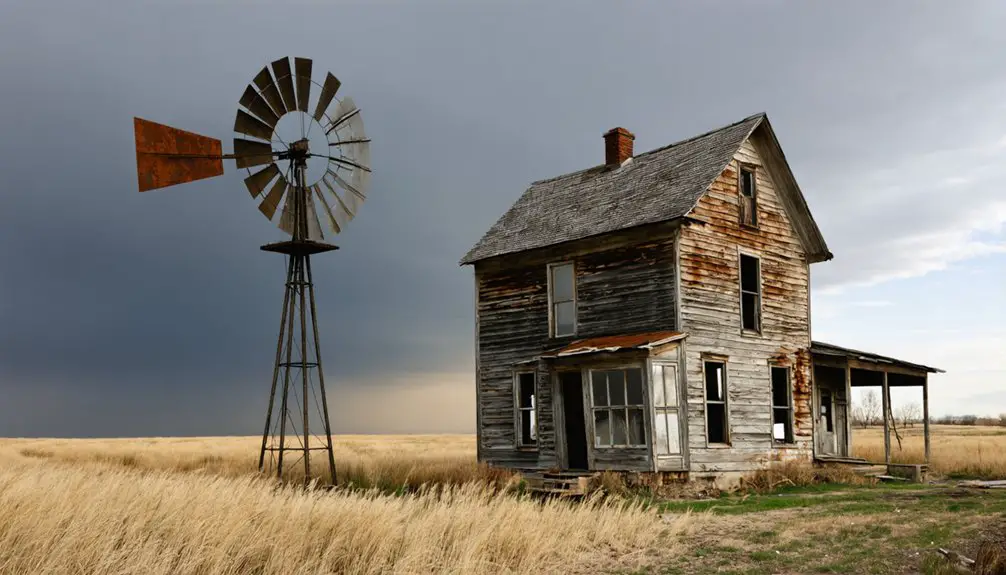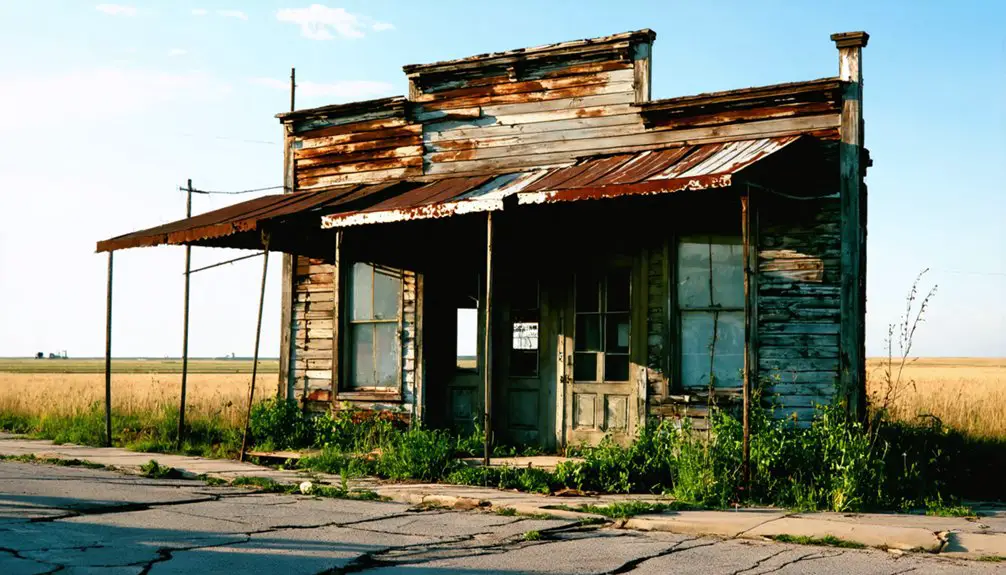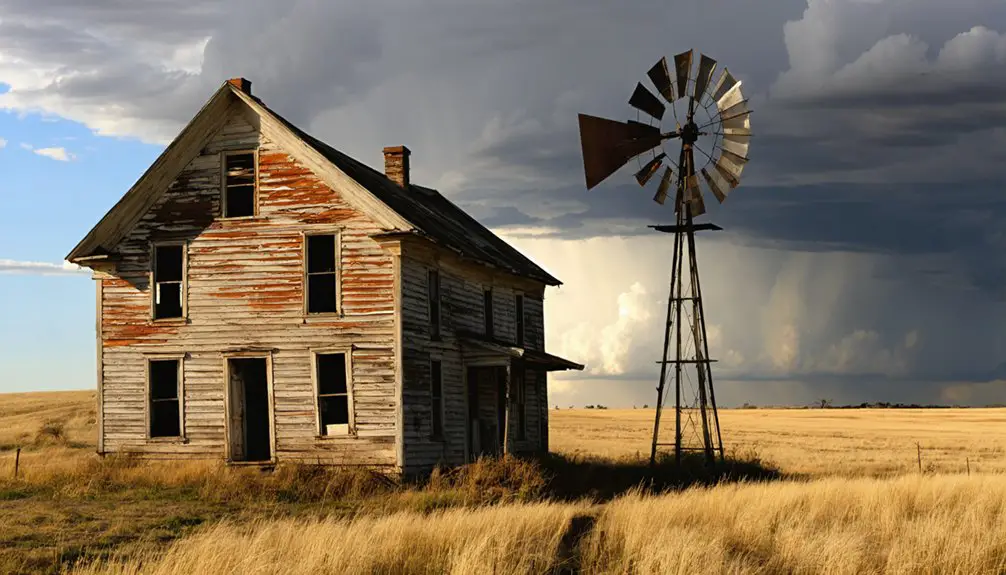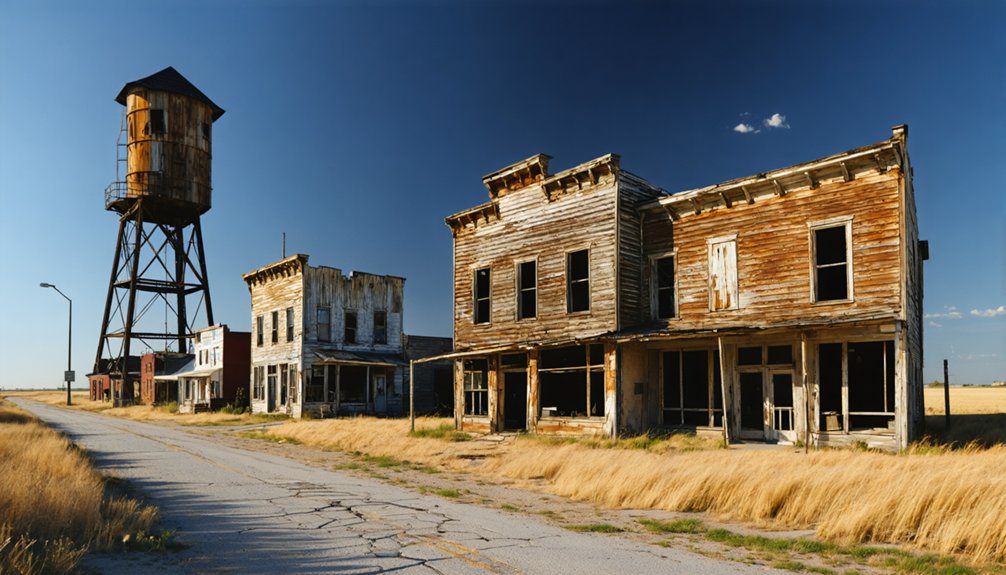
You’ll find estimates ranging from 60 to 200 ghost towns across Nebraska, though no official registry exists to provide a definitive count. The variation depends on your definition—whether you’re counting sites with standing structures, foundations alone, or simply names on historical plat maps. Cass County’s records alone document 64 vanished settlements, while prominent travel guides highlight six to seven notable locations. These communities disappeared across three major waves spanning 140 years, from speculative 1850s failures through railroad-era abandonment to modern rural consolidation, each leaving distinct traces throughout the state’s varied terrain.
Key Takeaways
- Nebraska has no official registry of ghost towns, making an exact count impossible to determine.
- Travel guides typically highlight 6-7 notable ghost town sites for visitors to explore.
- Individual county records reveal extensive abandonment; Cass County alone documents 64 vanished settlements.
- Counts vary significantly based on definition—whether including only standing structures, foundations, or cemetery markers.
- Three abandonment waves since the 1850s created hundreds of failed towns across railroad routes and waterways.
The Current Count of Nebraska’s Abandoned Settlements
Although Nebraska’s prairie landscape conceals dozens of abandoned settlements, no official registry exists to provide a definitive count of the state’s ghost towns.
Nebraska’s abandoned settlements number in the dozens, yet no official record tracks these prairie ghost towns definitively.
You’ll find prominent travel guides highlighting 6 to 7 notable sites, while historical societies document numerous railroad-era settlements from 1870-1890.
Wikipedia catalogs specific examples like Carns, Charlestown, and Covington, though it’s far from all-inclusive.
The challenge in counting stems from varying definitions—some sites show clear urban decay with standing structures, while others exist only as cemetery markers or foundation traces.
Speculative settlements complicate matters further, appearing solely on historical maps without physical remains.
Preservation efforts focus primarily on accessible railroad towns where graded streets and grain elevators still mark the landscape, making them easier to identify than flood-erased river settlements.
These abandoned communities span diverse landscapes from the rolling sandhills to fertile lowlands, each terrain type offering distinct preservation conditions for remaining structures.
Many former settlements survive only as grain elevator silhouettes against the horizon, their surrounding buildings long vanished into the prairie.
When and Why These Towns Disappeared
Nebraska’s ghost towns emerged and vanished across three distinct waves spanning 140 years. You’ll find the first casualties among 1850s speculator settlements—27 towns platted in Cass County alone during 1857 before regulations curbed paper town schemes. Old survey methods and indefinite locations doomed places like Brooklyn and California City before they truly began.
The railroad era brought boomtown patterns from 1870-1920, creating stops like Josselyn and Saint Michael that thrived briefly then faded as commerce shifted. Railroad companies often named towns alphabetically, with sequential stops receiving names beginning with consecutive letters to encourage expansion and settlement.
Post offices tracked this decline: Prairie Center closed in 1902, Poole struggled until 1972.
The final wave hit during economic consolidation. Farm mechanization eliminated rural service centers, while over 900 documented abandonments by the 1960s revealed communities dependent on flour mills and sawmills couldn’t survive modern transportation networks. Stores like the Venus community establishment, which served residents for nearly a century from 1879 to 1979, represent the exceptional longevity some trading posts achieved before finally succumbing to modernization.
Where to Find Ghost Towns Across the State
The distribution of Nebraska’s ghost towns follows geographic patterns tied to transportation networks and natural resources.
You’ll find railroad ghost towns scattered across the state, marked by graded streets from the 1870-1890 expansion and isolated grain elevators angled against county road grids. Northeast Nebraska, particularly Knox County, holds numerous vanished settlements like Blyville and Mars—communities that live only in urban legends and folklore stories now.
River settlements occupied strategic fords along Nebraska’s waterways, though floods erased most traces. Sarpy County alone contains 34 ghost town sites, while Cass County maps reveal forgotten post offices and townships. Many early Missouri River settlements were either flooded or altered by the river’s changing course over time. These abandoned communities provide valuable insight into the state’s historical settlement patterns and migration trends.
For exploration, travel the Outlaw Trail Scenic Byway to Brocksburg, visit Dobytown‘s adobe remnants along Highway 50A, or discover Amboy east of Red Cloud on Heritage Highway 136.
Tracking Down Lost Communities Through Historical Records
When communities vanish from the landscape, they leave deliberate paper trails that researchers can follow backward through time. You’ll find ghost town documentation in county records, where Cass County alone lists 64 vanished settlements—27 platted during 1857’s speculative boom.
Historic maps and plat books reveal founding dates, surveyors, and proprietors like James W. Bond who filed town sites in 1858. Post office records track community lifespans: Prairie Center operated 1874-1902, while Josselyn lasted just two years.
Railroad remnants dot the countryside where expansion between 1870-1890 spawned towns that collapsed by the late 1930s. Aerial photographs expose hidden foundations and roadbeds, while newspapers and oral histories pinpoint exact locations.
Mining history appears less frequently than agricultural settlement patterns in Nebraska’s abandonment story. Some towns experienced dramatic name changes throughout their existence, as Buda was originally called Kearney before becoming Shelby in 1872.
Famous Abandoned Sites Worth Exploring
Scattered across Nebraska’s rural highways, five accessible ghost towns offer tangible connections to settlement patterns documented in county archives. Steele City and Belvidere, both maintaining populations around 50, preserve classic frontier architecture along the Oregon Trail corridor.
You’ll find Roscoe’s abandoned commercial district positioned along US 30, where Chamberlains and other structures stand as testaments to failed economic ventures. Keystone, established 1906, features mostly vacant Main Street buildings with one functioning post office.
Morrillville’s cement-covered school cave and dancehall ruins evoke pioneer-era simplicity in Knox County. While haunted legends circulate among locals, restoration efforts remain minimal—these sites exist as authentic archaeological landscapes rather than tourist attractions. Antioch, once labeled the Polish capital of Nebraska, now contains only one inhabited house alongside a brick building that possibly served as a former bank.
Each location documents Nebraska’s expansion cycles through preserved physical evidence. Like many ghost towns, these communities declined during the Dust Bowl and economic downturns of the 1930s that destroyed plains farming communities.
Frequently Asked Questions
Can You Legally Visit and Explore Ghost Town Sites in Nebraska?
You can legally visit many Nebraska ghost towns from public roads and state historic sites, but you’ll need landowner permission for private property. Legal considerations and preservation efforts protect these sites while allowing respectful exploration of accessible locations.
Are Any Nebraska Ghost Towns Privately Owned or Protected Property?
Weathered “No Trespassing” signs guard many Nebraska ghost towns—you’ll find private ownership dominates sites like Factoryville and Saint Michael, while property protection shields Crouse within Branched Oak State Recreation Area. Always respect boundaries and research land status before exploring.
What Artifacts or Structures Typically Remain at Nebraska Ghost Towns Today?
You’ll find abandoned buildings along main streets, grain elevators angled to old railroad tracks, cemetery headstones, building foundations, and graded street patterns. Historical artifacts include mill remnants, blacksmith shops, and tree-lined routes marking settler pathways through vanished communities.
Do Ghost Towns Have Any Economic Value for Tourism in Nebraska?
Ghost towns offer you significant tourism value through their historical significance and preservation efforts. You’ll find heritage tourism circuits, architectural landmarks, and research opportunities that generate economic activity while honoring Nebraska’s settlement patterns and railroad expansion history.
How Do Ghost Towns Differ From Towns With Very Small Populations?
Ghost towns show complete urban decay with zero residents, while you’ll find small-population towns maintain minimal inhabitants. Historical decline differs: ghost towns suffered total abandonment through economic collapse, whereas surviving settlements adapted despite shrinking from hundreds to dozens of residents.
References
- https://dorchestertimes.blogspot.com/2019/12/pleasant-hill-one-of-nebraskas-most.html
- https://blog.batchgeo.com/ghost-towns/
- https://history.nebraska.gov/wp-content/uploads/2017/12/doc_publications_NH1937GhostTowns.pdf
- https://www.loveexploring.com/gallerylist/188219/the-us-state-with-the-most-ghost-towns-revealed
- https://freepages.rootsweb.com/~gtusa/history/usa/ne.htm
- https://history.nebraska.gov/finding-nebraskas-ghost-towns/
- https://visitnebraska.com/trip-idea/explore-7-authentic-ghost-towns-nebraska
- https://www.geotab.com/ghost-towns/
- https://en.wikipedia.org/wiki/List_of_ghost_towns_in_Nebraska
- https://www.onlyinyourstate.com/trip-ideas/nebraska/ne-ghost-towns-road-trip