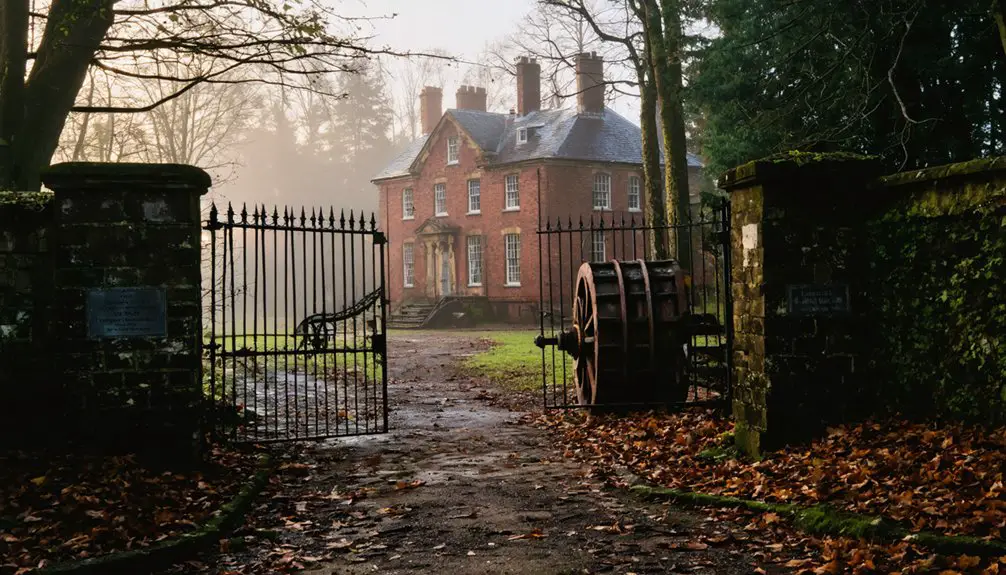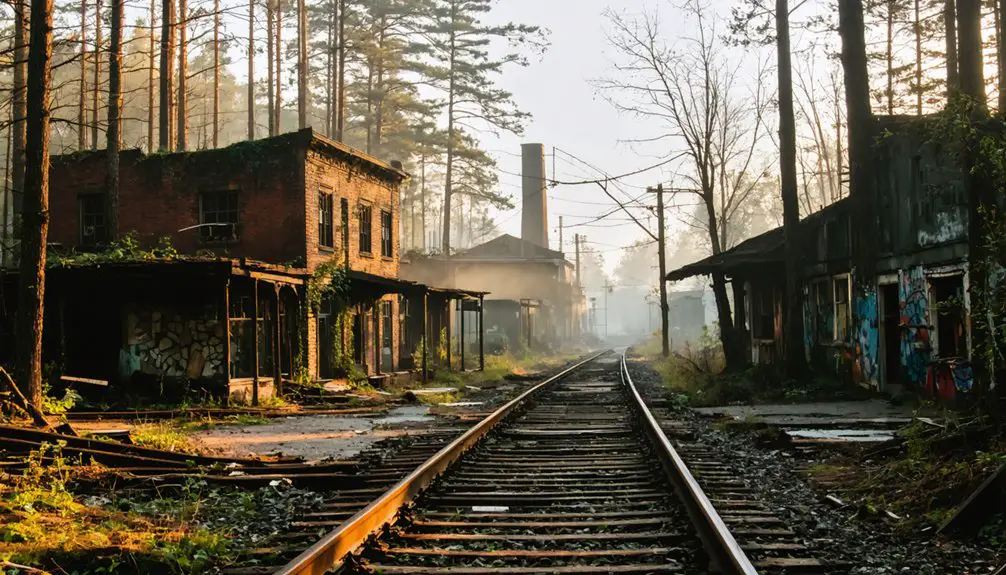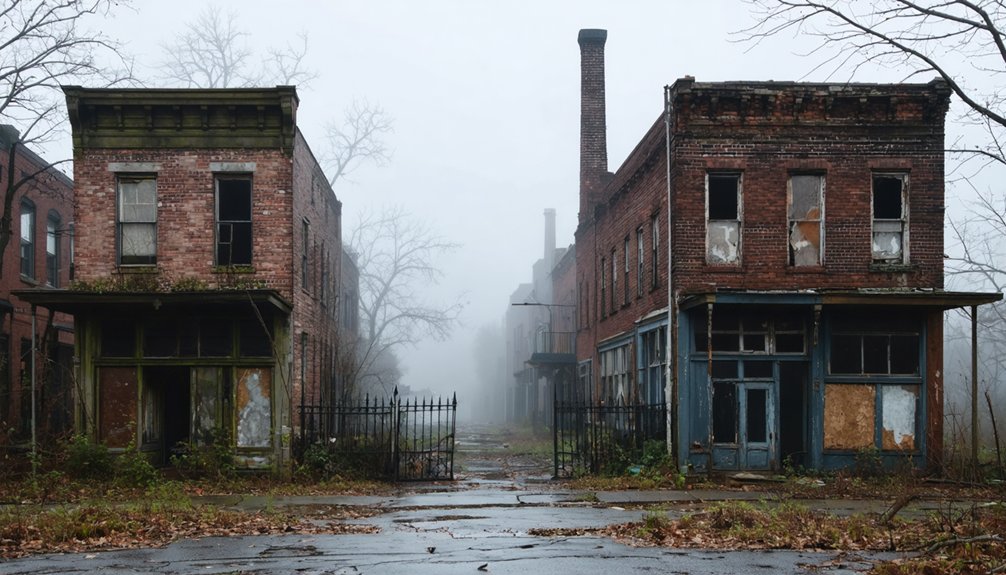
You’ll find estimates ranging from 7 to 23 ghost towns in New Jersey, depending on how sources define “abandoned.” Some counts include only fully deserted settlements, while others encompass preserved historic villages or towns with fewer than 200 residents. The Pine Barrens holds clusters like Batsto and Atsion, while northern sites include Waterloo Village and Feltville. Most were abandoned due to industrial decline, transportation shifts, or government projects. These accessible sites—many within state parks—offer documented history intertwined with local legends that continue to intrigue visitors today.
Key Takeaways
- New Jersey has no standardized count of ghost towns, with estimates ranging from 7 to 23 depending on definition.
- Definitions vary between fully abandoned settlements, preserved historic villages, and towns with populations under 200 people.
- Jersey Digs recognizes 7 accessible ghost town sites emphasizing visitor-friendly locations rather than total enumeration.
- Different sources report varying numbers, with Wikipedia listing 8 counties and documentaries mentioning 11 or 12 towns.
- Count variations stem from verification difficulties and differing criteria for what constitutes an abandoned settlement.
Counting New Jersey’s Ghost Towns: The Numbers Debate
When you try to count New Jersey’s ghost towns, you’ll quickly discover there’s no agreed-upon number. Sources range from seven notable sites to twenty-three documented locations, depending on how you define abandonment.
The inconsistency stems from varying definitions—some sources count fully abandoned settlements experiencing urban decay, others include preserved historic villages, and still others encompass towns with population decline under 200 residents.
Wikipedia’s incomplete list covers eight counties, while YouTube documentaries claim eleven in one installment and twelve more in another. Jersey Digs identifies seven worth visiting, focusing on accessibility rather than comprehensive enumeration. Towns were abandoned due to resource depletion or technological shifts, such as when mining operations ceased and paper mills closed as industries declined. Difficulty in verifying abandoned sites further complicates efforts to establish definitive totals across the state.
Without standardized criteria distinguishing between tourist attractions like Batsto Village and demolished sites like Demon’s Alley, you’re left steering through conflicting counts that reflect each researcher’s methodology rather than absolute totals.
Where to Find Abandoned Settlements Across the State
New Jersey’s abandoned settlements cluster chiefly in the Pine Barrens, where former industrial villages like Batsto, Atsion, and Whitesbog now stand preserved within state forests across Burlington County. You’ll discover these sites span diverse regions beyond typical urban development patterns.
Pine Barrens ghost towns stand frozen in time, their preserved industrial villages offering glimpses into New Jersey’s forgotten economic past.
Key locations for exploration:
- Northern corridor: Waterloo Village (Allamuchy Mountain State Park) and Feltville (Watchung Reservation) offer archaeological significance in Union and Sussex counties.
- Coastal remnants: Allaire Village in Monmouth County and South Cape May preserve maritime heritage.
- Pine Barrens heart: Weymouth Furnace and Ong’s Hat reveal industrial history along accessible routes. Batsto Village contains a 32-room mansion alongside historic structures including a general store and functioning post office.
- Industrial ruins: Double Trouble State Park and Red Mill Museum Village document economic transformation. These sites represent a portion of 19 documented pages cataloging ghost towns across the state.
- Remote settlements: Walpack Center and Pahaquarry Township provide wilderness access in Warren County.
You’re free to visit most sites through state park systems without restrictions.
The Most Accessible Ghost Towns for Visitors
You’ll find New Jersey’s most accessible ghost towns within state parks and historic reservations, where preserved buildings and ruins remain free or low-cost to explore.
Five primary sites—Feltville, Waterloo Village, Batsto Village, Allaire Village, and Atsion—offer distinct visiting experiences ranging from self-guided walks through restored structures to formal tours with period reenactors.
Each location maintains regular operating hours and provides infrastructure like parking and visitor centers, making them practical destinations for documenting the state’s abandoned settlement history. Feltville offers self-guided walking tours through its remaining houses, church, and carriage house, with an audio tour option for visitors exploring the former printing factory village.
Walpack Center provides ranger-led tours through its paused-in-time streets, where original buildings like the church, store, and schoolhouse remain untouched after residents vacated following canceled dam construction plans.
Free-Entry Historic Villages
While authentic ghost towns typically charge no admission due to their abandoned nature, New Jersey offers several preserved historic villages that maintain free or low-cost entry, providing accessible glimpses into the state’s vanished communities.
Free-Access Historic Sites:
• East Jersey Old Town Village provides year-round free admission to 16 authentic 1700s-1800s buildings, including taverns and blacksmith shops.
Revolutionary War interpreters debunk ghost town myths through living demonstrations.
The Village features accessible parking and wheelchair-friendly grounds for all visitors.
- Historic Walnford offers no-cost entry to its farmstead setting with hands-on historic kitchen activities and seasonal educational programs like Groundhogs, Woodchucks & Whistlepigs.
- Historic Smithville hosts 30 free historic village festivals annually among 60 specialty shops, transforming from a stagecoach stop into an accessible cultural destination.
The village features cobblestone walkways and foot bridges that create an authentic small-town atmosphere.
- Historic Cold Spring Village charges $16 adults but provides military discounts and special Ghost Walks.
- Allaire Village requires general admission on weekends while offering membership benefits.
State Park Ghost Towns
Because New Jersey’s Department of Environmental Protection manages several abandoned settlements within state parks, visitors gain unprecedented access to ghost towns through maintained trail systems and preserved structures.
You’ll find Double Trouble State Park in Ocean County showcasing cranberry and paper mill remnants without entrance fees or restrictions. The park’s trails lead directly to vacant buildings documenting Pine Barrens industrial heritage.
Whitesbog Village within Brendan T. Byrne State Forest presents preservation challenges as original cranberry farming structures face natural urban decay. Yet you’re free to explore this birthplace of commercial blueberry cultivation at 120 W Whites Bogs Road.
Batsto Village, known as the “Jewel of the Pines”, stands as a well-preserved colonial settlement that produced cannonballs for George Washington before transitioning to glass production and becoming Joseph Wharton’s summer estate. The area’s ancient burial grounds remain wrapped in mist, connecting these historic sites to the spiritual legacy of the Lenni Lenape tribe who inhabited the region around 1200 A.D.
These state-managed sites provide authentic encounters with New Jersey’s industrial past while addressing ongoing preservation challenges through minimal intervention strategies that balance historical integrity with public access.
Guided Tour Opportunities
Guided tours transform New Jersey’s ghost towns from inaccessible ruins into educational experiences. Operators provide both historical context and safe passage through abandoned sites.
You’ll find paranormal investigators leading evening walks through Flemington’s 15-stop tour, where urban legends merge with documented history along Stangl Road and Main Street.
The Pine Barrens offers self-guided audio tours through Harrisville’s abandoned mill settlements, letting you explore at your own pace from dawn to dusk.
Available Ghost Town Tour Options:
- Pine Barrens podcast tours navigate Deserted Village ruins via mobile device
- Historical Society of Moorestown presents interactive encounters with colonial spirits along Kings Highway East
- Lore & Legends adventures combine folklore traditions with hands-on exploration
- Cape May’s Historic Haunts House Tour documents Victorian-era paranormal history
- Princeton Tour Company conducts equipment-based ghost hunts through abandoned locations
Why These Communities Were Left Behind
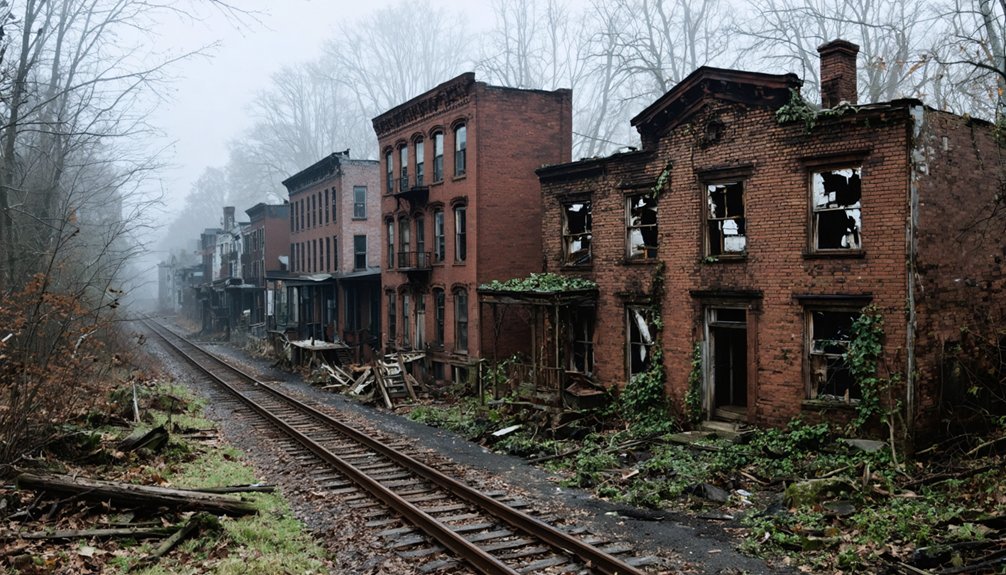
Industrial decline transformed thriving New Jersey settlements into abandoned ruins as factories shuttered and workers dispersed. You’ll find Feltville’s 175 residents vanished after David Felt’s 1860 retirement, while Allaire Village’s 400-person ironworks community collapsed in 1846.
Transportation shifts accelerated urban decay—Waterloo Village died when canals became obsolete, and Ong’s Hat disappeared after railways bypassed the Pine Barrens.
Government actions dealt decisive blows: Walpack Center’s houses were bulldozed for a dam never built, and Newark authorities completely erased Demon’s Alley by 2005.
Natural disasters and resource depletion finished what economics started. These ghost town legends emerged from bog iron exhaustion, maritime route changes, and failed industries that left entire communities stranded without purpose or population across Burlington, Ocean, and Sussex counties.
Legends and Lore of New Jersey’s Forgotten Places
When New Jersey’s settlements fade into ruins, folklore rushes in to fill the void left by displaced residents and demolished buildings. You’ll find urban legends clustering around these abandoned sites, transforming mundane histories into supernatural mysteries.
Notable ghost town legends across New Jersey:
- Ong’s Hat – Burlington County tales claim a 19th-century cult mixed science and occult practices before achieving interdimensional transport through mysterious disappearances.
- Demon’s Alley – West Milford’s demolished mid-20th-century neighborhood spawns stories of secretive rituals and shadowy figures haunting overgrown woods.
- Walpack Center – Sussex County’s dam-displaced community fuels ghost stories around its remaining 19th-century buildings.
- Double Trouble – Ocean County’s abandoned cranberry operations inspire spectral tales amid Pine Barrens isolation.
- Raritan Landing – Colonial port excavations uncover artifacts sparking legends of lost spirits.
Batsto Village: A Living Museum in the Pine Barrens
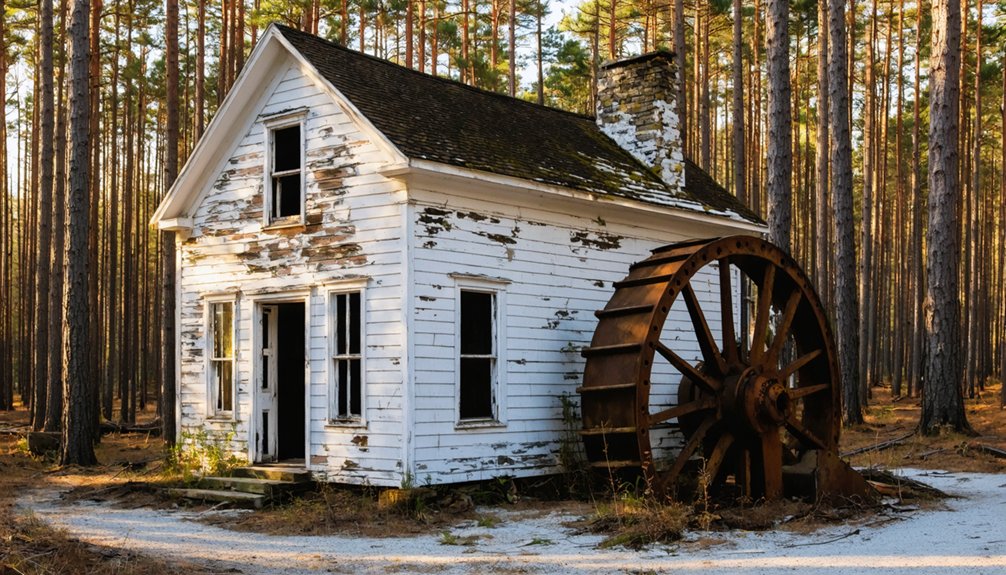
Unlike the truly abandoned settlements scattered throughout New Jersey, Batsto Village stands as a carefully preserved window into the state’s industrial past. You’ll find 40+ historic structures within Wharton State Forest, documenting iron production from 1766 through the Richards family’s 91-year tenure.
When Joseph Wharton acquired the 96,000-acre property in 1876, he prevented the urban decay that claimed similar industrial towns.
The state’s 1950s purchase created preservation challenges—balancing authentic history with public access.
Primary sources reveal residents remained until 1989, maintaining living connections to nearly 250 years of commerce.
Today, you’re free to explore the mansion, gristmill, and general store, experiencing how deliberate conservation transformed potential abandonment into educational opportunity within the Pinelands National Reserve.
Feltville: the Deserted Village With a Mysterious Past
Deep in the Watchung Mountains, Feltville’s story begins not with mystery but with frontier industry—Peter Willcocks’ 1736 sawmill operation that cleared hundreds of acres to supply lumber for New Jersey’s expanding agricultural settlements.
Before paranormal legends took hold, Feltville emerged from practical necessity—a frontier sawmill carving civilization from wilderness timber.
By 1845, industrialist David Felt transformed this settlement into a thriving mill town of 175 residents, earning the nickname “King David” for his strict governance.
The village’s decline came swiftly after the Panic of 1857. Felt abandoned his town in 1860, and subsequent ventures failed.
By the 1870s, complete desertion earned it the ominous name “Deserted Village.”
Haunted legends surrounding Feltville include:
- Two factory girls drowned in the mill pond
- Three sisters vanished while camping in 1912
- Thirteen witches allegedly buried along the cursed road
- Persistent ghostly sightings reported throughout abandoned buildings
- Satanic cult activity rumored in surrounding woods
Waterloo Village and Walpack Center: Northern New Jersey’s Time Capsules
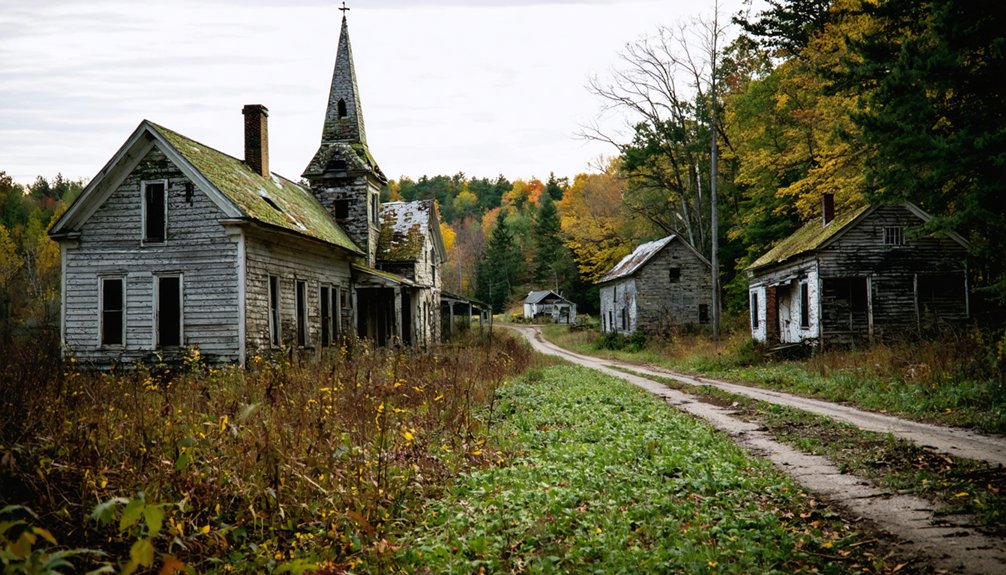
While Feltville earned its ghostly reputation through abrupt abandonment, New Jersey’s northern highlands preserve two settlements where time stopped for entirely different reasons—one through economic obsolescence, the other through governmental intervention.
Waterloo Village in Byram Township flourished as a Morris Canal town from 1831 until railroads rendered waterways obsolete. You’ll find roughly two dozen Colonial and Victorian structures along the Musconetcong River, though preservation challenges have plagued this National Register site since 2006.
Despite haunted legends surrounding its abandoned buildings, the real specters are deterioration and vandalism following the state’s lease cancellation.
Walpack Center tells a different story—a thriving 19th-century community forcibly depopulated in the 1970s for the cancelled Tocks Island Dam project, leaving an entire township frozen in bureaucratic limbo within Delaware Water Gap National Recreation Area.
Visiting Today: What’s Preserved and What’s Open to Explore
Today’s ghost town explorer will find New Jersey’s abandoned settlements split between two distinct preservation models: fully operational outdoor museums with visitor infrastructure, and atmospheric ruins accessible through public parklands.
The state’s approach to modern conservation balances historic integrity with public access, creating opportunities for urban archaeology enthusiasts and casual visitors alike.
Current Access Points:
- Batsto Village (Burlington County) offers extensive tours of the Richards/Wharton mansion, blacksmith shop, and operational mills through the NJ Department of Environmental Protection.
- Feltville (Union County) provides free wandering among eight preserved houses and historic structures via Watchung Reservation trails.
- Double Trouble (Ocean County) maintains hiking trails through authentic ruins.
- Whitesbog Village combines cranberry industry buildings with Brendan T. Byrne State Forest access.
- Atsion features museum tours alongside explorable factory remains.
Frequently Asked Questions
Can You Legally Metal Detect in New Jersey’s Ghost Towns?
You can’t legally metal detect in New Jersey’s ghost towns without written permission. State forest regulations and historic preservation laws protect these sites, including those with haunted legends. Unauthorized detecting on public lands results in citations and equipment confiscation.
Are Any Ghost Towns in New Jersey Privately Owned?
Yes, you’ll find privately owned ghost towns like Ong’s Hat and portions of Harrisville in New Jersey. Historic preservation and land ownership records confirm these sites remain on private property, restricting your access without permission—unlike state-managed locations you can freely explore.
What’s the Best Season to Photograph New Jersey’s Abandoned Settlements?
Fall offers you the best lighting conditions for photographing New Jersey’s abandoned settlements. Low-angle sunlight enhances textures, leaf drop exposes structures fully, and morning fog creates atmospheric effects—essential seasonal photography tips supported by field documentation.
Do Any Ghost Towns Charge Admission Fees?
Yes, you’ll pay admission at preserved ghost town artifacts like Batsto Village and Allaire Village, while abandoned settlements including Harrisville Ruins, Milbrook Village, and Feltville offer free exploration—giving you unrestricted freedom to roam authentic historic sites.
Are Overnight Camping Trips Allowed at Ghost Town Sites?
You can’t camp overnight at New Jersey’s ghost town sites. Historical preservation regulations and tourist attractions policies prohibit staying after hours. State park rules direct you to designated campgrounds away from these protected historic structures instead.
References
- https://en.wikipedia.org/wiki/List_of_ghost_towns_in_New_Jersey
- https://www.loveexploring.com/gallerylist/188219/the-us-state-with-the-most-ghost-towns-revealed
- https://www.youtube.com/watch?v=JakWh73E7e4
- https://jerseydigs.com/ghost-towns-in-nj/
- https://www.jerseysbest.com/community/take-a-road-trip-through-n-j-s-spooky-ghost-towns-to-see-peculiar-pieces-of-history/
- https://www.youtube.com/watch?v=ZIp3AYb0ulw
- https://www.journeythroughjersey.com/blog/forgotten-jersey-ghost-towns-and-lost-villages/
- https://www.geotab.com/ghost-towns/
- https://pinelandsalliance.org/learn-about-the-pinelands/pinelands-history-and-culture/ghost-towns-of-the-pine-barrens/
- https://www.youtube.com/watch?v=5_7QPnGFzWw