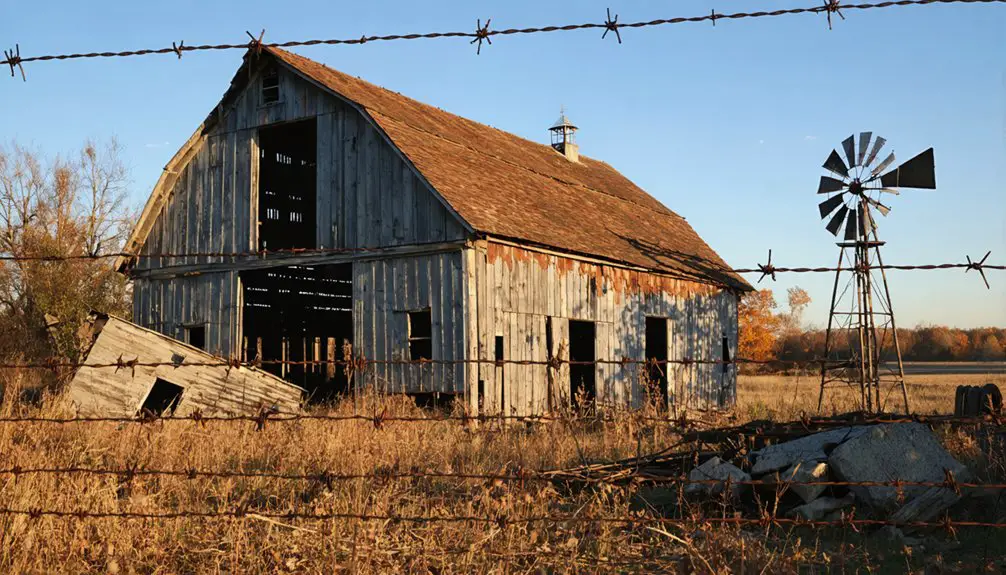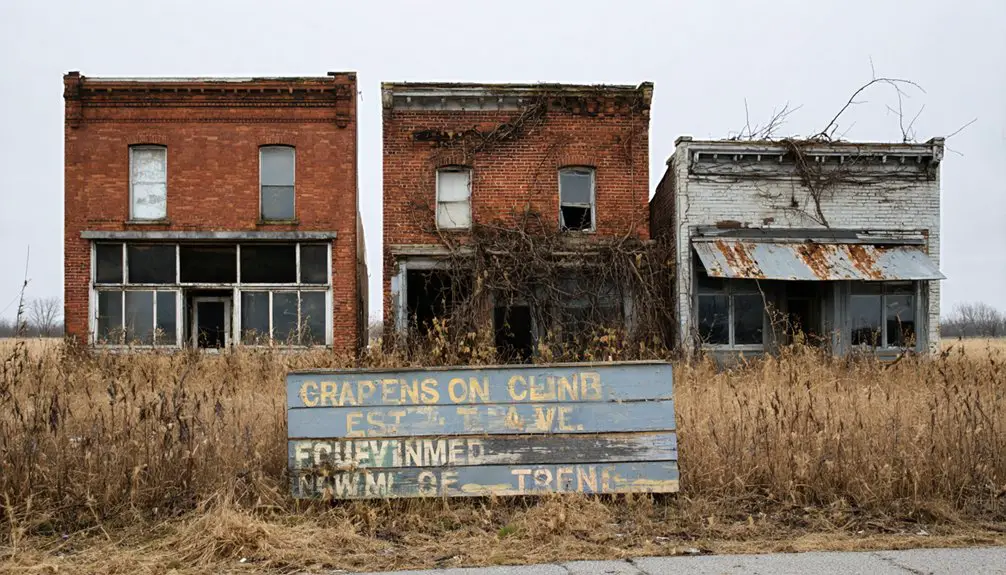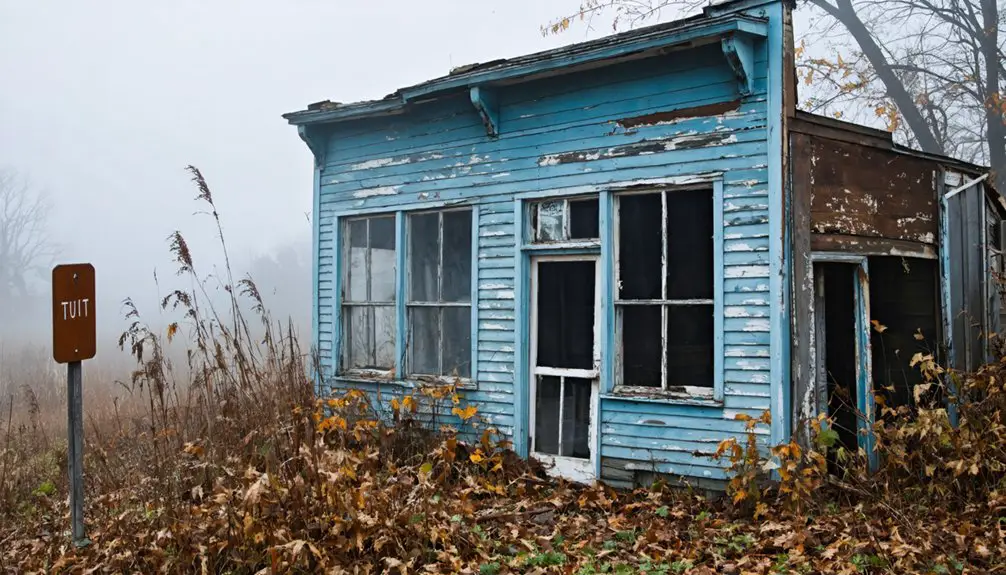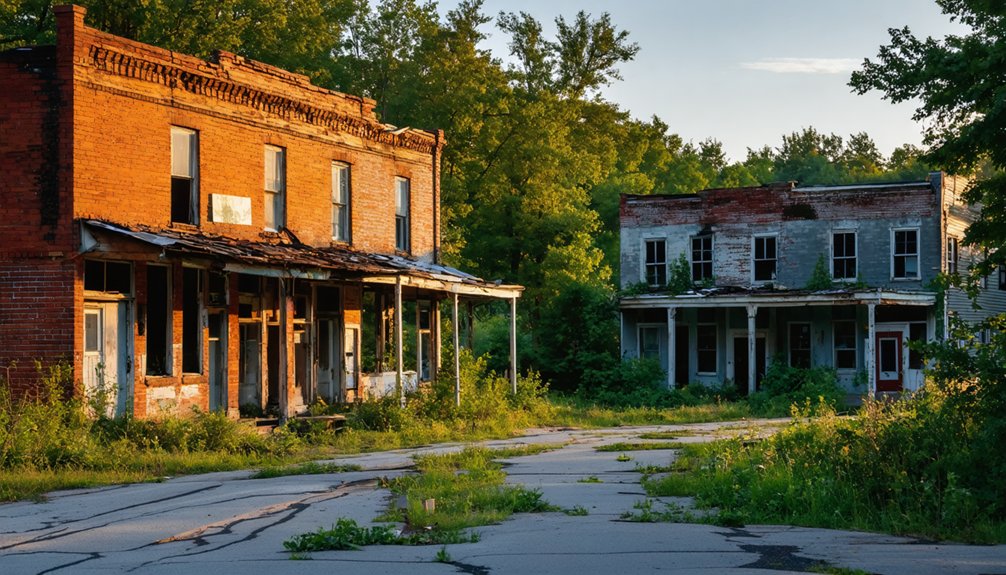
You’ll find at least 30 documented ghost towns scattered across Ohio, though local historians estimate dozens more vanished settlements remain unrecorded in county archives. These abandoned communities—from coal camps like San Toy to railroad stops like Moonville—disappeared between the 1830s and 1970s due to economic collapse, flooding, and industrial decline. No official registry exists, making the true count elusive. Hancock and Franklin counties show notable concentrations, while southeastern Ohio’s forested hills conceal countless ruins, foundations, and forgotten cemeteries waiting to reveal their stories.
Key Takeaways
- No definitive registry exists, but published sources document approximately 26 to 30 significant ghost towns across Ohio.
- Local historians estimate dozens more vanished settlements remain undocumented, particularly from the 1830s to 1970s economic shifts.
- Notable ghost towns include Helltown, Moonville, San Toy, Haydenville, and Boston Mills, each with unique abandonment histories.
- Many sites retain physical remnants like foundations, cemeteries, and crumbling buildings, while others exist only as historical footnotes.
- Franklin and Hancock counties show notable concentrations, though the actual number likely exceeds recorded figures due to research gaps.
Defining What Counts as a Ghost Town
Although historians and preservation societies debate the precise criteria, a ghost town fundamentally emerges when the economic reason for a settlement’s existence vanishes—whether that’s a depleted coal mine in southeastern Ohio, a bypassed canal town, or a shuttered iron furnace community.
You’ll find economic decay marks these places where residents abandoned hope alongside their homes.
What separates ghost towns from completely erased settlements? Infrastructure remnants.
You need visible evidence: foundations, cemeteries, crumbling mercantile buildings, or overgrown main streets.
Total abandonment isn’t required—some Ohio ghost towns retain skeleton populations or part-time residents.
What matters is the tangible architectural record of a community that once thrived.
Without accessible physical remains, you’re examining historical footnotes, not ghost towns you can document and preserve.
Official Counts and Historical Estimates
You’ll find no definitive registry of Ohio’s ghost towns, though published rankings typically document around 26 significant sites while Wikipedia’s admittedly incomplete list exceeds 30 locations.
County archivists and local historians estimate dozens more settlements vanished from Ohio’s landscape between the 1830s and 1970s, their existence now preserved only in courthouse records and old plat maps. These varying counts reflect different criteria—some sources catalog only completely abandoned sites, while others include semi-ghost towns where a few residents still remain after mass buyouts or economic collapse. Some towns like Atwood in Carroll County were deliberately abandoned for flood control through the creation of reservoirs and lakes. Boston Mills became part of Cuyahoga Valley National Park through eminent domain, despite some structures remaining in what is now a historic district.
Published Rankings Show 26
When examining published rankings of Ohio’s ghost towns, the official counts consistently settle near 26 documented sites, though broader catalogs like ghosttowns.com extend this number to 46 locations across the state. These rankings reveal fascinating preservation challenges for urban exploration enthusiasts seeking authentic abandoned settlements.
The most compelling documented sites include:
- San Toy in Perry County – once housing nearly 1,000 coal miners before labor disputes emptied it, leaving only roads and a crumbling jail.
- Moonville – featuring haunting railroad ruins that draw countless visitors to Gretchen’s Lock.
- Helltown (Boston Mills) – Summit County’s most infamous location, shrouded in local legends.
- Seagrove in Franklin County – ranking among the top eleven ghost towns statewide.
You’ll find these sites rated on abandonment scales from 1 to 7, with higher numbers indicating complete desertion. The Whitewater Shaker Village near Cincinnati still maintains 23 original buildings from its 1824 founding, making it one of the best-preserved former settlements. For those researching Ohio’s abandoned settlements, enabling JavaScript ensures access to interactive maps and video documentation that enhance the exploration experience.
Wikipedia’s Incomplete 30+ List
Wikipedia’s documentation of Ohio’s ghost towns presents a fragmented archival picture, cataloging 30+ settlements across multiple lists that the platform itself acknowledges as incomplete.
You’ll find Franklin County alone accounts for 17 entries—from Ackerman to Wonderland—while Hancock County concentrates another cluster including Clements, Cordelia, and Crow.
The platform’s category system adds specialized examples like Moonville’s railroad tunnel and Knockemstiff’s flood-abandoned structures.
This partial enumeration reveals significant gaps in preservation efforts, as many settlements lack proper documentation of their sociocultural impact on regional development. These deserted communities represent snapshots of past lives, with buildings that remain empty and deteriorating throughout the state. The geographic spread encompasses both northern and southern Ohio regions, reflecting historical settlement patterns across the state.
The fragmented records suggest you’re looking at a baseline count rather than comprehensive inventory. Franklin County’s explicit acknowledgment of incompleteness indicates Ohio’s actual ghost town total likely exceeds these preliminary archives by substantial margins, awaiting independent researchers to document forgotten communities.
Historians Estimate Dozens More
Ghosttowns.com’s registry documents 37 settlements—from Bluestone to Providence—establishing a baseline that historians consider merely the documented fraction of Ohio’s abandoned communities. You’ll find researchers estimate thousands more across the state, with underground ruins and cemetery inscriptions revealing what official counts miss.
Northwest Territory settlements from 1798 onward created networks of towns that economic shifts erased from memory.
Evidence pointing to dozens more includes:
- Coal mining collapses left entire Vinton County communities like Oreton abandoned, their workers’ homes now forest-reclaimed foundations.
- Canal system failures stranded Sprucevale’s population after 1870, visible locks marking ghost commerce routes.
- San Toy’s 1,000 residents vanished following 1931 mine closures and labor violence.
- Cemetery inscriptions in every county mark settlements cartographers never recorded.
- Moonville’s location within dense Vinton County forests along the Marietta and Cincinnati Railroad resulted in over 20 railroad fatalities that contributed to its eventual abandonment.
- River traffic decline eliminated transportation service jobs that sustained entire communities along Ohio’s waterways, transforming bustling ports into forgotten landings.
Your freedom to explore uncovers Ohio’s hidden history.
Coal Mining Communities That Vanished
You’ll find San Toy’s history marked by labor tensions that erupted into violent strikes during the early 1900s, when Sunday Creek Coal Company workers fought for union recognition amid dangerous conditions. The company’s response—bringing in strikebreakers and armed guards—left scars that outlasted the mines themselves.
Meanwhile, Moonville’s abandoned railroad tunnel stands as southeastern Ohio’s most documented ghost town remnant, where the Baltimore and Ohio Railway once hauled coal through a route now reclaimed by forest and folklore.
San Toy’s Labor Disputes
When disgruntled workers pushed a flaming log cart into the mine shaft in 1924, they ignited more than just coal—they set fire to San Toy’s future. The labor unrest culminated in flames that consumed the mine, hospital, and theater, marking Perry County’s most dramatic union struggles.
San Toy’s violent labor history reveals:
- Workers risked everything for fair treatment in unsafe conditions that claimed countless lives
- The 1924 arson destroyed their own workplace, demonstrating desperate men choosing destruction over oppression
- Mining resumed briefly after settlement, but Sunday Creek Coal Company abandoned operations by 1927
- Rapid depopulation followed, as 2,000 residents scattered when corporate power terminated their livelihoods
This immigrant labor community stood against exploitation, but their resistance ultimately accelerated the town’s demise by 1931.
Moonville’s Haunted Railroad Legacy
While San Toy’s workers fought corporate power with flames, a different kind of darkness haunted Moonville’s railroad corridor. You’ll find southeastern Ohio’s most compelling intersection of railroad history and haunted folklore along this abandoned Marietta and Cincinnati track, where over 21 documented fatalities occurred between 1856 and 1978.
The dense woodland muffled approaching locomotives, creating deadly conditions for workers and travelers alike.
Railroad history records reveal Theodore Lawhead’s 1880s collision spawned the white-robed “Engineer” apparition, while an 1859 accident produced the stumbling “Brakeman” ghost. The “Lavender Lady” allegedly manifests near the tunnel’s entrance, accompanied by her distinctive scent.
Today, only the Moonville Tunnel, cemetery stones, and foundations remain—silent witnesses to a community where industrial progress extracted both natural resources and human lives.
The Most Famous Abandoned Sites

You’ll discover Ohio’s most haunting abandoned places through:
- Helltown (Peninsula) – Urban legends and government buyouts created Ohio’s most infamous ghost town, where overgrown streets still draw explorers seeking truth behind the myths.
- San Toy – Perry County’s violent coal legacy lives on through crumbling jailhouses and collapsed mine entrances hidden in dense woods.
- Moonville Tunnel – The railroad’s sole surviving monument attracts thousands annually to southeastern Ohio’s forests.
- Haydenville – Ohio’s last company town showcases intact industrial architecture from 1852, preserving mining-era craftsmanship.
Hancock County’s Concentration of Lost Towns
Beyond the state’s most notorious abandoned sites, Hancock County presents a different narrative of loss—one measured not in dramatic ruins but in wholesale erasure. You’ll find over twenty documented ghost towns scattered across its townships, with Marion Township holding the highest concentration at five named settlements.
Marion Township alone harbors five vanished settlements—the highest concentration of ghost towns in a county defined by wholesale erasure rather than romantic ruins.
These weren’t victims of typical urban decay—they simply never achieved viability. Alba, Ashery, Big Lick, and El Rose exemplified failed settlement sustainability, lacking the businesses and rail connections necessary for survival.
Marion Township’s Elm Grove, Marvins Mill, and North Ridgeville joined Orange Township’s Hassan and Reed’s Corner in fading from maps entirely. Unlike reconstructed attractions near Findlay, these communities left minimal physical evidence.
You’re tracing losses documented primarily through archival records and unsold land plats.
Exploring Ohio’s Forgotten Communities Today

Today’s preservation-minded explorer will find Ohio’s ghost towns offer vastly different experiences than their Hancock County counterparts—these communities left tangible traces you can still walk through.
Modern preservation efforts have transformed abandoned sites into accessible historical destinations, creating unique tourism opportunities across southeastern Ohio’s forested hills.
Sites Worth Your Freedom to Explore:
- Moonville Tunnel – Walk through the 1850s railroad structure where iron and coal miners once labored, now surrounded by haunting forest silence along accessible hiking trails.
- Vinton Furnace – Discover rusting industrial archaeology hidden on remote trails off Stone Quarry Road, where nineteenth-century iron production shaped regional development.
- Haydenville – Examine Ohio’s last company town’s architectural relics, built from local bricks that tell manufacturing stories.
- Boston Mills Helltown – Experience Cuyahoga Valley National Park’s preserved mill town structures.
Frequently Asked Questions
What Caused Most Ohio Ghost Towns to Become Abandoned?
You’ll find economic decline drove most Ohio ghost towns into urban decay—mining closures, railroad shutdowns, and mill failures stripped away livelihoods. When industries collapsed, residents couldn’t sustain communities, forcing them to seek opportunities elsewhere and leaving settlements abandoned.
Are Any Ohio Ghost Towns Actually Haunted or Just Folklore?
You’ll find zero verified hauntings—it’s pure folklore. Paranormal legends surrounding Moonville, Helltown, and San Toy stem from abandoned structures and tragic history. You’re free to explore these preserved sites and decide yourself what’s real versus regional storytelling.
Can You Legally Visit and Explore Ohio’s Ghost Towns?
You can legally visit many Ohio ghost towns on public trails and parks, but you’ll face access restrictions at hazardous structures and private property. Always research ownership and safety regulations beforehand to explore responsibly while respecting preservation efforts.
Which Ohio Ghost Town Had the Largest Population at Its Peak?
When push comes to shove, Oreton Peak topped other historical settlements with 800-900 residents. You’ll find this mining community outpaced Moonville and similar ghost towns, representing Ohio’s ambitious industrial spirit before economic shifts triggered its eventual abandonment.
Are There Plans to Preserve Any Ohio Ghost Towns Historically?
You’ll find historical preservation efforts underway through organizations like Ohio Ghost Town Exploration Co., which actively documents sites and advocates for maintenance. They’re creating tourist attractions by mapping coordinates and promoting heritage trails at locations like Moonville.
References
- https://en.wikipedia.org/wiki/List_of_ghost_towns_in_Ohio
- https://wrkr.com/ohio-ghost-towns/
- https://www.youtube.com/watch?v=QWTtG6njIDs
- https://www.loveexploring.com/gallerylist/188219/the-us-state-with-the-most-ghost-towns-revealed
- https://hockingvacations.com/blog/exploring-the-ghost-towns-of-ohio-unearthing-forgotten-histories
- https://freepages.rootsweb.com/~gtusa/history/usa/oh.htm
- https://ohioghosttowns.org
- https://www.geotab.com/ghost-towns/
- https://cura.osu.edu/ghost-neighborhoods
- https://www.lindasellsmoore.com/blog/what-is-a-ghost-town/