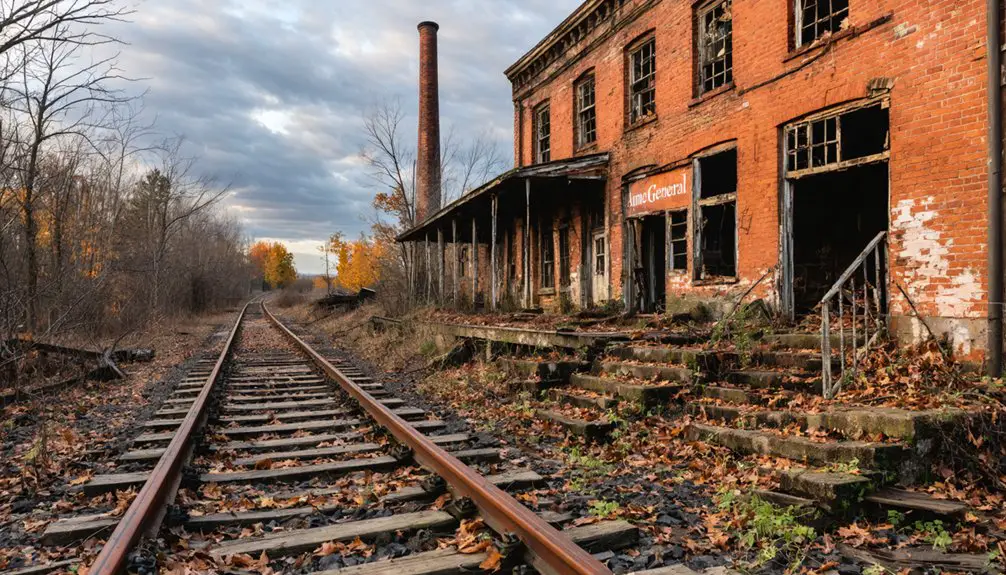
Pennsylvania contains 105 documented ghost towns as of 2023, ranking 22nd nationally for abandoned settlements. You’ll find the densest concentration in Indiana County, which holds 36 sites—third among all U.S. counties. Most cluster in western Pennsylvania’s coal belts, Venango County’s oil fields, and along former industrial corridors. At least five communities lie submerged beneath reservoirs, while towns like Centralia remain abandoned due to underground mine fires. The count doesn’t capture every vanished settlement, and the stories behind each abandonment reveal Pennsylvania’s complex industrial heritage.
Key Takeaways
- Pennsylvania has 105 documented ghost towns as of 2023, ranking 22nd among U.S. states for abandoned settlements.
- Indiana County contains the highest concentration with 36 ghost towns, ranking third nationally among all U.S. counties.
- Most ghost towns are located in western Pennsylvania, reflecting the region’s coal mining and industrial heritage.
- At least five communities were submerged during 20th-century dam projects, creating underwater ghost towns.
- Ghost towns concentrate in Venango County oil fields and coal belts of Columbia and Armstrong Counties.
Counting Pennsylvania’s Abandoned Settlements: What the Data Shows
According to the most all-encompassing datasets available, Pennsylvania contains 105 documented ghost towns, placing it 22nd among U.S. states for abandoned settlements. You’ll find this figure comes from 2023 data compiled by sources like Geotab and BatchGeo, though earlier counts reported lower numbers in the hundreds.
Historical population fluctuations tied directly to resource extraction cycles created these abandoned communities—coal mining, oil drilling, and logging operations drew thousands of workers before inevitable busts left empty streets.
Environmental impacts also shaped Pennsylvania’s ghost town landscape: Lake Wallenpaupack’s creation submerged Wilsonville entirely, while depleted forests and exhausted mineral deposits rendered once-thriving settlements economically unsustainable. The state notably contains 46 submerged ghost towns, with most located under lakes created by dams or flooding.
Indiana County alone holds 36 ghost towns, ranking third nationally at the county level. These abandoned settlements serve as tangible links to the state’s dynamic industrial past, offering lessons about infrastructure development and economic shifts.
Western Pennsylvania concentrates most abandoned settlements, reflecting the region’s intensive industrial heritage.
Indiana County: The Ghost Town Capital of Pennsylvania
With 36 documented ghost towns, Indiana County claims Pennsylvania’s highest concentration of abandoned settlements and ranks third nationally among all U.S. counties—trailing only Kern County, California (113 ghost towns) and Lawrence County, South Dakota (93).
The history of abandoned towns in Pennsylvania’s history reveals fascinating stories of economic booms and subsequent declines. Many of these ghost towns were once thriving communities that fell victim to industrial changes and migration trends. Exploring these sites provides a glimpse into the past and the resilience of human settlement patterns in the region.
Indiana County holds Pennsylvania’s densest ghost town cluster and ranks third nationally with 36 documented abandoned settlements.
You’ll find these sites scattered across townships, remnants of the coal-mining industry’s collapse in the early 1900s. Urban decay defines locations like Wehrum, once housing 230 families with full infrastructure, and Claghorn, marked by its 1917 three-arch bridge.
Historical preservation efforts center on the Ghost Town Trail, a 46-mile path connecting sites including Kelly’s Station, Lackawanna No. 3, Scott Glenn, and Whiskey Run. The trail features hard-packed limestone dust surfacing on a former railroad grade, providing accessible passage through these historic sites. Additional abandoned settlements along this trail include Loop and Edri, former coal towns that contributed to the county’s industrial history.
This concentration represents more than one-third of Pennsylvania’s 105 total ghost towns, making Indiana County essential for understanding the state’s industrial heritage.
Beneath the Surface: Pennsylvania’s Submerged Communities
Beneath Pennsylvania’s reservoir system lie at least five documented communities, deliberately flooded during 20th-century dam construction projects that prioritized regional water management and flood control over existing settlements.
You’ll find Somerfield under Youghiogheny River Lake, Social Hall beneath Conemaugh River Lake, and Milford Mills submerged by Marsh Creek Lake. Wilsonville disappeared under Lake Wallenpaupack, while Tohickon Village rests beneath Lake Nockamixon’s waters.
These sites represent involuntary displacement where authorities determined collective needs superseded individual property rights. Similar to forced evacuations at Fricks Lock for the Limerick power plant, these communities transitioned from functional towns to submerged ghost towns. Additional towns including Millwood Shaft, Marburg, Straight, and Loop under Conemaugh River Lake expanded Pennsylvania’s count of submerged settlements.
When Somerfield’s waters receded in 1999, exposed houses, bridges, and portions of the National Road emerged—creating unexpected underwater archaeology opportunities.
The submerged infrastructure periodically surfaces during drawdowns, revealing roads, foundations, and remnants of communities that residents abandoned without choice during Pennsylvania’s aggressive mid-century dam development era.
Centralia, Pithole, and Other Famous Abandoned Towns
Pennsylvania’s most notorious abandoned settlement, Centralia, began as a thriving anthracite mining hub in Columbia County when Alexander Ray founded it in 1866.
The town’s prosperity ended when a 1962 trash fire ignited underground coal seams, spreading through abandoned mine tunnels beneath nearly 3,000 residents’ homes.
Despite decades of extinguishing attempts, toxic gases, sinkholes, and life-threatening carbon monoxide forced near-total evacuation by the 1980s.
Federal buyouts relocated families as urban decay consumed tilting homes and cracked streets.
Congress allocated over $42 million in 1983 to address the fire and relocate residents through eminent domain proceedings.
Today, you’ll find empty roads, new-growth forests, and St. Mary’s Church standing amid historical preservation efforts.
The fire still burns beneath 3,700 acres, inspiring Silent Hill‘s underground inferno.
Route 61 passes this cautionary tale where government authority chose abandonment over costly intervention.
A well-maintained Orthodox cemetery remains on the hillside above town, surrounded by plumes of smoke and noxious gases from the continuing underground fire.
Industries That Built and Destroyed Pennsylvania Communities
Throughout the late 1700s, bituminous coal mining transformed Pennsylvania’s landscape when operations began at Coal Hill near Pittsburgh, establishing an extractive economy that would define the Commonwealth for two centuries.
Economic shifts shaped entire communities:
- Pennsylvania Coal and Coke Company built Wear with 250 homes for over 1,200 miners.
- Steel industry collapse in the late 1970s-1980s emptied thousands from Rust Belt towns.
- Lumber operations like Barkley Lumber Company founded Laquin in 1902.
- Pittsburgh consumed over 400 tons of bituminous coal daily by 1830.
- Brownsville thrived as a 19th-century shipbuilding hub on the Monongahela River.
Environmental impacts devastated settlements permanently. Laurel Run‘s mine fire started in 1915 and continues burning today. Centralia suffered from a persistent underground coal fire since the early 1960s, transforming the bustling town into a haunted symbol and shifting its population out. Deep mines with vertical coal veins caused increased water inflow that elevated operational costs and forced abandonment of mining infrastructure.
You’ll find Ghost Town Trail communities like Wehrum and Bracken completely abandoned after extraction ended.
Exploring Ghost Towns You Can Still Visit Today
You’ll find Pennsylvania’s accessible ghost towns concentrated in three distinct regions: the oil fields of Venango County, the coal belts of Columbia and Armstrong Counties, and government-seized sites in Union County.
Each location maintains different access protocols—Pithole offers year-round walking tours through its visitor center, while Yellow Dog Village permits entry only on designated dates.
Before visiting any site, you must verify current regulations, as properties like Frick’s Lock remain private despite public interest, and Centralia poses documented health hazards from its underground mine fire.
Preserved Mining Museum Villages
- Original company housing structures remain accessible
- Self-guided exploration of authentic mining architecture
- No corporate interference—independent historical preservation
- Dirt-road authenticity without modern sanitization
- Direct access to working-class industrial heritage
Accessible Abandoned Coal Towns
Beyond the curated exhibits and restored structures, Pennsylvania’s landscape holds dozens of genuine abandoned coal towns where you can walk through authentic ruins without admission fees or guided tours.
You’ll find Rausch Gap’s foundations and cemetery along St. Anthony’s Wilderness rail trail, abandoned since 1910. Yellow Dog Village offers legally accessible remnants where nature reclaims structures without restriction. Wehrum’s hidden ruins near Vintondale remain open for exploration, untouched by historical preservation efforts that might limit access.
Centralia draws visitors to its graffiti highways and scorched earth, though toxic gases create genuine hazards.
Peale’s relocated foundations sit quietly in Clearfield County woods during ongoing reclamation. These sites exist outside formal community revitalization programs, preserving their authentic abandonment while remaining accessible to those seeking unmediated encounters with Pennsylvania’s coal-mining past.
Safe Entry and Regulations
While Pennsylvania’s abandoned coal towns invite exploration, trespassing laws apply uniformly across the commonwealth regardless of a property’s condition. You’ll need landowner permission before entering any abandoned site, as visitor safety remains your responsibility. Regulatory guidelines don’t differentiate between occupied and derelict structures—unauthorized entry constitutes criminal trespass.
Before exploring, consider these essential practices:
- Research property ownership through county tax records to identify who controls access rights
- Secure written permission from current landowners, even for seemingly abandoned sites
- Document structural hazards including collapsed floors, unstable walls, and contaminated water sources
- Notify someone of your exploration plans and expected return time
- Carry emergency communication devices since cell service proves unreliable in remote coal regions
Your freedom to explore exists within legal boundaries that protect both property rights and personal safety.
Frequently Asked Questions
Are Pennsylvania’s Ghost Towns Legally Accessible to the Public?
You’ll find many Pennsylvania ghost towns are legally accessible through public trails and state parks, where you can explore abandoned architecture with historical significance. However, some sites remain restricted due to safety hazards or private ownership restrictions.
What Safety Hazards Exist When Visiting Abandoned Pennsylvania Towns?
You’ll encounter hazardous structures with collapsing floors, unstable roofs, and contaminated materials like asbestos. Trespassing risks include legal consequences, abandoned mine shafts, toxic emissions from Centralia’s coal fire, and limited emergency access in remote mountainous locations.
Can You Buy Property in Pennsylvania’s Ghost Towns?
Like chasing shadows through forgotten doorways, you’ll find most Pennsylvania ghost town properties aren’t available. Haunted legends surround abandoned structures now protected as parks or held privately. Centralia, Frick’s Locks offer rare exceptions, though legal restrictions severely limit your purchasing freedom.
How Do Ghost Towns Affect Surrounding Communities Economically Today?
Ghost towns accelerate local economic decline in your region through lost tax revenue and decreased property values. While tourism impact provides minimal gains, you’ll find surrounding communities face workforce reduction, infrastructure strain, and reduced state funding based on population losses.
What Preservation Efforts Protect Pennsylvania’s Ghost Town Historical Sites?
Like guardians of memory, you’ll find restoration techniques protecting Pennsylvania’s historical landmarks through National Register designations, rail trail conversions, and tourism operations—particularly in Western Pennsylvania’s mining regions, where community stewardship preserves your access to authentic industrial heritage.
References
- https://www.geotab.com/press-release/american-ghost-towns/
- https://blog.batchgeo.com/ghost-towns/
- https://en.wikipedia.org/wiki/List_of_ghost_towns_in_Pennsylvania
- https://www.atlasobscura.com/things-to-do/pennsylvania/ghost-towns
- https://uncoveringpa.com/ghost-towns-in-pa
- https://www.youtube.com/watch?v=J8cgAdVe5ZA
- https://www.rural.pa.gov/datagram/244/Ghost-Towns-in-Pennsylvania
- https://www.cjr.org/special_report/year-of-fear-mckeesport-census.php/
- https://www.loveexploring.com/gallerylist/188219/the-us-state-with-the-most-ghost-towns-revealed
- https://www.geotab.com/ghost-towns/