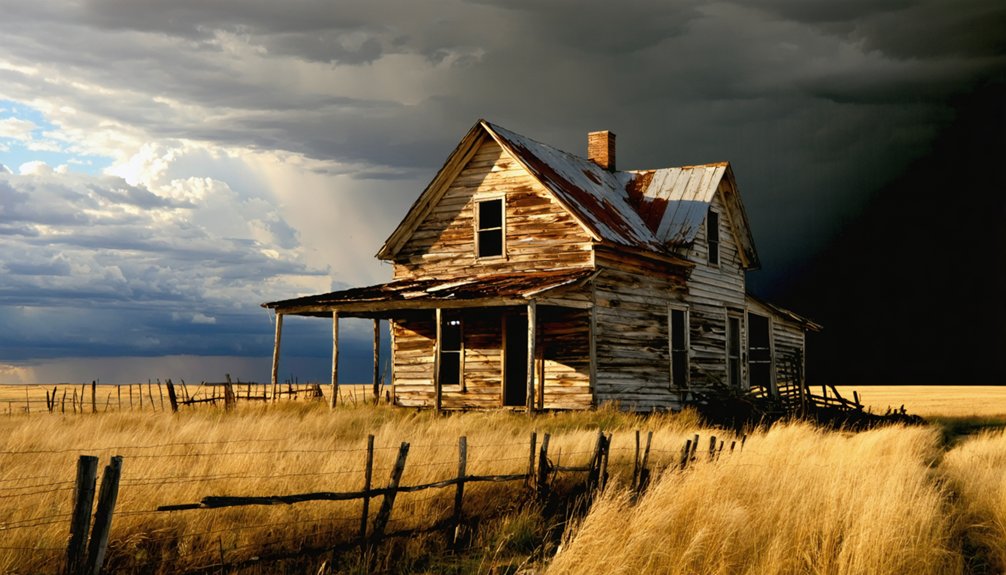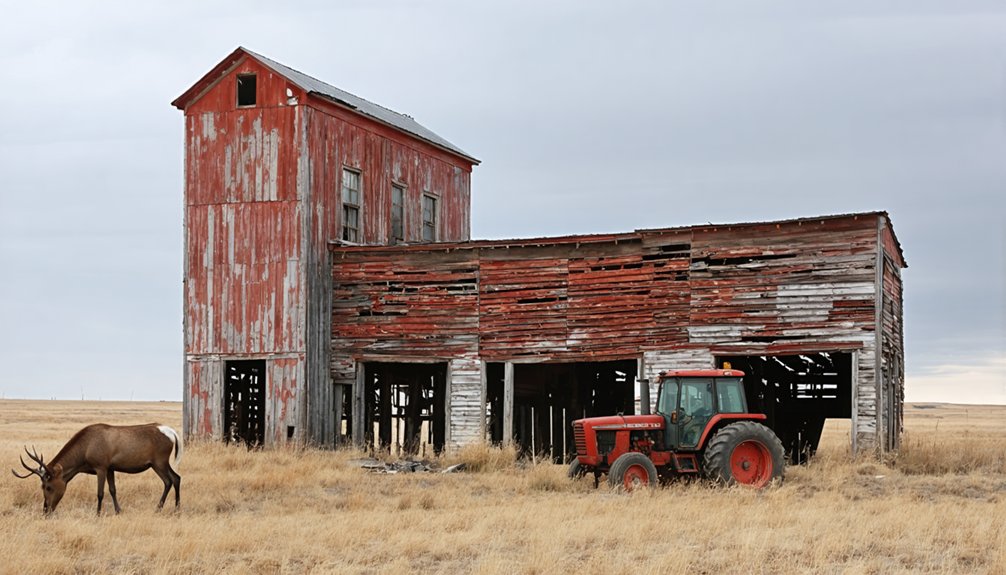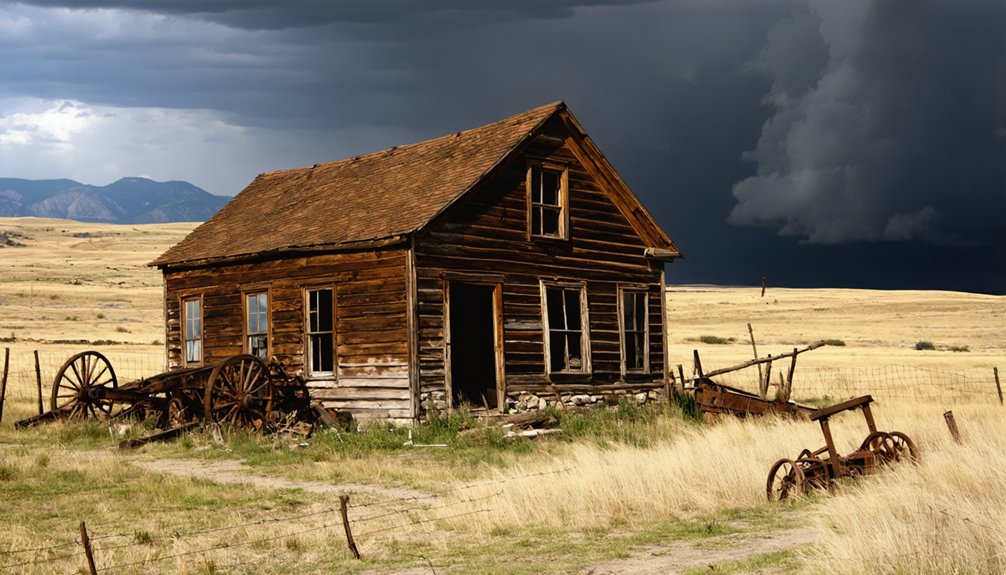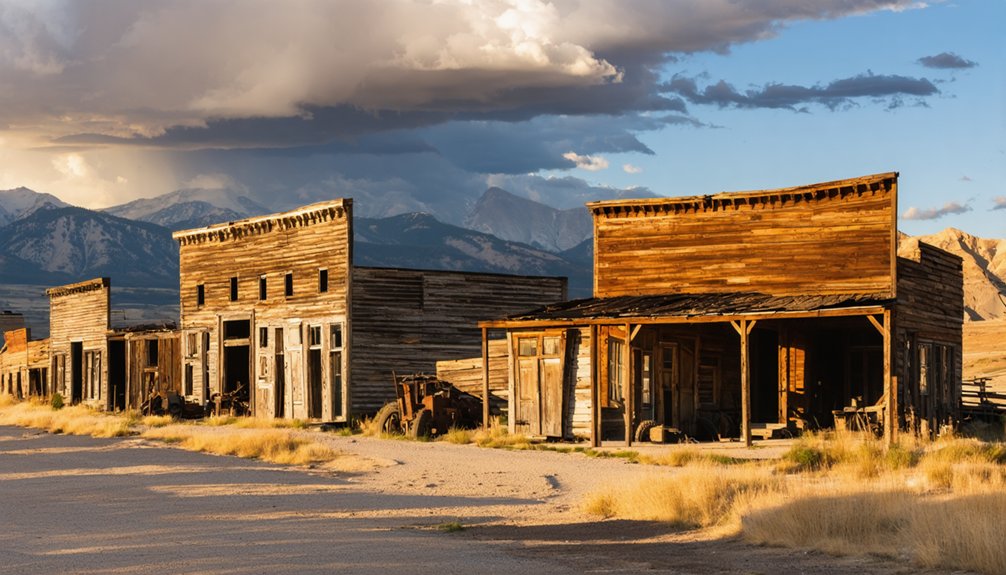
You’ll find between 238 and 246 documented ghost towns scattered across South Dakota, ranking it fifth nationally for abandoned settlements. The Black Hills region alone contains over 600 ghost sites—remnants of the 1876 Gold Rush that drew thousands westward. Lawrence County leads with 93 documented locations, more than any other county in America. These abandoned communities range from completely barren sites to preserved ruins with standing structures, while some maintain tiny populations of just two or three residents. The state’s all-encompassing documentation reveals how resource exhaustion, railroad abandonment, and route changes transformed thriving settlements into historical artifacts.
Key Takeaways
- South Dakota has approximately 238 to 240+ documented ghost towns, ranking fifth nationally in total number of abandoned settlements.
- The Black Hills region alone contains over 600 ghost sites, representing the highest concentration within the state.
- Lawrence County holds 93 ghost towns, the second-highest county total nationally, stemming from the 1876 Gold Rush.
- Around 246 ghost towns currently attract tourists and paranormal enthusiasts exploring South Dakota’s frontier heritage.
- Ghost towns range from completely abandoned sites to locations with minimal populations, some retaining only 2-3 residents.
The Numbers Behind South Dakota’s Ghost Towns
South Dakota’s landscape holds the remnants of 238 ghost towns, securing the state’s position as fifth in the nation for abandoned settlements.
You’ll find Texas leading with 511, followed by California’s 346, Kansas’s 308, and Florida’s 257. Alternative sources document over 240 sites statewide, with more than 600 concentrated in the Black Hills region alone.
Lawrence County dominates with 93 ghost towns—second only to California’s Kern County at 113.
You can explore abandoned infrastructure throughout Pennington County, including Black Fox and Bluevale, or investigate Meade County’s Calcite and Big Bottom.
The ghost town architecture ranges from Ardmore’s 16-resident remnants recorded in 1980 to completely barren sites like Canyon City and Bernardsville, offering tangible evidence of settlement patterns across South Dakota‘s territorial history. These abandoned settlements often reflect resource booms that once drove population growth before economic shifts led to their decline. Some sites have been transformed into tourist destinations, attracting visitors interested in exploring the state’s frontier heritage.
Lawrence County: America’s Ghost Town Capital
You’ll find Lawrence County holds the distinction of containing ninety-three documented ghost towns—more abandoned settlements than any other county in the United States. This concentration stems directly from the 1876 Black Hills Gold Rush, when thousands of prospectors established mining camps across the region’s gulches and hillsides.
The county’s surviving sites, from Galena’s 1877 McDonald Smelter ruins to Tinton’s preserved 1936 schoolhouse, provide physical evidence of South Dakota’s most intensive period of mineral extraction and settlement. These settlements emerged during the 1870s gold rush, transforming the Black Hills landscape with houses, stores, and other structures that still stand today. Many locations now exist as barren areas with no traces of the original civilization that once thrived there.
Ninety-Three Abandoned Settlements
Lawrence County stands as America’s most concentrated repository of ghost towns outside California, harboring 93 abandoned settlements within its borders. You’ll find this remarkable concentration documented in Geotab’s 2018 analysis of over 3,000 U.S. abandoned towns, which ranks the county second nationally behind only Kern County, California’s 113 sites.
The abandoned infrastructure spans diverse communities like Nahant, founded in 1890 and now completely deserted, and Terraville, which peaked at 90 residents. Preston’s ghost town cemetery remains in North Lawrence’s unorganized territory.
Sites like Bernardsville, Roubaix, and Carbonate Camp near Crow Creek offer tangible evidence of settlement failure. Ghost town preservation efforts face challenges across the county’s 800 square miles, where 32.2 people per square mile now inhabit land once supporting dozens more communities.
Gold Rush Legacy Sites
When gold was discovered in the Black Hills in 1874, the subsequent rush transformed Lawrence County into a sprawling network of mining camps that would eventually number 93 abandoned settlements.
You’ll find Galena, established in March 1876 when miners discovered silver-laden galena deposits instead of gold. The camp supported 75 residents and multiple businesses during peak operations.
Maitland boasted seven surrounding mines and over 50 structures before its 1915 exodus. Like its namesake in New South Wales, Australia, which was founded for cedar logging, this mining settlement served as a resource extraction hub.
Rochford’s preserved cemetery and general store showcase authentic mining heritage, while Flatiron’s successful gold operations represent the district’s productive claims.
These sites offer substantial tourism opportunities for exploration.
The Homestake Mine, opened in Lead in 1877, anchored this district through the 1880s boom period.
Historical preservation efforts now protect these testament frameworks to frontier independence.
Galena’s McDonald Smelter, constructed in 1877, was the first facility in the Black Hills to process silver and lead ore.
Gold Rush Boom and Bust: Why So Many Towns Failed
You’ll find that most South Dakota ghost towns collapsed when gold veins exhausted after the 1880s, triggering rapid population exodus from once-thriving mining camps.
Economic viability ended swiftly—settlements like Big Bottom operated merely nine years (1878-1887) before abandonment, while others lost their post offices within months of opening.
The decline accelerated as railroads bypassed failing towns and additional disasters struck, including outlaw raids that destroyed Bloomington by 1877 and fires that reduced barren sites like Calcite to ruins. Some railroad communities like Artas and White Rock experienced dramatic drops from their peak populations, with White Rock falling from 368 residents in 1910 to just 8 today. Today, South Dakota has 246 ghost towns scattered across the state, many of which attract paranormal enthusiasts seeking spectral encounters in their abandoned structures.
Mining Settlements After 1880s
As placer deposits depleted by 1880, mining operations shifted dramatically toward hard rock processes that concentrated near Lead and Deadwood. This shift spawned dozens of settlements across the Black Hills.
You’ll find that lode mining surpassed placer extraction by this pivotal year, fundamentally transforming the region’s economic landscape.
Key settlements established during this *shift* include:
- Terraville – formalized with post office, school, and homes, reaching 700 residents
- Carbonate – settled after West Virginia Mine claim, named for silver-lead carbonate ore
- Spokane – founded 1890, extracting gold, silver, copper, zinc, mica, and graphite profitably into the 1920s
- Harney Peak Tin operations – boomed throughout the 1880s with over 1,000 claims
Mining collapse and economic decline eventually consumed these communities as ore grades diminished and operational costs escalated relentlessly. Terraville’s mills, which operated 900 stamps by 1901, represented the area’s peak milling capacity before consolidation shifted operations entirely to Lead. Carbonate’s decline proved particularly catastrophic when smelter fumes killed cats, leading to rat infestations that spread a diphtheria epidemic forcing complete abandonment by 1910.
Railroad Decline and Abandonment
While mining operations concentrated around Lead and Deadwood, railroad expansion simultaneously reshaped South Dakota’s settlement patterns with equal force. Between 1883-1884, companies like the Fargo and Southern Railroad platted 142 of 285 new towns, creating communities such as White Rock along state borders.
You’ll find these railroad-dependent settlements faced inevitable decline when trucking replaced rail transport for cattle shipping. The Milwaukee Road’s control led to White Rock’s line abandonment in 1980, triggering the town’s near-complete disappearance by 2024.
Dumont remains with only cattle pens and section house ruins, while Clifton stands deserted along the Burlington line. Towns like Oral peaked at 865 residents during the 1970s before fading, and Stamford now qualifies as a genuine ghost town with zero current inhabitants.
The Black Hills Mining Route and Its Abandoned Settlements
When Lieutenant Colonel George Armstrong Custer‘s expedition discovered gold along French Creek in July 1874, it triggered a cascade of events that would transform the Black Hills into one of America’s most significant mining frontiers. Despite violating the 1868 Fort Laramie Treaty, prospectors flooded Dakota Territory by 1875, establishing settlements that would define the region’s mining legacy.
The boom created distinctive infrastructure patterns:
- Homestake Mine (claimed April 1876) operated 125 years, producing 10% of the world’s gold supply.
- Mining techniques evolved from placer deposits to hard-rock operations using chlorination, smelting, and cyanide processing by 1900.
- Abandoned infrastructure includes the Gold Mountain Mine (1920s-1941) and failed ventures like Deadwood Zinc and Lead.
- First Black Hills railroad (1881) facilitated timber transport before external connections arrived in 1885.
Famous Ghost Towns You Can Still Visit Today
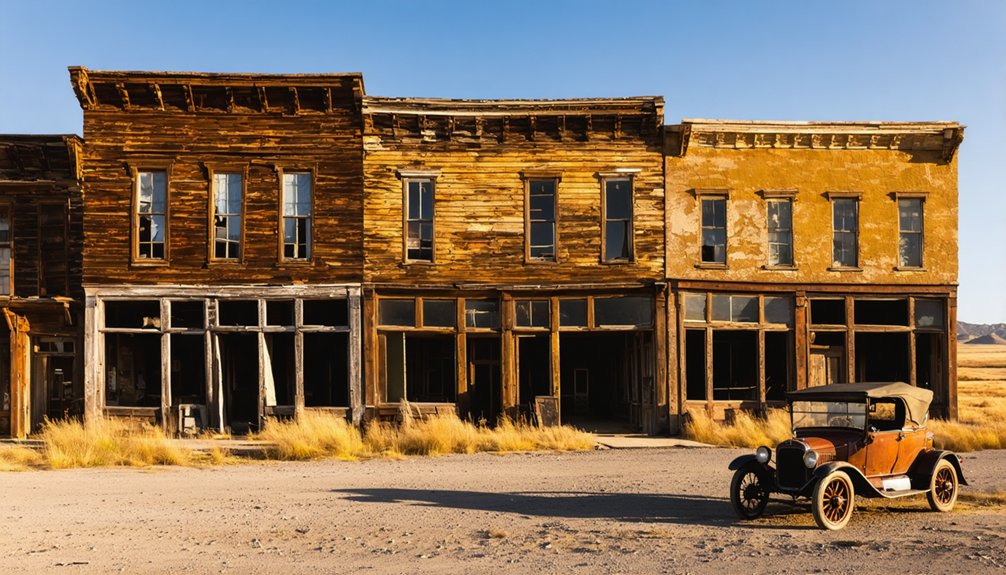
Though decades have passed since residents abandoned these settlements, several Black Hills ghost towns remain remarkably intact and accessible to modern visitors. You’ll find Spokane, founded in 1890, offering significant standing structures along a moderate hiking trail from Spokane Creek Campground. Despite urban legends promising gold, it primarily yielded mica, silver, and graphite.
Beyond the Black Hills, prairie settlements tell different stories. Ardmore‘s abandoned businesses and rusted vehicles earn 4.5 stars on Tripadvisor, while Argonne documents early 20th-century decline after its 1970 abandonment.
Capa’s crumbling structures dot southwestern South Dakota’s landscape, and Conata demonstrates nature’s reclamation—prairie dogs now inhabit former homesteads. These sites invite exploration without restrictions, though haunted tales occasionally surface among visitors documenting their experiences at these historically significant locations.
From Railroad Dreams to Abandoned Streets
Railroad expansion across South Dakota during the 1880s triggered an unprecedented town-building frenzy that ultimately created more communities than the region could sustain. You’ll find evidence of 285 towns platted during those boom years, with 142 established directly by railroad companies chasing profits across the prairie.
The pattern of urban decay followed predictable triggers:
- Detroit dissolved completely when rail lines bypassed it—the general store relocated to Claremont, leaving scattered buildings absorbed into farms.
- White Rock withered after Milwaukee Road’s 1980 abandonment, nearly vanishing by 2024.
- Marshalltown disappeared when 1886 surveys routed tracks elsewhere despite existing infrastructure.
- Stamford became a true ghost town with zero current residents.
Today’s historical preservation efforts face abandoned grades, tunnel remnants near Deadwood, and cattle pen ruins marking where communities once thrived.
Ghost Towns That Still Have Residents
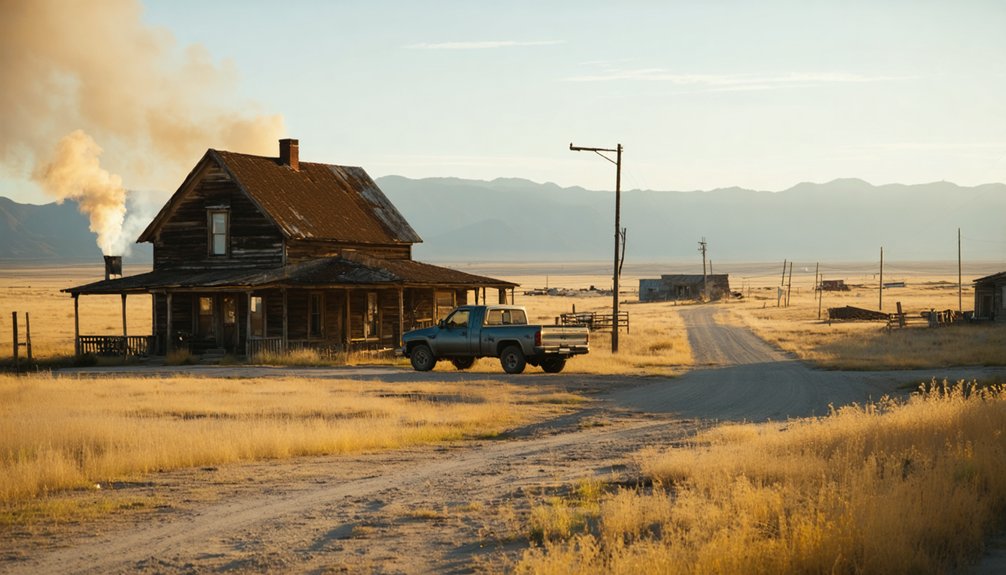
While most ghost towns eventually lose every last inhabitant, some South Dakota communities cling to existence with populations you can count on one hand. Hillsview recorded just 2 residents in 2020 before dropping to zero, while Lowry maintains 3 people despite peaking at 90 in 1940.
South Dakota’s smallest towns defy complete abandonment, clinging to survival with populations measurable on a single hand.
Verdon’s 5 residents represent a stark decline from its 1910 peak of 136, and both Butler and Albee hold steady at 6 inhabitants each.
These near-ghost towns reflect failed railroad dreams and agricultural shifts that reshaped the prairie landscape.
You’ll find preservation efforts remain minimal in communities with single-digit populations, though their cultural heritage persists through maintained post offices or grain elevators.
Butler’s drop from 17 residents held for three decades demonstrates how quickly these settlements can fade into obscurity.
Mapping and Documenting South Dakota’s Lost Communities
Multiple resources catalog South Dakota’s ghost towns through different methodologies, creating a complex web of documentation that varies in scope and precision. You’ll find over 600 ghost towns identified in the Black Hills alone through patient research combining early USGS maps from 1900, field investigations, and old-timer recollections.
Documentation methods include:
- Rating systems from 1-4 based on remaining ghost town architecture and accessibility
- GPS coordinates for viewable sites like Maitland (44.0847,-103.7462)
- Section-township-range locations such as Rockerville in Sections 13-14, T1S, R6E
- Physical evidence cataloging—shaft houses, ore bins, cyanide vats, and mill foundations
Ghost town preservation varies dramatically, from tourist attractions with visible ruins to completely barren sites. Historical societies define qualifying communities as having multiple families, whether villages, mining camps, or railroad sidings.
Frequently Asked Questions
Are South Dakota’s Ghost Towns Safe to Explore on Your Own?
Safety varies wildly—you’ll face crumbling structures, unstable mining shafts, and prairie dog swarms. While haunted legends attract adventurers, preservation efforts remain minimal. Exercise extreme caution, respect property boundaries, and you’re free to explore these decaying remnants at your own risk.
Can You Buy Property in South Dakota’s Abandoned Ghost Towns?
You can potentially buy property in some ghost towns, though land ownership varies considerably. Historical preservation laws, private holdings, and federal restrictions often complicate purchases. You’ll need thorough title research and should verify zoning regulations before attempting any acquisition.
What’s the Best Time of Year to Visit Ghost Towns?
You’ll find late spring through early fall (May-October) ideal for exploring South Dakota’s ghost towns. Seasonal weather remains mild, roads stay accessible, and tourist crowds thin considerably during weekdays, giving you unrestricted freedom to photograph and investigate these historic sites.
Do You Need Permits to Photograph South Dakota Ghost Towns?
You generally don’t need permits for photographing South Dakota’s ghost towns from public property, though historical preservation laws protect certain sites. For tourism development purposes, always respect private land boundaries and check county regulations before exploring abandoned structures.
Which Ghost Town Has the Most Preserved Original Buildings?
Mystic stands out for historical preservation, with several abandoned buildings intact since 1986’s National Register listing. You’ll find the mine manager’s house—occupied until the 1970s—alongside a restored schoolhouse, making it exceptionally well-preserved compared to other South Dakota ghost towns.
References
- https://www.geotab.com/press-release/american-ghost-towns/
- https://www.youtube.com/watch?v=POtU2hFPQsU
- https://en.wikipedia.org/wiki/List_of_ghost_towns_in_South_Dakota
- https://openprairie.sdstate.edu/etd/4061/
- https://b1027.com/haunted-locations-south-dakota/
- https://b1027.com/south-dakota-has-an-abundance-of-ghost-towns/
- https://www.powderhouselodge.com/black-hills-attractions/fun-attractions/ghost-towns-of-western-south-dakota/
- https://www.sdpb.org/rural-life-and-history/2023-08-21/some-black-hills-ghost-towns-and-their-origins
- https://www.blackhillsbadlands.com/blog/post/old-west-legends-mines-ghost-towns-route-reimagined/
- https://blog.batchgeo.com/ghost-towns/