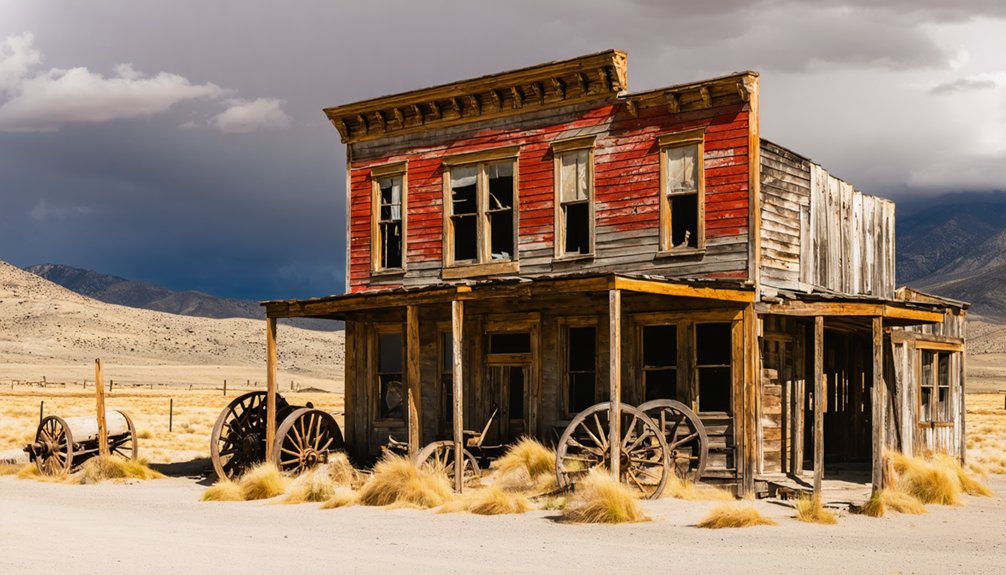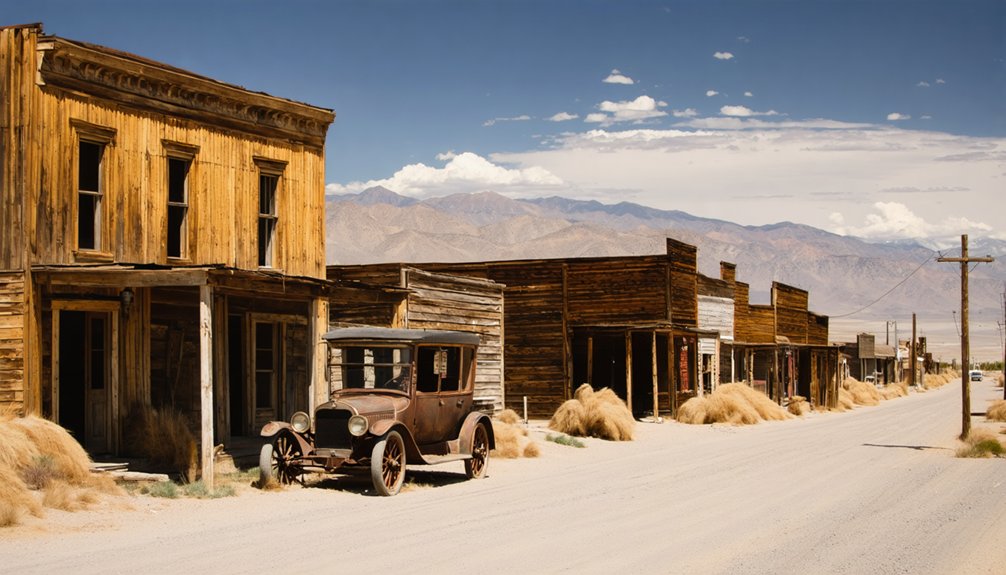
You’ll find between 3,800 and 4,500 ghost towns scattered across the United States, according to extensive mapping projects and documentation efforts. This wide range exists because definitions vary—some sources count only fully abandoned sites, while others include partially vacant communities that’ve lost over 75% of their peak population. Western states like California, Nevada, and Colorado contain the highest concentrations, primarily from 19th-century mining booms. These abandoned settlements span every state, with detailed catalogs maintained by resources like Ghosttowns.com tracking their locations, histories, and current conditions for those seeking deeper insights into America’s forgotten communities.
Key Takeaways
- The United States has between 3,800 and 4,500 ghost towns, with sources identifying over 3,800 mapped and photographed locations.
- No single authoritative count exists due to varying definitions of what qualifies as a ghost town across different sources.
- Nearly 3,824 mining sites across 12 western states alone contributed to ghost town formations through boom-and-bust cycles.
- Texas contains 550 ghost towns from oil boom abandonment, while California has over 240 from historic mining operations.
- Classification varies by criteria including vacancy rates, population decline, and whether absorbed communities are counted as ghost towns.
The Total Count of Ghost Towns Across America
While pinning down an exact number proves elusive, credible estimates place the total count of ghost towns in the United States between 3,800 and 4,500 sites.
Geotab’s research identifies over 3,800 mapped and photographed locations nationwide, while video analyses cite 4,531 abandoned communities at various stages.
You won’t find a single authoritative count because definitions vary widely—some include sites absorbed into newer settlements, while others focus strictly on complete abandonment.
Wikipedia maintains state-by-state lists for all 50 states without providing a centralized total.
Resources like Ghosttowns.com and Ghosttowns.de catalog these abandoned settlements with detailed listings and historical information.
These abandoned communities represent opportunities for cultural preservation and environmental recovery, particularly in mining regions and Dust Bowl-affected areas.
Modern ghost towns emerge from economic decline in cities like Detroit and Flint, where vacancy rates exceed 20% and neighborhoods have lost over a quarter of their population since 2010.
The lack of standardized criteria means you’re steering through estimates rather than definitive census data when exploring America’s forgotten settlements.
States With the Highest Concentrations of Abandoned Communities
Texas dominates the ghost town landscape with 511 abandoned communities—nearly 50% more than its nearest competitor. California follows with 346 abandoned settlements, while Kansas holds 308.
You’ll find significant regional clustering: Kern County, California alone contains 113 ghost towns, the nation’s highest county-level concentration.
Mining heritage drove most abandonments. Montana, Nevada, and Colorado each host over 99 ghost towns tied to extractive industries.
Colorado’s St. Elmo exemplifies historical preservation efforts from its 1880 founding.
Pennsylvania’s 105 include Centralia, evacuated after a 1962 coal fire.
Eastern states show minimal abandonment—Rhode Island has just one ghost town.
Washington state features 116 ghost towns, including Monte Cristo abandoned by 1907 due to repeated flooding that devastated the mining operations.
This geographic disparity reflects western settlement volatility versus northeastern stability, creating opportunities for community revitalization where economic conditions permit restoration efforts. These abandoned settlements serve as tangible links to America’s dynamic past, offering educational insights into historical infrastructure and development patterns.
What Defines a Ghost Town in Modern Times
While you might expect a universal threshold for classifying ghost towns, modern definitions vary markedly across organizations and researchers. Ghost Town USA’s classification system establishes five categories based on building remains and population levels, ranging from sites with no structures to semi-ghost towns with reduced but active populations.
According to contemporary standards, a settlement’s shift to ghost town status depends more on the ratio of abandoned-to-occupied structures and the loss of its original economic purpose than on reaching a specific population number. The lack of a widely accepted formal definition means ghost towns are primarily implied by the presence of remaining or partly remaining buildings rather than strict population criteria. Researcher T. Lindsay Baker emphasizes that ghost towns should be publicly accessible and evenly distributed across geographic regions for proper documentation and study.
Population Decline Thresholds
Defining a ghost town in modern times involves more nuanced population thresholds than the stereotypical image of a completely deserted settlement might suggest. You’ll find that complete abandonment isn’t required—many of the 4,531 U.S. ghost towns maintain skeleton populations or part-time residents.
Oregon’s definition exemplifies this flexibility: an incorporated city lacking sufficient electorate to fill governmental offices qualifies, regardless of actual headcount. The key threshold isn’t zero residents but rather significant decline from former commercial prominence.
Research documents 102 U.S. ghost towns with residual populations, while urban preservation efforts recognize sites like South Pass City despite continued activity. Texas requires public access and visible remains for inclusion, emphasizing architectural significance over pure desertion.
You’re witnessing towns where economic viability ceased, even if stubborn residents remain. These deserted settlements contain evidence of infrastructure and remaining buildings that reveal their former purpose, distinguishing them from sites that were simply never developed. Streets and roads are often still observable, providing clear evidence of previous human activity and the settlement’s original layout.
Vacancy Rate Measurements
Modern vacancy rate measurements reveal that ghost towns exist on a spectrum rather than conforming to binary occupied-or-abandoned classifications.
You’ll find these sites categorized through tangible metrics that assess both structural integrity and population loss.
Expedition Utah’s classification system demonstrates this nuance, ranging from completely barren landscapes to semi-abandoned settlements.
The measurement criteria include:
- Class 4 settlements with 75%+ buildings vacant and populations below 10% of boom levels
- Physical remains visibility, from nearly intact structures to archaeological foundations
- Service loss indicators like post office closures and unincorporated status changes
- Remote access considerations affecting both preservation and documentation feasibility
- Population thresholds under 400 residents with minimal active structures
These metrics allow you to identify ghost towns objectively while acknowledging sites maintain skeleton populations or caretaker presence.
Classification systems also incorporate the town’s original historical purpose, distinguishing between mining operations, railroad settlements, military installations, logging camps, and agricultural communities to provide context for their decline patterns.
The transportation infrastructure changes that bypass former settlements through rerouted highways or abandoned railroad lines frequently accelerate the classification of marginal communities into ghost town status.
Economic Forces Behind Mass Abandonment
You’ll find that economic forces create ghost towns through three distinct patterns of collapse. Resource extraction industries—particularly mining and oil—generated the most dramatic abandonments, with southwestern oil towns losing up to 90% of their 25,000-person populations when reserves depleted.
Mining communities like Cripple Creek and Leadville experienced complete exodus after mineral exhaustion.
Agricultural depressions and modern urban decay have since replicated these boom-bust cycles, as evidenced by Sunbelt cities experiencing Rustbelt-like vacancy rates following the subprime crisis and 1.3 million vacant U.S. homes recorded in Q4 2023.
Mining and Oil Collapse
While ghost towns evoke romantic images of weathered saloons and dusty Main Streets, their creation followed brutal economic patterns driven by resource extraction.
You’ll find nearly 3,824 historical mining sites across twelve western states where gold and silver discoveries triggered explosive urbanization, only to collapse when ore depleted.
Mining relics scattered across Arizona, Colorado, and Nevada tell stories of boom-bust cycles that destroyed communities within decades.
Key collapse mechanisms included:
- Support businesses failing immediately as laborers fled depleted sites
- Over 100,000 idle oil and gas wells now abandoned across Texas and New Mexico
- Statistical models predicting 13,000 additional well abandonments requiring nearly $1 billion in cleanup
- Environmental impacts from orphaned wells creating long-term state cleanup burdens
- Towns like Castle Dome losing 2,000+ residents when silver ore quality declined
Agricultural Depression Era Decline
When corn prices plummeted from $1.30 per bushel in 1919 to just $0.47 in 1920—a catastrophic 63 percent collapse—American farming communities entered a death spiral that would devastate rural populations for over a decade.
You’ll find that 60 of every 1,000 farmers lost their farms between 1920–1934, with Iowa surrendering half its family farms to foreclosure.
Land values crashed to $35 per acre while property taxes tripled from forty-six cents to $1.45 per acre in Minnesota, creating an impossible squeeze.
Before agricultural policies and farm subsidy programs emerged, this economic devastation triggered a cascade effect: for every four failed farms, one rural business shuttered.
The combination of crushing debt, environmental collapse, and absent government intervention transformed thousands of thriving agricultural communities into abandoned ghost towns across America’s heartland.
Modern Urban Economic Decay
The economic forces that decimated agricultural communities in the 1920s now play out in America’s urban centers, where 1.3 million homes sat vacant in Q4 2023—representing 1.27% of all U.S. properties. You’ll find 44 ZIP codes classified as modern ghost towns, where population decline intersects with economic collapse. East Saint Louis exemplifies this decay: median home values at $44,600 versus $239,100 statewide, with 15.1% vacancy rates.
Critical Economic Indicators:
- San Francisco lost 60,000+ residents (2020-2023) amid affordability crises
- Business travel dropped 30-40% in major metros, triggering hotel bankruptcies
- Detroit rental vacancies reached 19.9%; Las Vegas hit 16%
- 26 ZIP codes show 20%+ population decline with values 14-80% below state medians
- Community resilience through green revitalization offers recovery pathways
Census data confirms national rental vacancy at 10.1%, homeowner vacancy at 2.9%.
The Dust Bowl’s Lasting Impact on Great Plains Settlements
Between 1930 and 1940, environmental catastrophe reshaped the Great Plains in ways that would permanently alter its settlement patterns. The Dust Bowl devastated 16 million acres across Texas and Oklahoma panhandles, with farmers losing 480 tons of topsoil per acre.
You’ll find that 100 million acres became potentially unproductive forever.
This farming decline triggered massive population shifts—2.5 million people abandoned southern and Great Plains farms, while total population fell 3-7% across five central Plains states.
By 1936, 21% of rural families required federal relief, reaching 90% in hardest-hit counties.
Per-acre farmland values plummeted 28% in high-erosion areas, and communities never recovered.
Most migrants moved internally from devastated counties to less-affected regions, permanently depopulating entire settlements that would become ghost towns.
Urban Decline and Contemporary Vacant ZIP Codes
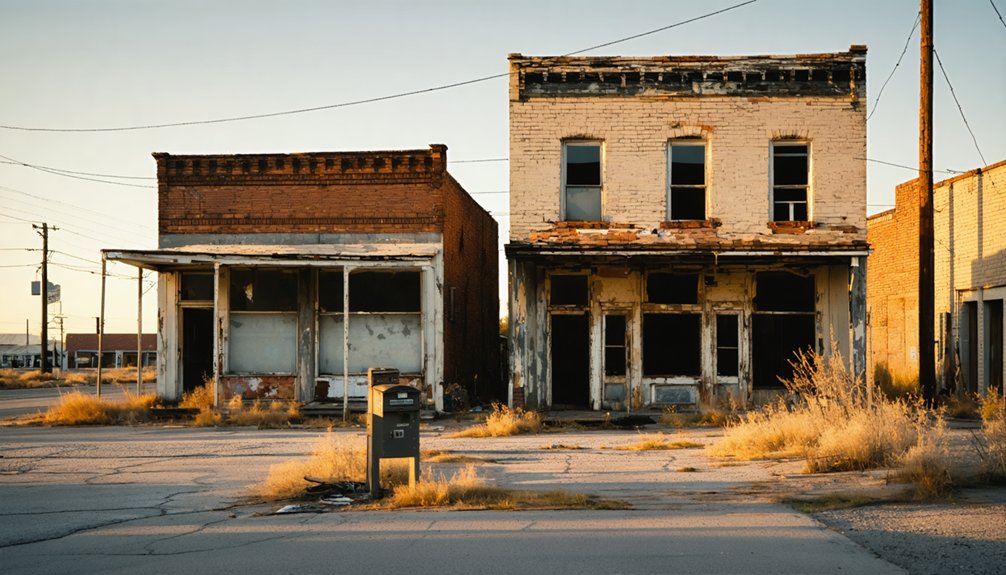
While historical forces like the Dust Bowl created ghost towns through agricultural collapse, modern America faces urban abandonment driven by economic restructuring and demographic shifts.
Today’s ghost towns emerge not from failed harvests but from collapsing industries, leaving entire neighborhoods vacant in America’s once-thriving cities.
As the remnants of these forgotten places beckon, many adventurers and photographers find themselves exploring abandoned towns in California. Each location tells a story of prosperity turned to desolation, with crumbling buildings and rusting machinery serving as haunting reminders of a different era. This unique exploration not only captures the beauty of decay but also ignites a sense of nostalgia for the lives once lived in these now-silent communities.
Urban decay now manifests through vacant properties concentrated in specific regions, with over 2,000 declining ZIP codes identified across metropolitan areas.
Contemporary patterns reveal:
- Population hemorrhaging: San Francisco lost 7.4% of residents (2020-2023), followed by St. Louis at 6.6% and Jackson, MS at 6.5%
- Vacancy concentrations: Lakeland, FL holds 1.6% homeowner vacancy rate; Baton Rouge records 1.5%
- Regional shifts: Suburban areas showed 2,333 declining ZIP codes (2006-2009), up 42.8% from previous period
- Market stagnation: Fort Myers homes sit 62 days on market; Denver listings exceed 15,000 with 52% experiencing price cuts
- Long-term abandonment: New Orleans reports 29% of vacant homes empty two-plus years
Famous Abandoned Sites and Historic Structures
Scattered across America’s landscape, dozens of preserved ghost towns offer tangible connections to the nation’s boom-and-bust economic cycles, with sites like Bodie, California maintaining 110 frontier-era structures in a state of “arrested decay.” These abandoned communities represent distinct historical phenomena—gold rush speculation, extractive industry collapse, and transportation route obsolescence—that transformed thriving settlements into vacant relics within decades.
Historical preservation efforts demonstrate the cultural significance of these sites. You’ll find Elkmont Historic District‘s 60 buildings within Great Smoky Mountains National Park, while Bannack, Montana’s structures recall 1860s mining violence.
Kennecott Mine in Alaska showcases industrial heritage, and St. Elmo, Colorado exemplifies boom-town ephemera. These locations provide unmediated access to America’s economic experimentation, allowing you to explore authentic frontier conditions without bureaucratic interpretation.
Ghost Towns Finding New Life Through Tourism
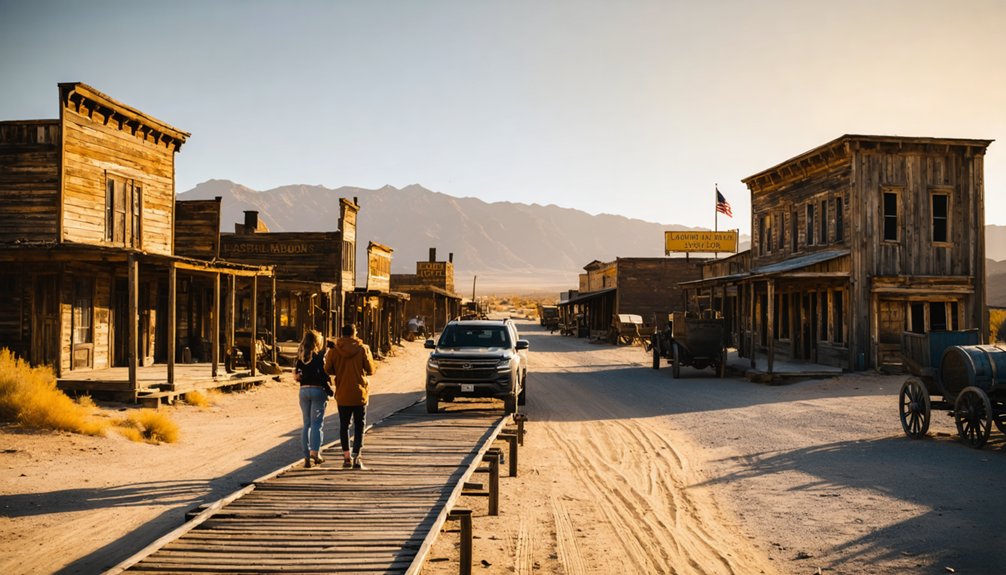
Economic reinvention has transformed America’s ghost towns from symbols of abandonment into revenue-generating heritage destinations, with tourism now sustaining communities that mining collapses had left for dead.
Tourism breathes new life into forsaken mining towns, transforming economic decay into profitable preservation across America’s frontier landscape.
Park City exemplifies community revitalization, rebounding from 1,366 residents in 1960 to over 8,000 today after Treasure Mountain Resort‘s 1963 opening created opportunities for displaced miners. The town now hosts 600,000 annual visitors and the 2002 Winter Olympics.
Cultural preservation drives success across multiple states:
- Texas leads with 550 ghost towns, many from the 1901 Spindletop oil boom
- California hosts 240+ sites tied to 1880s mining expansion
- St. Elmo, Colorado attracts summer tourists to well-preserved 1880s structures
- Fort Jefferson, Florida operates as a National Monument since 1935
- Over 3,800 documented sites nationwide offer tourism potential
Heritage tourism has granted second chances to abandoned communities in all 50 states.
Property Values and Demographics in Declining Areas
Unlike historic ghost towns that emptied suddenly through resource depletion, today’s declining areas face gradual abandonment driven by property value erosion and demographic shifts.
Real estate trends show Cape Coral–Fort Myers projected to decline 9-11% due to overdevelopment and insurance costs, while North Port–Sarasota–Bradenton expects 8-9.5% drops from cooling migration.
Texas markets including Austin and San Antonio face languishing homes as remote workers relocate elsewhere.
Demographic shifts accelerate as coastal Florida markets experience return migration from insurance pressures, while climate-driven moves from vulnerable areas like Altadena to Santa Monica redistribute populations.
Reduced tax bases in high-risk areas exacerbate inequality for remaining residents.
Nationally, half of U.S. cities saw year-over-year price drops, with markets like Orlando down 4.2% and Jacksonville declining 2.7%.
Frequently Asked Questions
Can You Legally Explore or Visit Ghost Towns in the United States?
Peeling back layers of time, you’ll find hidden histories legally accessible at public ghost towns like Bodie, California, and Death Valley sites. These tourist attractions welcome exploration, though private properties require owner permission per state trespassing laws.
Who Owns the Land Where Ghost Towns Are Located?
Ghost town ownership rights vary by land classification—you’ll find federal agencies controlling western sites, states preserving notable camps, private owners holding Texas ranches with hundreds of ruins, and counties managing local clusters throughout Great Plains regions.
Are Ghost Towns Dangerous to Visit Due to Unstable Structures?
Like downloading a virus onto your adventure, you’ll face real structural hazards at ghost towns—rotting floors, collapsing roofs, and toxic materials threaten visitors. Take safety precautions: avoid entering buildings, as 3,800+ documented sites contain unmonitored dangers.
Can You Buy Property or Buildings in a Ghost Town?
You can buy ghost town property through auctions, tax sales, or private negotiations with current owners. Historical preservation restrictions may limit modifications, but buyer opportunities exist for restoration projects, tourism ventures, or alternative development meeting local regulations.
What Happens to Ghost Town Artifacts and Historical Items Found There?
You’ll find ghost town artifacts protected by federal and state laws prohibiting historical artifact removal without permits. Ghost town preservation requires proper documentation and handling, as unauthorized collection constitutes theft of cultural resources under the Archaeological Resources Protection Act.
References
- https://www.loveexploring.com/gallerylist/131658/abandoned-in-the-usa-91-places-left-to-rot
- https://247wallst.com/housing/2024/04/11/americas-modern-ghost-towns-2/
- https://en.wikipedia.org/wiki/Lists_of_ghost_towns_in_the_United_States
- https://www.youtube.com/watch?v=u1KkAEZYqZY
- https://www.geotab.com/ghost-towns/
- https://joybird.com/blog/top-ghost-towns-in-america/
- https://www.youtube.com/watch?v=aTbMdOZRZO4&vl=en
- https://www.geotab.com/press-release/american-ghost-towns/
- https://www.loveexploring.com/gallerylist/188219/the-us-state-with-the-most-ghost-towns-revealed
- https://www.youtube.com/watch?v=9sqf1Ayk3N0