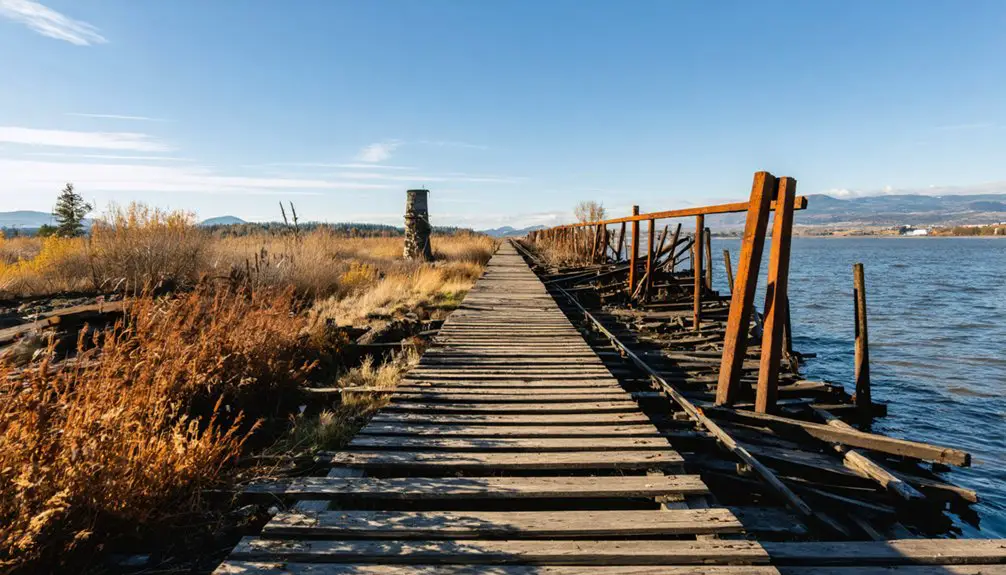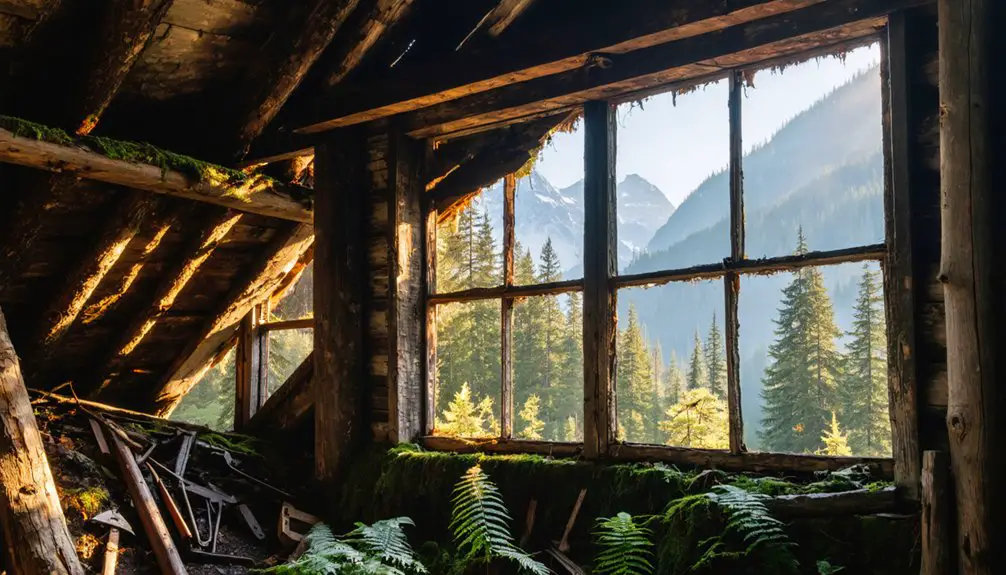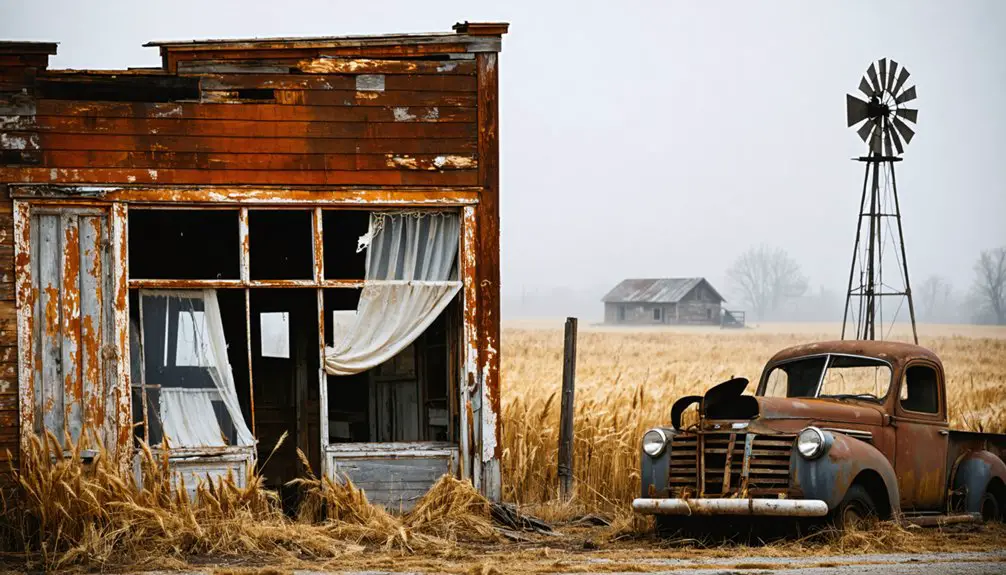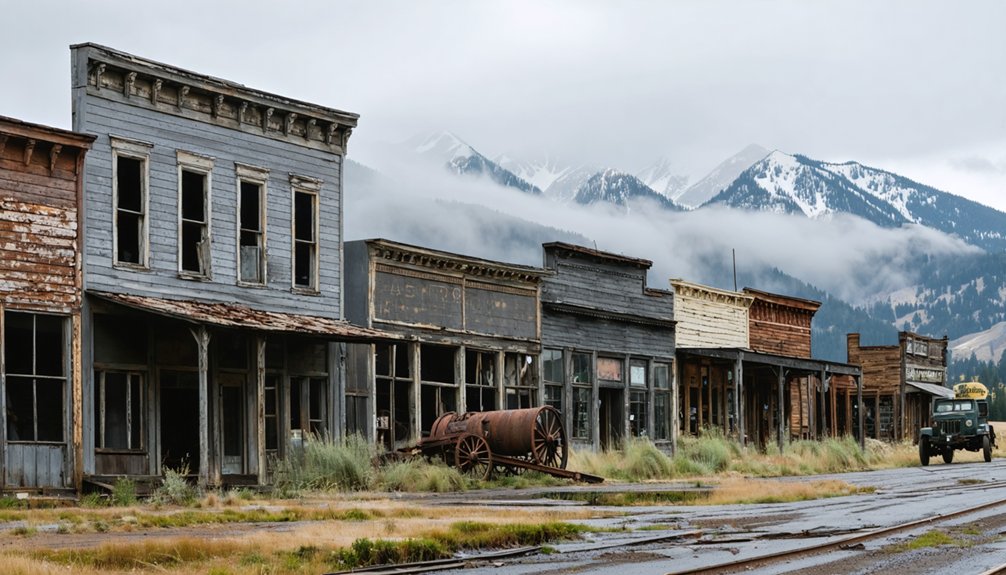
Washington State contains approximately 116 documented ghost towns, though you’ll find estimates ranging from 110 to over 130 depending on how strictly abandonment is defined. These settlements emerged primarily during the late 1800s and early 1900s as mining camps, railroad terminals, and agricultural communities before being abandoned due to exhausted ore deposits, transportation shifts, and economic decline. King County leads with 16 documented sites, while notable concentrations appear throughout Eastern Washington, the Columbia Plateau, and the Cascade regions, each reflecting distinct patterns of settlement and collapse that shaped the state’s frontier history.
Key Takeaways
- Washington State has approximately 116 documented ghost towns, ranking 25th nationwide in total number of abandoned settlements.
- Total estimates exceed 130 ghost towns depending on sources and definitions used to classify abandoned or semi-abandoned sites.
- King County leads with 16 ghost town sites, followed by clusters in Lewis, Pierce, Whitman, and Eastern Washington regions.
- Most ghost towns originated in the late 1800s to early 1900s as mining camps, railroad stops, or agricultural communities.
- Notable preserved sites include Liberty, Monte Cristo, Molson, and Nighthawk, offering various levels of accessibility and historical structures.
The Total Number of Ghost Towns Documented Across Washington State
Washington State harbors 116 documented ghost towns** scattered across its diverse terrain, placing it 25th among all U.S. states in this haunting metric. You’ll find these abandoned settlements** documented through multiple sources, including Geotab’s exhaustive mapping project and BatchGeo’s nationwide database of over 4,000 locations.
Washington’s 116 ghost towns rank 25th nationally, their stories preserved through comprehensive mapping databases documenting thousands of abandoned settlements.
King County leads with 16 sites, while Lewis, Pierce, and Whitman counties host numerous others. These remnants of urban decay tell stories of gold rush failures, railroad abandonment, and fire devastation.
Post office records track their rise and fall—like Mendota‘s brief 1909-1923 existence. Some sources count over 130 sites statewide, though documentation varies by definition. Many of these settlements originated as train terminuses that attracted workers and fortune seekers during periods of expansion. Washington’s ghost towns reflect the broader pattern of industry or agricultural failure that created thousands of abandoned settlements nationwide.
Architectural preservation efforts continue capturing these fragments of Washington’s frontier past before nature reclaims them entirely.
Famous Ghost Towns Worth Visiting in Washington
Washington’s ghost towns span from 1870s Gold Rush settlements to early 1900s mining operations.
Locations like Liberty earned National Register designation in 1974 and Monte Cristo attracts visitors via an 8-mile roundtrip hike from Barlow Pass.
You’ll find varying levels of preservation, from Ruby’s remaining stone foundations and Nighthawk’s intact hotel and schoolhouse to Claquato’s fully restored 1850s church with its original bell.
Access ranges from roadside stops at Sherman’s open terrain ruins to moderate trails like the 2.5-mile Franklin railroad grade and the half-mile path to Copper City’s collapsed structures. Molson’s old schoolhouse museum operates from Memorial Day to Labor Day with volunteer staff showcasing pioneer artifacts and farm machinery. The Enloe Dam offers a picturesque stop on the National Register of Historic Places, resembling a natural waterfall near these historic mining sites.
Historic Mining Towns
Scattered throughout the Cascade Mountains and Okanogan County, Washington’s historic mining towns tell the story of boom-and-bust cycles that shaped the state’s development from the 1860s through the early 1900s.
You’ll find Nighthawk, dating to the 1860s, with its 1903 mill still standing after serving six concentration operations.
Liberty, originally called Meaghersville, became the state’s oldest mining town east of Cle Elum during the 1870s Gold Rush.
Monte Cristo boomed in the 1890s before abandonment by 1907.
Ruby City once housed six general stores and served as county seat for eleven months.
Copper City served as the center of mining claims from 1907 to 1942, where prospectors planned but never completed a railroad connection to transport ore from the mountain operations.
While these Washington towns declined, other western mining communities like Aspen and Telluride reinvented themselves as ski resorts, transforming from abandoned camps into thriving tourist destinations.
These sites now balance tourism development with minimal environmental impact, letting you explore authentic structures and equipment without modern interference—preserved proof of prospectors who chased freedom through mineral wealth.
Accessibility and Trail Information
While these mining settlements preserve Washington’s extractive heritage, reaching them requires varying degrees of physical effort and route planning. You’ll find Ruby, Nighthawk, and Old Molson accessible via Okanogan County’s rural roads, demanding no hiking—just drive directly to foundations, standing hotels, and mining equipment scattered across open sites. These locations exemplify urban decay through weathered structures and relic preservation at ground level.
Monte Cristo demands more commitment: you’ll hike eight miles roundtrip from Barlow Pass, following a closed road east of Granite Falls with minimal elevation change. Franklin offers middle ground—a 2.5-mile trail gaining just 200 feet along an old railroad grade near Mount Rainier.
Molson operates as an open-air museum with well-preserved structures including the 1896 assay office, homesteads, and a large schoolhouse that remained functional until 1969.
Each site presents different access challenges, from casual roadside stops to backcountry treks through Washington’s extractive past.
Preservation and Current Conditions
Among Washington’s abandoned settlements, preservation success varies dramatically based on community advocacy and geographic isolation.
Since 1960, local efforts transformed Molson into the state’s best-preserved ghost town, maintaining it as a free open-air museum with intact offices, farming equipment, and bank buildings.
You’ll find Liberty added to the National Register of Historic Places in 1974, still functioning as a living ghost town with remaining residents.
Claquato’s church underwent restoration in the 1950s before receiving national recognition.
The Washington Trust’s annual Most Endangered Places list, established in 1992, highlights the cultural significance of threatened properties.
Meanwhile, Monte Cristo represents environmental impact on neglected sites—accessible only via an 8-mile hike through rusty remnants until its post office closed in 1983.
Penawawa’s cemetery was relocated due to Little Goose Dam construction, illustrating how infrastructure projects have physically altered ghost town sites.
The brick schoolhouse operates as a museum during summer months, where visitors can explore historical classroom tours and gain insights into the town’s educational past.
Where to Find Washington’s Abandoned Towns by Region
Washington’s ghost towns cluster into five distinct regions, each offering unique access points and historical contexts. In Eastern Washington, you’ll find railway towns like Govan (1889) and Sherman along Highway 2, while Almota marks where creek meets Snake River.
Eastern Washington’s Highway 2 corridor preserves railway heritage through abandoned settlements where 19th-century commerce once thrived along strategic transportation routes.
Central Washington features Chesaw’s gold-boom remnants and former post office towns like Winesap (1909-1944).
The Northern Cascades showcase Northern State’s 5-mile trail north of Highway 20, where mental hospital foundations face preservation challenges. Mount Rainier‘s southwestern slopes hide Franklin’s 2.5-mile cemetery trail and Monte Cristo’s 8-mile trek to 1890s mining ruins.
The Southeastern Columbia Plateau holds White Bluffs—established 1861, abandoned 1943—and Alderdale along State Route 14, where local legends persist despite abandonment. Collectors can reference historical maps from 1883 to trace original ghost town locations across the region.
Why These Towns Were Abandoned Throughout History
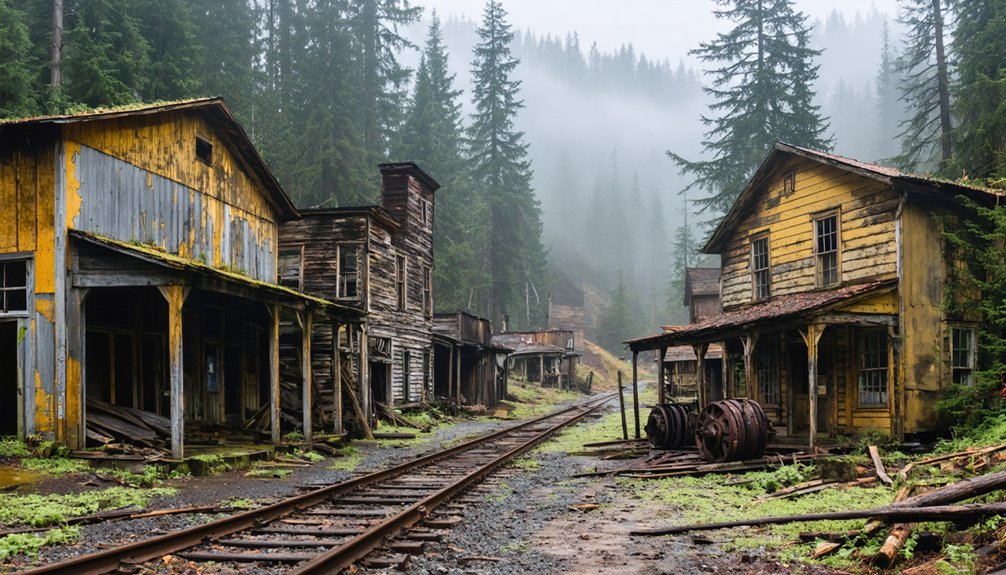
The mining industry’s collapse stands as the primary catalyst behind Washington’s ghost town phenomenon, with exhausted ore deposits forcing entire communities into obsolescence between the 1890s and 1940s.
You’ll find Monte Cristo’s funding crisis ended its boom by 1907, while Wakanda’s mines declined after supporting over 1,000 residents. Copper City’s 42 claims ceased operations in 1942 without railroad access.
Transportation shifts accelerated urban decay throughout the state. When railroads converted from steam to diesel in 1918, Melmont’s coal operations became obsolete.
Moncton disappeared entirely in 1915, submerged beneath Rattlesnake Lake. Economic decline struck Northern State Mental Hospital‘s 700-acre complex, closing in 1976.
Devastating fires compounded these challenges—Melmont burned during the 1920s, while wooden mining structures across Washington succumbed to flames, accelerating abandonment.
How to Access and Explore These Ghost Town Sites Today
Accessing Washington’s ghost towns requires varied approaches depending on location and terrain preservation. You’ll find eastern sites like Govan and Sherman off Highway 2, where you can drive directly to 1889-era ruins and explore freely among structures tied to urban legends of unsolved murders.
In addition to Govan and Sherman, you can also explore ghost towns in Washington like Bodes and Waldo, where remnants of once-thriving communities tell stories of the past. Many of these sites offer scenic hiking trails, allowing you to appreciate the natural beauty alongside historical artifacts. Make sure to bring along a camera to capture the haunting yet captivating landscapes that surround these abandoned places.
Monte Cristo demands more effort—an 8-mile roundtrip hike from Barlow Pass follows century-old miner paths to 1890s equipment and buildings.
Northern Chesaw sits 30 minutes from Oroville, showcasing cultural significance through remnants of its Chinese mining heritage and boom-era saloons.
Use resources like AbandonedWashingtonState.com and Proxi.co interactive maps for navigation.
Most locations impose no entry fees or restrictions, letting you wander abandoned schoolhouses, cemeteries, and mining operations at your own pace across open terrain.
Preservation Efforts and Current Conditions of Washington’s Ghost Towns
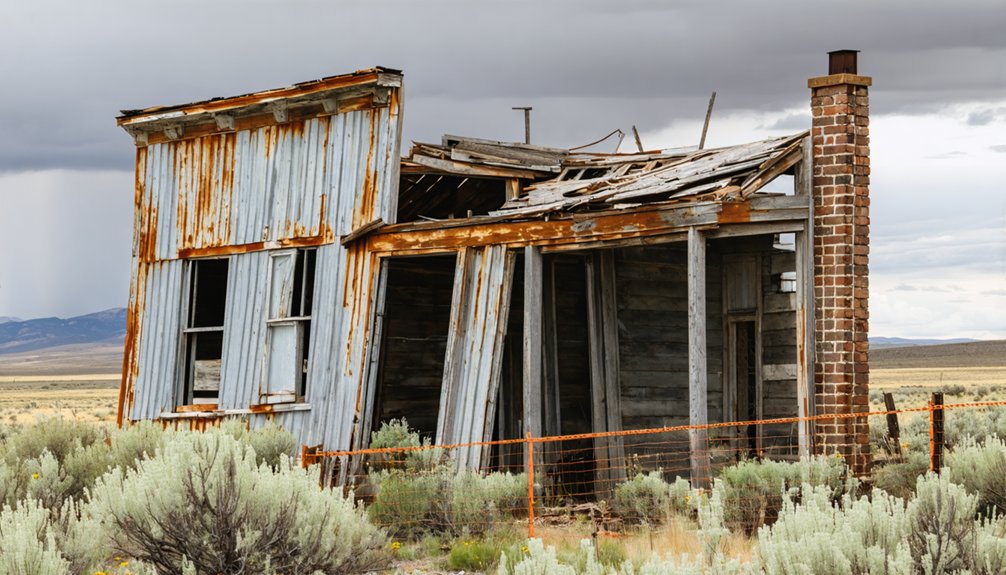
While exploring these abandoned settlements reveals their physical accessibility, understanding what protects them from complete disappearance requires examining formal preservation measures and on-the-ground realities.
You’ll find Liberty and Claquato’s church earned National Register of Historic Places status in 1974 and the 1950s respectively, securing their historical significance. The Washington Trust for Historic Preservation has maintained an annual Most Endangered Places list since 1992, accepting year-round nominations for threatened properties.
However, urban decay persists—many sites exist as “little more than ruins.” Monte Cristo retains rusty equipment and abandoned structures, while Claquato survives through just two landmarks.
Documentation efforts now employ technology to preserve these forgotten places before they vanish completely. You’re witnessing a race against demolition, neglect, flooding, and environmental degradation threatening Washington’s remaining ghost town heritage.
Frequently Asked Questions
Are Ghost Town Artifacts Legal to Take or Must They Stay On-Site?
You’d *love* taking souvenirs, but artifacts legality remains murky in Washington’s ghost towns. Preservation ethics strongly discourage removal—those rusty relics at Monte Cristo and crumbling foundations elsewhere survived decades precisely because visitors left history untouched for future explorers.
What Safety Hazards Exist When Exploring Abandoned Mining Towns in Washington?
You’ll encounter hazardous unstable structures like collapsed buildings from 1907-1942 operations and sealed mine shafts with entry risks. Environmental contamination risks from century-old mining chemicals persist, while log crossings, unmarked shafts, and deteriorating foundations threaten your exploration freedom.
Do Any Washington Ghost Towns Allow Overnight Camping or Lodging Nearby?
You’ll find camping near several Washington ghost towns—Monte Cristo offers dispersed forest sites after an 8-mile hike, while Northern State Recreation Area provides designated campgrounds. These historic preservation sites balance tourist attractions with overnight access, letting you explore freely on multi-day adventures.
Which Ghost Towns Require Special Permits or Permissions Before Visiting?
You’ll need permits for most Washington ghost towns due to private land ownership and preservation laws. Clay City, Port Blakely, and Devil’s Tower require owner permission, while national park sites like Melmont demand entrance fees and wilderness permits before exploration.
Are There Guided Ghost Town Tours Available in Washington State?
No commercial guided tours operate at Washington’s ghost towns—you’ll explore independently. Self-guided trails at Franklin, Monte Cristo, and Northern State let you discover historical preservation sites freely. YouTube virtual tours offer ghost town photography previews before you visit these abandoned locations.
References
- https://www.youtube.com/watch?v=fHHqtYhmz5w
- https://roadsrus.wordpress.com/2023/04/18/washington-ghost-towns/
- https://en.wikipedia.org/wiki/List_of_ghost_towns_in_Washington
- https://stateofwatourism.com/ghost-towns-of-washington-state/
- https://www.wta.org/go-outside/seasonal-hikes/fall-destinations/hidden-history-ghost-town-hikes
- https://www.geotab.com/ghost-towns/
- https://www.ghosttownsofwashington.com
- https://www.abandonedwashingtonstate.com/ghost-towns.html
- https://blog.batchgeo.com/ghost-towns/
- https://www.loveexploring.com/gallerylist/188219/the-us-state-with-the-most-ghost-towns-revealed