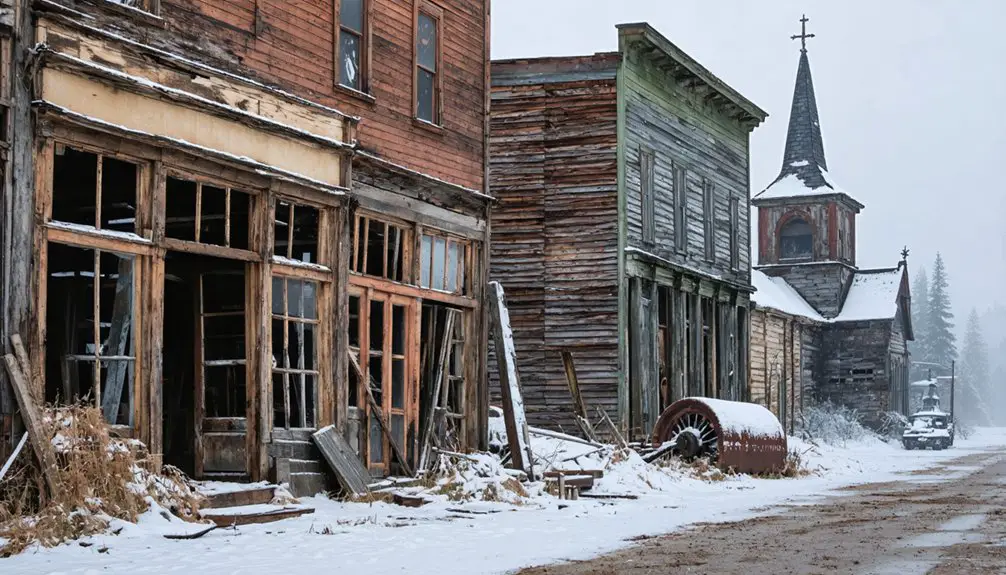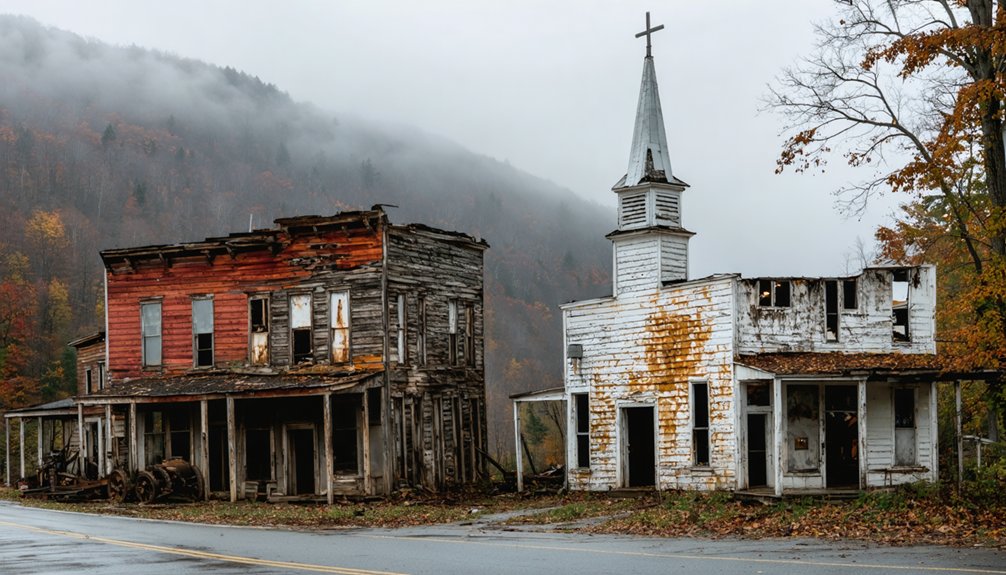
You’ll find between 50 and 70 documented ghost towns scattered across West Virginia, with authoritative sources like Wikipedia cataloging over 60 abandoned settlements. Fayette County alone contains nine ghost towns within a 12-mile New River Gorge stretch, while Charleston’s vicinity hosts eleven such sites. These numbers vary based on classification criteria—whether partially intact structures or fully abandoned communities count—with some lists including submerged towns like Gad beneath Summersville Lake. The concentration reflects coal industry decline, company town abandonment, and railroad evolution that shaped Appalachia’s industrial landscape throughout the 19th and 20th centuries.
Key Takeaways
- West Virginia has approximately 50-70 documented ghost towns, with authoritative sources listing between 21 and over 60 abandoned settlements statewide.
- Fayette County contains nine ghost towns within a 12-mile stretch of New River Gorge, making it a concentrated area of abandoned settlements.
- Charleston area has eleven ghost towns within roughly 50 miles, while McDowell County features multiple coal-era remnants from the mining industry.
- The 465 coal company towns built in southern coalfields contributed significantly to ghost town formation after mines closed and resources depleted.
- Notable accessible ghost towns include Nuttallburg, Kaymoor, Thurmond, Winona, and submerged Gad beneath Summersville Lake with preserved infrastructure.
The Numbers Behind West Virginia’s Abandoned Settlements
Determining the exact number of ghost towns in West Virginia presents a significant challenge due to inconsistent definitions and documentation methods across various sources.
You’ll find reports ranging from 21 to 69 abandoned settlements statewide, with exhaustive databases like Wikipedia and Kiddle enumerating over 60 distinct entries.
These discrepancies stem from varying criteria: some sources count only complete abandonment, while others include sites with partial remains or ghost town architecture still visible against natural landscapes.
Fayette County holds the highest concentration with nine documented locations, followed by McDowell County’s multiple sites.
The variation reflects whether compilers include submerged towns like Gad and Stiltner, industrial remnants, or semi-preserved settlements like Thurmond.
Many of these abandoned settlements were former coal mining communities that declined when the industry collapsed.
The boom and bust cycles characteristic of West Virginia’s mining industry directly created and destroyed numerous settlements throughout the state’s history.
Collectively, approximately 50-70 towns appear across authoritative lists with partial overlaps.
Why Coal Mining Created and Destroyed Entire Communities
You’ll find that coal mining’s inherent volatility—from rapid extraction booms to sudden seam depletion—created settlements that materialized around productive veins and vanished when resources expired.
Coal companies constructed entire towns like Peytona (established 1858 with $110,000 investment) and Thomas/Coketon (developed from 1884). They wielded complete economic, social, and legal control over miners and their families through company-owned housing, stores, and infrastructure. Miners were paid in coal scrip redeemable only at company-owned stores, further entrenching corporate control over daily life.
When seams depleted or newer technologies rendered operations obsolete—as occurred with Thomas/Coketon’s coke ovens by 1915 and its last underground mine closure in 1956—companies abandoned these communities.
The Civil War devastated the region’s coal infrastructure, with military actions destroying salt works and a flood in 1861 damaging critical transportation sluices along the Coal River.
This left behind ghost towns across Boone, Kanawha, and Tucker counties.
Boom-and-Bust Mining Cycles
Throughout West Virginia’s nearly 150-year coal industry history, the state’s mining communities rose and fell with dramatic swings in employment that created entire towns during boom periods and abandoned them during busts.
You’ll find that employment peaked at 130,457 jobs in 1940, then plummeted to just 19,427 by 2013—an 85% decline.
Between 2008 and 2017 alone, more than 760 mines ceased operations as the industry contracted from 1,435 to 671 active sites.
These economic shifts triggered severe urban decline, transforming once-prosperous communities into ghost towns like Thurmond, Matewan, and Lake Shawnee.
The pattern repeated across generations: operators opened mines, workers flooded in, towns materialized—then when seams exhausted or markets collapsed, everyone departed, leaving abandoned infrastructure across approximately 173,000 acres of former mining lands.
Towns like Whitesville along Route 3 exemplify this decline, with abandoned storefronts and darkened traffic lights marking the transition from mining prosperity to economic distress.
The employment collapse devastated state revenues, with coal severance taxes dropping from over $300 million in 2010 to about $200 million in 2020, reducing funding for schools and public services that once sustained these communities.
Company Towns and Control
The boom-and-bust pattern that emptied mining communities didn’t operate through market forces alone—coal operators engineered a system of total dependence by constructing entire towns from scratch. Starting in the 1880s, companies built 465 settlements in West Virginia’s southern coalfields, housing 80 percent of miners by 1922.
These unincorporated coal communities lacked elected officials or independent police—operators hired private detectives instead. You’d find company control extending beyond housing: wages paid in scrip bound workers to company stores, eliminating competition.
The system varied dramatically—some towns offered indoor plumbing and recreation facilities, while others remained filthy and repressive. Housing arrangements reinforced social hierarchies, with superintendents’ elaborate homes positioned prominently while Black miners and immigrants occupied less desirable areas farther from town centers.
This economic stranglehold sparked the Mine Wars (1912-1921), as operators violently resisted unionization attempts that threatened their monopolistic grip on workers’ lives. The decline accelerated during Roosevelt’s New Deal, when policies promoting minimum wages and employee ownership undermined the paternalistic company town model that had dominated the coalfields for decades.
Depleted Seams, Abandoned Towns
When coal seams ran dry or became too expensive to extract, entire communities evaporated—mining employment peaked at 130,457 workers in 1940 before plummeting to just 14,780 by the 2010s. A collapse that transformed thriving towns into shells of broken storefronts and darkened windows.
You’ll find ghost towns like Red Ash, Royal, and Sewell scattered across Fayette and Raleigh Counties, their cultural memory fading alongside shuttered operations.
McDowell County’s transformation from prosperity to abandonment exemplifies this pattern—Osage dwindled to 80 residents after mines closed.
The boom-and-bust cycle left 173,000 acres of pre-1977 abandoned mine lands requiring $5 billion in environmental restoration costs.
West Virginia holds 20% of America’s pre-1977 reclamation liability, second only to Pennsylvania, a testament to extraction’s lasting grip on your freedom. The economic hemorrhaging extended beyond the mines themselves—reduced spending in retail, construction, and education compounded the devastation as tax revenues halved in coal-dependent counties. Families were displaced by Interstate 79 construction and mining activities in the late 1960s, accelerating the dissolution of communities that had once thrived on coal industry wealth.
The Role of Railroad Evolution in Town Abandonment
Railroad technology’s evolution from steam to diesel power fundamentally transformed Thurmond from West Virginia’s busiest rail hub into an abandoned settlement within two decades.
The town’s railroad heritage depended entirely on steam locomotive servicing—your prosperity ended when technological obsolescence arrived.
Diesel engines eliminated three critical economic functions:
- Water tower operations serving 24-hour refueling ceased completely.
- Coal supply infrastructure became unnecessary across the 73-mile route.
- Passenger depot services declined from 95,000 annual travelers to zero.
You’ll find Thurmond exemplifies how single-industry dependence creates vulnerability.
The C&O Railway’s diesel shift in the 1940s removed the town’s sole economic purpose.
Where to Find Ghost Towns Across the Mountain State
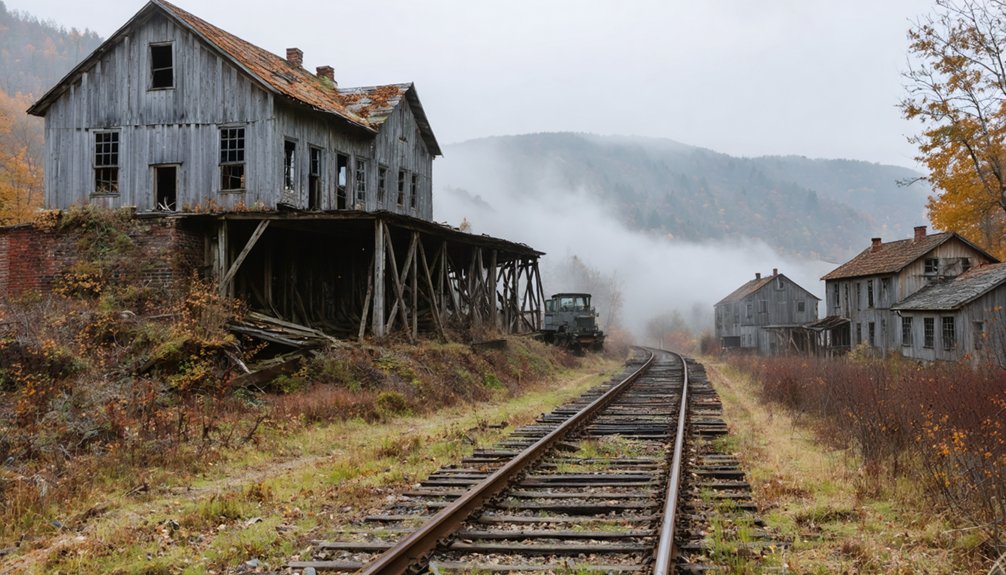
Beyond Thurmond’s technological decline, West Virginia’s ghost towns cluster across distinct geographic corridors that reflect the state’s industrial history. You’ll find over 60 documented settlements, with Fayette County containing nine sites concentrated within a dozen-mile stretch of the New River Gorge.
West Virginia’s 60+ ghost towns trace industrial decline through geographic corridors, with Fayette County hosting nine sites along the New River Gorge.
Charleston anchors access to eleven ghost towns within a 50-mile radius, while McDowell County preserves multiple coal-era remnants including Algoma and Beartown.
Navigation requires general coordinates rather than precise addresses—expect long, winding dirt roads with limited cell reception. The National Park Service’s 1998 acquisition of Nuttallburg eliminated trespassing concerns, providing legal access to abandoned architecture including 40 surviving coke ovens.
Nicholas County’s Gad lies submerged beneath Summersville Lake, while Greenbryer’s small graveyard connects to haunted legends from 1897. North Bend Rail-Trail near Cairo offers unrestricted exploration.
Must-See Abandoned Towns and What Remains Today
While most of West Virginia’s 60+ documented ghost towns require bushwhacking through unmarked terrain, five sites offer preserved infrastructure substantial enough to warrant dedicated visits.
Nuttallburg (National Park Service, 1998-present) features 40 intact coke ovens from the original 80, plus visible tipple structures and abandoned mine relics marking production that ceased in 1958.
Kaymoor’s 821-stair descent reveals preserved safety warning signs—authentic historical ghost town legends still hanging where miners once read them daily.
Thurmond maintains 5-6 residents among railroad structures and the former Dunglen hotel ruins across-river.
Three essential characteristics define accessible ghost towns:
- Documented preservation by federal or state entities
- Maintained trail access without trespassing requirements
- Interpretive infrastructure explaining original settlement purposes
Winona retains its pool hall and active church, while Gad lies submerged beneath Summersville Lake.
Preserving Industrial Heritage Through Ghost Town Sites
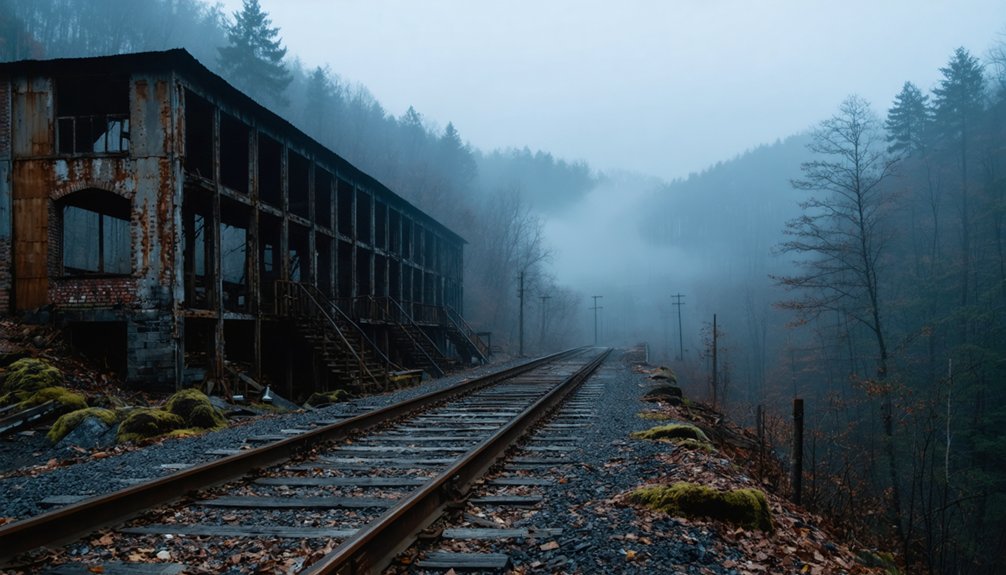
You’ll find that West Virginia’s ghost towns function as open-air museums documenting coal, railroad, and petroleum industries that shaped Appalachian development from the 1860s through the mid-20th century.
The National Park Service’s 2003 stabilization program at Thurmond—including metal roofing installations on twenty structures and the 1995 depot restoration—preserves tangible evidence of communities that handled more freight than Cincinnati at their peak.
Sites like Kaymoor’s 821-stair mining complex with intact safety signage and Volcano’s ruins at Mountwood State Park provide you with direct archaeological access to boom-and-bust industrial cycles that left over 60 ghost towns within a 12-mile New River Gorge corridor.
Archaeological and Cultural Preservation
As the National Park Service assumed stewardship of the New River Gorge National Park, it inherited responsibility for preserving West Virginia’s most significant industrial ghost towns, establishing a 100-mile corridor of archaeological sites that document coal mining‘s profound impact on Appalachian communities (National Park Service, 2021).
You’ll find preservation strategies targeting cultural artifacts across multiple sites:
- Structural stabilization at Nuttallburg and Kaymoor maintains original tipples, coke ovens, and miners’ housing.
- Archaeological surveys catalog mining equipment, conveyor systems, and community infrastructure.
- Interpretive programs document labor conditions and engineering innovations without sanitizing industrial realities.
These efforts preserve Thurmond’s railroad architecture and Sewell’s vegetation-reclaimed ruins, allowing you to witness how coal barons’ economic dominance shaped—and ultimately abandoned—entire Fayette County communities (New River Gorge National Park, 2021).
Educational Value for Visitors
The ghost towns of West Virginia’s coalfields function as outdoor classrooms where visitors encounter tangible evidence of Appalachian industrial transformation. Sites like Nuttallburg offer unprecedented access to complete coal processing infrastructure spanning 88 years of continuous operation (1870-1958).
You’ll trace boom-to-bust narratives through Thurmond’s railroad-era prosperity and Kaymoor’s woodland ruins, experiencing historical storytelling that reveals economic vulnerability to technological shifts. The 100-mile route through Fayette and Raleigh counties clusters eight interpretive sites—including Sewell and Stotesbury—enabling efficient heritage touring.
National Park Service documentation provides 1926 panoramic contexts, while preserved structures foster community connections to ancestral labor histories. These accessible monuments illuminate coal’s role in shaping regional identity, offering freedom to explore industrial archaeology without institutional mediation.
Frequently Asked Questions
Are Ghost Towns in West Virginia Safe to Explore on Your Own?
Exploring alone isn’t safe—urban decay creates structural hazards, while historic preservation rules restrict unescorted access. You’ll face collapse risks, trespassing charges, and terrain challenges. NPS-managed sites require guided tours, limiting your freedom to roam independently through West Virginia’s abandoned settlements.
Can You Legally Take Artifacts or Souvenirs From Abandoned West Virginia Towns?
Don’t let the siren call of souvenirs tempt you—removing artifacts from West Virginia’s ghost towns violates legal restrictions under the 1906 Antiquities Act. Historical preservation laws impose fines up to $20,000, protecting these cultural resources for future generations.
What Should Visitors Bring When Exploring Remote Ghost Town Locations?
You’ll need sturdy hiking boots, water, GPS devices, and first-aid supplies for remote explorations. Bring cameras with proper lenses for photography tips, respecting historical preservation by documenting—not disturbing—artifacts. Cell service is often unavailable in these isolated locations.
Do Any Ghost Towns in West Virginia Offer Guided Tours?
The National Park Service offers guided tours at Thurmond and Nuttallburg as tourist attractions. You’ll find rangers lead interpretive programs highlighting historic preservation efforts at these mining sites, though most ghost towns require self-guided exploration with informational signage.
Are Ghost Town Sites Haunted or Associated With Paranormal Activity?
Many ghost town sites you’ll encounter feature haunted legends and paranormal sightings, particularly Trans-Allegheny Lunatic Asylum’s shadow figures and Lake Shawnee’s tragic history. However, most industrial ghost towns lack documented supernatural activity, focusing instead on historical preservation.
References
- https://en.wikipedia.org/wiki/List_of_ghost_towns_in_West_Virginia
- https://wvexplorer.com/2025/10/19/ghost-towns-in-southern-west-virginia/
- https://www.youtube.com/watch?v=-EeLwLa2t90
- https://wvtourism.com/5-wv-ghost-towns/
- https://minskysabandoned.com/2015/07/30/west-virginia-ghost-towns-part-1-nuttallburg/
- https://www.geotab.com/ghost-towns/
- https://www.wvnews.com/news/wvnews/west-virginias-ghost-towns-history-industry-and-collapse/article_750c0b12-dd9b-4139-8af1-720ff55be395.html
- https://kids.kiddle.co/List_of_ghost_towns_in_West_Virginia
- https://www.youtube.com/watch?v=wYiDeaGt-yE
- https://www.loveexploring.com/gallerylist/188219/the-us-state-with-the-most-ghost-towns-revealed