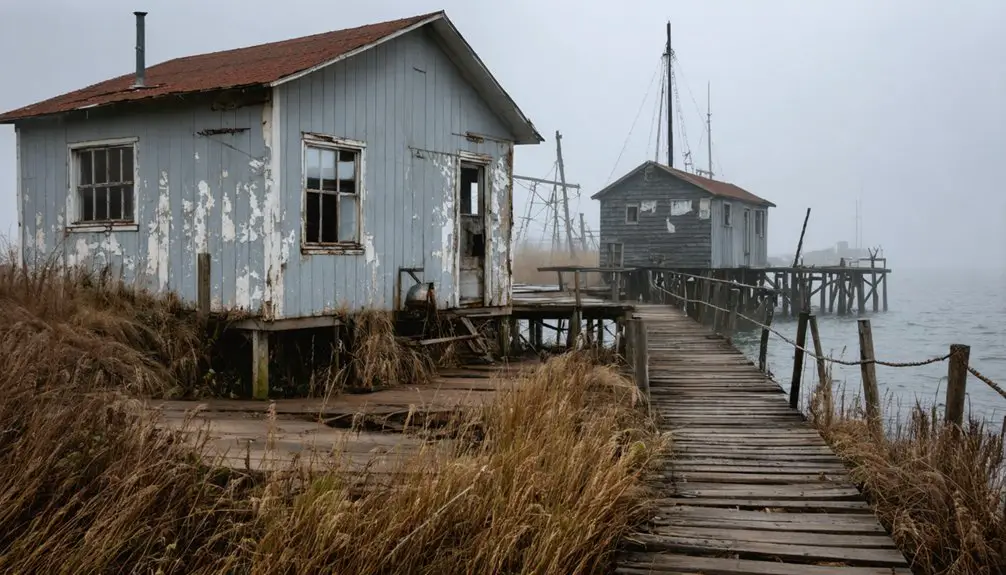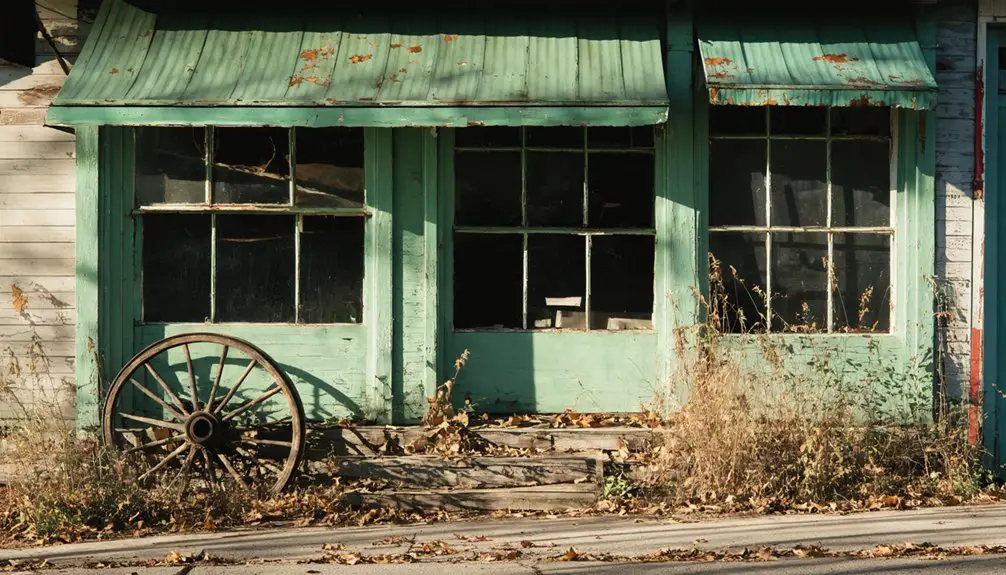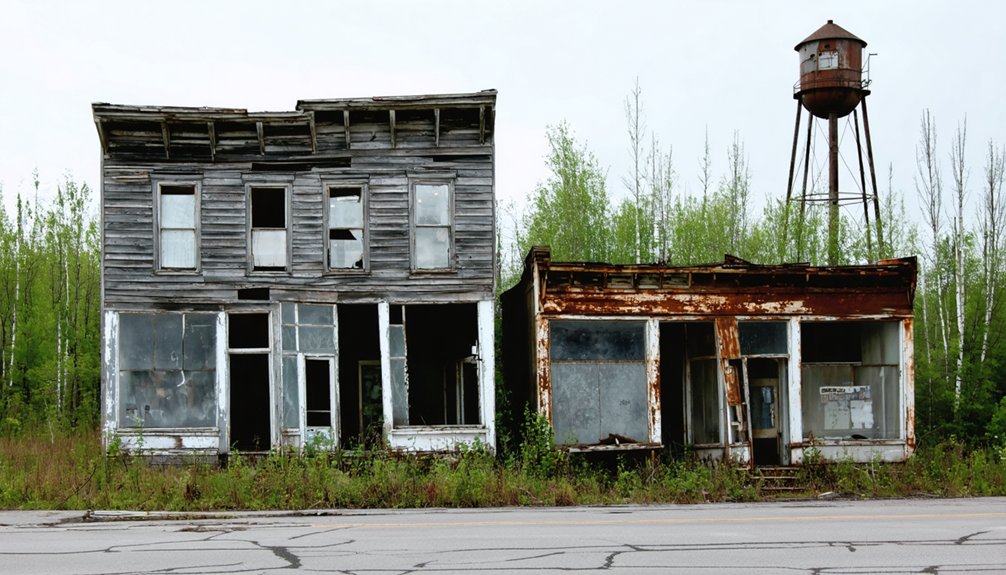
Wisconsin contains between 147 and 155 officially documented ghost towns, though you’ll find the actual number likely exceeds 600 when including every abandoned logging camp, failed mining settlement, and vanished crossroads community. The state’s northern counties—particularly Marinette and Vilas—harbor the densest concentrations from timber industry collapses, while southwestern regions like Lafayette and Grant preserve lead-mining remnants from the 1840s. The Geographic Names Information System identifies over 600 potential sites, revealing how railroad routes, resource depletion, and catastrophic fires like the 1871 Peshtigo disaster shaped these disappearances across Wisconsin’s landscape.
Key Takeaways
- Wisconsin has between 147 and 155 identified ghost towns, though incomplete records and varying definitions affect the exact count.
- Geotab documents 155 ghost town sites, with concentrations primarily in Adams and Milwaukee Counties hosting about 10 each.
- The GNIS database identifies over 600 potential ghost towns in Wisconsin using broader classification criteria.
- Northern counties like Marinette and Vilas contain the most ghost towns due to logging industry booms and collapses.
- Wisconsin ranks above Michigan’s 128 ghost towns but below Texas’s 511 in national comparisons.
Counting Wisconsin’s Abandoned Settlements: What the Numbers Tell Us
While documentation efforts have identified between 147 and 155 ghost towns across Wisconsin, these figures represent incomplete tallies that shift as researchers uncover previously undocumented settlements and reassess existing sites.
You’ll find counting challenges stem from varying definitions—some sources classify any historic community experiencing population decline to one-fifth its peak, while others require complete abandonment. The state’s ghost towns range from barely intact scattered buildings to more substantial remnants marked by cemeteries and historical markers.
Urban decay followed predictable patterns: railroad route changes, economic failures, and resource depletion triggered exodus. Wisconsin’s hundreds of abandoned settlements place it among mid-tier states nationally, ranking above Michigan’s 128 but below Texas’s 511, reflecting the state’s nineteenth-century settlement boom and subsequent consolidation. Nationally, Pennsylvania and Colorado each have hundreds of ghost towns, positioning Wisconsin in the middle range of states with documented abandoned settlements. Illinois maintains 82 ghost towns, placing it in a similar range to Wisconsin’s count.
Geographic Distribution Across Wisconsin Counties
You’ll find Wisconsin’s ghost towns concentrated in three distinct geographic zones that reflect the state’s economic history.
Northern counties like Marinette and Vilas contain abandoned logging settlements.
Southern counties including Lafayette and Grant preserve lead-mining communities from the 1840s-1890s.
Milwaukee and Adams Counties each document 10 ghost towns, demonstrating that southeastern Wisconsin’s early settlement patterns produced comparable abandonment rates to the state’s resource-extraction regions.
The Apostle Islands region off Bayfield’s northern tip contains multiple abandoned island settlements from the mid-1800s logging and quarrying era.
Railroad routes either ensured survival or sealed town fates by bypassing settlements entirely, determining which communities would thrive and which would disappear.
Northern Mining and Logging Concentrations
Wisconsin’s northern counties contain the state’s densest concentrations of ghost towns, directly correlating with the late nineteenth and early twentieth century logging boom that transformed the region’s wilderness into industrial landscapes.
You’ll find Bayfield County’s abandoned mill sites near Washburn and Drummond, where temporary logging camps literally dug into dirt banks and disappeared after timber depletion.
Sawyer County experienced severe urban decline when the Wisconsin Colonization Company’s model town Ojibwa failed—cutover land proved unsuitable for farming, triggering massive tax defaults and demographic shifts.
The Nicolet Forest area witnessed similar patterns as railroad logging peaked between 1910-1920.
Towns like Cavour and Tipler vanished when firms like Thunder Lake Lumber Company exhausted local timber.
These boom-and-bust cycles created archaeological landscapes dotted with thousands of abandoned camps, mills, and settlements.
Archaeological investigations have documented between 15 and 2,000 logging-related sites across Wisconsin, including tent camps, railroad terminals, and mill remnants within federal lands like the Nicolet National Forest.
The lumber industry’s dominance in the region employed a quarter of Wisconsin’s workforce in the 1890s, operating winter logging camps and conducting river log drives that sustained these now-vanished communities.
Southern County Town Clusters
Contrasting sharply with the logging-driven abandonments of northern Wisconsin, the southern counties developed ghost town clusters tied to mineral extraction failures, speculative railroad schemes, and agricultural miscalculations that left distinctive archaeological signatures across the landscape.
You’ll find Lafayette County’s Gratiot’s Grove exemplifies lead-mining collapse, while Grant County’s Stonefield preserves cultural heritage through Nelson Dewey’s farm village experiment. Green County’s Centerville represents pure speculation—drawings sold in eastern cities depicted nonexistent buildings, leaving only surveyors’ stakes.
Archaeological sites like Pleasant Ridge document freedmen settlements, and Voree preserves Mormon history as the “Hill of Promise.” Railroad route decisions proved fatal: Moscow’s buildings relocated to Blanchardville when tracks bypassed the original townsite. Belmont served as Wisconsin’s territorial capital for a single legislative session in 1836-1837 before abandonment left the original site three miles northwest of the current town.
Colonel Henry Gratiot’s home, a testament to the anti-slavery pioneer who founded the lead mining community, still stands today and has been renovated into a Bed and Breakfast. These southern clusters reveal how transportation infrastructure, mineral depletion, and fraudulent land schemes determined settlement survival across Wisconsin’s agricultural belt.
Regional Abandonment Pattern Analysis
Although Wisconsin’s 155 ghost towns appear scattered across the state’s landscape, their distribution reveals systematic patterns tied to extractive industries, transportation corridors, and speculative ventures that defined 19th-century settlement dynamics.
You’ll find northern concentrations where logging and mining operations exhausted resources, while southern clusters in Lafayette, Walworth, Green, and Crawford counties reflect failed agricultural speculation and lead-mining collapse.
Eastern counties—Marinette, Menominee, and Kenosha—contain settlements abandoned after the catastrophic 1871 wildfire devastated lumber infrastructure.
Cultural influences shaped distinct abandonment waves: Mormon communities left architectural styles evident along Walworth County’s Mormon Road, while utopian experiments like Wisconsin Phalanx dissolved when cooperative economic models proved unsustainable.
Railroad route diversions particularly impacted communities anticipating connectivity, leaving physical evidence of speculative miscalculations across Wisconsin’s geography.
Historical maps documenting these settlements display numbered ghost towns alongside Indian reservations, railroads, and mineral resources, providing comprehensive geographic records of Wisconsin’s abandoned communities.
Railroad Routes and Economic Shifts That Created Ghost Towns
Between 1836 and 1865, numerous settlements sprouted across southern Wisconsin in direct anticipation of railroad construction, their founders banking entire community futures on proximity to proposed rail lines.
Speculators gambled everything on railroad proximity, founding entire towns where they hoped the tracks would run.
When you examine Wisconsin’s ghost towns, you’ll discover that railroad placement decisions sealed communities’ fates. Towns bypassed by rail experienced immediate economic decline—Star Lake exemplifies this pattern after the “Northwoods Hiawatha” discontinued service in 1943, prompting depot dismantling and abandonment. The area reverted to a ghost town phase, with artifacts from the railroad era still found along lakeshores and backwoods today.
Major carriers like the Milwaukee Road and Chicago & North Western wielded tremendous power through route selection, creating winners and losers across the landscape. Strategic decisions sometimes reflected competing interests rather than geographic logic.
Natural resource depletion compounded these vulnerabilities—lead mining settlements like Gratiot’s Grove and company towns like Stonehaven dissolved when deposits exhausted or industrial operations ceased.
The Lumber Boom and Bust: Northern Wisconsin’s Vanished Communities
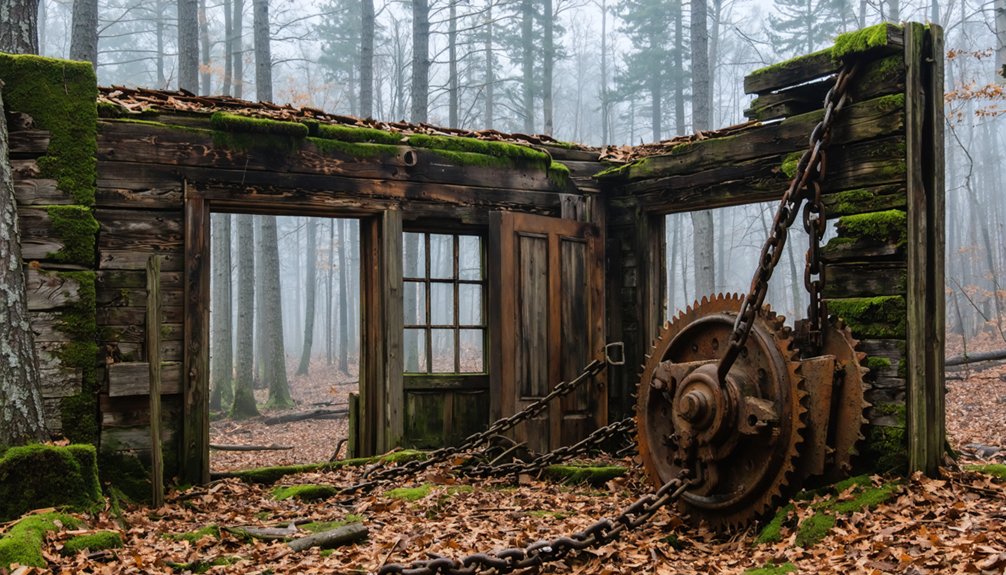
While railroad placement determined which settlements survived in southern Wisconsin, northern Wisconsin’s ghost towns emerged from a different economic force entirely. You’ll find lumber towns like Brookville, Wildwood, and Zeda rose rapidly in the 1880s, thrived briefly, then vanished within decades as surrounding forests were depleted.
The St. Croix Boom operated for fifty-eight years before closing in 1914 after timber exhaustion. Railroad companies and lumber operators clear-cut vast tracts—displacing indigenous history and traditional land management—then abandoned the “cutover” landscape.
Failed agricultural settlement schemes followed, with settlers unable to pay taxes on unsuitable farmland. The Forest History Association documents fourteen such ghost towns, each representing financial losses and environmental devastation.
Today’s environmental restoration efforts attempt reversing this nineteenth-century ecological catastrophe across Wisconsin’s northern counties.
Mining Towns That Disappeared After Resource Depletion
You’ll find Wisconsin’s mining ghost towns concentrated in the southwestern counties of Lafayette and Grant, where lead and zinc deposits fueled brief but intense settlement periods during the mid-1800s.
Communities like Pendarvis, Gratiot’s Grove, and New Diggings emerged as Cornish and European immigrants established extraction operations, constructing wooden cabins and limestone homes that served miners and smelters.
Once these mineral veins were exhausted by the late nineteenth century, residents abandoned these settlements en masse, leaving preserved structures that now stand as monuments to resource-dependent economies that collapsed when their singular commodity disappeared.
Northern Wisconsin Mining Boom
The discovery of iron ore in the Gogebic Range spanning northern Wisconsin and Michigan in 1872 triggered a speculative frenzy that transformed the region’s economic landscape. Eastern investors rushed to extract wealth, establishing communities like Ironwood and Hurley while constructing palatial homes.
You’ll notice how this boom fundamentally differed from sustainable development—northern Wisconsin’s settlement served out-of-state interests rather than local prosperity.
The region’s mining towns exhibited critical vulnerabilities:
- Total economic dependence on single-industry mining operations
- Absent mining regulations enabling resource exhaustion without accountability
- Severe environmental impact from uncontrolled extraction practices
- Capital flight when profitable deposits depleted
Michigan’s towns proved more resilient as profitable deposits concentrated across state lines. When resources exhausted, investors departed for lucrative opportunities elsewhere, leaving Wisconsin communities without economic foundations or political stability.
Lead and Zinc Exhaustion
Lead mining transformed southwestern Wisconsin’s Driftless Area beginning in the 1820s, as thousands of miners from eastern states and Cornwall flooded the region to extract easily obtainable ore deposits. By 1829, you’d find over 4,000 miners producing 13 million pounds annually, with the state controlling half the nation’s output by the 1840s.
However, mining technology couldn’t overcome depletion economics—extracting remaining ore became prohibitively expensive. You’d witness one-third of residents abandoning the region by 1844 for Michigan’s copper and iron fields, followed by mass exodus during the 1849 California Gold Rush.
Zinc mining temporarily replaced lead operations, but environmental impacts from air and water pollution increased regulatory costs. Wisconsin’s last metallic mine closed around 1979, leaving ghost towns like Pendarvis as monuments to resource exhaustion.
Abandoned Settlements Remain Today
Wisconsin’s mining boom left scattered remnants across the landscape, where settlements vanished as completely as the ore bodies they’d depended upon. You’ll find these abandoned sites throughout Lafayette and Ozaukee counties, where cultural heritage survives primarily through preservation efforts at scattered cemeteries and historical markers.
Notable examples include:
- Gratiot’s Grove – Henry Gratiot’s house stands as Wisconsin’s second-oldest home, restored as a bed and breakfast.
- Stonehaven – Quarry town disappeared between 1901-1925 when Lake Shore Stone Company ceased operations.
- New Diggings – Natural resource exhaustion sealed its fate alongside railroad rerouting.
- Northern logging settlements – Peshtigo and Sugar Bush leveled in 1871’s devastating fire.
These ghost towns represent freedom from corporate dependency, yet their minimal remains challenge modern preservation efforts documenting Wisconsin’s extractive industries.
Natural Disasters and Fires That Erased Settlements
While human ambition built Wisconsin’s settlements, natural catastrophes and conflagrations proved equally powerful in erasing them from the landscape.
You’ll find Sinnipee’s 1839 malaria outbreak—triggered by mosquito-breeding floodwaters—decimated its population, forcing survivors to abandon their Mississippi River port.
The catastrophic Peshtigo Fire of October 8, 1871 killed between 1,200 and 2,400 residents, erasing records and necessitating mass burials that would later influence cremation practices and folklore legends.
Donaldson’s unrecorded fire destroyed its sawmill economy entirely.
Dozens of Lake Michigan coastal communities disappeared when fires consumed their timber-dependent infrastructure and shipping piers.
Doveland’s 1990s vanishing remains unexplained—theories suggest earthquake-induced sinkholes or dam-related flooding, though no confirmed evidence exists.
These disasters didn’t merely damage settlements; they obliterated them from maps and memory.
Notable Wisconsin Ghost Towns Worth Exploring
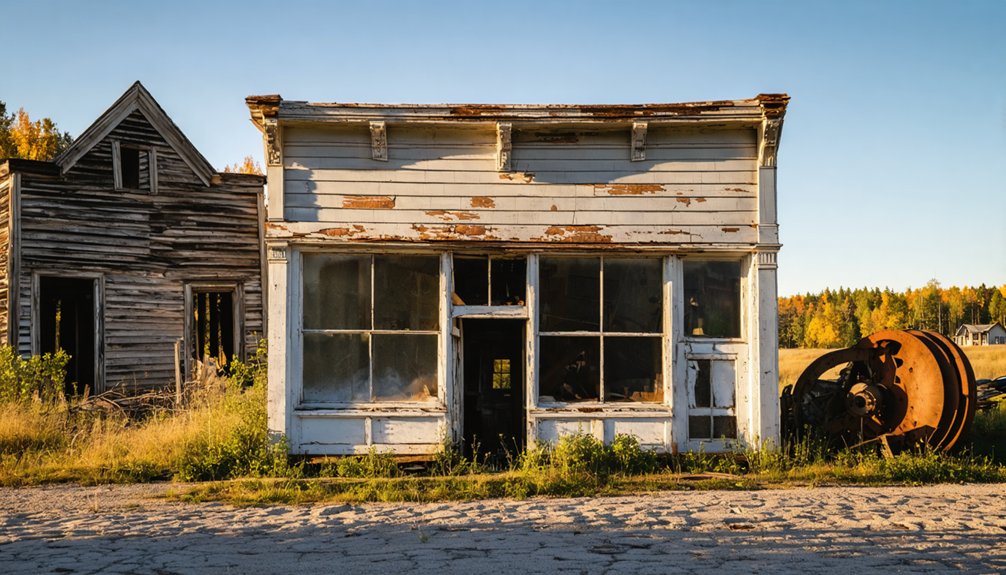
Five ghost towns across Wisconsin’s landscape offer tangible connections to the state’s forgotten chapters, each preserving distinct narratives of military strategy, religious experimentation, and economic miscalculation.
- Fort Howard (Brown County) showcases military structures from 1812, abandoned after malaria forced relocation—demonstrating how ecological impacts determined settlement viability.
- Ceresco (Fond du Lac County) preserves Fourierist commune architecture, representing utopian idealism’s collision with practical reality.
- Ulao (Ozaukee County) reveals Lake Michigan’s logging prosperity through port foundations, connected to Charles Guiteau’s controversial legacy.
- Cooksville (Rock County) maintains its general store and 19th-century buildings, exemplifying cultural preservation amid railroad-induced decline.
Dover’s Dane County ruins and these sites collectively document how transportation networks, disease, and philosophical movements shaped Wisconsin’s territorial evolution, offering you unfiltered access to authentic historical landscapes.
Mapping Resources and Documentation of Abandoned Sites
Digital cartography has transformed ghost town research through multiple specialized mapping initiatives that document Wisconsin’s hundreds of abandoned settlements with unprecedented precision.
Modern mapping technology has revolutionized how researchers catalog and preserve Wisconsin’s vanishing settlements with remarkable accuracy and detail.
You’ll find the State Cartographer’s Office identified over 600 potential cartographic phantoms in the GNIS database, utilizing Fast Phantom Finder software with quarter-mile buffers against Wisconsin’s Statewide Parcel Map.
BatchGeo’s Heat View mapping reveals marker density where ghost town locations overlap, while Geotab documents 155 sites concentrated in Adams and Milwaukee Counties.
The Vanishing Wisconsin project creates historical digital atlases preserving forgotten communities before ecological succession erases physical evidence.
Victor Bates’ pre-1969 cartographic work archives northern mining and logging settlements.
Clark County’s electronic resources provide cemetery listings and interactive exploration tools, enabling you to research abandoned sites facing modern redevelopment pressures.
Frequently Asked Questions
Can You Legally Visit and Explore Wisconsin’s Ghost Towns?
You can legally visit Wisconsin’s ghost towns if they’re on public land, but you’ll need permission for privately-owned sites. Historical preservation laws protect structures, so you can’t disturb artifacts or buildings without violating land ownership rules governing these abandoned settlements.
Are There Any Haunted Ghost Towns in Wisconsin?
Yes, several Wisconsin ghost towns feature paranormal sightings and ancient legends. Fort Howard and Fort Crawford rank among the state’s creepiest abandoned sites, where you’ll find documented supernatural encounters alongside their well-preserved historical remains and eerie atmospheres.
What Artifacts or Structures Remain at Wisconsin Ghost Towns Today?
You’ll find remaining structures like Fort Crawford’s repurposed buildings, Cooksville’s general store, and Henry Gratiot’s house among Wisconsin’s ghost towns. Historical artifacts primarily include cemeteries, foundations, and architectural remnants, though most sites retain only archaeological evidence today.
Which Wisconsin Ghost Town Is Closest to Major Cities Like Madison?
Like forgotten pages awaiting rediscovery, Cooksville stands closest to Madison—just 25 miles southeast. You’ll find exceptional historical preservation there, offering tourism opportunities that let you explore Wisconsin’s authentic past independently, free from modern constraints and commercial development.
Do Property Owners Still Exist for Abandoned Wisconsin Ghost Town Sites?
You’ll find property owners exist for many Wisconsin ghost town sites—private farmland holds Imalone’s remnants, while Gratiot House operates commercially. However, property ownership mysteries surround abandoned Mormon settlements and cemetery-only locations, where ghost town preservation remains unclear or public.
References
- https://blog.batchgeo.com/ghost-towns/
- https://en.wikipedia.org/wiki/List_of_ghost_towns_in_Wisconsin
- https://www.youtube.com/watch?v=1vEiZqnWZ0A
- http://shunpikingtoheaven.blogspot.com/2016/05/a-wisconsin-ghost-town.html
- https://www.geotab.com/ghost-towns/
- https://www.wisconsinhistory.org/Records/Image/IM116137
- https://www.foresthistoryassociationwi.com/publications/ghostoftf/
- https://www.loveexploring.com/gallerylist/188219/the-us-state-with-the-most-ghost-towns-revealed
- https://247wallst.com/special-report/2018/11/02/30-american-ghost-towns-3/
- https://kroc.com/wisconsin-is-one-of-the-most-haunted-states-in-the-us/