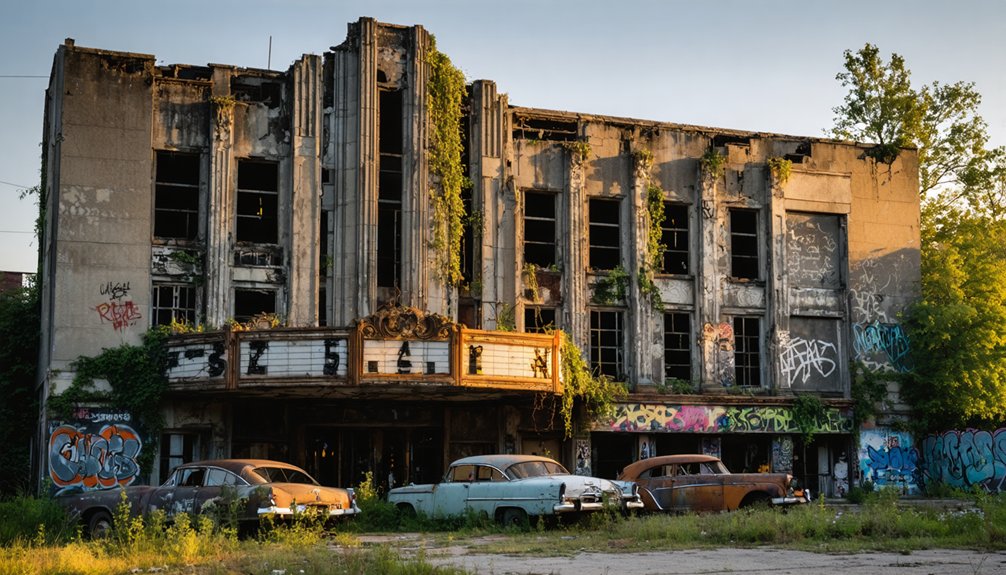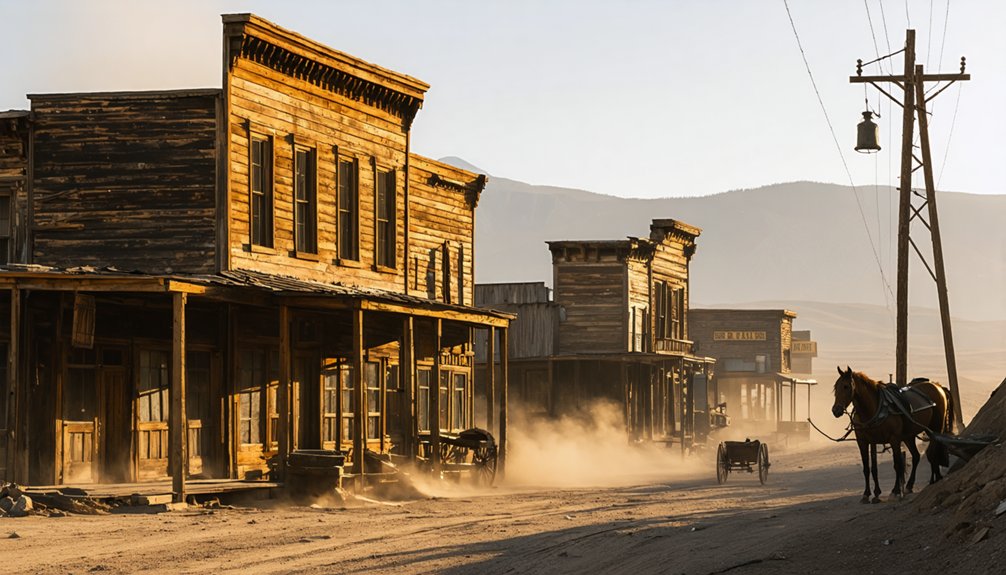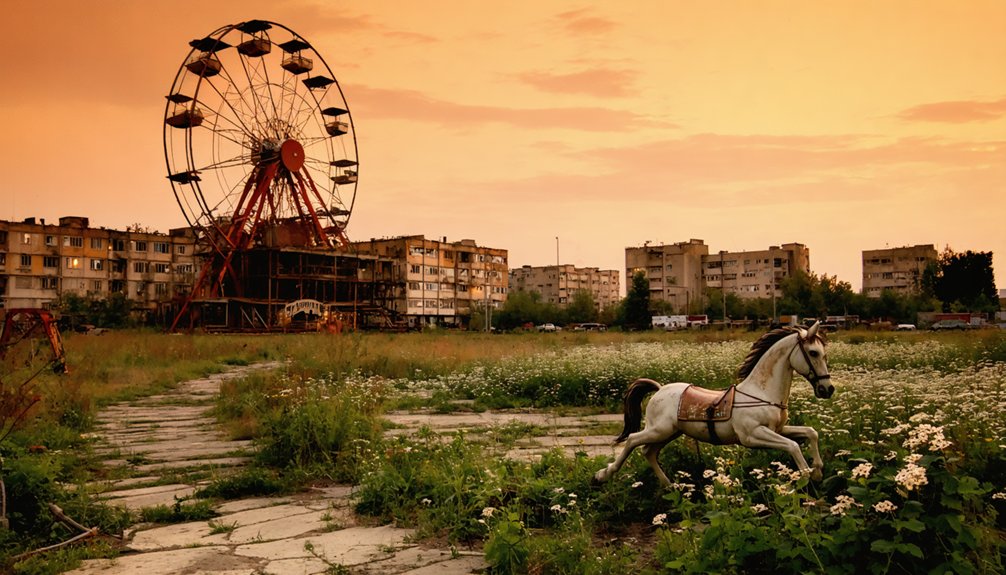
America’s ghost towns offer immersive post-apocalyptic experiences without actual disaster. You’ll walk through Centralia’s smoldering streets, explore Bodie’s perfectly preserved 1880s interiors, or discover Nevada’s desert-reclaimed mining settlements. Southern ghost towns hidden in encroaching forests provide eerie encounters with nature’s reclamation process. For photographers, these abandoned sites create dramatic opportunities to capture civilization’s fragile remnants. Proper preparation guarantees you’ll safely experience these haunting intersections of American ambition, economic collapse, and time’s relentless march forward.
Key Takeaways
- Centralia, Pennsylvania offers a true post-apocalyptic experience with its ongoing underground fire, toxic legacy, and smoke seeping through the earth.
- Bodie, California preserves an authentic 1880s mining town in “arrested decay” with 200 original structures containing furniture and supplies.
- Nevada’s Rhyolite features crumbling ruins alongside surreal art installations at the Goldwell Open Air Museum for an otherworldly atmosphere.
- Southern ghost towns like Lost Cove showcase nature’s reclamation of human settlements, creating mysterious forest features from industrial ruins.
- Ghost towns near national parks, like Kennecott in Wrangell-St. Elias, provide immersive experiences with dozens of preserved buildings in dramatic landscapes.
The Eerie Coal Fire Wasteland of Centralia, Pennsylvania

A smoldering labyrinth of destruction lies beneath the abandoned streets of Centralia, Pennsylvania, where America’s most persistent environmental disaster continues to burn.
You’re walking on ground that conceals a fire that’s raged since 1962, when a botched trash burn ignited coal seams that once fueled this mining town’s prosperity.
As you explore, you’ll notice the eerie absence of nearly 3,000 former residents, forced to flee the Centralia fire’s toxic legacy of carbon monoxide plumes and ground temperatures reaching 900°F.
Five stubborn residents remain in this post-apocalyptic landscape where smoke still seeps through cracks in the earth. The once-popular Graffiti Highway attraction has been buried to prevent tourists from accessing the dangerous area.
The government abandoned attempts to extinguish this inferno decades ago after spending over $42 million on failed relocation efforts.
Now it’s yours to witness—a hauntingly vacant town where the underground blaze will continue for another 250 years.
Bodie’s Frozen-in-Time Wild West Mining Community
Standing as America’s most authentic Wild West ghost town, Bodie beckons you to step into a perfectly preserved slice of 1880s mining life.
This California landmark maintains “arrested decay” authenticity—you’ll witness weathered Bodie architecture exactly as miners abandoned it when the gold ran dry in 1942, with $70 million in precious metals extracted during its heyday. Due to the various interpretations of the name, visitors should note that this specific Bodie refers to the historic ghost town, not other places or people sharing the name. The area earned its notorious reputation as the Badman from Bodie phrase became widespread by 1880, reflecting its lawless character.
Experience mining culture through:
- Original interiors – peer through dusty windows at furniture, cookware, and supplies left behind when 10,000 residents fled
- Authentic downtown – explore remnants of 65 saloons where gunfighters once brawled
- Untouched buildings – photograph nearly 200 wooden structures, including the historic Miners’ Union Hall
- True Wild West setting – wander freely through this remote outpost where civilization briefly flourished then vanished
Desert-Preserved Ruins of Nevada’s Gold Rush Settlements
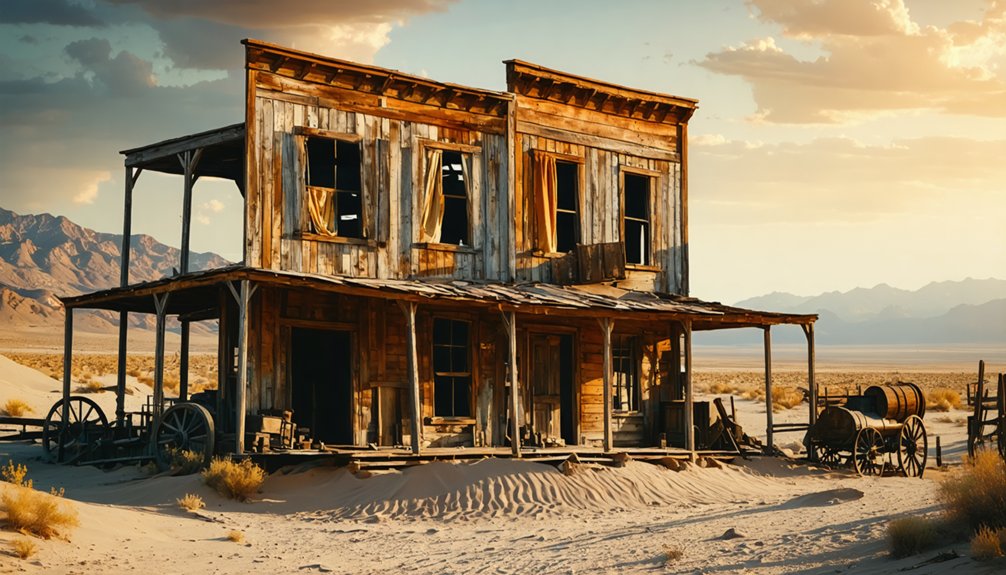
Nevada’s parched desert landscapes serve as natural preservationists, maintaining the skeletal remains of once-thriving gold rush communities in haunting detail.
Venture through Rhyolite ruins where crumbling banks and Tom Kelly’s restored Bottle House stand frozen in “arrested decay,” while surreal art installations at Goldwell Open Air Museum add ghostly figures to the post-apocalyptic tableau.
Time stands still among Rhyolite’s sun-bleached ruins, where history and art collide in Nevada’s harshest landscapes.
Unlike completely abandoned sites, Goldfield attractions offer a semi-living ghost town experience.
Explore the allegedly haunted Goldfield Hotel, a courthouse featuring Tiffany lamps, and the bizarre International Car Forest with painted vehicles jutting from desert soil.
For deeper wilderness immersion, trek to remote Pine Grove, Humboldt City, or Tunnel Camp where untouched stone structures and weathered wooden frames tell silent stories of boom-and-bust cycles beneath vast Nevada skies. The well-preserved Fort Churchill, established in 1860, offers visitors a more structured historical experience with its extensive grounds and visitor center. These sites offer exceptional photography opportunities among the weathered remnants of Nevada’s mining past.
Southern Ghost Towns Reclaimed by Nature
You’ll find an eerie beauty in the Southern ghost towns where tenacious vegetation has reclaimed once-bustling communities like Lost Cove and Mortimer in North Carolina.
As you explore these hauntingly beautiful remnants, you may also discover haunted sites in Oregon’s landscape, each revealing their own spectral stories. From decrepit buildings nestled in dense forests to shadowy apparitions near ancient trails, these locations are steeped in local lore. Each step through these eerie sites offers a glimpse into the past, where history and mystery intertwine.
As you explore these abandoned settlements, you’ll witness how nature’s gradual takeover transforms industrial ruins and homesteads into mysterious forest features, with stone chimneys and building foundations emerging from thick undergrowth. Lost Cove’s fascinating history includes its development as a moonshine hub by 1898 due to its remote location in the rugged Nolichucky Gorge. Elkmont, Tennessee features 19 protected buildings that showcase the early 20th-century architecture of this former Appalachian Club headquarters.
These forest-consumed towns offer a haunting glimpse of how quickly human civilization can fade when abandoned, leaving only scattered artifacts and weathered gravestones as a testament to generations of Southern heritage.
Nature’s Gradual Takeover
While most people imagine abandoned towns as frozen moments in time, nature works relentlessly to reclaim these forgotten spaces throughout the American South.
You’ll witness urban decay transformed by flora resurgence as you explore these atmospheric relics to impermanence.
Experience nature’s takeover firsthand at these locations:
- Buffalo City, NC – where moonshine-era structures dissolve beneath aggressive vegetation after disease and Prohibition’s end triggered mass exodus. Rusted signs and overgrown rails remain as silent testimony to this once-bustling “Moonshine Capitol of the World.”
- Lost Cove’s railway ghost town – now seamlessly integrated into Pisgah National Forest through deliberate conservation
- Terlingua’s quicksilver ruins – where desert elements accelerate wood deterioration while concrete frameworks stubbornly persist. The town’s mining economy collapsed suddenly when the company went bankrupt in the 1940s, leaving residents with no choice but to abandon their homes.
- Monty Nay’s submerged streets – uniquely preserved underwater, occasionally revealed during extreme droughts for fleeting exploration opportunities
Haunting Southern Heritage
The Deep South’s abandoned settlements tell a different story from their western counterparts—one where humidity, vegetation, and time conspire to create hauntingly beautiful tableaux of cultural decay.
You’ll find Cahaba, Alabama’s former capital, now surrendered to forest, its 200-year-old undisturbed remains offering archaeological treasures beneath the Southern decay.
Venture to Rodney, Mississippi, where rusted signs and dilapidated structures—once home to freed slaves and Russian immigrants—emerge from encroaching wilderness.
In Blakeley, what appears as a simple hill reveals itself as a fort structure, completely consumed by nature’s persistence.
The haunted heritage of these places lives on in preserved cemeteries and yearly commemorations, providing glimpses into communities devastated by yellow fever, cholera, and economic collapse—a somber reminder of civilization’s fragility.
Accessible Historic Ghost Towns Near National Parks
Ever wondered which abandoned settlements from America’s frontier past are both historically significant and conveniently located near major national parks?
These ghost towns offer unparalleled access to authentic American history while you’re exploring our nation’s natural wonders.
- Kennecott – Access this copper mining relic in Wrangell-St. Elias via McCarthy Road or book an air taxi for superior ghost town accessibility.
- Grafton – Just 5 miles from Zion, cross the historic 1924 Rockville Bridge to explore restored frontier homes with interpretive displays.
- Bannack – Montana’s territorial capital features over 60 preserved buildings near Yellowstone, with camping options for extended exploration.
- Rhyolite – This gold rush remnant sits 45 minutes from Death Valley’s Furnace Creek, showcasing the boom-and-bust cycle of western expansion.
Photography Guide to America’s Most Atmospheric Abandoned Sites
Capturing the haunting beauty of America’s abandoned places requires more than just a camera—you’ll need technical skills, specialized equipment, and knowledge of the most atmospheric locations across the country.
Ghost town history comes alive through your lens when you master essential photography techniques.
Pack a sturdy tripod for low-light conditions and long exposures that reveal star trails above decaying structures. Bring headlamps for exploring interiors safely while light-painting abandoned saloons and jailhouses.
Wide-angle lenses capture sweeping main streets while macro shots reveal rust patterns and peeling paint.
Head to Bodie, California for authentic historic atmospheres, Rhyolite for stark post-apocalyptic visuals, or Animas Forks for dramatic mountain ruins.
Focus on textures, abandoned artifacts, and architectural features that tell stories of America’s mining past.
Frequently Asked Questions
Can You Legally Explore Ghost Towns Without Permits or Permissions?
Ever seen the difference between lawful exploration and trespassing? You can’t legally explore ghost towns without proper permissions—state regulations vary, but exploration ethics demand respecting property rights whether private or public land.
How Safe Is It to Visit Abandoned Structures in Ghost Towns?
It’s highly hazardous. You’re risking falls through rotted floors, collapsing roofs, and exposure to toxins. Always assess structural integrity first and maintain essential safety precautions like proper footwear and breathing protection.
Are Ghost Towns Accessible During Winter Months?
Most ghost towns have limited winter accessibility, requiring snowmobiles, skis, or snowshoes instead of cars. You’ll face early closures, impassable roads, and need proper gear for winter exploration adventures.
Do Any Ghost Towns Allow Overnight Stays or Camping?
Step into the shadows of history! You’ll find ghost town accommodations at St. Elmo’s Guest House, while places like Calico Ghost Town offer overnight camping nearby—though most restrict camping within structures for preservation.
What Paranormal Activity Has Been Reported in America’s Ghost Towns?
You’ll encounter extensive paranormal reports in America’s ghost towns, from ghost sightings in Bodie to spectral miners in St. Elmo. Each location’s haunted history features EVPs, temperature drops, and disembodied voices echoing their tragic pasts.
References
- https://devblog.batchgeo.com/ghost-towns/
- https://carte-urbex.com/blogs/infos/top-10-abandoned-places-in-the-usa
- https://albiongould.com/ghost-towns-to-visit-in-the-states/
- https://whakestudios.com/us-ghost-towns/
- https://www.geotab.com/ghost-towns/
- https://en.wikipedia.org/wiki/Lists_of_ghost_towns_in_the_United_States
- https://www.youtube.com/watch?v=RiqCBFpF_G8
- https://www.timeout.com/usa/things-to-do/ghost-towns-usa
- https://www.hertz.com/p/american-road-trip-planner/west-coast/ghost-towns-of-the-west
- https://pabucketlist.com/the-rise-and-fall-of-centralia-pas-toxic-ghost-town/