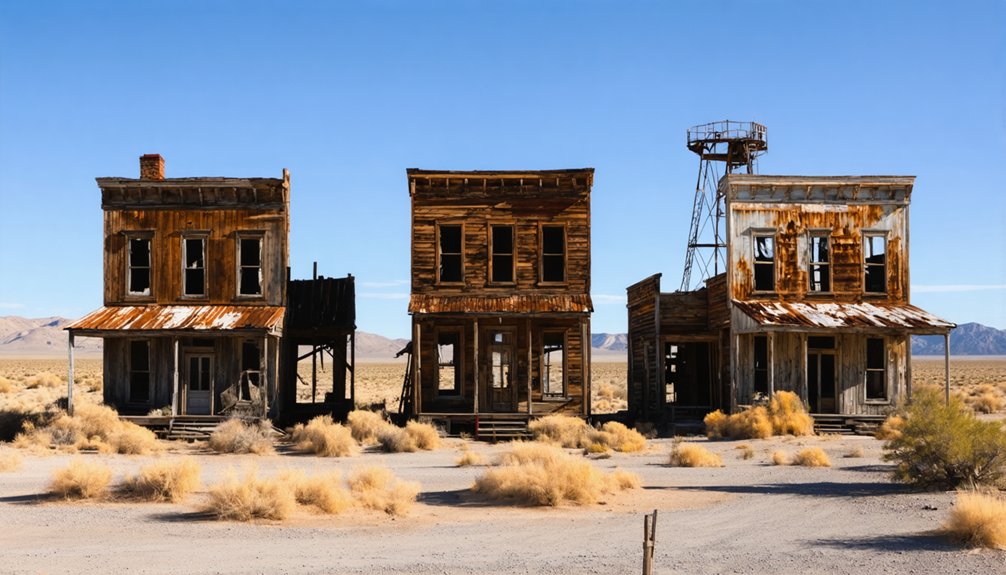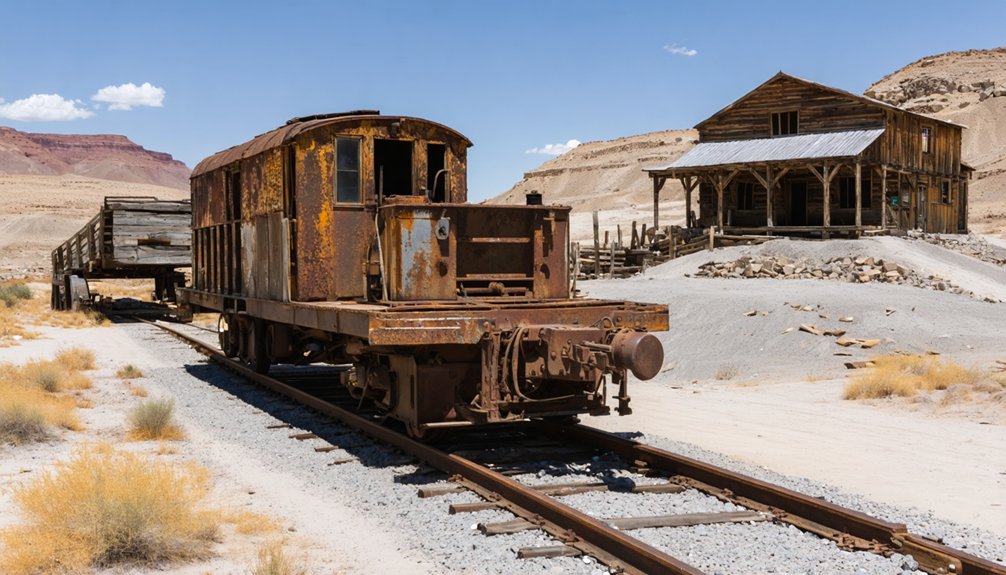
Nevada’s ghost towns leave behind dangerous environmental legacies you’ll encounter today. Mercury and arsenic contamination persist in waterways and soils, with toxin levels thousands of times above safe thresholds. You’ll find these pollutants bioaccumulating through food chains while abandoned mine structures pose physical dangers to humans and provide habitat for wildlife. This complex intersection of environmental hazards, ecological adaptation, and historical significance creates a challenging conservation paradox that demands innovative solutions.
Key Takeaways
- Mercury contamination from the Comstock Era released 7 million pounds into watersheds, persisting for millennia without intervention.
- Abandoned mine sites produce toxic dust containing mercury and arsenic at concentrations up to 5,000 mg/kg.
- Approximately 200,000 abandoned mines in Nevada create physical hazards while simultaneously providing habitat for wildlife.
- Mining operations altered local hydrology and spread heavy metal contamination beyond extraction sites.
- Reclamation efforts blend engineering with ecological principles to stabilize soil and enhance wildlife habitats.
Legacy of Mercury Contamination in Nevada’s Waterways
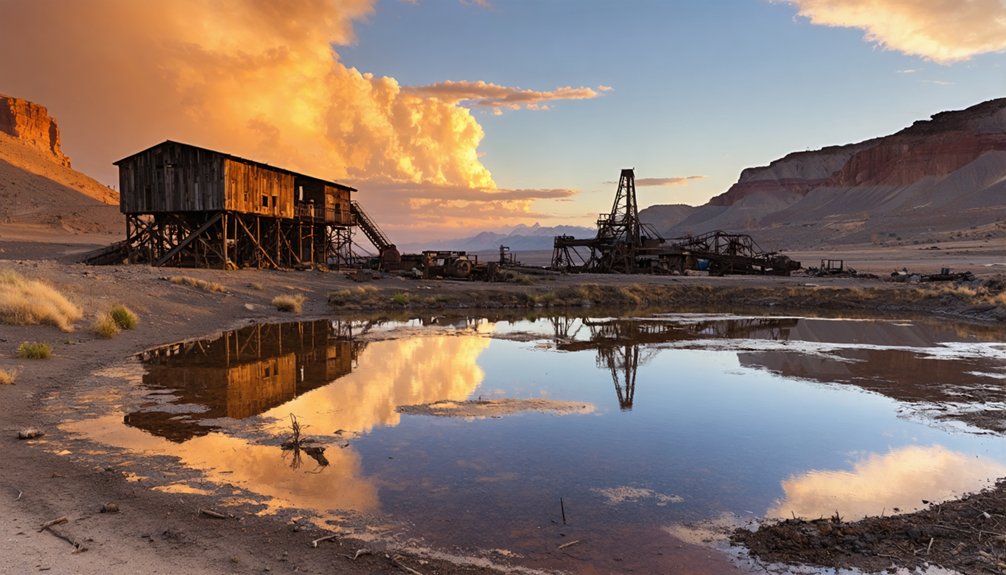
When you examine Nevada’s picturesque ghost towns, what remains hidden beneath their historic charm is a toxic legacy that continues to haunt the state’s waterways.
The Comstock Era (1859-1880) released approximately 7 million pounds of mercury into the Carson River watershed through inefficient amalgamation processes and leaky retorts.
This persistent contamination isn’t merely historical—it’s actively cycling through ecosystems today. Total mercury levels in mine-affected waters frequently exceed EPA criteria by thousands of times, while methylmercury, the most toxic form, bioaccumulates through food chains. Recent studies have documented that significant bioaccumulation is occurring throughout the food web, from water striders to predatory fish. USGS scientists have extensively mapped these contamination patterns to help inform remediation efforts.
Sport fish routinely surpass the 0.3 ppm threshold that triggers consumption advisories. Despite historical remediation efforts, erosion and sediment transport guarantee this contamination will persist for millennia without intervention, affecting both wildlife and human communities throughout these watersheds.
Toxic Metal Exposure Through Dust From Abandoned Mine Sites
When you visit Nevada’s ghost towns, you’re likely stirring up more than historical memories as mercury-laden trail dust becomes airborne with each step across tailings piles.
Your recreational activities near abandoned mine sites create direct pathways for inhaling arsenic-contaminated dust particles, which at concentrations up to 5,000 mg/kg pose significant health risks even during short exposures.
Children exploring these seemingly adventurous landscapes face particularly heightened vulnerability to toxic metal exposure, as their developing respiratory systems process proportionally more air per body weight than adults. Much like Delamar’s historical nickname “The Widowmaker” due to silica dust fatalities, these abandoned mining sites continue to present serious respiratory hazards to modern visitors. The crystalline silica that plagued Del Mar’s miners remains in the soil and can still cause respiratory problems similar to those experienced in the 1890s.
Mercury-Laden Trail Dust
Across the arid landscapes of Nevada’s forgotten mining towns, mercury-laden trail dust presents one of the most insidious environmental threats to both ecosystems and human health.
When you explore these ghost towns, you’re potentially breathing microscopic particles of mercury released during historical dry-milling operations in water-scarce areas like Candelaria.
This invisible danger stems from crushing and pulverizing processes that spread mercury across large surface areas, creating persistent contamination that continues generating dust decades later.
The approximately 7 million pounds of mercury lost during the Comstock Era has contributed significantly to this widespread contamination problem.
During windy conditions or recreational activities, these particles become airborne, extending mercury’s toxic reach beyond abandoned sites.
Without proper dust mitigation strategies, your mercury exposure risks increase dramatically while hiking, biking, or off-roading near these historic tailings.
The legacy of inefficient extraction techniques now manifests as an environmental justice issue where freedom to explore intersects with unseen hazards.
Despite these dangers, historical amalgamation practices were eventually replaced by cyanide leaching in the 1960s when recommended by the U.S. Bureau of Mines.
Arsenic Health Risks
Mercury contamination represents just one toxic legacy of Nevada’s mining history, with arsenic presenting an equally dangerous but distinct threat to ecosystem health and human safety.
When you hike or ride ATVs near ghost towns, you’re likely disturbing dust containing arsenic concentrations that exceed EPA screening levels by up to 20 times. This exposure pathway is particularly concerning because arsenic inhalation directly increases your risk of lung cancer, cardiovascular disease, and reproductive problems. Heavy metals persist in mine waste and soils for centuries without intervention, creating long-term public health concerns in mining regions.
Children face heightened vulnerability due to their developmental stage and activity patterns. Evidence from sites like the Anaconda Copper Mine shows that uranium and arsenic contamination can persist for decades after mining operations cease.
After storms or wildfires, arsenic remobilizes from soil into air and water, creating new exposure risks. The contamination doesn’t stay isolated—arsenic plumes extend miles underground, threatening drinking water aquifers and creating persistent health risks that can last for generations without proper remediation.
Recreational Exposure Pathways
Although abandoned mining sites draw numerous outdoor enthusiasts each year, these recreational areas harbor invisible dangers through contaminated dust that readily becomes airborne. When you hike, bike, or drive OHVs through ghost towns like Delamar or Candelaria, you’re disturbing fine particulates containing toxic metals that mining operations left behind decades ago.
Your recreational activities resuspend these hazardous particles, creating direct inhalation pathways to your lungs. The historical dry-milling practices at locations like Candelaria significantly contributed to the dangerous dust conditions that persist today.
- Your children face heightened risk when playing in or exploring these historically significant areas
- Dry, windy conditions dramatically increase toxic dust exposure
- Steep terrain with crushed tailings intensifies dust liberation during recreational use
- Mercury and lead particles become bioavailable through your physical disturbance
- Recreational safety requires understanding invisible hazards where dust mitigation measures are absent
Threats to Water Resources From Historic and Modern Mining
While historic mining towns may evoke nostalgic images of Nevada’s frontier past, they’ve left behind a toxic legacy that continues to plague the state’s water resources today.
When you explore these abandoned sites, you’re witnessing the lasting environmental consequence of unregulated extraction.
Water quality degradation is most severe at sites like Leviathan Mine, where sulfuric acid formation mobilizes arsenic, copper, and other heavy metals into streams.
You’ll notice orange precipitates coating creek beds—visual evidence of ongoing contamination decades after operations ceased.
Though thorough studies show significant acid mine drainage affects only about 0.05% of abandoned mines in northern Nevada, the impacts can be profound.
The Carson River watershed still bears mercury’s burden from Comstock Era mining, while arsenic exceeds safe levels in 22% of tested private wells across the state. The Anaconda Copper Mine site demonstrates how contamination sources can be disputed, with ARCO claiming natural geothermal activity contributed to groundwater pollution rather than mining operations alone.
Physical Dangers Presented by Unsecured Mine Structures
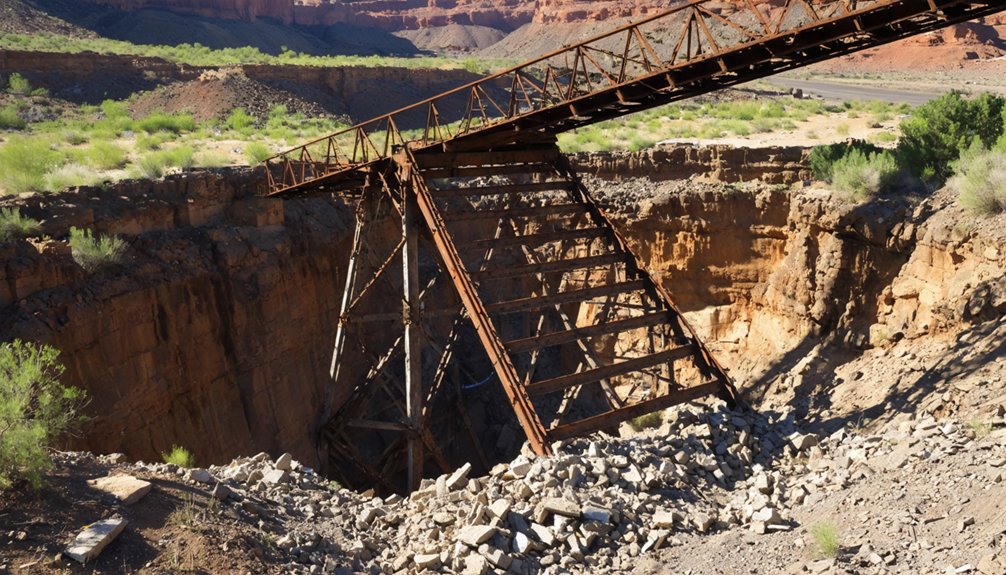
Beyond the invisible threat of water contamination, Nevada’s mining ghost towns harbor immediate physical dangers that can prove deadly to unprepared visitors.
With approximately 200,000 abandoned mines across the state and only a fraction properly secured, you’re entering a landscape where mine shaft hazards lurk beneath seemingly solid ground.
Nevada’s phantom mining heritage conceals deadly subterranean traps where the earth’s crust may give way without warning.
- Deadly vertical shafts plunge hundreds of feet, claiming dozens of lives annually
- Decaying timber supports create imminent structural decay and cave-in risks
- Historic buildings and trestles may collapse under your weight without warning
- Remote locations mean emergency response could be hours away if accidents occur
- Natural inhabitants like venomous snakes and disease-carrying animals have claimed these ruins as habitat
The Nevada AML program works to address these dangers, but thousands of hazardous sites remain, creating an intersection of cultural heritage and lethal risk across the Silver State’s landscape.
Wildlife Adaptation to Abandoned Mines as New Habitats
Where humans fear to tread, wildlife thrives. Nevada’s abandoned mines, once bustling with industrial activity, now serve as unexpected sanctuaries for diverse species. You’ll find at least 19 bat species have adapted to these subterranean spaces, using stable microclimates for roosting, hibernation, and raising young.
These mine ecosystems represent remarkable wildlife adaptations beyond bats. Rodents, reptiles, and birds utilize these structures as refuges from urbanization and climate change. The Townsend’s big-eared bat particularly depends on these artificial caves for survival.
The ecological benefits extend beyond providing shelter. These mines function as wildlife corridors across fragmented landscapes, while bat populations support broader ecosystem services through insect control.
Some species even exhibit genetic uniqueness, having evolved distinct traits in these isolated environments – powerful evidence of nature’s resilience in reclaiming human-altered landscapes.
Ghost Town Formation: Economic Collapse and Environmental Consequences
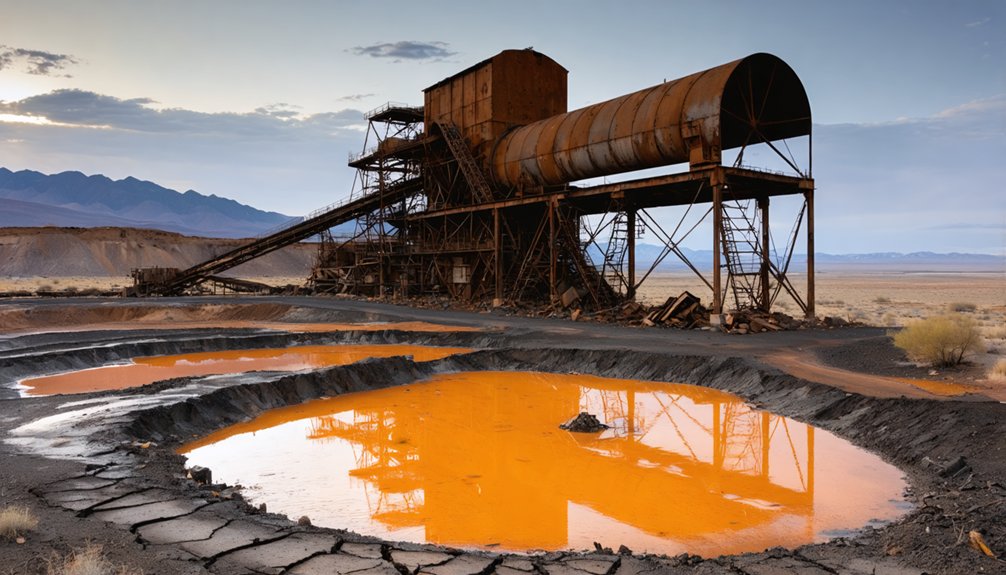
When silver and gold were discovered across Nevada’s rugged terrain, boomtowns sprouted virtually overnight, only to face devastating economic downturns that transformed them into the ghost towns you’ll find scattered throughout the state today.
These abandoned settlements reflect the boom-bust cycle of resource extraction economies, where prosperity vanished as quickly as it appeared.
- Mining booms created instant cities like Rhyolite and Goldfield, complete with infrastructure that now stands decaying.
- The Panic of 1907 triggered sudden collapse, leaving behind toxic heavy metal contamination and acid mine drainage.
- Mercury used in gold processing continues polluting watersheds, with millions of pounds lost in the Carson River.
- Abandoned mines altered local hydrology, disrupting ecosystems and creating hazardous conditions.
- Mining debris, incorporated into local construction, spread contamination beyond original extraction sites.
Reclamation Strategies for Mining-Impacted Landscapes
Although Nevada’s ghost towns stand as stark reminders of abandoned extraction economies, extensive reclamation strategies have emerged to heal these scarred landscapes and mitigate their environmental impacts.
You’ll find that modern approaches blend engineering with ecological principles, reshaping disturbed lands to match natural topography while implementing passive bioreactors to treat contaminated drainage.
Nevada’s regulatory framework now mandates financial assurances—currently $2.6 billion—ensuring companies fund reclamation if they abandon sites.
Reclamation techniques like waste consolidation, topsoil capping, and strategic revegetation with native species transform mining scars into functioning ecosystems.
The most successful ecological restoration projects incorporate wildlife habitat enhancement alongside soil stabilization, creating landscapes that support biodiversity.
Despite these advances, funding limitations and the sheer number of abandoned sites—the highest in the nation—continue to challenge Nevada’s efforts to fully restore its mining legacy.
Protection of Endemic Species in Mining-Adjacent Ecosystems
You’ll find remarkable biodiversity hotspots surrounding Nevada’s ghost towns, where specialized endemic species like the Devils Hole pupfish survive in isolated spring systems that have evolved over millennia.
These fragile aquatic sanctuaries face existential threats from groundwater depletion caused by exploratory mining activities, which can dramatically alter hydrological conditions critical for species survival.
The preservation of pupfish habitats requires integrated conservation strategies that combine legal protections, tribal partnerships, and scientific monitoring to maintain the delicate balance of these unique ecosystems.
Pupfish Habitat Preservation
As mining operations encroach upon Nevada’s fragile desert ecosystems, the preservation of pupfish habitats has emerged as a critical battleground for conservation efforts.
You’ll find these tiny endemic fish fighting for survival in specialized springs where groundwater depletion from nearby lithium mining threatens their existence. Drilling operations could lower aquifers by up to 50 feet locally, potentially drying out the springs these rare species call home.
- Ash Meadows Wildlife Refuge houses 26 endemic species dependent on stable spring flows
- Legal challenges cite failures to assess environmental impacts before approving mining
- Pupfish populations have historically crashed to just 35 individuals when water levels drop
- The Endangered Species Act establishes minimum water levels for habitat protection
- Long-distance hydrological effects make damage often irreversible once detected
Effective pupfish conservation requires habitat restoration and legal enforcement of water rights against resource extraction interests.
Biodiversity Hotspot Protection
While Nevada’s ghost towns stand as historical artifacts of bygone mining booms, their surrounding lands now represent vital biodiversity hotspots requiring urgent protection.
You’ll find places like Ash Meadows National Wildlife Refuge harboring 26 endemic species found nowhere else on Earth, including the critically endangered Devil’s Hole pupfish.
These fragile ecosystems face existential threats from both abandoned and active mining operations. Groundwater disruption from exploratory drilling can devastate the hydrologic systems sustaining these unique species.
The withdrawal of public lands from new mineral claims represents a vital step in biodiversity conservation.
Ecosystem restoration efforts must balance remediation of mining hazards with protection of wildlife that have adapted to these modified landscapes.
Without continued vigilance, mining activities could trigger local extinctions in these irreplaceable biodiversity sanctuaries.
Balancing Heritage Preservation With Environmental Restoration
The challenge of preserving Nevada’s mining ghost towns while addressing their environmental hazards presents a complex paradox for conservationists and historians alike.
You’ll find mining companies supporting heritage tourism through informational kiosks while simultaneously managing ecological balance through reclamation bonds. When exploring these historic landscapes, you’re witnessing an ongoing negotiation between cultural significance and environmental health.
- Archaeological bonds ($1.4 million at Cortez Hills) protect significant mining artifacts
- Historic industrial equipment preservation occurs alongside reforestation efforts
- Local communities collaborate with developers to safeguard cultural values
- Ghost town landmarks remain while surrounding hazards are mitigated
- Tourism initiatives help fund both preservation and environmental restoration
This balanced approach demonstrates how Nevada’s mining legacy can be honored without perpetuating the environmental damage that once characterized the industry.
Frequently Asked Questions
How Do Ghost Towns Affect Local Property Values?
Like sinking ships, ghost towns create property depreciation through abandoned buildings and crumbling infrastructure. You’ll see market perception plummet as economic activity vanishes, triggering a downward spiral affecting neighboring communities too.
Can Abandoned Mining Sites Become Tourist Attractions?
Yes, you’ll find abandoned infrastructure transformed into thriving heritage tourism destinations. These sites blend ecological recovery with cultural preservation, offering you freedom to explore America’s mining past while supporting local economies.
Are There Health Risks for People Visiting Nevada Ghost Towns?
Walking through these ghost towns is like dancing with danger. You’ll face serious health hazards including toxic gases, unstable structures, and heavy metals. Take visitor precautions—stay on marked paths and avoid entering mines.
As you explore, keep an eye out for ghostly encounters at military installations, where whispers of the past linger amidst the ruins. Many report seeing shadowy figures or hearing inexplicable sounds, adding an eerie dimension to the already unsettling atmosphere. Each step could reveal forgotten stories, intertwining the history of these sites with tales of the supernatural.
Who Pays for Cleanup of Unowned Abandoned Mines?
Public funds cover cleanup responsibility when no viable owner exists, with state programs and federal agencies shouldering mining liability costs. You’ll find taxpayers ultimately finance these ecological remediation efforts through various governmental initiatives.
How Long Does Mining Contamination Persist in Soil?
Like a stubborn ghost, mining’s toxic legacy lingers in your soil for centuries. You’ll find contamination duration varies—acid drainage and metal pollution causing soil degradation for decades to millennia without proper remediation interventions.
References
- https://cawaterlibrary.net/wp-content/uploads/2017/05/Environmental-Health-Risks-from-Abandoned-Mines-in-the-Sierra-Nevada.pdf
- https://insideclimatenews.org/news/15072024/nevada-community-fights-lithium-mine-near-wildlife-refuge/
- https://nevadamining.org/cortez-hills-the-story-of-nevadas-newest-large-scale-mine/
- https://minerals.nv.gov/uploadedFiles/mineralsnvgov/content/Programs/AML/2018_NDOM_AML_Final_20190430.pdf
- https://minerals.nv.gov/uploadedFiles/mineralsnvgov/content/Programs/AML/2017_NDOM_AML_Report_Final.pdf
- https://pubs.usgs.gov/sir/2004/5236/text5236.html
- https://www.leg.state.nv.us/Division/Research/LegInfo/Orientation/2010-11/Handouts/Dec7/13-MiningHandouts.pdf
- https://ui.adsabs.harvard.edu/abs/2001AGUFM.H52F..06A/abstract
- https://mavensnotebook.com/2024/10/30/usgs-new-maps-identify-legacy-mercury-contamination-in-the-sierra-nevada/
- https://nbmg.unr.edu/geohazards/MiningRelatedContamination.html