Indian Springs, California was once a thriving resort built over ancient Tongva sacred waters. From 1927 until the 1960s, Charles Bowden’s creation offered swimming, dancing, and horseback riding while serving as an Olympic training ground. Unlike many contemporaries, the springs welcomed all races during segregation. Urban development eventually buried the springs beneath a shopping center, though the waters still flow underground. The silent persistence of these waters tells a deeper story of resilience.
Key Takeaways
- Indian Springs transformed from a Tongva sacred site to a popular 1930s-1940s resort before becoming largely abandoned by 1966.
- The vibrant recreational area featured pools, dance floors, and Mission Revival architecture before urban renewal erased most physical structures.
- Once a multicultural gathering place during segregation, Indian Springs now exists primarily through historical markers and community memory.
- The natural spring waters continue flowing beneath modern infrastructure, symbolizing the persistence of nature despite urban development.
- Archaeological evidence and commemorative plaques document the site’s transition from Indigenous village to recreation area to ghost town.
The Tongva’s Sacred Spring: Indigenous Origins
Long before Indian Springs became a ghost town, the land resonated with the vibrant culture of the Tongva people, who established a flourishing community around the sacred waters of Kuruvungna Springs as early as 500 BC.
Archaeological evidence suggests your connection to this land may extend over 8,000 years, making it one of Southern California’s oldest continuously inhabited sites.
When you visit today, you’re standing where generations of Tongva families lived in harmony with these life-giving waters.
The name “Kuruvungna” means “a place where we’re in the sun” in their Uto-Aztecan language.
These sacred waters weren’t just physical sustenance—they formed the spiritual center of Tongva culture, hosting ceremonies and community gatherings that maintained their ancestral traditions.
The springs were remarkably productive, yielding up to 25,000 gallons daily of fresh water that supported the thriving Tongva settlement.
In 1769, the Portolà Expedition camped at this significant village site, documenting their encounter with the Tongva people and these remarkable springs.
Charles Bowden’s Vision: Creating a Native American Oasis
While the sacred springs had served the Tongva people for millennia, a new chapter began in 1927 when Charles Bowden, a visionary entrepreneur of Blackfoot Native American descent, purchased the land nestled in Montrose canyon.
Inspired by the natural spring and oak grove, Bowden developed an entrepreneurial vision that would transform this environmental treasure into a recreational park.
You’d have found swimming pools, dance floors, stables, and a merry-go-round—all designed as cultural homage to indigenous connections with the land.
The resort balanced modern amenities with preserved natural features, creating a space where the community could gather while honoring Native American heritage.
During a time when such recognition was rare, Bowden’s creation stood as both celebration and commercial interpretation of indigenous traditions.
Indian Springs became one of the few recreational facilities that welcomed non-white visitors during an era of widespread segregation.
The venture faced challenges similar to the ancestral Puebloans who abandoned their settlements when water sources failed due to drought conditions.
Recreational Paradise: Features of the Resort’s Heyday
When Indian Springs Resort reached its peak in the 1930s and 1940s, it transformed into a recreational paradise that perfectly balanced natural beauty with thoughtful amenities.
The golden age of Indian Springs brought nature and comfort together in a canyon oasis unlike any other.
You’d find yourself swimming in the centerpiece pool built over the natural spring, surrounded by a canyon filled with majestic oak trees that provided ample shade.
The resort’s dance floor became the heart of social gatherings, where community events brought together visitors from diverse backgrounds.
You could spend your days enjoying recreational activities like horseback riding at the stables or taking the children for rides on the merry-go-round.
The landscape itself—with its year-round spring water—created a revitalizing atmosphere that kept families returning.
Everything from the architecture to the activities was designed to harmonize with the natural canyon environment, creating a truly inclusive retreat. Visitors could also enjoy games such as bocce ball and shuffleboard on the carefully maintained grounds.
The resort’s Mission Revival architecture gave the property its distinctive historical character that became a hallmark of the Indian Springs experience.
Olympic Training Ground: Athletic Legacy of Indian Springs
Before Indian Springs became a ghost town, it served as a significant training ground for Olympic swimmers from the 1920s through the 1960s.
This racially inclusive facility pioneered athlete conditioning methods using its natural spring water environment, creating a training haven during the segregation era.
What made Indian Springs special for Olympic development:
- Integration of natural environmental factors that enhanced swimmer endurance and recovery
- Innovative water-based training techniques that contributed to advancements in athletic preparation
- Creation of a model that would influence the more formalized Olympic Training Centers established years later
The recreation center attracted diverse visitors from throughout the community due to its welcoming and inclusive environment.
The legacy of Indian Springs as an athletic training ground remains part of California’s Olympic history, despite the property being sold and repurposed in the 1960s—shortly before the establishment of official U.S. Olympic Training Centers began with Colorado Springs in 1978. Unlike Indian Springs’ informal setup, modern USOPC facilities provide comprehensive scientific support with specialized equipment and dedicated sports medicine experts.
Multicultural Haven in Segregated Times
The athletic contributions of Indian Springs extended beyond physical training techniques into the social fabric of Southern California. While public pools across the region enforced strict racial segregation policies during the Jim Crow era, Indian Springs maintained non-discriminatory admission—creating a rare multicultural haven where diverse communities could gather.
Indian Springs stood as an oasis of equality, defying segregation when other pools divided communities by color.
You would have witnessed remarkable cultural exchange as Tongva descendants, Hispanic families, Black communities, and white visitors shared the same recreational space when such integration was virtually nonexistent elsewhere.
This policy of inclusion wasn’t just progressive—it was revolutionary. The spring waters nurtured community resilience, providing marginalized populations access to leisure opportunities systematically denied them throughout the 1920s-1960s.
The facility’s welcoming approach created a social sanctuary where freedom from discrimination could be briefly experienced, establishing Indian Springs as a vital historical counterpoint to institutional segregation. Similar to the Agua Caliente Band of Cahuilla Indians who created communities around sacred healing waters, Indian Springs represented a place where natural resources fostered human connection despite societal divisions. The abundance of water allowed visitors to experience the same natural prosperity that enabled the Agua Caliente to cultivate crops for generations.
Vanishing Act: How a Canyon Became a Parking Lot
Beneath what appears today as an ordinary shopping center parking lot in Montrose lies the extraordinary story of Indian Springs’ physical erasure. In 1966, a new owner executed a complete transformation under the banner of urban renewal, ending decades of communal recreation and natural beauty.
The canyon’s burial happened in three distinct phases:
- Dirt was hauled from the Verdugo Hills Hospital construction site.
- The natural oak grove and spring were completely covered.
- The canyon’s topography was leveled to create today’s flat commercial space.
You can still find a small commemorative plaque marking this lost oasis, but the cultural erasure is profound.
While shoppers park their cars, few realize they stand above flowing waters—the persistent spring that continues its journey underground, outlasting the human reshaping above.
Underground Persistence: The Spring That Refuses to Die
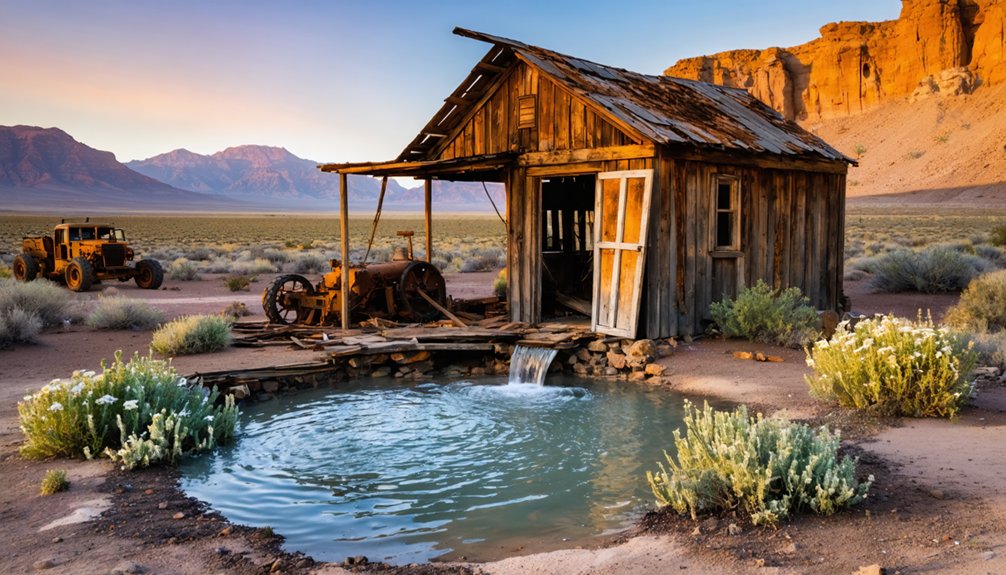
You’ll find the spring’s water still flowing beneath University High School‘s parking lot, a persistent natural force that survived the canyon’s 1960s transformation into urban infrastructure.
The Tongva’s sacred Kuruvungna (“place where we’re in the sun”) continues bubbling up through sand despite a century of development that diverted its once-drinkable waters into municipal drainage.
Though no longer visible in its natural form, this underground waterway represents both ecological resilience and cultural persistence, as the spring refuses to vanish completely despite concrete’s heavy hand.
Flowing Beneath Concrete
Despite decades of urban development and concrete encasement, Indian Springs’ namesake water source continues its determined journey beneath the surface. This remarkable example of urban ecology persists where the Tongva once gathered, defiantly flowing under the layers of human progress that attempted to tame it.
The spring’s resilience manifests in three key ways:
- Sustained underground flow despite being covered by pavement and landfill
- Continued connection to the regional aquifer system that’s existed for millennia
- Resistance to complete elimination despite altered groundwater management practices
You’re witnessing nature’s quiet rebellion—water finding its ancient path regardless of concrete barriers. While you can’t see the spring that once nourished generations of indigenous peoples and later resort-goers, it remains a living symbol of natural systems that refuse to disappear.
Water Outlives History
The resilience of Indian Springs’ water extends far beyond its current hidden existence—it represents a timeless force that has outlived entire civilizations.
You’re witnessing a water legacy that predates modern development by millennia—the same springs that quenched Tongva and Gabrieleno people’s thirst still flow beneath parking lots and buildings today.
What’s remarkable is how these underground reservoirs persist. The spring at Montrose continues its journey beneath construction debris from the 1960s, while Palm Springs’ thermal waters complete a 12,000-year underground cycle before surfacing.
These waters once formed the spiritual and practical center of indigenous life, flowing at rates between 5-60 gallons per minute despite surface abandonment.
Even after development buried Indian Springs under dirt from hospital construction in 1966, the water refuses to disappear—a silent witness to history‘s passing phases.
California’s Pattern of Lost Places: Context for Indian Springs
You’ll find that California’s ghost towns, including Indian Springs, often emerged from transportation shifts that initially created boomtowns around stagecoach stops, railroads, and later highways.
As automobiles replaced trains and new routes bypassed older settlements, once-thriving communities withered when their economic lifelines disappeared.
This boom-bust pattern repeated across the state throughout the 20th century, with Indian Springs representing a microcosm of how changing infrastructure priorities repeatedly transformed California’s landscape.
Transportation Shifts
When railroads carved through California’s rugged deserts and mountains in the late 19th century, they didn’t just transport people and goods—they birthed entire communities.
The Atchison Topeka & Santa Fe Railway established towns like Bagdad and Siberia, creating lifelines across harsh landscapes.
These transportation shifts directly triggered ghost town decline when priorities changed.
You’ll find the pattern repeated across California’s forgotten places:
- Towns flourished at railway stops, supporting passengers, freight, and mining operations
- Mid-20th century highway systems redirected traffic away from rail-dependent communities
- Route 66 bypasses and the end of steam engine service delivered final blows to struggling settlements
Today, you’ll navigate to these abandoned places by car—ironically using the very transportation mode that hastened their demise—finding only crumbling depots and narrow gauge tracks as silent witnesses.
Boom-Bust Development Cycles
California’s boom-bust development cycles follow a familiar yet devastating pattern that’s vividly illustrated by Indian Springs’ rise and fall.
Like hundreds of communities that emerged during the Gold Rush era, Indian Springs followed the predictable trajectory from discovery to abandonment.
When resources were plentiful, you’d have witnessed explosive growth—thousands flocking to previously uninhabited areas, establishing businesses, homes, and community infrastructure within months.
These towns weren’t merely mining camps but functioning communities with diverse economies.
The inevitable resource depletion triggered rapid decline.
Once profitable mines exhausted their yields, economic instability followed swiftly.
What took years to build often collapsed within months as residents abandoned their investments to seek opportunities elsewhere.
Indian Springs represents this cycle perfectly—a community that couldn’t survive when its primary economic engine failed.
What Remains: Commemorative Markers and Memory
Although Indian Springs‘ physical structures have largely disappeared, the memory of this once-thriving California settlement lives on through carefully placed commemorative markers and preserved cultural artifacts.
The commemorative significance of the site is most prominently anchored by an E Clampus Vitus marker from 1954, standing as silent testimony to the area’s historical narratives.
When visiting the remnants of Indian Springs, you’ll find:
- Heritage plaques installed by groups like the Sons and Daughters of Utah Pioneers that document pioneer experiences
- Educational signage emphasizing the layered history of Indigenous peoples, settlers, and migrants
- Archaeological traces including faded petroglyphs and rock art featuring sunburst motifs and animal figures
Unlike Bodie and other ghost towns, Indian Springs lacks extensive gravesites, focusing instead on educational preservation rather than structural remains.
From Natural Wonder to Urban Development: A California Story
If you stand in the parking lot of today’s Montrose shopping center, you’re walking over what was once a verdant canyon with oak trees, abundant wildlife, and a natural spring that served the Tongva people for generations.
The 1966 filling of the canyon with dirt from the hospital construction site represents a common California story—natural wonders sacrificed for commercial development.
You can’t see the spring anymore, but it continues to flow beneath the concrete, a hidden reminder of what this place once was.
Paradise Paved Over
The transformation of Indian Springs from pristine natural wonder to urban development tells a story repeated throughout California’s landscape history.
You would’ve once found a wooded canyon where Tongva people gathered for thousands of years around natural springs and oak groves that offered year-round shade and sustenance.
By the 1960s, this paradise was literally paved over:
- The natural canyon was filled in with landfill
- Original oak groves were removed for construction
- The natural spring was buried beneath urban development
What was once a site of cultural resilience became Charles Bowden’s commercialized Indian Springs Resort in the 1920s.
Today, ecological restoration efforts seek to honor indigenous perspectives rather than continuing patterns where natural wonders are sacrificed for urban expansion and profit.
Springs Beneath Concrete
Beneath the sprawling concrete of today’s shopping center, Indian Springs’ waters still flow—unseen but undeterred.
When developers filled Montrose Canyon in the 1960s, using dirt from the future Verdugo Hills Hospital site, they merely covered—not conquered—the natural springs.
You can’t see the Tongva people’s ancient gathering place or Bowden’s once-vibrant resort, but local urban legends persist about springs revival. Some claim you can still hear water flowing beneath the asphalt on quiet nights.
The shopping center stands as evidence to changing values, where commercial potential trumped cultural preservation.
A small historical marker acknowledges what lies beneath—thousands of years of Indigenous stewardship and decades of community recreation, now entombed under parking spaces.
The water continues its journey, indifferent to the transformation above.
Frequently Asked Questions
Did Any Famous Celebrities Frequent Indian Springs During Its Operation?
Based on available research, we can’t confirm celebrity visits to Indian Springs. You’ll need to explore local historical archives to uncover this community’s potentially significant connections to Hollywood’s past.
What Happened to the Resort’s Original Structures and Equipment?
You’ll find most original structures were buried as landfill in the 1960s, though Calistoga’s Indian Springs preserved some historical architectural remnants through renovation, including the 1910 geothermal pool that’s still operating today.
Are There Any Photographs or Film Footage of Indian Springs?
You’ll find limited photographic evidence from historical archives, with most visual documentation coming from modern ghost town enthusiasts and amateur explorers who’ve captured Indian Springs’ deteriorating structures through personal photography projects and online videos.
Could the Canyon and Natural Spring Theoretically Be Restored Today?
Like raising the dead, restoration potential exists theoretically, but you’d face monumental environmental challenges excavating 75 feet of landfill, redirecting underground springs, and reviving an ecosystem buried beneath decades of development.
Did Any Paranormal Activity or Legends Surround Indian Springs?
You won’t find documented ghost sightings or paranormal legends at Indian Springs. Historical records focus on its natural springs and recreational history rather than supernatural tales common to other California ghost towns.
References
- https://abc7.com/post/montrose-indian-springs-pool-history/10456904/
- https://www.youtube.com/watch?v=jOKMDqfEajQ
- https://www.cityofindianwells.org/our-city/about/visiting-the-desert/history-of-indian-wells
- http://www.rosamondca.us/history/WillowSprings.htm
- https://www.legendsofamerica.com/ca-mojaveghosttowns/
- https://en.wikipedia.org/wiki/List_of_ghost_towns_in_California
- https://nvtami.com/2024/01/23/northern-washoe-county-ghost-towns-2/
- https://smconservancy.org/property/kuruvungna-sacred-springs/
- https://kids.kiddle.co/Tongva_Sacred_Springs
- https://www.altaonline.com/dispatches/a6456/kuruvungna-secret-sacred-spring-in-west-l-a/