Colonial ghost town investigations require a balance of historical research and scientific methodology. You’ll need to establish environmental baselines, document all findings systematically, and research the location’s traumatic history. Many paranormal claims in abandoned settlements stem from collective trauma, natural psychological phenomena, or environmental factors. Controlled experiments comparing haunted sites with non-haunted locations can enhance credibility. Proper investigation techniques reveal whether spectral encounters reflect genuine anomalies or simply our connection to America’s complex past.
Key Takeaways
- Scientific paranormal investigations use baseline measurements, historical research, and controlled experiments to objectively examine colonial ghost towns.
- Abandoned colonial sites often experience paranormal activity correlating with historical trauma, violence, and sudden population exodus.
- EVPs, temperature fluctuations, and electromagnetic anomalies are common documented phenomena at historic ruins like Jamestown and Fort Mifflin.
- Spectral encounters often reflect cultural intersections of European and indigenous spiritual traditions in colonial American settings.
- Preservation efforts must balance paranormal tourism with protecting structural integrity of historically significant abandoned colonial sites.
The Historical Foundations of Colonial Abandonment
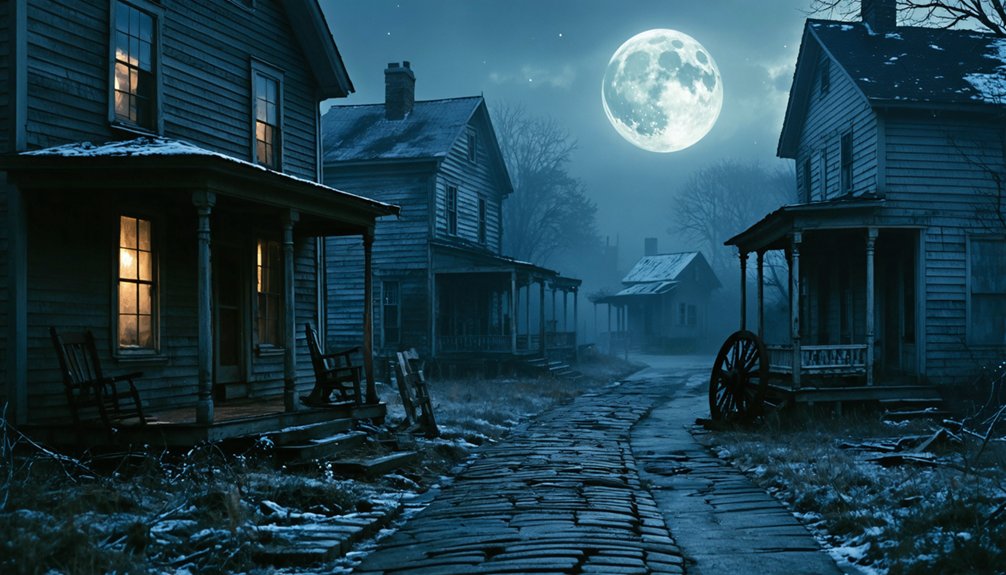
While many visitors to colonial ghost towns are drawn to their paranormal reputation, understanding the historical foundations of their abandonment reveals far more mundane explanations than supernatural forces.
You’ll find economic decline and resource depletion at the core of most desertions, particularly in mining towns where gold, silver, and copper extraction ceased being profitable. This pattern is clearly illustrated in Bodie, California, where the once-thriving community was abandoned due to declining gold supply.
Natural disasters accelerated many towns’ demise, with hurricanes, floods, and fires destroying essential infrastructure.
The shifting of transportation routes left once-thriving communities isolated, as railroad closures cut lifelines to markets.
Agricultural failures from drought or freezes devastated farming settlements, while sociopolitical conflicts, particularly during the Civil War, altered the significance of certain colonial outposts.
Urban centralization ultimately drew populations away from these remote settlements, completing the shift from boom to abandonment. In the United States alone, approximately 3,800 ghost towns stand as testament to this cycle of growth and decline.
Documented Spectral Encounters in Early American Settlements
Although skeptics might dismiss colonial ghost stories as mere folklore, early American settlement records contain numerous documented spectral encounters that reveal the intersection of religious fears, cultural trauma, and indigenous spiritual beliefs.
You’ll find Cotton and Increase Mather’s meticulous accounts of poltergeists and demonic manifestations reflecting Puritan anxieties, while Richard Chamberlayne’s “Lithobolia” details supernatural stone-throwing at a New Hampshire tavern.
These spectral narratives weren’t isolated—they formed a coherent colonial folklore tradition.
Colonial ghost stories represent not disconnected tales but a unified spiritual narrative threading through America’s earliest settlements.
Revolutionary battlefields later became hotspots for phantom soldier sightings, particularly the recurring “Headless British Officer” preceded by spectral hoofbeats.
Virginia’s hauntings uniquely blend European and indigenous spiritual traditions, incorporating Algonquian, Siouan, and Iroquois beliefs.
The Nelly Butler case exemplifies how these encounters weren’t merely frightening—they often conveyed warnings and prophecies to the living.
Paranormal investigators suggest these manifestations persist because traumatic events from Revolutionary battles leave residual energy that continues to affect locations like Fort Mifflin and Jockey Hollow.
Charles Brockden Brown’s novel “Wieland” further explored these supernatural elements through psychological horror that resonated with colonial fears of isolation and religious fanaticism.
Scientific Approaches to Colonial Paranormal Investigation
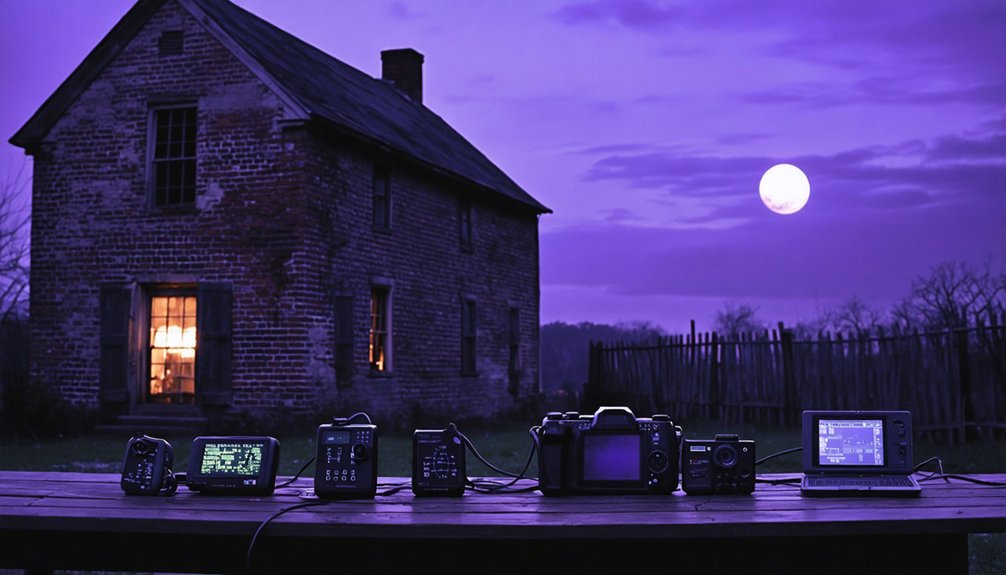
Despite the supernatural folklore permeating colonial American history, modern paranormal investigation employs rigorous scientific methodologies to examine spectral claims objectively.
When you investigate colonial sites, you’ll need to establish baseline measurements before equipment calibration to distinguish genuine anomalies from environmental interference. Historical research into local accounts and events is crucial for providing contextual background information for any paranormal claims you encounter.
You’re encouraged to combat confirmation bias by systematically documenting all findings—both supporting and contradicting paranormal hypotheses.
Apply thermal imaging to identify cold spots in colonial structures while simultaneously recording EMF fluctuations and potential EVPs. Be aware that localized temperature variations might actually result from air conditioning drafts rather than supernatural presence. Your investigation gains credibility through controlled experiments comparing allegedly haunted locations with similar non-haunted sites.
Remember that freedom to explore the unknown thrives alongside methodical procedures.
The Connection Between Historical Trauma and Ghostly Manifestations
The psychological echoes of collective trauma often manifest as spectral phenomena in locations scarred by historical violence. When you investigate colonial ghost towns, you’re encountering more than mere folklore—you’re witnessing the unconscious processing of unresolved historical trauma through ghostly manifestations.
Research demonstrates a significant correlation between childhood trauma and paranormal experiences (r = .44), with emotional abuse showing the strongest connection. This relationship is mediated by transliminality—a heightened sensitivity to psychological material from your unconscious. Many of these ghostly encounters may be attributed to experiences of sleep paralysis during which individuals report sensing presences and seeing apparitions.
In post-colonial settings, these apparitions function as metaphors for cultural erasure and displacement, preserving collective memory when official records fail. They represent resistance against dominant narratives and reconnection with suppressed heritage.
Case Studies: America’s Most Haunted Colonial Ruins
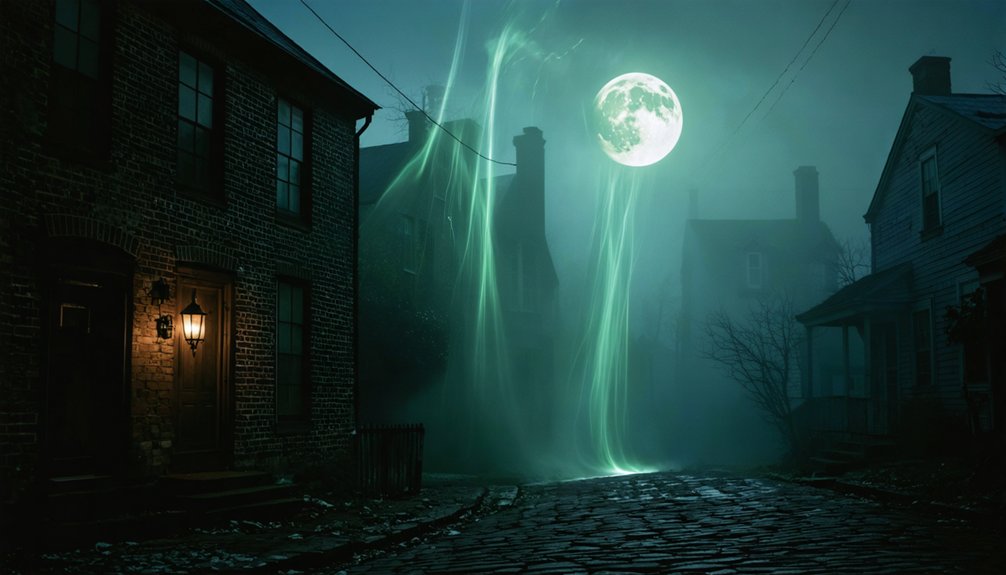
When you examine the legends of Roanoke’s Vanishing Specters, you’ll find consistent patterns of apparitions appearing at sunset near the original settlement’s perimeter.
Jamestown’s Restless Souls present more complex paranormal activity, with documented temperature fluctuations and electromagnetic anomalies concentrated around excavated gravesites.
These colonial spectral phenomena correlate strongly with historical records of violent deaths, suggesting traumatic imprints may persist in locations where sudden mortality rates exceeded normal patterns. Similar to the Winchester House, where Sarah Winchester built continuously for 38 years to appease the spirits of victims killed by Winchester rifles.
Fort Mifflin follows this pattern with its pivotal role in the Revolutionary War creating conditions for persistent hauntings, as the largest bombardment of the conflict resulted in nearly 250 casualties.
Roanoke’s Vanishing Specters
Throughout centuries of American colonial history, few paranormal enigmas have captivated investigators as persistently as Roanoke’s vanishing specters.
The 1902 Woman in Black phenomenon represents one of Roanoke’s most documented hauntings, where a mysterious figure targeted married men walking home after dark, vanishing before they reached their doorsteps.
You’ll find spectral sightings extend beyond this apparition to specific locations like Room 606, where investigators have recorded electronic voice phenomena and reported a female ghost descending from the ceiling.
The abandoned Patterson Avenue mansion, with bodies discovered beneath its foundation, further exemplifies how physical evidence sometimes corroborates paranormal claims. This Victorian-era structure originally served as a funeral parlor, contributing to its macabre reputation among local residents.
When analyzing these occurrences methodically, the Lost Colony’s disappearance—marked only by the enigmatic “Croatoan” carving—emerges as the foundational mystery underlying Roanoke’s persistent supernatural reputation.
Jamestown’s Restless Souls
Beneath crumbling colonial facades, Jamestown’s restless souls continue to manifest in ways that challenge conventional explanations.
At Ambler Mansion ruins, you’ll encounter documented temperature anomalies and visual phenomena consistent with sites built atop mass graves. The empirical evidence—EVPs, unexplained mist formations, and recurring apparition patterns—warrants methodical investigation.
The Jamestown Church grounds present a particularly compelling research opportunity. With over 100 graves dating to the 1600s, the site yields consistent spectral sightings and measurable atmospheric disruptions.
Your likelihood of encountering paranormal activity increases near Lady Lydia’s reported manifestation zones or the Peyton Randolph House, where a young soldier’s apparition follows predictable patterns.
These ghostly legends aren’t merely colonial folklore—they represent observable phenomena awaiting proper scientific documentation and analysis.
Preservation Challenges in Paranormally Active Historic Sites
When you investigate paranormally active historic sites, you’ll encounter the complex challenge of managing curious tourists without compromising structural integrity or alleged supernatural conditions.
Documentation methods for paranormal claims must be developed alongside traditional historic preservation techniques, creating methodologies that acknowledge both tangible artifacts and reported ethereal phenomena.
Environmental degradation poses particular concerns at these locations, as weather damage and climate change effects may alter both the physical structures and the reported paranormal characteristics that make these sites culturally significant.
Balancing Tourism With Preservation
The delicate balance between tourism development and historical preservation presents significant challenges for managers of paranormally active colonial ghost towns.
Exploring abandoned sites in California offers a unique glimpse into the past and invites a deeper understanding of local history. These forgotten places, when approached with respect and care, can become rich educational experiences for communities and visitors alike. However, this exploration must also align with efforts to preserve the stories and structures that define California’s diverse heritage.
You’ll notice effective preservation strategies minimize tourist impact through controlled access points and rotation of visitation areas, allowing damaged sections to recover without closing entire sites.
When you visit these locations, you’re participating in an economic ecosystem that must sustain both local communities and conservation efforts.
Successful management frameworks involve you in the preservation process through educational programs that transform passive sightseers into preservation advocates.
The most effective approaches don’t merely restrict access but create sustainable visitation models where your tourism dollars directly fund restoration projects.
This creates a self-sustaining system where increased interest in paranormal phenomena actually enhances, rather than degrades, these irreplaceable historical treasures.
Documenting Ethereal Heritage
Documenting paranormal phenomena presents unique preservation challenges that extend beyond typical historical conservation efforts.
When you record ghostly folklore, you’re balancing the integrity of historical structures with the public’s fascination with the supernatural. Paranormal investigations often introduce equipment and increased foot traffic that accelerate deterioration of fragile artifacts and architecture.
Your documentation methods must respect both the physical site and its spectral narratives without compromising preservation standards. Invasive techniques not only damage historical materials but potentially misrepresent the site’s actual significance.
The ethical dimensions are equally critical—recording paranormal experiences shouldn’t exploit historical tragedies or sacred spaces for mere entertainment value. Instead, develop protocols that protect the site’s physical integrity while acknowledging the cultural importance of supernatural beliefs that have become entwined with the location’s heritage.
Environmental Impact Concerns
Although many heritage preservation specialists focus on structural integrity and artifact conservation, environmental impact concerns present equally critical challenges at locations reputed to have paranormal activity.
When examining these historic sites objectively, you’ll find the actual documented threats are development pressures, climate change impacts, and neglect—not supernatural phenomena.
Urban expansion threatens formerly isolated ghost towns as property values rise, while coastal and riverside historic settlements face increasing damage from severe weather events.
The preservation strategies needed address tangible problems: the National Park Service’s $12 billion maintenance backlog, remote sites vulnerable to vandalism, and sustainable funding mechanisms.
Rather than focusing on unsubstantiated paranormal claims, effective preservation requires addressing environmental degradation through heritage tourism initiatives that revitalize these abandoned communities while protecting their authentic historical significance.
Frequently Asked Questions
Can Paranormal Activity Increase During Specific Lunar Phases or Weather Conditions?
Yes, you’ll likely experience increased paranormal activity during full moon lunar cycles. Weather patterns including electromagnetic disturbances and atmospheric pressure changes may influence manifestations, though scientific evidence remains inconclusive.
Do Spiritual Beliefs of Colonial Settlers Influence Types of Hauntings Reported?
While skeptics might dismiss the connection, you’ll find colonial settlers’ historical beliefs directly shaped hauntings through cultural rituals that reverberate today—their Puritan worldview transforms residual energy into manifestations reflecting their religious anxieties.
How Do Native American Spiritual Traditions Interpret Colonial Ghost Phenomena?
You’ll find Native American spiritual beliefs frame colonial hauntings as disrupted passages—souls trapped by violent deaths and desecrated sacred lands requiring ceremonial intervention to restore cultural balance and spiritual harmony.
Can Modern Construction Trigger Increased Paranormal Activity in Colonial Sites?
Like old wounds reopened by a surgeon’s knife, construction disturbances can seemingly amplify historical reverberations. You’ll find evidence suggesting physical disruption of colonial sites correlates with increased reports of paranormal activity, though skeptical analysis remains essential.
Do Paranormal Experiences Differ Between Visitors and Long-Term Local Residents?
Yes, your visitor experiences typically involve isolated, sensational encounters, while resident perceptions reveal gradual, normalized phenomena with deeper historical context—suggesting different psychological frameworks shape how each group interprets paranormal events.
References
- https://studyfinds.org/americas-ghost-towns/
- https://nightofthejack.com/2025/01/23/top-creepy-ghost-towns-in-america/
- https://en.wikipedia.org/wiki/List_of_reportedly_haunted_locations_in_the_United_States
- https://dailypassport.com/spooky-small-u-s-towns/
- https://ghostcitytours.com/news/top-10-most-haunted-cities-america/
- https://www.purewow.com/travel/haunted-small-towns
- https://colonialghosts.com/top-ten-haunted-places-in-eastern-virginia/
- https://www.notesfromthefrontier.com/post/untitled
- https://www.geotab.com/ghost-towns/
- https://www.christywanders.com/2024/08/top-ghost-towns-for-history-buffs.html