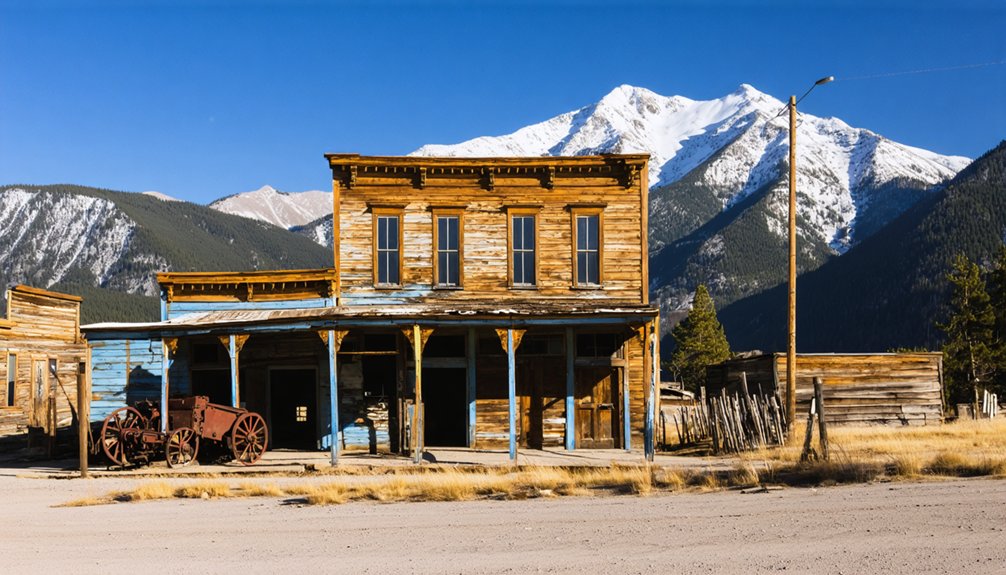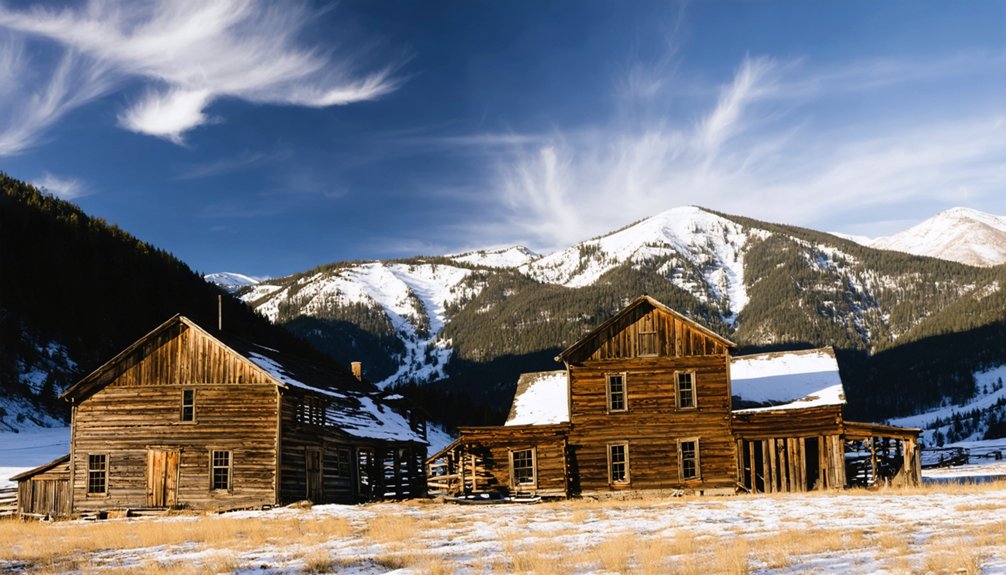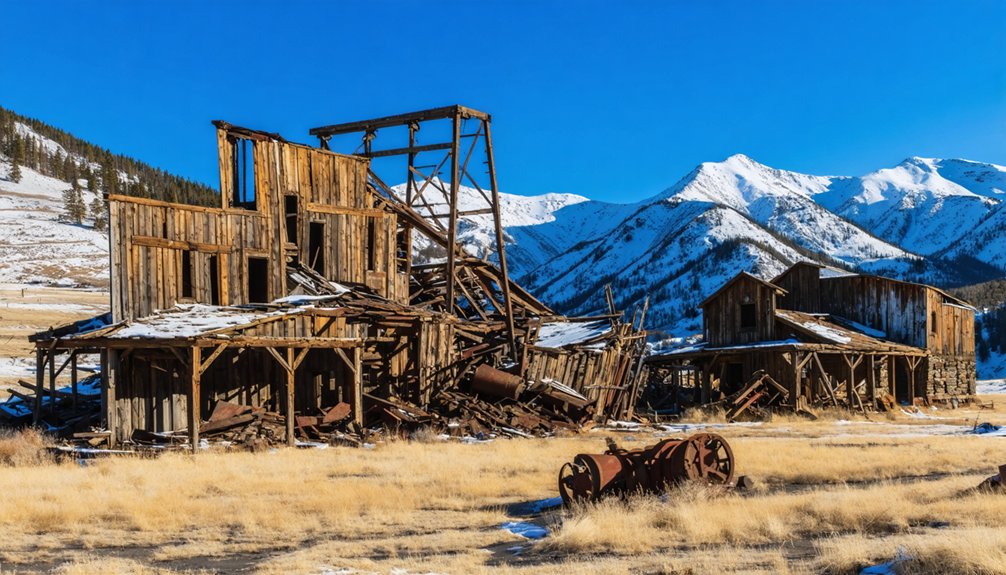
You’ll find Jefferson’s remnants in Park County, where this 1860s settlement emerged from the extralegal Jefferson Territory movement before transforming into a railroad hub. Named after Thomas Jefferson, the town thrived on gold mining, ranching, and rail commerce until the 1893 silver crash devastated Colorado’s economy. At its peak, Jefferson supported 300 residents with diverse businesses—from cheese factories to stage depots—before the railroad’s 1899 dismantling sealed its fate. The story behind its depot ruins and environmental transformations reveals how infrastructure, not just minerals, shaped frontier development.
Key Takeaways
- Founded in 1860 as Jefferson City during Colorado’s gold rush, named after President Thomas Jefferson and part of extralegal territorial movement.
- Economy thrived on placer gold mining, ranching, and railroad operations until the 1893 silver crash caused economic collapse.
- Railroad construction in 1879 transformed it into a transportation hub connecting Denver and mining districts with depots and freight yards.
- Population peaked at 300 residents by 1881, supported by saloons, stores, mills, and infrastructure serving miners and ranchers.
- Today remains a small ranch supply center with visible railroad remnants and structures marking its historical significance.
From Multiple Names to Jefferson: The Town’s Founding in 1860
When gold fever gripped the eastern slopes of the Rocky Mountains in 1860, prospectors streaming into the region established Jefferson City as part of the broader territorial aspirations of miners who’d grown impatient with distant governance. You’ll find this settlement emerged from the extralegal Jefferson Territory movement, where prospectors declared independence from Kansas Territory’s jurisdiction.
The town’s naming reflected their provisional government structure—a bold assertion of self-determination in territory Washington hadn’t officially organized.
Territorial boundaries remained fluid as Jefferson cycled through administrative designations. Mining technology advances in nearby Black Hawk and Central City created demand for supply stations, positioning Jefferson City as a vital staging point.
The settlement eventually simplified its name to “Jefferson” following Colorado Territory‘s official organization in 1861, marking its progression from provisional camp to recognized community. Robert W. Steele served as the territory’s governor from 1859 to 1861, providing crucial leadership during this transitional period. The region had been part of the Arapaho’s traditional territory in Colorado, where they had expanded from their earlier northern plains homelands.
The Jefferson Territory Era and Administrative Transitions
As gold seekers flooded Colorado’s mountain valleys in 1859, they found themselves governing a political vacuum—Kansas Territory’s administration sat 600 miles east, offering no practical jurisdiction over mining disputes or civil order.
You’ll discover that residents formed the extralegal Jefferson Territory on October 24, 1859, electing Robert W. Steele as governor and establishing a General Assembly.
Though unrecognized by Washington, this provisional government created courts and enacted laws addressing frontier needs. Political disputes plagued the territory when Arapahoe County courts challenged Jefferson’s judicial authority, and many citizens refused to acknowledge its legitimacy.
Jefferson Territory operated without federal approval, establishing its own courts and laws while facing constant challenges to its judicial legitimacy from rival authorities.
When Congress established Colorado Territory in February 1861, Steele disbanded Jefferson on June 6. The provisional government organized 12 counties during its first legislative session, establishing local administrative structures across the region. Yet Jefferson’s legal framework wasn’t wasted—Colorado’s General Assembly reenacted many of its statutes. The territory was named after President Jefferson, whose Louisiana Purchase had opened western lands to American expansion.
Gold Mining as the Primary Economic Engine
Gold discoveries transformed Colorado from a remote territorial outback into a magnet for thousands of fortune-seekers who’d reshape the region’s destiny.
You’ll find the 1858 Pikes Peak Gold Rush sparked America’s second-largest mining excitement, establishing permanent settlements like Denver City near Cherry Creek’s confluence with the South Platte.
Lewis Ralston’s June 1850 discovery at Ralston Creek preceded George Jackson’s January 1859 strike at Idaho Springs, but John Gregory’s May 1859 find at Gregory Gulch created the first true bonanza.
Jefferson County’s coal mines provided essential fuel for steam locomotives and ore-processing mills, while industrial artifacts from this era reveal how cultural influences from Georgia prospectors and Eastern settlers merged.
Central City became the “Richest Square Mile on Earth,” dominating Colorado’s economy for two decades.
The district’s hardrock mining declined in the 1860s when prospectors struggled with sulfide processing difficulties, though a successful smelter built in 1868 revived operations.
The Arapahoe Bar placer mining district organized along Clear Creek in November 1858, marking one of the earliest formal mining operations in the region.
Diversification: Ranching, Railroad, and the Cheese Factory
Though Jefferson’s economy began with gold fever, the town’s survival depended on its ability to pivot toward sustainable enterprises that could outlast depleted veins. After 1860, you’d find ranching practices transforming South Park’s grasslands into profitable cattle operations, anchoring settlement when ore prices collapsed.
The town’s strategic position as a railroad stop enhanced connectivity until 1933, linking remote ranchers to distant markets. Jefferson stands today as one of Park County’s permanent communities, distinguishing itself from completely abandoned settlements scattered throughout the region.
Jefferson’s most distinctive venture showcased agricultural innovation few frontier settlements attempted:
- Cheese factory operations processing local dairy into marketable products
- Railroad infrastructure enabling efficient livestock and goods transport
- Integrated ranching-rail economy creating resilient revenue streams
This diversification strategy allowed Jefferson to persist where single-industry camps vanished, combining cattle, transportation, and dairy processing into an economic model that sustained Park County’s inhabitants long after gold fever subsided. Like Crystal City’s transformation into a tourist resort hosting parties, Jefferson adapted its identity beyond mining origins to ensure survival through changing economic conditions.
Population Growth and Infrastructure Development
You’ll find Jefferson’s transformation from railroad infrastructure to bustling community remarkably swift—the 1878 wye, water tower, and stock pens attracted 300 residents by 1881.
This rapid expansion demanded essential services and commercial buildings that archives show sprouted along the tracks to support miners, ranchers, and railroad workers.
The community’s growth mirrored patterns seen in settlements like Winfield, which grew to 1,500 residents within nine years of founding, complete with saloons, stores, and a school.
Yet Jefferson’s population proved as volatile as the mining economy itself, with the same infrastructure that enabled growth becoming monuments to the town’s eventual decline.
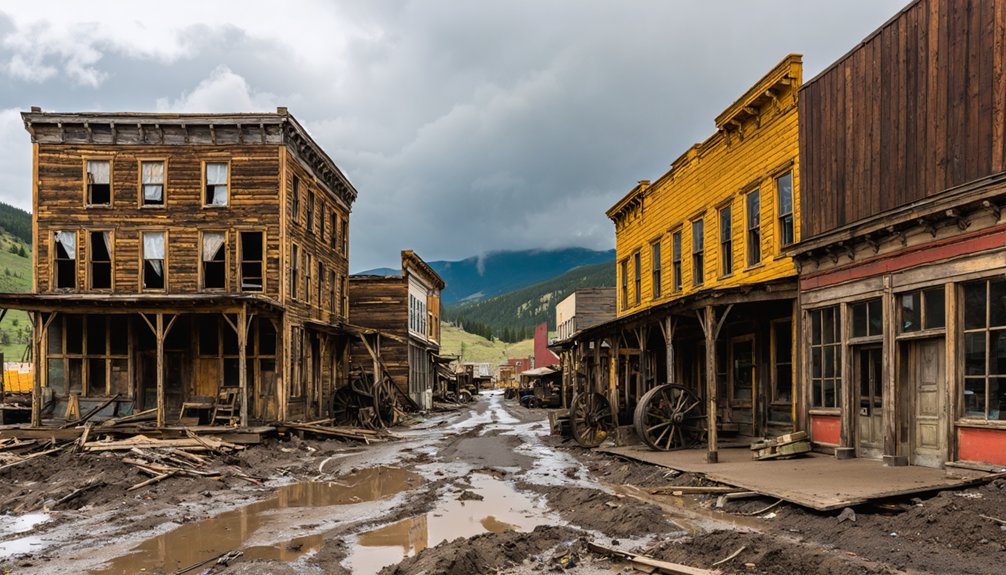
The town’s history is preserved through visual documentation that captures the remaining structures and landscape of this abandoned Colorado settlement.
The history of Patterson, Colorado is a fascinating tapestry woven from the stories of its early settlers and the challenges they faced. As time marched on, the town witnessed both growth and decline, leaving behind relics that tell tales of resilience and aspiration. Today, these remnants serve as a poignant reminder of a past that continues to captivate the imagination of visitors and historians alike.
Mining Boom Population Surge
When the Pikes Peak Gold Rush erupted in 1858 as the second largest mining excitement in U.S. history, prospectors flooded into the region and transformed empty valleys into bustling settlements almost overnight. You’d witness population explosions that defied belief—Central City ballooned from 10 residents to 10,000 within a single month during summer 1859 after John Gregory’s strike at Gregory Gulch.
The demographic surge reshaped Colorado’s political landscape through three distinct waves:
- Initial Rush (1858-1859): 30,000 settlers arrived within 18 months, with Park County alone absorbing one-third.
- Silver Boom Era (1877-1880): Leadville rocketed from 200 to 15,000+ residents.
- Territory to Statehood: Population growth justified Colorado Territory formation in 1861 and statehood by 1876.
Prospecting techniques and mining slang spread as quickly as the fortune-seekers themselves.
Essential Services and Buildings
As the Denver, South Park & Pacific Railroad stretched its tracks across South Park in 1879, Jefferson’s infrastructure materialized around the transportation lifeline that would define its existence.
You’ll find the frame depot and two-story section house anchored the community’s northeast-to-southwest alignment, while W.R. Head’s log hotel served stagecoach travelers and ranch patrons alike.
By 1884, essential businesses lined the tracks: two butcher shops, a blacksmith, saloon, lumber mill, and general store with attached harness shop.
The small school building doubled as community hall for meetings and monthly church services when Father Dyer rode through.
This historical architecture supported 75-80 permanent residents and surrounding ranchers.
Head formalized the 40-acre townsite in 1883, creating South Park’s supply hub.
Economic Decline and Exodus
Jefferson’s economic foundation crumbled when the railroad that created it proved insufficient to sustain long-term prosperity.
You’ll find the town’s decline mirrored patterns across Colorado’s mining frontier, where competing settlements drained populations and resources.
Environmental challenges compounded Jefferson’s struggles as harsh winters and difficult terrain made operations increasingly impractical.
The exodus occurred through three distinct phases:
- Population drainage to richer deposits discovered in nearby camps during the 1858-59 gold rush
- Infrastructure decline as residents relocated entire buildings to more prosperous Golden City
- Final abandonment when rail service and mining operations ceased permanently
Life in a Multi-Purpose Frontier Settlement
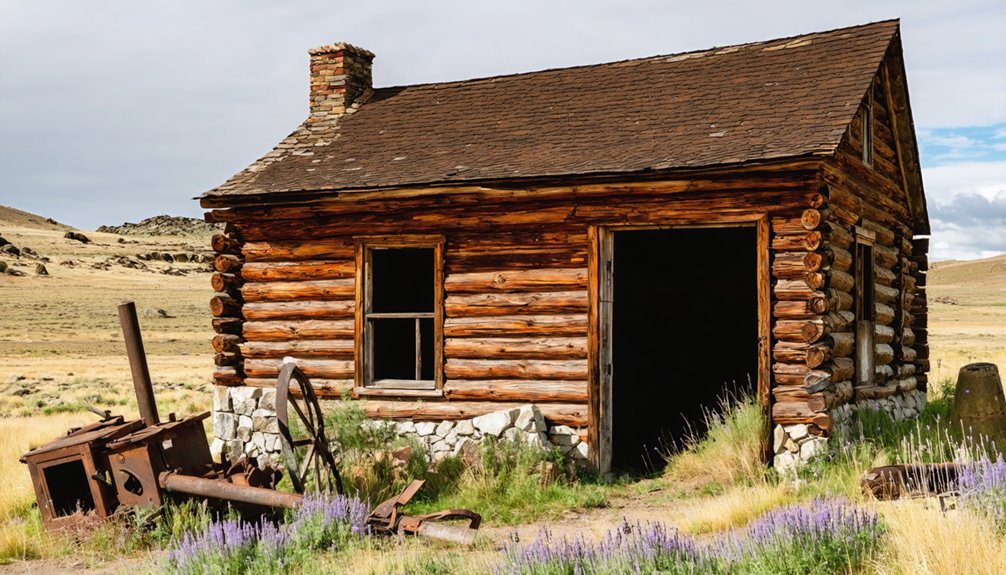
You’d find George Morrison’s home serving as the town’s nerve center—simultaneously operating as a hotel, stage depot, post office, general store, and family residence.
Daily life revolved around supporting gold rush traffic through toll road operations that connected miners to camps in Black Hawk and Central City.
The settlement’s infrastructure remained minimal by design, with free land plots distributed to attract just enough residents to maintain these essential staging operations for westbound prospectors.
Mining and Ranching Operations
Gold wasn’t the only game in town when Jefferson City sprang to life in 1860. You’d find settlers pursuing diverse ventures that defined true frontier independence.
Mining techniques evolved from simple placer operations in Clear Creek to more sophisticated extraction methods, while ranching development transformed the landscape into productive grazing land.
The settlement’s economic foundation rested on three pillars:
- Placer gold mining along Clear Creek using pans and sluices
- Cattle and sheep ranching on open range adjacent to mining claims
- Dairy production including a cheese factory serving local markets
Railroad Commerce and Trade
When the railroad arrived in 1860, Jefferson transformed from an isolated mining camp into a crucial transportation hub connecting Colorado’s frontier settlements.
You’ll find that the Denver, Leadville, and Gunnison network established Jefferson as a key junction point, where miners, supplies, and commercial goods moved freely between Denver and Central City’s gold districts.
The town’s railroad architecture included depot facilities, freight yards, and equipment storage that supported diverse commerce—from mining equipment to cheese factory products.
These logistics networks enabled independent ranchers and entrepreneurs to access eastern markets through South Park’s rail corridors.
However, when authorities dismantled the infrastructure in 1899 and rerouted lines southward, Jefferson’s economic independence collapsed, ultimately contributing to its transformation into the ghost town you can explore today.
Community Infrastructure Development
How did a remote Colorado settlement transform itself from railroad junction into a self-sustaining frontier community? You’ll find Jefferson’s evolution reflected in its multi-purpose structures that maximized limited resources. The post office opened October 3, 1879, establishing official recognition, while a defunct cheese factory found new life as a community gathering hall.
Jefferson’s practical approach to frontier living included:
- Educational and Religious Spaces: The small schoolhouse doubled as a monthly church venue, hosting Father Dyer’s services.
- Commercial Hub: Head’s log house served simultaneously as hotel, stage stop, and residence.
- Industrial Support: A lumber mill and blacksmith shop provided essential construction and repair services.
This northern architecture reflected frontier pragmatism, where 75-80 permanent residents shared spaces rather than duplicating facilities in their 40-acre townsite.
The Silver Crash of 1893 and Economic Collapse
By 1893, the federal government’s monetary policies had created an unsustainable situation in the American silver industry. The Coinage Act of 1873 had established a gold standard, yet subsequent legislation forced Treasury purchases of millions of silver ounces annually.
This government intervention flooded the silver market, driving prices from 83 cents to 62 cents per ounce. Economic indicators revealed catastrophic consequences: unemployment reached 40-50% in mining communities, with nearly 100% in single-mine towns.
Colorado’s silver-dependent economy collapsed entirely—mines shuttered, fortunes vanished, and business ceased for three years. You’d witness 15,242 national business failures averaging $22,751 in liabilities each.
The crisis equaled the Great Depression‘s severity, proving how federal monetary manipulation could devastate entire regions and industries.
Treacherous Roads and the Final Years of Occupation
As Jefferson’s economic importance faded after the silver crash, the town’s physical isolation became increasingly untenable. The accessibility challenges that once seemed manageable during prosperous times now spelled doom for remaining residents.
Mountain passes surrounding Jefferson presented formidable obstacles:
The treacherous mountain passes encircling Jefferson transformed from mere inconveniences during boom times into insurmountable barriers hastening the town’s inevitable decline.
- Scofield Pass routes remained among Colorado’s roughest roads, requiring buildings to be transported over precarious four-mile stretches.
- Winter supply operations demanded fifty men tunneling through massive snow drifts to maintain packtrain access.
- High elevation locations near 9,000 feet complicated year-round transportation to mining camps.
Legacy and Historical Importance in Jefferson County
Unlike the isolated mining camps that preceded it, Jefferson established its legacy through transportation infrastructure rather than precious metals. You’ll find its historical importance stems from the 1879 Denver, South Park & Pacific Railroad depot that transformed indigenous history’s ranchlands into a commercial hub.
The environmental changes brought by rail construction—wye tracks, water towers, and stock pens—reshaped Park County’s economy permanently.
Jefferson’s contribution to regional development mirrors its modern role as a ranch supply center. Though population never exceeded 300 residents, you can still trace its influence through surviving depot structures and rail embankments.
The town preserved Colorado’s frontier expansion pattern where transportation networks, not gold strikes, created lasting settlements. These visible artifacts document how railroad infrastructure fundamentally altered territorial landscapes.
Frequently Asked Questions
What Remains of Jefferson’s Original Buildings and Structures Today?
You’ll find Jefferson survived as a permanent community with some original or restored buildings, unlike typical abandoned buildings in Park County’s ghost towns. Historic preservation efforts rescued structures, though harsh winters destroyed most fragile remnants at high elevations.
Can Visitors Legally Access the Jefferson Ghost Town Site?
Legal access to Jefferson’s site isn’t publicly documented, so you’ll need to verify current ownership and obtain permission before visiting. Follow safety guidelines, respect private property rights, and check local regulations to avoid trespassing charges.
Were There Any Notable Conflicts or Crimes in Jefferson’s History?
Yes, you’ll find Jefferson’s history marked by rampant claim-jumping and mining disputes among 1859 gold-seekers. Without proper law enforcement or legal frameworks, violence escalated until settlers established the provisional Jefferson Territory to address the chaos.
What Native American Tribes Originally Inhabited the Jefferson Area?
You’ll find the Ute, Arapaho, and Cheyenne Native tribes originally called this land home. The Utes maintained strongest cultural influence here, using Indian Hills as their primary summer campground and meeting place for centuries before settlers arrived.
How Does Jefferson Compare to Other Nearby Colorado Ghost Towns?
Jefferson’s mining history mirrors nearby ghost towns like Mount Vernon and Puma City, though you’ll find fewer tourist attractions here. Unlike Buckskin Joe’s thousands, Jefferson remained smaller, leaving minimal physical evidence of its boom-and-bust cycle.
References
- https://www.uncovercolorado.com/ghost-towns/mount-vernon/
- https://southparkheritage.org/where-have-all-the-ghost-towns-gone-by-christie-wright/
- https://janmackellcollins.wordpress.com/category/colorado-ghost-towns-2/
- https://coloradosghosttowns.com/Jefferson City Colorado.html
- https://en.wikipedia.org/wiki/List_of_ghost_towns_in_Colorado
- https://www.jeffco.us/3161/Jeffco-Sesquicentennial
- https://www.goldenhistory.org/arapahoe-city-jefferson-countys-first-city/
- https://en.wikipedia.org/wiki/Arapahoe
- https://kids.kiddle.co/Arapahoe
- https://historicjeffco.wordpress.com/wp-content/uploads/2015/02/2010histjeffco31.pdf