You’ll find Johnny Ringo’s grave in Turkey Creek Canyon within the Chiricahua Mountains, about 50 miles east of Tombstone, Arizona. The site marks where the notorious gunfighter’s body was discovered in July 1882 with a fatal head wound—officially ruled suicide despite lingering conspiracy theories. Access requires driving 4.5 miles on Turkey Creek Road off Highway 181, then walking 45 yards to the fenced grave on private ranch property. The site’s open daily 8 a.m. to 6 p.m., with the full story revealing intriguing forensic mysteries and conflicting evidence.
Key Takeaways
- Johnny Ringo’s grave is located in Turkey Creek Canyon, 50 miles east of Tombstone in Arizona’s Chiricahua Mountains foothills.
- The site is accessible via Turkey Creek Road off Highway 181, requiring 4.5 miles of gravel-to-dirt road driving.
- Ringo died in July 1882 from a gunshot wound, officially ruled suicide despite persistent murder conspiracy theories.
- The grave sits on private ranch property, open daily 8 a.m. to 6 p.m. with variable entrance fees.
- Visitors park at a pullout and walk 45 yards to the fenced grave site featuring a plaque and headstone.
Location and How to Get There
Located in the rugged foothills of the Chiricahua Mountains, Johnny Ringo’s grave sits in Turkey Creek Canyon, approximately 50 miles east of Tombstone in Cochise County, Arizona.
The site’s historical significance draws visitors to this remote corner of the Sulphur Springs Valley, where geographic features mirror the wild frontier Ringo knew.
You’ll access the grave via Turkey Creek Road off Highway 181, traveling 4.5 miles east through dry grasslands.
The route shifts from gravel to dirt as you approach the marked entrance gate.
A small pullout provides parking.
From there, you’ll walk just 45 yards to reach the site, which sits alongside Turkey Creek—one of the area’s rare year-round water sources.
Remember to latch the gate; you’re crossing private ranch property.
A donation box allows visitors to contribute to the site’s upkeep and show appreciation to the property owners who maintain public access.
While visiting the region, history enthusiasts often explore the Tombstone Historic District, which encompasses multiple sites including the famous O.K. Corral where you can walk into the actual location of the legendary gunfight.
The Death of Johnny Ringo
On July 13 or 14, 1882, Johnny Ringo met his end in Turkey Creek Canyon, approximately 100 yards from the site visitors now encounter along the remote trail. You’ll find historical accuracy matters here—contrary to romantic narratives, he wasn’t stranded in a waterless wasteland.
Historical truth often disappoints those seeking frontier drama—Ringo died near water, not in some mythical desert of desperation.
He’d positioned himself near Turkey Creek, the region’s only water source for miles.
Ranch inhabitants heard a gunshot around 3 p.m. Thursday. Ringo’s body was discovered slumped against an oak tree, bootless, feet wrapped in cloth strips, with a fatal head wound. A rifle was propped against a nearby tree, and his pistol was found with five loaded chambers and the hammer positioned on an empty cartridge. His horse was found several miles away from the scene.
He’d spent weeks drinking heavily and publicly discussing suicide, suggesting serious mental health struggles intensified by witnessing his father’s violent death years earlier.
While murder theories persist, the coroner’s evidence points toward self-infliction, though certainty remains elusive.
What You’ll Find at the Grave Site
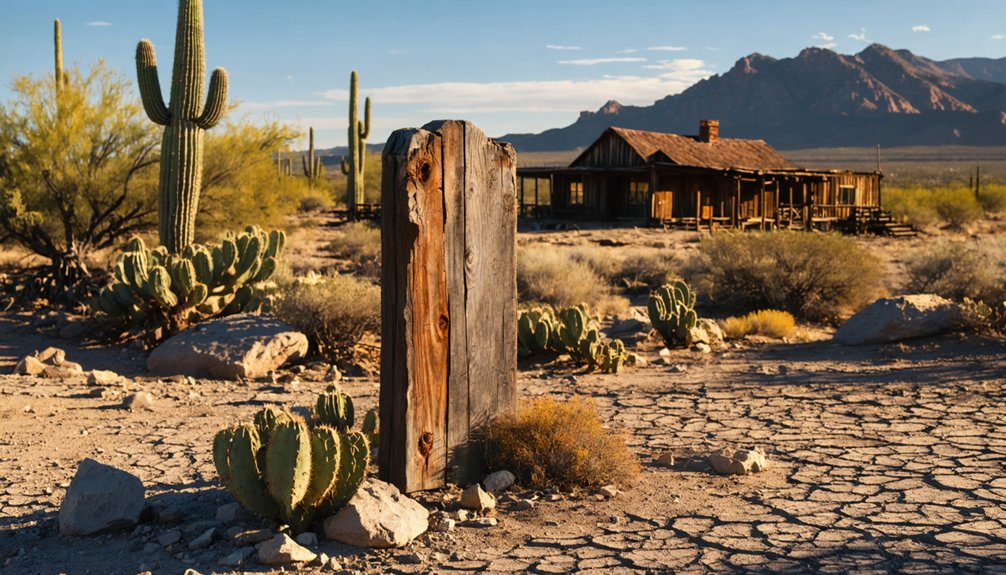
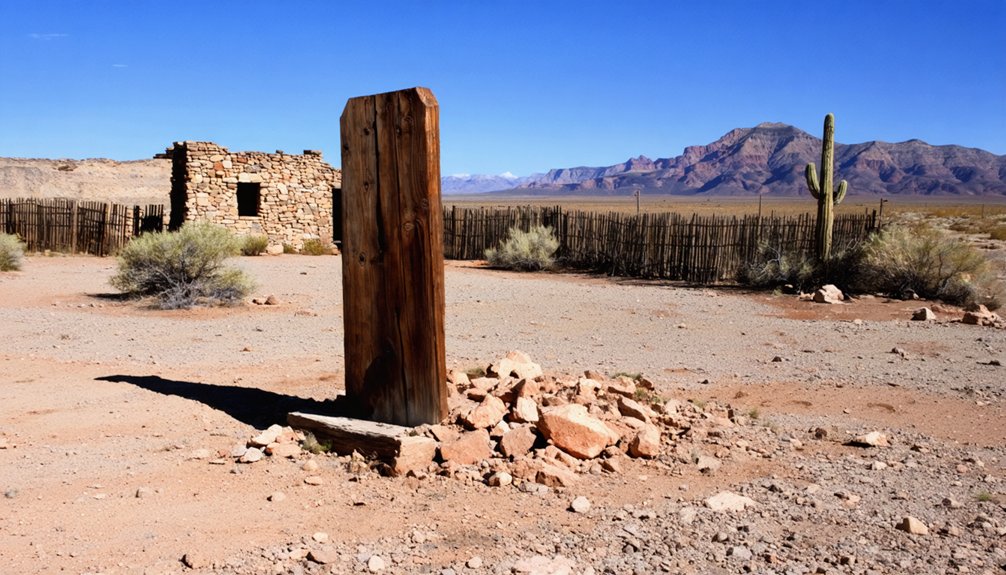
The grave site sits 4.5 miles east of Highway 181 along Turkey Creek Road, where a chain-link fence guides visitors from a small roadside pull-off to the monument just 45 yards away.
You’ll find two conflicting markers—a historic plaque noting July 14, 1882, and a white headstone inscribed with July 13, 1882—reflecting the mystery that defines Ringo’s death.
The historical significance extends beyond the outlaw himself; this Arizona Historical Landmark represents frontier justice’s ambiguous nature.
A rock pile surrounds the grave near an oak tree where his body was discovered. His body was found in the crook of a tree, a detail that adds to the enigmatic circumstances surrounding his final moments. The body was discovered with a single gunshot to the right temple, leading to the official ruling of suicide despite numerous competing theories.
The cultural impact remains evident in the maintained donation box and preserved access through private ranch land, demonstrating continued fascination with Old West legends along Turkey Creek’s year-round waters.
Visiting Hours and Access Rules
You can visit Johnny Ringo’s grave daily from 8 a.m. to 6 p.m., seven days a week, though you’re accessing private property with landowner permission.
The site requires you to stay on the designated 45-yard trail between the roadside gate and gravesite, with strict prohibitions against picnicking, wandering to the water, or leaving the fenced corridor.
While some sources mention a $15 fee, others indicate free admission with optional tips, so you should confirm current payment requirements before your visit.
The grave marks the location where Ringo’s body was found, as he was buried at the site of his death in this remote part of southeast Arizona.
A chain-link fence now surrounds the historic site to help preserve it and keep visitors within the appropriate boundaries.
Daily Operating Hours
Planning your visit to Johnny Ringo’s grave site requires understanding its daily access window, which runs from 8 a.m. to 6 p.m. every day of the week.
You’ll find no seasonal variations or holiday closures—the seven-day schedule remains constant year-round. The landowners maintain these daylight hours to balance public access with property management needs.
Early morning arrivals offer distinct advantages for your experience. You’ll encounter fewer visitors and ideal conditions for wildlife observation in the surrounding desert landscape. The cooler temperatures also make the brief walk more comfortable.
Evening visits work well too, though you should arrive with sufficient time to view the site’s historical significance before the 6 p.m. closure. The designated parking pull-off is located just beyond a gate, providing convenient access to the trailhead. The grave site itself is shaded by tall trees, offering a peaceful resting place for the notorious outlaw.
This consistent schedule lets you plan your Arizona ghost town exploration without uncertainty about availability.
Exploring the abandoned structures of Maxton, Arizona, reveals stories frozen in time and the whispers of the past. Each decaying building tells a tale of history and mystery, inviting adventurers to uncover its secrets. As dusk settles, the haunting beauty of these remnants becomes even more apparent, creating an atmosphere that is both eerie and captivating.
Private Property Protocols
Understanding access hours means little without knowing the property rules that govern your behavior at this privately-owned historic site.
Private access exists solely because landowners permit entry through an open gate along Turkey Creek Road. You’ll find posted signs detailing conduct expectations: stay on the fenced trail leading directly to the gravesite, keep visits brief, and don’t picnic or loiter.
The chain-link fence defines strict property boundaries—you can’t walk to the water or explore outside this designated corridor. Your access extends only from the gate to Johnny Ringo’s grave at the treeline’s base.
A donation box near the headstone accepts preservation contributions.
Respecting these boundaries ensures continued public access to this Arizona Historical Site on graciously shared private land.
Johnny Ringo’s Outlaw Legacy
You’ll find Johnny Ringo’s legacy intertwined with the violent cattle rustling operations of the Cochise County Cowboys, where he earned his reputation as “King of the Cowboys” through armed confrontations and robbery.
His documented crimes— from the 1881 Galeyville poker heist to his deputized pursuit of the Earps in 1882— reveal a pattern of operating within gray legal areas, often avoiding prosecution despite his feared gunfighting skills.
The circumstances surrounding his death in July 1882 remain contested, with evidence supporting both suicide and murder theories involving Wyatt Earp, Doc Holliday, or Frank Leslie.
Cowboys Gang Activities
Upon arriving in Arizona Territory in December 1879, Ringo immediately immersed himself in the violent world of the Cochise County Cowboys, a loose confederation of cattle rustlers who raided Mexican ranches and sold stolen stock across the U.S. border.
Operating around Tombstone’s booming mining district, he earned the title “King of the Cowboys” through his deep involvement with the Clanton Gang.
You’ll find that despite Wyatt Earp’s accusations, no contemporary Arizona charges for cattle theft exist against him. These wild west outlaw tales reveal a man who shifted from elected Texas constable to Arizona criminal within months.
His gang capitalized on the lawless frontier, where rustling operations thrived amid disputes over mining claims and territorial control during 1881’s escalating violence.
Mysterious Death Theories
How did Johnny Ringo really die on that July day in 1882? You’ll find competing theories that transform his death into a forensic mystery.
The official coroner ruled suicide, citing his melancholic state and paranoid tendencies during a multi-day drinking bender. Yet physical anomalies challenge this verdict—his cartridge belt was buckled upside down, and a scalp piece was reportedly cut from his skull.
Historical conspiracy theories point to Buckskin Frank Leslie, whom witnesses spotted trailing Ringo near Turkey Creek. Leslie allegedly boasted about the killing years later, and his gunfight with Ringo’s friend Billy Claiborne fueled suspicions.
Wyatt Earp also claimed responsibility, though his Colorado alibi contradicts involvement. The evidence remains contradictory, leaving you to weigh each theory’s merits at this isolated grave site.
Planning Your Visit to Turkey Creek Valley
Turkey Creek Valley in Arizona demands careful preparation due to its varied terrain and remote location across multiple jurisdictions, including Coconino National Forest, Tonto National Forest, and BLM lands.
You’ll need high-clearance 4×4 vehicles for the 16.3-mile off-road route featuring rocky creek beds and narrow ledges.
Spring and fall offer ideal conditions, while summer temperatures make hiking treacherous.
The moderate Turkey Creek Trail No. 92 stretches 3.5 miles one-way with 600-foot elevation gain, rewarding you with scenic viewpoints of the caldera and Red Rock Country.
GPS coordinates (34°48’34.5″N 111°49’04.1″W) guide you to the trailhead, accessible via State Routes 89A and 179.
Historical artifacts from the Ringo era remain discoverable along these secluded paths, though you’ll find limited amenities beyond nearby Arrowhead Cafe.
Frequently Asked Questions
Can You Camp Overnight Near Johnny Ringo’s Grave Site?
You can’t camp overnight at the grave itself—it’s private land with restricted hours. However, you’ll find camping options in nearby Coronado National Forest, where you should practice camp safety and prepare for wildlife encounters in the backcountry.
Are There Guided Tours Available to Johnny Ringo’s Grave?
Looking for organized tours? You won’t find guided tours here—the site’s historical significance requires preservation efforts through self-guided visits only. You’ll explore independently on this working ranch, respecting the private property while experiencing authentic Western history freedom.
Is the Grave Site Accessible for People With Mobility Issues?
The site presents significant accessibility challenges for visitors with mobility issues. You’ll encounter unpaved terrain, a 45-yard dirt path, and uneven ground near the creek. There’s no evidence of wheelchair ramps or paved surfaces for mobility considerations.
What Other Outlaw Graves Are Located Near Johnny Ringo’s Site?
Like Wild West folklore’s final chapter, you’ll find historical legends including Curly Bill Brocius and Zwing Hunt within twenty miles. Outlaw burials dot Turkey Creek’s ranchlands and Tombstone’s Boot Hill—Cowboys faction rivals resting near Ringo’s unmarked grave.
Are Photography and Videography Permitted at the Grave Site?
You’ll find no photography restrictions or videography permissions posted at the site. Visitors regularly document their visits through photos and videos without intervention, suggesting the Sanders family permits such activities within posted access rules.
References
- https://www.mapquest.com/us/arizona/johnny-ringos-grave-436386169
- https://www.tripadvisor.com/Attraction_Review-g60950-d10053507-Reviews-John_Ringo_Historic_Site-Tucson_Arizona.html
- https://www.youtube.com/watch?v=hSEs1pmYaL8
- https://www.youtube.com/watch?v=z-XMNGsQ_oo
- https://en.wikipedia.org/wiki/Johnny_Ringo
- https://www.atlasobscura.com/places/the-grave-of-johnny-ringo
- https://www.truewestmagazine.com/article/where-is-johnny-ringos-grave-located/
- https://cactusatlas.com/adventures/johnny-ringo-grave/
- https://www.findagrave.com/memorial/4284/johnny-ringo
- https://www.historynet.com/mysterious-death-of-johnny-ringo/