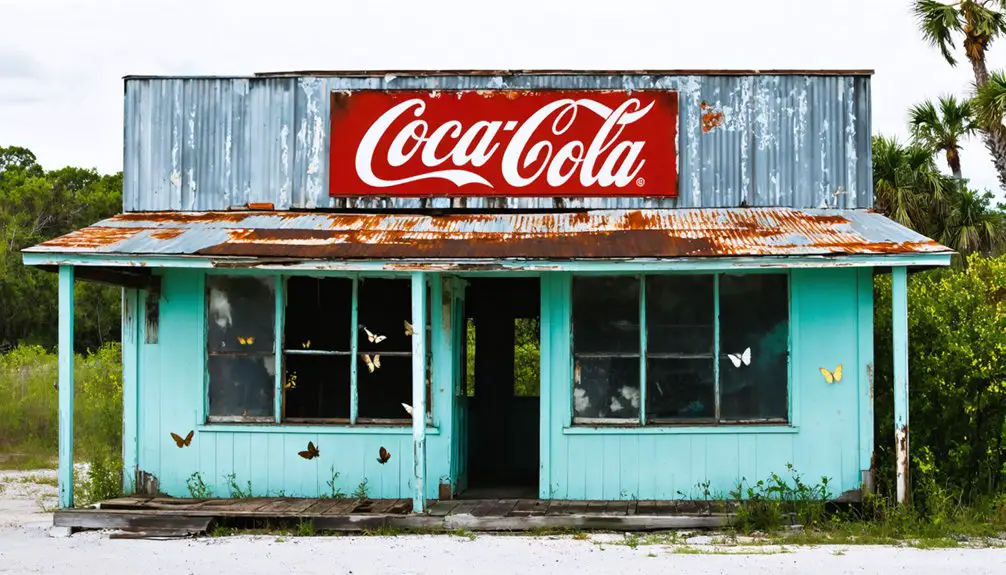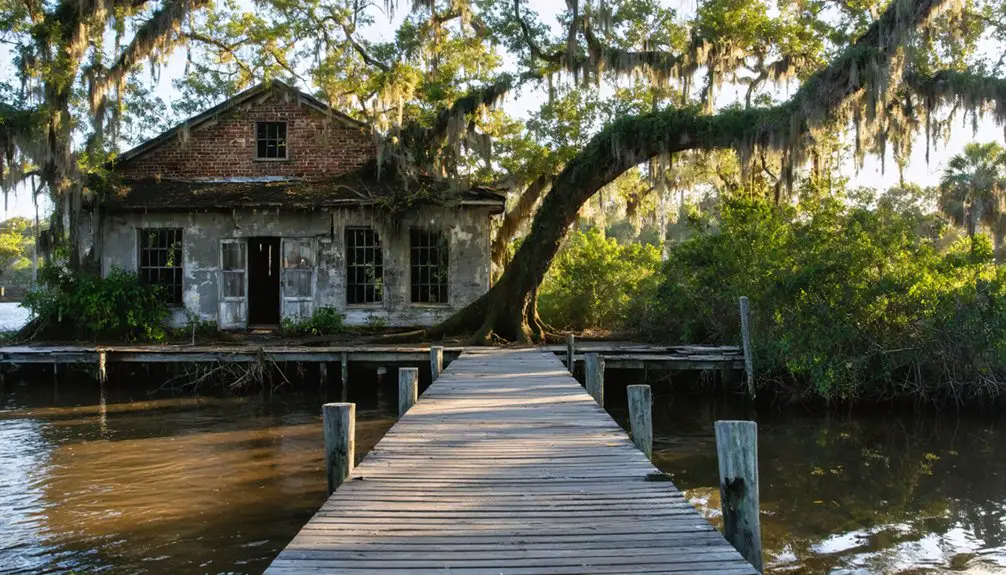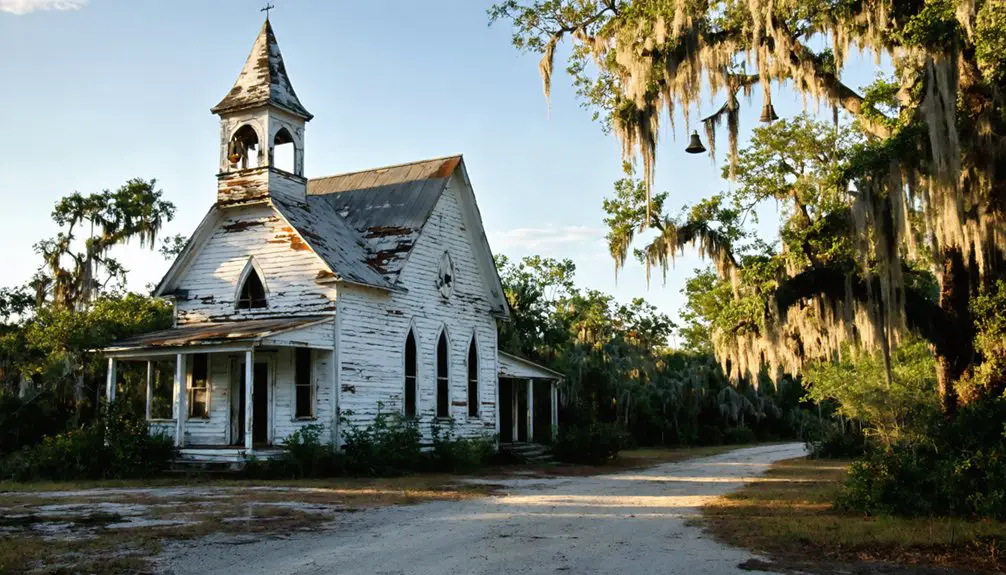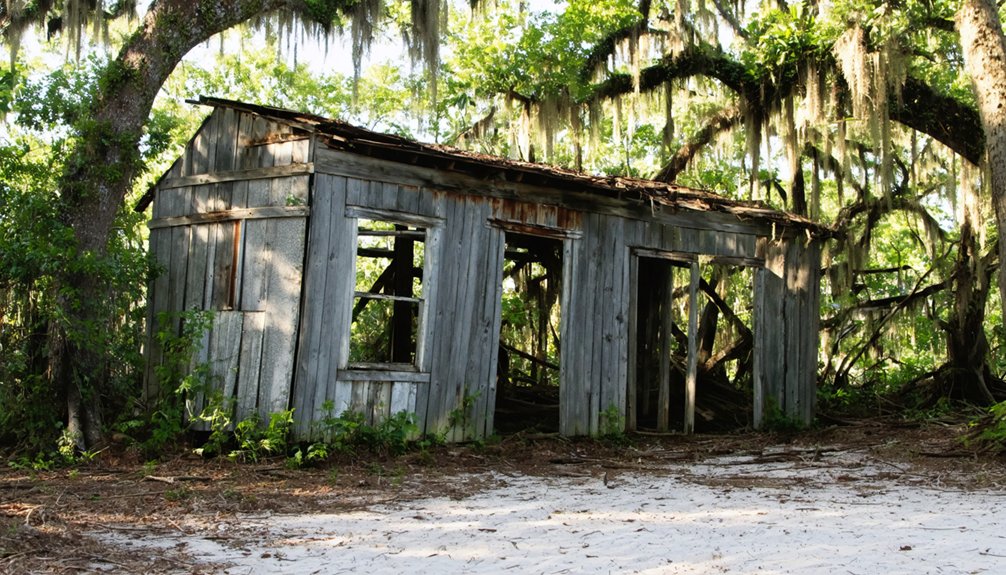
You’ll find Juno’s ghost town site three miles south of modern Juno Beach along PGA Boulevard, now buried beneath the gated Hidden Oaks community. From 1889 to 1899, this frontier settlement served as Dade County’s seat of government, complete with a wooden courthouse, the Tropical Sun newspaper, and a narrow-gauge “Celestial Railroad.” Flagler’s railway bypassed Juno in 1894, triggering its decline, while fires in 1899 and 1907 erased remaining structures. A 1938 roadside marker commemorates what luxury homes have replaced, though the full story reveals far more.
Key Takeaways
- Juno served as Dade County’s seat from 1889 to 1899, governing a vast territory from a wooden courthouse near Lake Worth.
- The Jupiter & Lake Worth Railway, nicknamed the Celestial Railroad, operated from 1889 until declining after Flagler’s railroad bypassed Juno in 1894.
- Pineapple farming fueled Juno’s economy in the 1880s-1890s, with fruit fetching premium prices in northern markets before tourism emerged.
- Fires in 1899 and 1907 destroyed the courthouse and remaining buildings, leaving no physical remnants of the original settlement.
- The ghost town site now lies within Hidden Oaks gated community along PGA Boulevard, marked only by a 1938 memorial.
The Rise of a Frontier Settlement in Palm Beach County
Before the Celestial Railroad carved its path through the palmetto scrub in 1889, the stretch of coast between Jupiter and Lake Worth remained stubbornly cut off from the rest of Florida’s frontier. You’d find no navigable inlets here—the Loxahatchee River’s mouth lay too shallow, and Lake Worth breached the ocean only irregularly.
Yet this wasn’t empty wilderness. Jeaga shell-mound settlements, some 5,000 years old, dotted the landscape near what early mapmakers called Groupers Hills, revealing profound Indigenous influence on the territory.
When Albert M. Field donated land for Juno’s establishment that year, the steamboat company’s 7½-mile track connected Jupiter’s wharf to Palm Beach, transforming isolation into opportunity. The territory fell under the jurisdiction of Dade County, established decades earlier in 1836, before Palm Beach County would later separate from it.
Revolutionary artifacts of settlement—pineapple fields and rail ties—marked civilization’s advance southward. Documentation of Juno’s historical significance comes from sources like the Historical Society of Palm Beach County, which preserves detailed records of the settlement’s development.
Serving as Dade County’s Seat of Government
You’ll find that Juno’s transformation into Dade County’s administrative center began in February 1889, when residents from the Lake Worth Lagoon region successfully petitioned to relocate the county seat from distant Biscayne Bay.
Albert M. Field donated land that year, and by 1890, a courthouse stood approximately 300 feet east of today’s historical marker, serving as the hub for legal proceedings and government functions across a county stretching from present-day Martin County to Miami-Dade.
This status drew The Tropical Sun—South Florida’s first newspaper—along with politicians, businessmen, and settlers who recognized that proximity to power meant opportunity in Florida’s frontier. The name Juno itself carries multiple historical associations, though in this context it specifically refers to the settlement that served as the governmental center before being abandoned. Juno’s role as county seat ended when Dade County seat moved from Juno to Miami on May 10, 1899.
Courthouse Operations and Infrastructure
The Dade County courthouse in Juno emerged from a straightforward transaction in 1889 when Albert M. Field donated land approximately 300 feet east of today’s historical marker. You’d have found a simple wood frame structure housing the historic courtroom where legal proceedings unfolded for a decade.
This building served as your government hub—hosting County Commission meetings, managing legal offices, and handling judicial affairs for communities scattered around Lake Worth. The courthouse wasn’t just about bureaucracy; it doubled as a social center where official business mixed with community gatherings.
Standing as the southern terminus of the Celestial Railroad from Jupiter, this modest facility met the sparse population’s needs from 1890 until 1899, when the county seat shifted and Juno began its fade into obscurity. Before Miami became the permanent county seat in 1899, the area had hosted different courthouses in various locations. The site’s historical importance was formally recognized in 1938 when the Seminole Chapter of the Daughters of the American Revolution erected a marker in the location.
County Seat Relocation
By 1888, residents along Lake Worth Lagoon had grown weary of traveling to Biscayne Bay whenever county business demanded their attention. Local politicians Elisha Newton Dimick, Alan E. Heyser, George W. Lainhart, and George W. Potter championed relocation, leveraging their population advantage. February 1889’s special election delivered victory—Juno would become Dade County’s seat.
Albert M. Field donated land for the courthouse, and by 1890, this settlement governed 7,200 square miles of territory. The historical architecture housed county operations until 1899, when Miami‘s explosive growth shifted power southward. That May referendum sealed Juno’s fate.
The county seat returned to Miami, and interest in the northern outpost evaporated. Miami was founded in 1896 and had rapidly outgrown the northern settlements. By 1907, Juno joined Florida’s local legends as another abandoned frontier town.
The Celestial Railroad: Jupiter & Lake Worth Railway
During the summer of 1889, a narrow-gauge locomotive chugged into service along a peculiar 7.5-mile stretch connecting two bodies of water that had no business being separated. The Jupiter & Lake Worth Railway‘s railway engineering solved a frustrating problem: steamboat passengers needed portage between Jupiter Inlet and Lake Worth Lagoon.
A narrow-gauge solution for steamboat passengers: 7.5 miles of track bridging waters that geography stubbornly kept apart.
You’d board at Jupiter station, ride the 3-foot-wide track through Venus and Mars—mere loading platforms—before reaching Juno. The wood-burning locomotive design required no turning facilities; it simply reversed northbound. The 30-minute trip ran three times daily, keeping to a predictable schedule for passengers and freight.
Harper’s dubbed it the “Celestial Railroad” in 1893, recognizing those planetary station names. For 75 cents maximum, you’d flag down trains from hunting spots in the bushes. The station names drew inspiration from Roman deities and celestial bodies, creating a whimsical astronomical theme along the route.
When Flagler’s Florida East Coast Railway arrived in 1894, this scrappy portage line couldn’t compete. By 1896, they’d auctioned everything off.
A Thriving Pineapple Farming Economy
Long before tourists discovered Palm Beach, pineapple growers transformed Juno’s sandy terrain into one of South Florida’s most profitable agricultural zones.
By the 1880s, pineapple cultivation spread across the Lake Worth region, with fields surrounding Juno becoming prominent landmarks.
The town’s eastern sandy soil proved ideal for growing the tropical fruit that commanded premium prices—$1.00 per pineapple in northern markets, worth roughly $20.00 today.
Agricultural settlements flourished throughout the area.
Harry DuBois operated a 20-acre plantation with a packinghouse along the Loxahatchee River, while John Clarke ran operations near present-day Parker Avenue.
Farmers hauled their boxed harvests seven and a half miles overland to Jupiter for shipment north.
By 1909, Florida’s pineapple industry had expanded dramatically, with approximately 5,000 acres under cultivation producing over 44 million pounds of fruit annually.
Life and Infrastructure in 1890s Juno
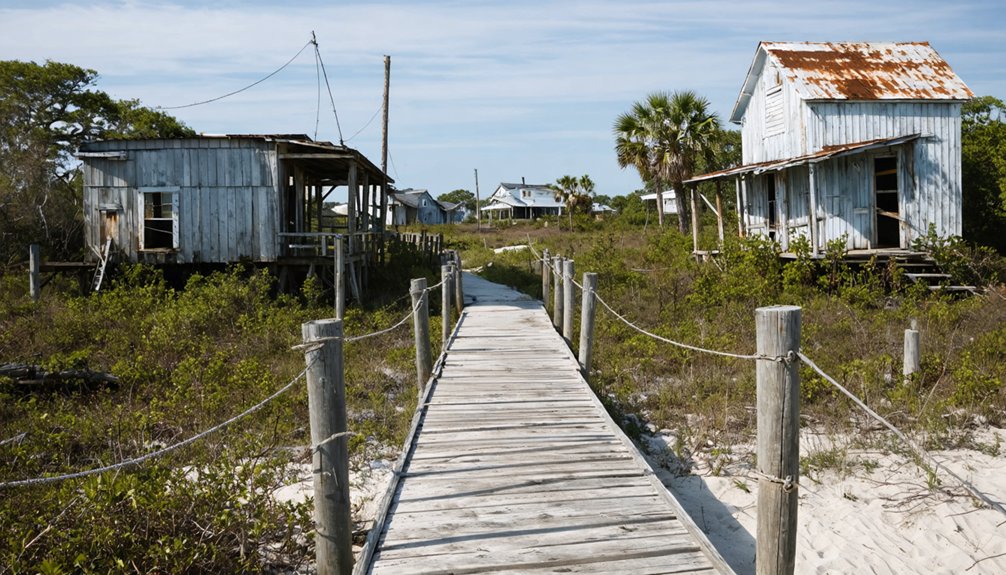
When Juno officially earned its county seat designation in 1890, the settlement comprised just seven houses, a courthouse, a newspaper office, and a jailhouse—modest infrastructure for a town governing territory stretching from present-day Martin County all the way to Miami-Dade County.
Early settlers had registered the town layout that same year, establishing their foothold along what’s now the Intra-Coastal Waterway near PGA Boulevard.
Juno’s founders staked their claim in 1890 along the waterway, creating a settlement that would briefly govern South Florida’s vast coastal territory.
You’d find The Tropical Sun publishing from its office until relocating to West Palm Beach in January 1895.
The jailhouse gained notoriety that year when it held Sam Lewis before South Florida’s first lynching incident.
Despite its small size—roughly 100 residents by 1896—Juno thrived as a farming community where warm breezes sustained pineapple cultivation and Lake Worth steamers delivered goods after the Celestial Railroad’s closure.
Henry Flagler’s Railroad and the Beginning of the End
When Henry Flagler’s Florida East Coast Railway pushed south from West Palm Beach in 1894, you’d have watched anxiously as his engineers surveyed potential routes through the wilderness.
The railroad baron chose to run his tracks seven and a half miles west of the existing Celestial Railroad line, effectively bypassing Juno as the region’s commercial hub.
That decision sealed the town’s fate—within months, merchants began closing their shops and families packed their belongings, following the prosperity that now flowed along Flagler’s new corridor.
Flagler’s FEC Route Choice
Henry Flagler’s 1885 purchase of the Jacksonville, St. Augustine & Halifax Railroad set forces in motion that would doom settlements like Juno.
When landowners south of Daytona petitioned for an 80-mile extension in 1892, Flagler shifted from acquiring existing lines to laying fresh tracks along the Indian River.
Railroad expansion accelerated after the devastating 1894-1895 freezes, which damaged crops as far south as Palm Beach but left Miami untouched.
Flagler’s land grants from private landowners sweetened the deal—Julia Tuttle offered 100 acres for a Miami terminal in 1895.
By 1896, his Florida East Coast Railway reached Biscayne Bay, bypassing Juno entirely.
You’ll find that strategic route choices, driven by commercial incentives and natural disasters, determined which frontier towns flourished and which vanished.
Juno’s Economic Collapse
While extending his Florida East Coast Railway southward in the mid-1890s, Henry Flagler made a calculated business decision that sealed Juno‘s fate—he refused to purchase the Jupiter and Lake Worth Railway. The FEC bypassed Juno entirely, redirecting economic activity to Palm Beach and West Palm Beach.
Historian Nathan D. Shappee recognized this as the blow from which the county seat never recovered.
You’d witness the economic decline unfold rapidly. Guy Metcalf relocated his Tropical Sun newspaper to West Palm Beach in January 1895, signaling Juno’s diminishing viability. The Jupiter and Lake Worth Railway collapsed without Flagler’s support, leaving Juno accessible only by Lake Worth steamer.
The Great Fires and Final Abandonment
As the Celestial Railroad fell into disuse following the completion of Henry Flagler’s railroad line, Juno’s fate was sealed.
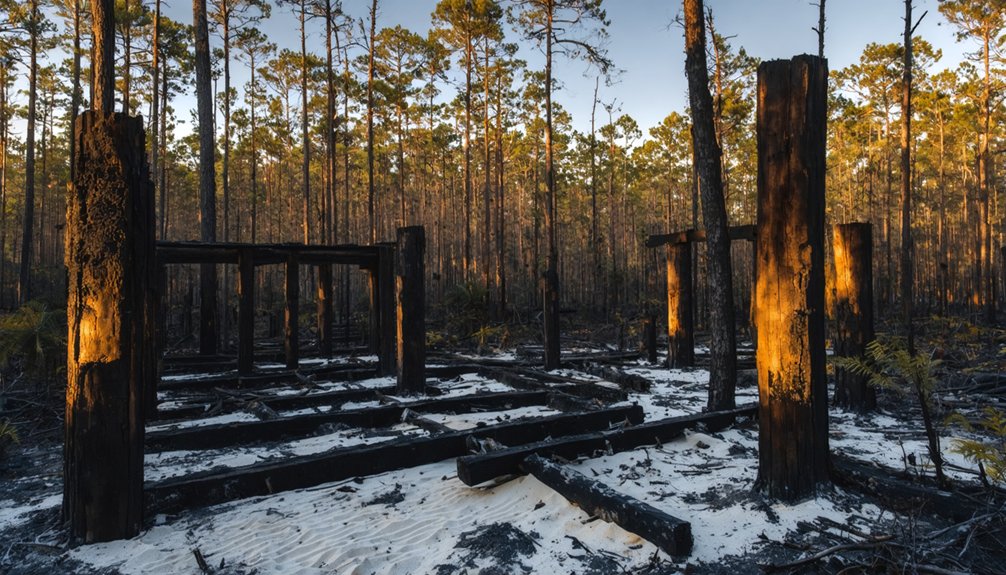
In 1899, after the courthouse was barged to Fort Dallas, fire consumed what remained of the settlement. You’d have found only charred foundations where pineapple merchants once thrived.
The 1907 forest fire delivered the final blow, erasing the last structures standing. Nature reclaimed the land with astonishing speed, though a brick cistern at Twelve Oaks survived as proof of the vanished lives.
The wildfire aftermath left few town relics—just memories of Jupiter, Mars, Venus, and Juno stations that once transported tropical bounty. By 1903, the community had fully abandoned ship, transforming eventually into Juno Beach, while the original settlement dissolved into legend.
What Remains Today: Hidden Oaks and the Lost Town
Where exactly did Juno vanish? You’ll find it three miles south of present-day Juno Beach, along PGA Boulevard near the Intracoastal Waterway—though you won’t get in.
The Hidden Oaks gated community now covers the entire townsite, barring public access to what little remains. Actually, nothing remains. The 1899 fire that preceded abandonment left no structures standing, and subsequent development erased every foundation.
There’s been no relic preservation or archaeological efforts here; modern construction simply paved over history.
The former courthouse site became a shopping square, while luxury homes occupy the rest.
A relocated historical marker on US Route 1 acknowledges what once stood here, but the ghost town itself? It’s genuinely gone, sealed behind gates.
Visiting the Ghost Town Site Along PGA Boulevard
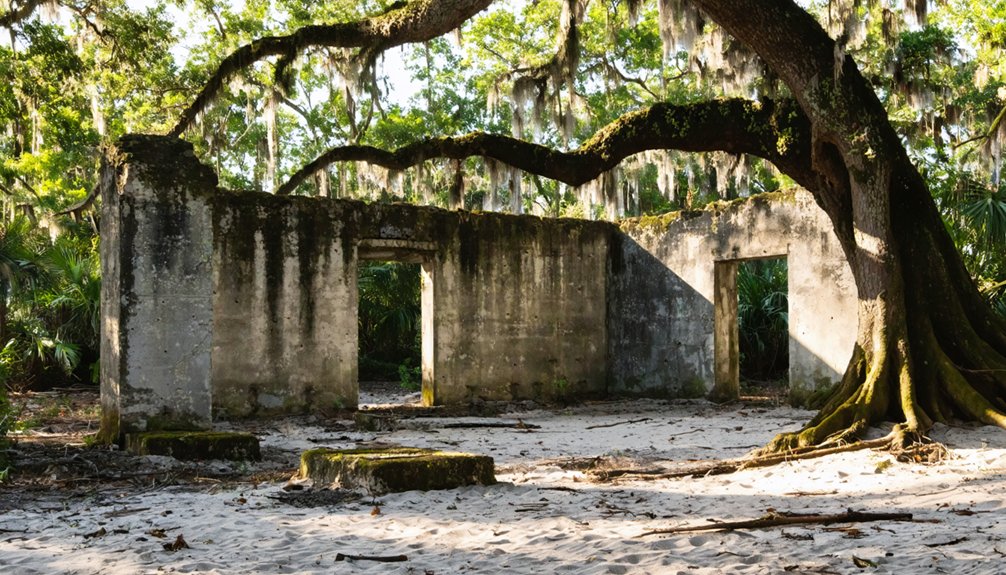
Today, PGA Boulevard (State Road 786) cuts directly through what was once Juno’s bustling downtown, though you’d never know it. The original townsite now sits behind the gates of Hidden Oaks, a private community that’s replaced any trace of historic architecture with modern luxury homes.
You can’t freely explore where the courthouse once stood—it’s now a shopping center.
Your best access point is the historical marker along U.S. Route 1 just north of PGA Boulevard, erected by the Daughters of the American Revolution in 1938.
The warm, breezy climate makes year-round visits pleasant, but there’s little to see beyond the marker itself.
No botanical gardens preserve the pineapple fields that once thrived here—just gated developments restricting the curious explorer.
Frequently Asked Questions
Why Was the Town Named Juno Instead of Another Celestial Name?
You’ll find Juno completed the railroad’s celestial sequence southward from Jupiter. The history of celestial naming followed Roman mythology—Jupiter’s divine consort deserved the terminus. Local folklore origins tie to promotional branding, not astronomical accuracy.
What Happened to the Residents After the Town Was Abandoned?
You’ll find scarce resident stories documenting their dispersal after Juno’s historical decline. Most settlers simply drifted to nearby Palm Beach communities seeking opportunity, leaving few archival traces of their individual journeys beyond the town’s collective abandonment.
Are There Any Photographs or Artifacts From Original Juno Preserved Today?
You’ll find archival photographs tucked away in Florida’s collections—pineapple farms, that old courthouse. The most tangible treasure? An original railroad spike displayed at Juno Beach Town Hall, thanks to preservation efforts saving these frontier remnants.
Can Visitors Access the Ghost Town Site Within Hidden Oaks Community?
You can’t access the site due to community restrictions enforced by Hidden Oaks’ gated entry. While visitor safety isn’t the concern, private property laws block your exploration entirely. The original townsite remains completely off-limits to unauthorized guests seeking historical traces.
Were Any Other Towns Along the Celestial Railroad Also Abandoned?
Beyond Juno’s vanished courthouse, you’ll find celestial railroad history reveals Venus and Mars were mere loading platforms—ghosts that never lived. Ghost town preservation focuses solely on Juno’s site, where Florida’s frontier dreams truly flickered before fading forever.
References
- https://www.ghosttowns.com/states/fl/juno.html
- https://www.youtube.com/watch?v=n3SBt_pPSd8
- https://en.wikipedia.org/wiki/Juno
- https://palmbeachpast.org/2011/03/palm-beach-countys-lost-towns-the-complete-list/
- https://education.pbchistory.org/pbc_community/juno/
- https://cccourthouse.org/wp-content/uploads/2023/12/Ghost-towns-and-Cemeteries-of-Citrus-County.pdf
- https://jbhistory.org/junos-heyday:-1890s
- https://www.juno-beach.fl.us/sites/default/files/fileattachments/history/page/4771/jb_history.pdf
- https://www.uflib.ufl.edu/spec/ingraham/expedition/Juno.htm
- https://discover.pbc.gov/pages/pbc_facts.aspx