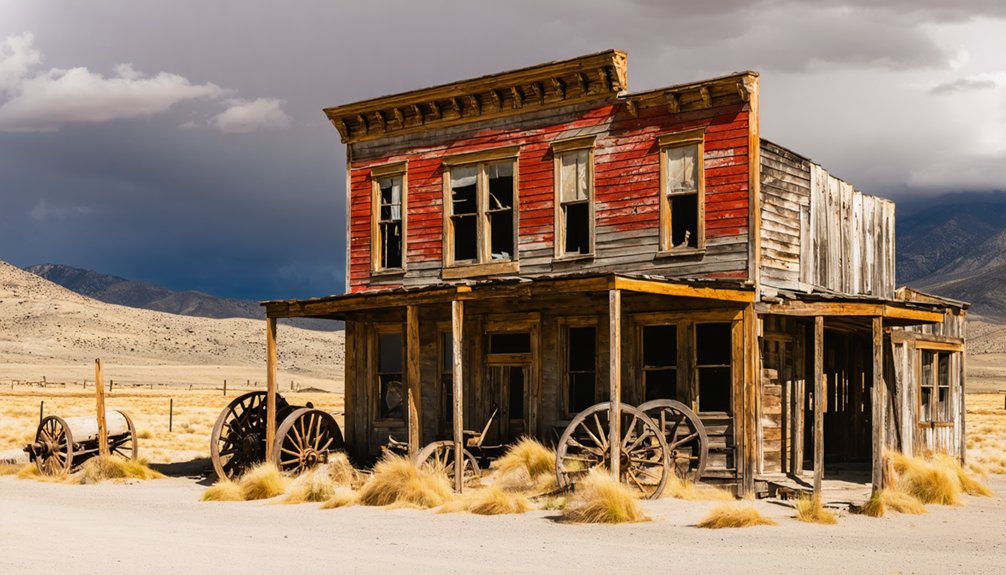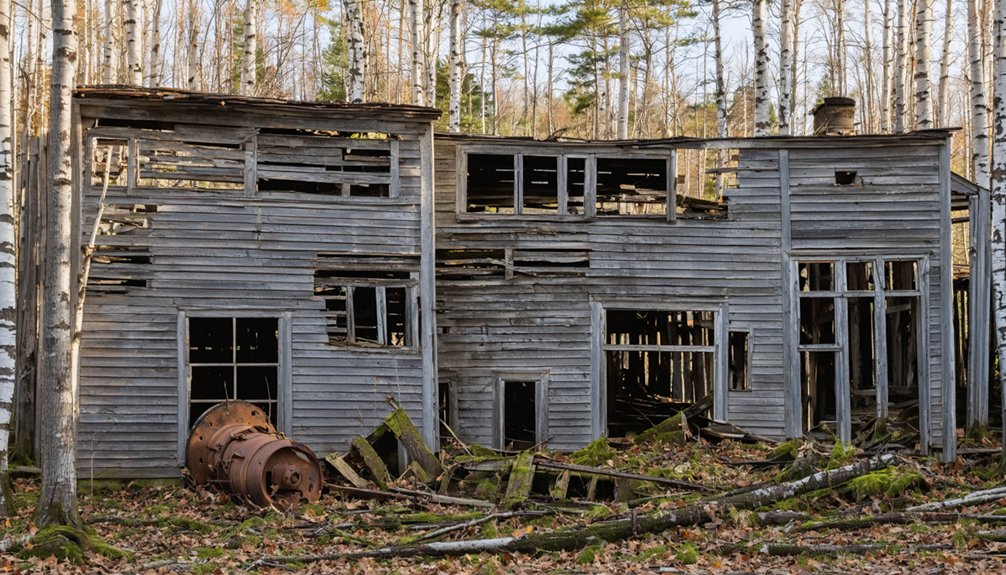
You’ll find dozens of haunting ghost towns across Michigan’s Keweenaw Peninsula, remnants of the 1800s copper boom that once produced 95% of America’s copper. Notable sites include Central Mine with its restored buildings and museum, Delaware’s stone ruins, Freda’s towering 253-foot smokestack, and the remote Bete Grise settlement. These abandoned mining communities—from Phoenix to Jacobsville—feature crumbling foundations, old cemeteries, and industrial relics scattered through overgrown forests, each telling stories of prosperity, tragedy, and the thousands of immigrant miners who built them before economic collapse reclaimed everything.
Key Takeaways
- Major ghost towns include Phoenix, Winona, Central, Freda, Delaware, Jacobsville, White City, and Bete Grise across the Keweenaw Peninsula.
- These settlements thrived during Michigan’s copper boom from 1845-1920s, producing approximately 11 billion pounds of copper.
- Towns were abandoned after mine closures, resource depletion, labor strikes, and tragedies like the 1913 Italian Hall disaster.
- Visitors can explore restored structures, tall smokestacks, industrial ruins, cemeteries, and scattered artifacts throughout the sites.
- The rugged, atmospheric locations feature hazards including unstable foundations and collapsed structures requiring careful exploration.
The Copper Mining Boom That Built a Region
Long before European prospectors ever set foot on the Keweenaw Peninsula, Native Americans had already extracted over 1.5 billion pounds of pure copper from this rugged landscape. Between 5000 and 1200 BCE, they worked over 5,000 open-pit mines using stone hammers and fire-setting techniques.
When Douglass Houghton’s 1840 geological report revealed massive deposits, fortune-seekers rushed northward. The Cliff Mine opened in 1845, generating profits equivalent to $104 million today.
By mid-century, Michigan supplied 95% of America’s copper needs. The boom’s cultural impacts transformed isolated wilderness into thriving industrial communities, while environmental legacies—abandoned shafts plunging thousands of feet deep—still mark the terrain. Central Mine achieved the rare distinction of profitability in its first year, producing 83,836 pounds of copper in 1855. Yet most of the ancient copper remains mysteriously unaccounted for, with less than 1% found in known artifacts despite the massive prehistoric extraction.
Between 1845 and the 1920s, you’ll find this region produced 11 billion pounds of native copper, building America’s electrical age.
From Thriving Cities to Abandoned Settlements
At their zenith, these copper settlements teemed with life that’s hard to imagine today when you’re standing among the silent ruins.
Central’s 1,350 residents vanished after the mine closed in 1894. Nearby communities swelled to 1,500 settlers before copper exhaustion and the 1913 miners’ strike triggered their collapse.
Cultural impacts transformed these diverse communities—workers from dozens of countries built thriving towns, only to watch them disappear within decades:
- Bete Grise dwindled to a handful by 1940, its clapboard homes and church gone
- Champion Mill at Freda shut down November 4, 1967, ending an era
- Kiwina became a ghost town post-1878, abandoned for 146 years
Environmental consequences remain visible: stamp sand beaches, poor rock piles, and overgrown streets where nature’s reclaimed what prosperity once built. Delaware Mine operated from 1847 to 1887, its crumbling stone walls now consumed by forest growth and trees sprouting through empty windows. Clifton once housed over 700 residents before joining the roster of abandoned settlements, leaving behind only foundations, old pottery, and cemetery markers scattered across the wilderness.
Where to Find Ghost Towns Across the Peninsula
The Keweenaw Peninsula’s ghost towns scatter across rugged terrain from Houghton County‘s western edge to Keweenaw County’s isolated northern tip, where 246 hardy residents now inhabit what was once a region of thousands.
Where thousands once thrived in copper boom times, just 246 residents now call Keweenaw County’s remote northern reaches home.
You’ll find seven major sites along the US-41 corridor, including Phoenix and Winona. Central sits 20 minutes north of Calumet, where 1,300 people once lived.
Freda’s 13 miles southeast of Houghton via the narrow Covered Road, its overhanging oaks and maples creating an atmospheric approach. Jacobsville’s 1868 lighthouse overlooks Keweenaw Bay, while continuing to road’s end reaches White City. The Jacobsville Sandstone quarry supplied stone for buildings nationwide, including St. Ignatius Loyola Church and the Waldorf-Astoria.
Local legends and ghost stories surround Bete Grise’s steep ruins and Cliff Cemetery, established 1846. Eagle Harbor and Eagle River, both accessible via M-26, mark significant points along the peninsula’s mining heritage route. A crowdsourced urbex map reveals nearly 100 abandoned mining sites waiting off the beaten path.
Exploring Notable Ghost Town Sites
Central’s weathered buildings rise from the forest twenty minutes north of Calumet, where you’ll discover the Keweenaw’s most accessible ghost town experience. This 1854 settlement produced 52 million pounds of copper before its 1898 closure. Today, you can rent restored miners’ homes or explore the museum complex independently.
For adventurous exploration beyond Central, consider these rewarding destinations:
- Delaware – Fifty miles north, this 1847-1887 operation once housed 1,200 residents with its own court system and daily rail service. Few structures remain—two abandoned homes along Highway 41—though the Delaware Mine offers tours, including shaft descents for $14.
- Freda – Concrete foundations and a challenging waterfall hike await among 1840s-era ruins.
- Phoenix – Within ten miles of Delaware, natural reclamation creates exceptional wildflower photography and wildlife observation opportunities.
Bete Grise’s remote northern peninsula location offers solitude seekers preserved ruins amid untouched wilderness. When exploring these sites, watch for old apple trees that mark former town locations and signal where communities once flourished.
What Remains: Structures and Ruins to Discover
Walking through these abandoned settlements, you’ll encounter a remarkable spectrum of preservation—from Central’s twenty frame structures still standing proud among the original 130 buildings to Delaware’s haunting stone shells where trees now grow through gaping windows.
Architectural remnants range from Mandan’s renovated buildings clustered along dirt roads to Port Oneida’s impressive 121 structures. You’ll find towering smokestacks—Mandan’s 265-foot stack and Freda’s 253-foot monolith still guiding Lake Superior boats. At Phoenix, the Carpenter Gothic style Phoenix Church stands alongside Evergreen Cemetery, established in 1843. The restored Methodist church at Central Mine serves as a testament to preservation efforts in this once-prominent copper producer from 1854.
Industrial artifacts tell deeper stories: Champion Mill’s massive concrete foundations cascade down hillsides, while pump houses and hoist houses from the 1870s crumble beside walking trails. Stamp mill ruins reveal processing operations, though you’ll need to watch for hazardous cement holes and deteriorating foundations where antique pottery fragments surface among scattered mining debris.
Mining Disasters and Historical Tragedies
Beneath the economic triumph of Keweenaw’s copper boom lurked constant danger—a reality that shattered families and communities with devastating regularity.
You’ll find the peninsula’s darkest chapters marked by catastrophic failures in mining safety. The 1872 Central Mine disaster dropped thirteen men down a shaft when their wire rope snapped, killing eight instantly. Michigan’s worst industrial tragedy struck Barnes-Hecker Mine in 1926, where a cave-in and flood sealed 41 bodies forever underground.
When copper’s promise turned to tragedy, wire ropes snapped and mines collapsed, burying generations beneath Michigan’s profitable earth.
Labor strikes erupted over these deplorable conditions. The 1913-1914 Copper Country Strike brought particular horror:
- Nine thousand miners demanded 8-hour days after working 10-12 hour shifts at 4,000-foot depths
- Deputies killed Croatian miners Steve Putrich and Alois Tijan
- Italian Hall’s false fire alarm crushed 74 souls, mostly children
These tragedies ultimately broke the miners’ resolve and accelerated the region’s decline.
Visitor Attractions and Historic Tours
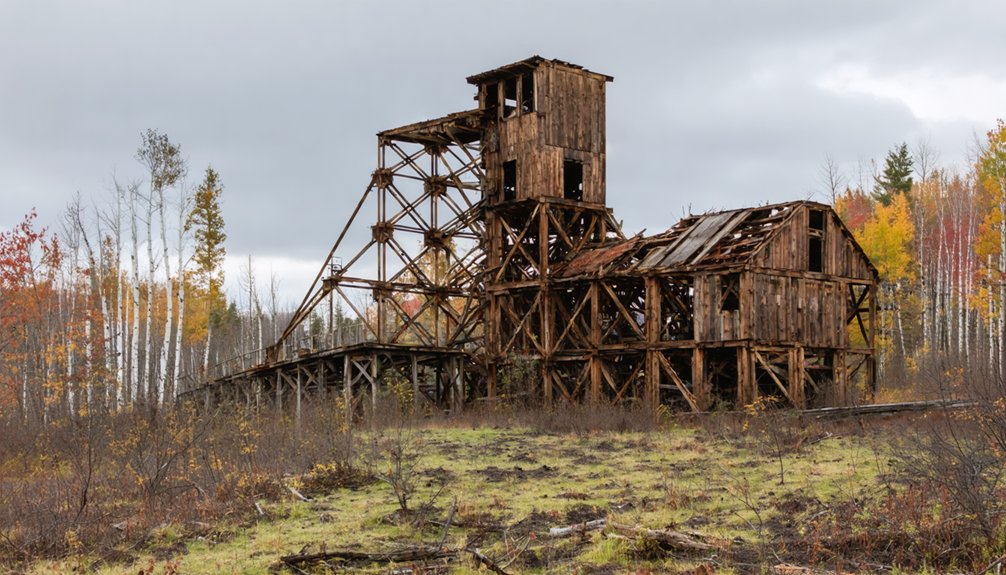
Phoenix’s trails wind past twenty frame structures, while Freda’s Champion Mill ruins sprawl like concrete amphitheaters beneath an imposing smokestack.
Local legends swirl around Keweenaw Vortex’s spiral-shaped tree, where you’ll find metaphysical gatherings each August.
The Jacobsville Lighthouse‘s red brick overlooks Keweenaw Bay.
Quincy Mine’s October haunted tours blend history with darker tales.
Mysteries and Paranormal Reports
Long after the copper boom’s final echo faded, the Keweenaw Peninsula’s abandoned settlements began accumulating stranger tales than their economic collapse could explain.
When the mines closed and the people left, something else moved into the empty spaces between Keweenaw’s forgotten buildings.
You’ll find spectral sightings concentrated at specific locations where paranormal investigations have documented unexplained phenomena:
- Calumet Theatre – Madam Modjeska’s ghost allegedly performs post-1909, drawing investigators to witness auditorium manifestations.
- Prospector’s Paradise – The Keweenaw Vortex’s spiral-shaped tree attracts energy seekers to what’s rumored as Native American burial grounds, hosting metaphysical gatherings each August.
- Central Mine Ghost Town – Nine hundred Cornish miners’ descendants abandoned these ruins after the 1950s shaft sealing, leaving eerie remnants.
The Cliff Cemetery’s seasonal inaccessibility and Freda’s Champion Stamp Mill ruins add atmospheric weight to these accounts.
Lake Superior’s reclamation creates genuinely mysterious landscapes worth exploring independently.
Frequently Asked Questions
Are Visitors Legally Allowed to Explore the Ghost Town Ruins?
You can’t legally explore all ruins due to property ownership restrictions. You’ll find publicly accessible sites like Central Mine and Freda offer legal exploration, but you must respect private property signs and verify access through local authorities first.
What Safety Precautions Should I Take When Visiting Abandoned Mine Sites?
You’ll need proper safety gear including closed-toe boots, helmet, and flashlight. Practice thorough hazard identification—watch for unstable ground, deep water hazards, and toxic air. I’ve seen too many explorers underestimate these Keweenaw sites’ dangers.
Can I Camp Overnight Near the Ghost Town Locations?
You can’t camp in ghost town sites due to historic preservation rules, but dispersed camping’s allowed 150 feet from forest roads nearby. Keep food secured against wildlife encounters, and always practice Leave No Trace principles while exploring freely.
While exploring ghost towns near Katmai National Park, be sure to take in the remnants of history that these locations offer. Each site tells a story of the past, inviting adventure and curiosity. Remember to respect the environment and the significance of these places as you wander through the area’s stunning natural landscape.
What Is the Best Time of Year to Visit Ghost Towns?
Fall paints your perfect ghost town canvas—September through mid-October balances open sites, stunning photography tips with golden foliage backdrops, and accessible historical preservation areas before winter locks you out. You’ll dodge summer crowds while capturing authenticity.
Are There Guided Tours Available Specifically for Ghost Town Exploration?
You’ll find guided exploration through Adventure Mining Company and Keweenaw National Historical Park, where local experts enhance your underground experiences. While Freda offers self-guided freedom, most sites prioritize historical preservation through independent discovery rather than structured ghost town tours.
References
- https://www.visitkeweenaw.com/things-to-do/museums-history/ghost-towns/
- https://www.youtube.com/watch?v=7-vjuqiGWJU
- http://focusingontravel.blogspot.com/2018/03/keen-on-keweenaw-county-ghost-towns.html
- https://beaumier.nmu.edu/ghosttowns/
- https://enjoyer.com/discovering-the-ghost-towns-of-the-keweenaw/
- https://exploringthenorth.com/ghost/towns.html
- https://en.wikipedia.org/wiki/List_of_ghost_towns_in_Michigan
- https://www.theinnatstonecliffe.com/blog/prehistoric-copper-heist-the-vanished-billions-of-the-keweenaw-peninsula
- https://www.keweenawhistory.org/Central-Mining-Co
- https://npshistory.com/publications/foundation-documents/kewe-fd-overview.pdf