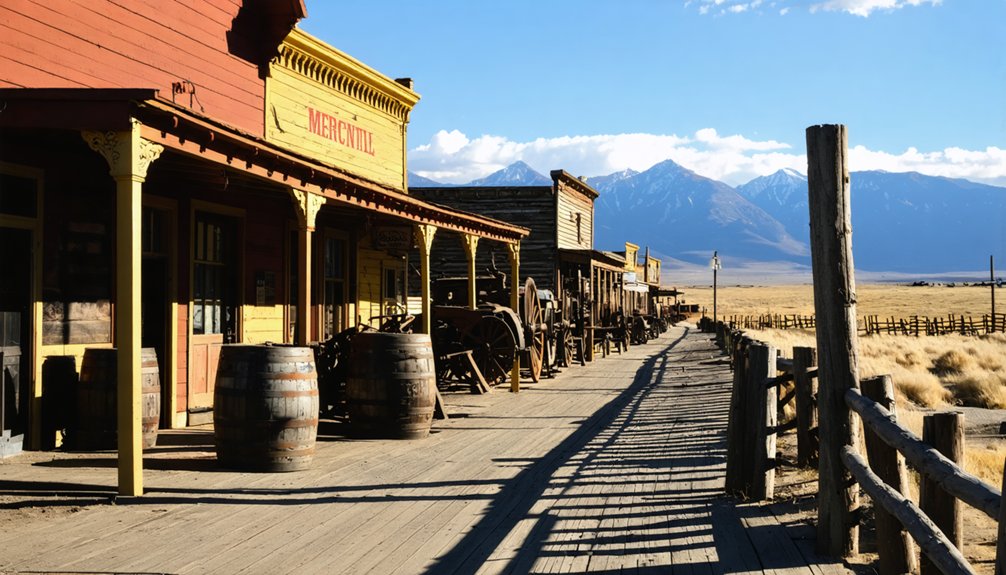
Lane Mill emerged in the late 1800s as a company town built around timber and mining operations. You’ll find this Sierra Nevada ghost town was once thriving with miners working 12-hour shifts extracting gold through mercury amalgamation and cyanide processing. The community featured saloons, general stores, and distinct housing based on social status. Today, you can explore the historical remnants via unpaved forest service roads, where California’s boom-and-bust resource history awaits.
Key Takeaways
- Lane Mill originated in the late 1800s as a company town centered around timber milling and mining operations.
- The town experienced economic prosperity through mining, processing up to 20 tons of ore daily yielding over $650,000 worth of minerals.
- Daily life revolved around 12-hour mining shifts, with social activities focused in saloons, stores, and a modest community hall.
- Economic decline began after the 1907 Panic, with final abandonment following the lumber mill’s closure in 1942.
- Today, Lane Mill is accessible via unpaved forest service roads, offering photography opportunities among historical remnants.
Historical Origins of Lane Mill
While California’s gold rush era spawned numerous boomtowns, Lane Mill emerged through a different industrial pathway in the late 1800s. Unlike its mining-focused neighbors, this settlement grew around timber milling operations, strategically positioned near abundant forest resources and transport routes for efficient distribution. Similar to Calico’s restoration, Lane Mill represents an important chapter in California’s industrial heritage. The town’s development paralleled that of Falk, established by Noah Falk in the 1860s to exploit valuable redwood timber.
You’ll find that community dynamics were shaped by the company-town structure, with workers and families forming tight-knit social bonds centered on the mill’s activities.
The company’s approach to resource management determined not only the town’s economic prosperity but its very physical layout, with company-built housing and amenities creating a self-contained ecosystem.
This interdependence between industry and community established Lane Mill’s foundation, though it also planted seeds for the town’s eventual vulnerability to market shifts.
Mining Operations and Economic Development
At Lane Mill, you’ll find evidence of the extensive ore crushing technology that once processed 10-20 tons daily through multi-stamp mills powered by 85-horsepower steam engines.
Mercury amalgamation on copper plates separated gold from crushed ore, while later operations implemented cyanide processing to recover precious metals from tailings when gold prices warranted the expense.
The boom-and-bust cycle that characterized Lane Mill’s economy reflected the volatile precious metals market, with operations expanding during periods of high gold prices and contracting when values fell, ultimately leading to the site’s abandonment. Similar to Lane Mill, the mining operations throughout Death Valley experienced dramatic decline following the San Francisco earthquake and financial Panic of 1907, which devastated investment in smaller mining ventures. The site’s historical significance is further enhanced by its connection to the region’s borax mining industry, which became a major economic driver in the Mojave Desert area.
Ore Crushing Technology
The evolution of ore crushing technology in Lane Mill represented a significant technological advancement that fueled the region’s economic prosperity during its mining heyday.
You’d have witnessed the transformation from early prospecting mills with modest twelve-ton daily capacities to sophisticated operations processing twenty tons daily by 1894.
These milling techniques incorporated eighty-five horsepower Coreless oil-burning steam engines that powered the complex ore extraction process.
The mills efficiently handled silver chloride and free gold ore requiring specialized smelting to separate valuable minerals from sulfides.
Gravity-fed systems transported ore through 4,700-foot trams, where loaded buckets descending mountains ingeniously pulled empty buckets back upward.
This technological marvel allowed Lane Mill to process sufficient ore to yield over $650,000 worth of minerals, sustaining the operation for years.
Similar to the Kennedy Mine’s operations, miners endured dangerous conditions with shifts extending over ten hours in dark, hot environments that posed significant health risks.
When gold prices peaked at $850 per ounce in 1980, there was renewed interest in reviving some of the dormant operations in California gold districts, including areas near Lane Mill.
Boom and Bust
Gold fever struck Lane Mill in 1904 when a significant discovery in the Funeral Mountains launched the area into a whirlwind of economic activity and speculative investment.
You’d have witnessed promoters scrambling to purchase claims while substantial capital flowed into the region, with initial ore values reaching up to $100,000.
The experience mirrored the earlier California rush where merchants often profited more consistently than the miners themselves.
Similar to other mining operations of the era, the region ultimately yielded approximately total shipments of $118,000 despite the initial high expectations and considerable investment.
Daily Life in Lane Mill’s Heyday
Walking through Lane Mill during its peak, you’d witness miners following grueling 12-hour shift rotations that structured the town’s daily rhythm.
Your accommodations would depend on your status—company executives occupied spacious hillside homes while laborers crowded into simple wooden bunkhouses with minimal amenities.
After shifts ended, you’d likely join fellow residents at the town’s saloon or community hall, where card games, musical performances, and occasional dances provided rare respite from the harsh mining lifestyle. Miners often paid for their drinks using raw gold collected from the three active mines that sustained the town’s economy.
The town flourished quickly, similar to other Gold Rush settlements where entrepreneurs established essential services like banks, hotels, and general stores within months of gold discovery.
Mining Work Routines
Laboring under the harsh desert sun, miners at Lane Mill adhered to a regimented daily schedule that maximized productivity while testing the limits of human endurance.
You’d find yourself working either day or night shifts, joining crews of 10-40 men who operated the one-stamp mill’s modest 10-12 ton daily capacity.
Mining safety concerns were constant companions—underground flooding required continuous pump operation, while mercury exposure during amalgamation posed silent dangers.
Labor challenges extended beyond extraction; you might maintain the 4,700-foot Riblet tramway, operate the 85-horsepower steam engine, or commence grueling 5-day supply runs covering 130 miles.
Your workday wouldn’t end at ore extraction—processing continued around the clock as companies pursued gold reserves valued at hundreds of thousands of dollars, driving the relentless pace of frontier mining life.
Living Quarters Setup
After enduring grueling shifts at the mill or mines, you’d return to accommodations that offered little comfort or luxury. You’d call home a hastily constructed wooden cabin built from local timber, designed purely for function rather than comfort.
These simple structures lacked insulation against the harsh Sierra Nevada winters.
Inside, your living conditions were equally sparse. You’d find only essential furnishings—a basic bed, table, chairs, and minimal cooking utensils.
No running water meant hauling buckets from nearby streams for drinking and washing. Candles or oil lamps provided your only light after sunset.
You’d cook over wood stoves in the same space where you slept, while sanitation meant visiting an outhouse.
Fire hazards, disease outbreaks, and overcrowding were constant threats in these rudimentary housing materials that defined Lane Mill’s transient existence.
Social Gathering Places
The heartbeat of Lane Mill’s social life pulsed through a handful of gathering places that stood in stark contrast to the austere living quarters.
You’d find townsfolk gravitating to the saloon, where card games and local gossip flowed as freely as whiskey. The general store served as more than a supply depot—it functioned as an informal parliament where social interactions shaped community opinion.
For organized community events, you’d head to the modest chapel or community hall, where dances breathed life into dusty evenings.
Wells Fargo’s office became a nexus of excitement when mail arrived, while the blacksmith’s shop offered warmth and camaraderie during winter months.
Chinese and Native American residents maintained separate social spheres, creating cultural havens within the settlement’s rigid boundaries.
Notable Buildings and Landmarks

Lane Mill’s skeletal remains offer visitors a haunting glimpse into California’s bygone timber industry. The imposing mill foundation stands as the site’s centerpiece, with scattered machinery parts telling tales of bustling production.
You’ll spot the ingenious water race system that once powered the operation, channeling creek water to drive the mill’s turbines.
Among the notable structures, the blacksmith shop’s ruins reveal where tools were forged and machinery repaired. Stone retaining walls and terraced areas mark the mill’s operational boundaries, while the crumbling worker cabins paint a picture of daily life.
As you explore, you’ll discover historical artifacts—rusty tools, weathered bottles, and metal fragments—scattered throughout the site. The surrounding creek and forest frame these remnants, preserving the atmospheric context of this once-thriving timber community.
Decline and Abandonment
While today’s visitors witness only the silent remains of Lane Mill’s once-thriving operations, this ghost town‘s fate wasn’t sealed in a single moment but through a gradual economic unraveling.
The town’s dependency on a single industry exposed critical economic vulnerabilities when timber resources dwindled and gold production declined.
The 1942 closure of the lumber mill—once employing 1,000 workers—marked the point of no return.
As jobs disappeared, families migrated to more promising opportunities elsewhere, triggering a cascade of business closures and service reductions.
Transportation shifts compounded these problems.
The automobile’s rising popularity diminished railroad importance, isolating Lane Mill from essential commerce networks.
Without maintenance, wooden structures succumbed to weathering and natural decay, completing the town’s transformation from bustling community to abandoned relic.
Visiting Lane Mill Today
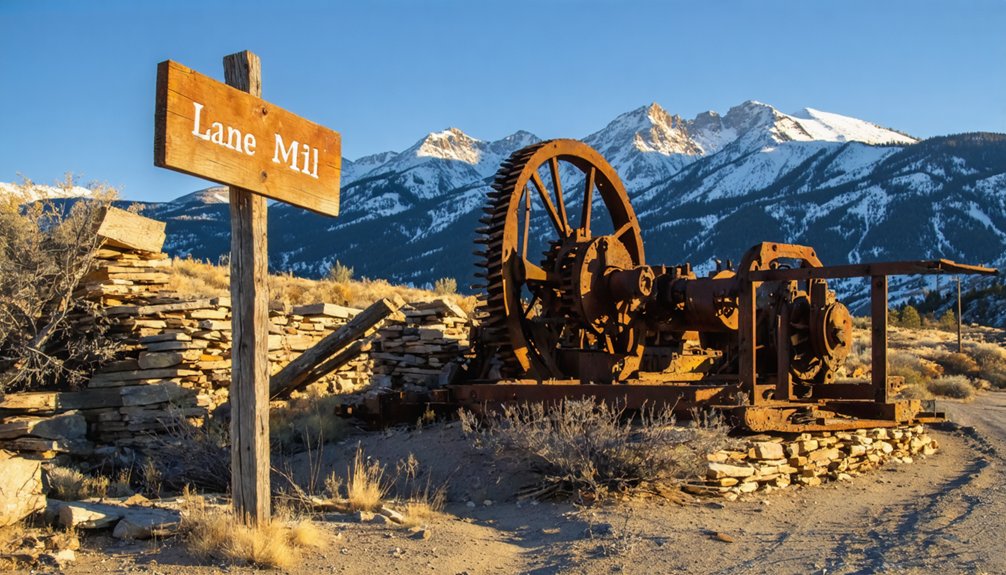
Despite its remote location nestled in the Sierra foothills, Lane Mill remains accessible to adventurous travelers willing to navigate unpaved forest service roads that wind through dense pine groves.
You’ll want to bring a high-clearance vehicle, plenty of water, and detailed maps, as cellular service is nonexistent in this forgotten corner of California.
The ghost town offers no amenities or guided tours—just raw, untouched historical tourism at its most authentic.
Several collapsed wooden structures, rusted mining equipment, and the crumbling stone foundation of the stamp mill await your discovery.
Photography enthusiasts will find endless compositions among the sun-bleached timbers and oxidized metal artifacts.
Visit during spring or fall to avoid extreme temperatures.
Remember to practice “leave no trace” ethics—take only photographs, leave only footprints.
Preservation Efforts and Historical Significance
Unlike the more popular California ghost towns that enjoy state protection, Lane Mill’s preservation status remains largely informal. The site faces significant preservation challenges including natural deterioration, limited funding, and its remote location that complicates maintenance efforts.
Despite these obstacles, Lane Mill holds substantial cultural significance as a tangible reminder of California’s boom-and-bust mining economy.
Like Bodie and Seneca, Lane Mill represents an important chapter in the state’s industrial heritage, illustrating 19th-century mining technologies and the diverse labor communities that powered these operations. The remaining structures and artifacts provide valuable insights into early mining town life.
Without formal protection, however, Lane Mill relies heavily on responsible visitors and local historians to maintain its historical integrity for future generations.
Frequently Asked Questions
Who Was Lane Mill’s Most Infamous Resident?
While history remains silent, you’ll need to seek Lane Mill’s infamous resident and local legend elsewhere—county archives and regional historical societies hold the secretive past you’re yearning to uncover.
What Natural Disasters Affected Lane Mill’s Development?
You’ll find Lane Mill’s development was severely hindered by major fires that devastated the area, while earthquake impacts and flood damage further isolated this remote settlement amid harsh mountain weather conditions.
Were There Any Major Crimes or Shootouts?
You won’t find evidence of major crimes or shootouts in Lane Mill’s history. Historical records show minimal crime rates and zero documented shootout incidents in this peaceful lumber community.
What Indigenous Tribes Lived in the Area Before Settlement?
Like ancient guardians of the desert’s secrets, the Timbisha Shoshone and Paiute Native Tribes maintained cultural heritage in this area before Lane Mill existed. You’ll find their descendants still connected to these lands today.
Did Lane Mill Have Connections to Any Famous Gold Rush Figures?
You’ll find no documented connections between Lane Mill and famous miners from the Gold Rush era. Any potential associations with notable gold discoveries remain unverified in historical records.
References
- https://patch.com/california/banning-beaumont/13-ghost-towns-explore-california
- https://rachelsruminations.com/favorite-ghost-towns-in-california/
- https://en.wikipedia.org/wiki/Bodie
- https://www.youtube.com/watch?v=Q_yjBgICWl8
- https://www.nps.gov/deva/learn/historyculture/death-valley-ghost-towns.htm
- https://www.youtube.com/watch?v=4abnhupnLac
- https://nvtami.com/2024/11/07/bodies-mono-mills/
- https://www.visitmammoth.com/blogs/history-and-geology-bodie-ghost-town/
- https://www.savetheredwoods.org/blog/spooky-redwoods-ghost-town-remains-a-presence/
- https://roadtrippers.com/magazine/gin-mill-seneca-california/