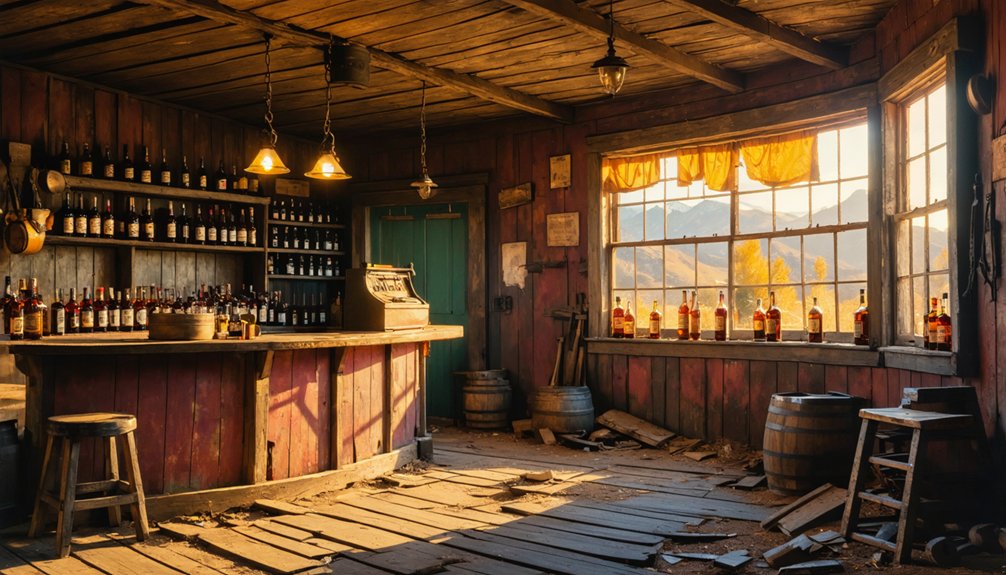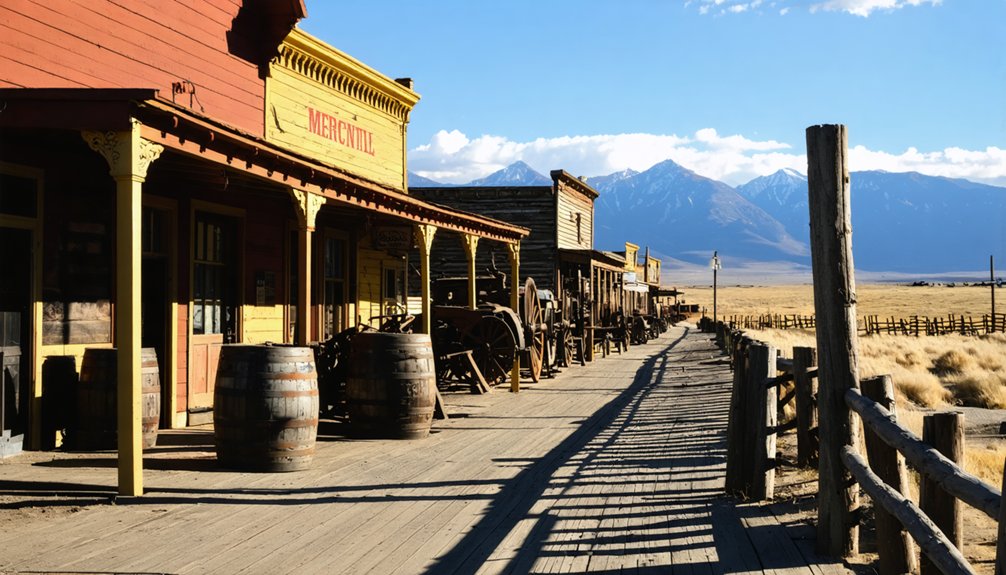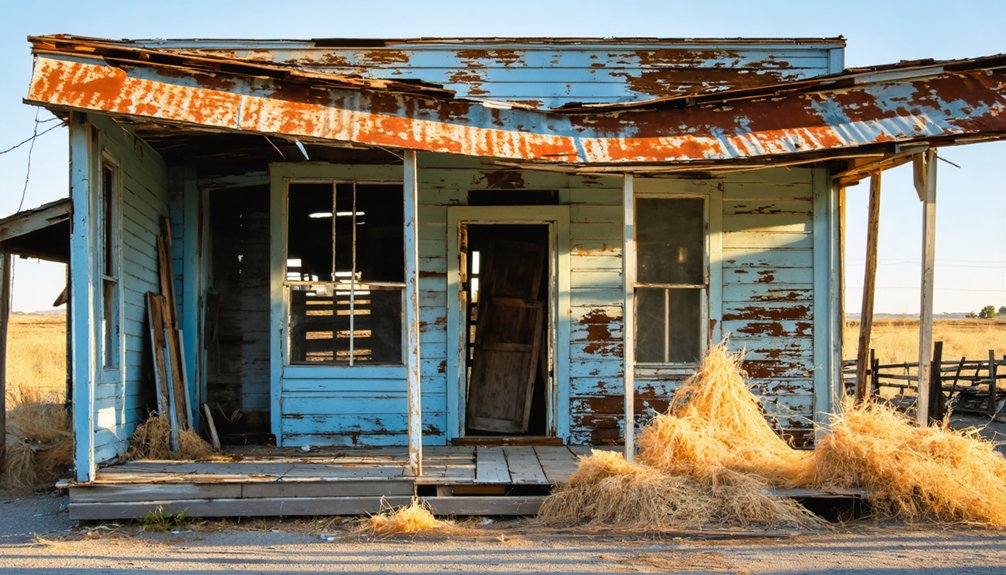
Langdon was once a thriving California mining town where gold and silver transformed the landscape in the late 19th century. Today, you’ll find scattered foundations, rubble, and rare surviving homes instead of the historic mansion demolished in 1939. The relocated octagonal study stands as the only significant architectural remnant. Visit to explore partially intact foundations of hotels, meeting houses, and jail cells while enjoying spectacular views of extinct volcanoes. The weathered ruins hold stories of boom-and-bust cycles waiting to be discovered.
Key Takeaways
- Langdon was a booming California mining town that experienced cycles of prosperity during silver rushes and wartime tungsten demand.
- Few original structures remain today due to the demolition of the historic mansion in 1939, leaving only foundations and scattered rubble.
- The town featured a stratified society with five distinct social classes centered around mining, with saloons serving as social hubs.
- Preservation efforts began in the 1990s, focusing on authenticity rather than commercialization to maintain Langdon’s historical integrity.
- Visitors can explore partially intact foundations, archaeological remains, cemetery ruins, and schoolhouse remnants at this California Historical Landmark.
The Rise and Fall of Langdon’s Mining Economy
As the rugged mountains surrounding Langdon yielded their first glimmers of gold and silver in the late 19th century, the sleepy California landscape transformed virtually overnight into a bustling frontier of opportunity.
You’d have witnessed placer mining techniques evolve into sophisticated underground operations as prospectors explored deeper for precious metals. Water pipelines stretched for miles, connecting lifelines to stamp mills where ore met machinery in the pursuit of wealth. The miners used simple tools like pans to sift gold from dirt, a common method during the California Gold Rush era. Chinese miners formed small mining villages and typically worked claims that Americans had abandoned.
Economic cycles defined Langdon’s pulse—booming with silver rushes in 1919 and wartime tungsten demand, then contracting as veins thinned or mineral prices plummeted.
The town’s fortunes rose and fell with global markets and technological advances. When companies like Pittsburgh and Mount Shasta Mining failed to strike anticipated riches, Langdon’s heartbeat slowed.
Langdon’s pulse ebbed as mining giants grasped at phantom veins and markets turned their fickle gaze elsewhere.
Eventually, the inevitable decline came as minerals dwindled and the freedom of the mining frontier faded into memory.
Walking Through Historical Remnants and Structures
When you wander through Langdon’s deserted grounds today, you’ll find little remaining from its once-thriving mining community. Unlike other California ghost towns with preserved wooden structures or adobe buildings, Langdon lost its centerpiece when the historic mansion was demolished in 1939—a devastating blow to the town’s historical architecture.
You’ll encounter mostly foundations, scattered rubble, and the occasional chimney stack where family homes once stood. The area now contains a shopping center called Langdon Plaza that was built after the mansion’s demolition. Similar to Chinese Camp, the few individual homes that survived stand as rare remnants of the original settlement.
The absence of Langdon Mansion—which the city declined to preserve due to maintenance costs—leaves visitors to piece together history from minimal physical evidence. Ghost town exploration here requires imagination, as you’ll find no central landmark like the post offices or hotels that anchor other abandoned settlements.
Only a relocated octagonal study survives as tangible evidence of Langdon’s architectural past.
Daily Life in a California Boom Town
Five distinct social classes defined life in Langdon during its boom era, creating a vibrant yet stratified community typical of California’s mining settlements. Had you lived here, your daily routine would have varied dramatically based on your position – from wealthy merchants to struggling miners, each with their own reality.
The mining lifestyle dominated Langdon’s economy, with laborers earning $2-$3 daily while skilled tradesmen commanded double. You’d have frequented one of the town’s numerous saloons, where gambling thrived alongside cultural diversity – Spanish, Chinese, Chilean and French influences mixing in unpredictable ways. Women were scarce in Langdon, as they comprised only 700 of 40,000 arrivals to California by ship in 1849.
Your entertainment options would have included bear fights, brass bands, and literary gatherings. The psychological allure of California’s superior climate attracted many residents who overlooked economic considerations in favor of scenic landscapes and favorable weather.
Meanwhile, you’d contend with constant fire threats, violence (six killings weekly in similar towns), and primitive living conditions – all hallmarks of California’s booming frontier existence.
Preservation Efforts and Current Status
Despite decades of neglect, Langdon’s weathered buildings now stand as tributes to dedicated preservation efforts that began in the late 1990s. Passionate owners have methodically acquired structures regardless of condition, focusing on authenticity rather than commercialization.
Traditional preservation techniques emphasize minimal intervention—primarily new roofs using rolled asphalt initially, later replaced with historically accurate cedar shingles. Similar to Gold Point’s restoration approach, the strategy involves internal stabilization of original structures while maintaining historical integrity. The project faces similar challenges to Cerro Gordo, including natural disasters like fires that have destroyed historic buildings.
Your support as ghost town enthusiasts creates a living museum where history breathes:
- Original materials remain whenever possible, preserving the town’s authentic character
- Community involvement through volunteer labor drives ongoing restoration
- Financial contributions from cabin stays fund essential building materials
- Systematic acquisition prevents structures from disappearing forever
- Research and documentation complement physical preservation, honoring Langdon’s cultural legacy
Visiting Langdon: What Remains to Discover
Today’s visitors to Langdon step into a haunting tableau where past and present merge amid the Mojave’s stark beauty.
You’ll discover partially intact foundations of original hotels and meeting houses, alongside granite-walled jail cells and the county post office—silent sentinels of a bygone era.
Your archaeological exploration reveals aqueduct structures and weathered chimneys from the early 1900s commune, while the cemetery and schoolhouse ruins offer poignant glimpses into community life.
Echoes of forgotten lives whisper through crumbling chimneys and silent schoolrooms, where desert winds tell stories of ambition and loss.
Though ghost town artifacts remain, remember that looting is prohibited to preserve this California Historical Landmark.
As you wander among structures that yielded 75,000 ounces of gold worth $31 million today, you’re walking the same paths as idealistic settlers who briefly thrived before the desert reclaimed its domain—a perfect metaphor for freedom’s fleeting nature.
The area surrounding Langdon features spectacular views of extinct volcanoes that have attracted explorers for generations.
Unlike Randsburg which experienced two major fires in 1898, Langdon’s structures gradually fell into disrepair without dramatic destruction.
Frequently Asked Questions
Was Langdon Connected to Any Famous Historical Figures?
You won’t find documented connections between Langdon and famous historical figures. Langdon’s history remains largely unrecorded, with historical connections to California’s gold rush era possibly lost to time.
What Indigenous Tribes Originally Inhabited the Langdon Area?
You’d find the Chimariko and Hupa tribes in the Langdon vicinity, stewarding this land for millennia. Their rich tribal history and cultural heritage flourished around Trinity River’s lifegiving waters before European encroachment.
Did Any Major Disasters Contribute to Langdon’s Abandonment?
Ninety percent of California ghost towns fell to economic pressures rather than catastrophes. You won’t find evidence of major natural disasters destroying Langdon—its soul quietly departed as mining profits vanished, leaving only whispers of prosperity.
Were There Any Unique Laws or Governance Structures in Langdon?
You’ll find no evidence of unique governance or unusual laws in Langdon. Like most mining settlements, it operated under typical county oversight rather than establishing distinctive local statutes or innovative political structures.
How Did Seasonal Weather Patterns Affect Mining Operations in Langdon?
You’d have witnessed weather impacts dramatically shifting mining efficiency—winter rains uncovering fresh gold, while summer heat allowed steady digging. Spring runoff aided panning, but floods and freezes often halted operations entirely.
References
- https://www.distilledhistory.com/langdonhouse/
- https://www.youtube.com/watch?v=OD9M6MP6RRU
- https://www.californist.com/articles/interesting-california-ghost-towns
- https://dornsife.usc.edu/magazine/echoes-in-the-dust/
- https://www.youtube.com/watch?v=ElbXVNDurPc
- https://www.vvdailypress.com/story/lifestyle/travel/2024/02/21/what-you-need-to-know-when-you-visit-kern-county-ghost-town-randsburg/72629893007/
- https://en.wikipedia.org/wiki/List_of_ghost_towns_in_California
- https://lonepinechamber.org/history/ghost-towns-of-the-lone-pine-area/
- https://npshistory.com/publications/deva/hrs-mining-v1p1.pdf
- https://www.publiclandsforthepeople.org/wp-content/uploads/2015/06/Desert-Fever-History-of-Mining-in-the-CDCA.pdf