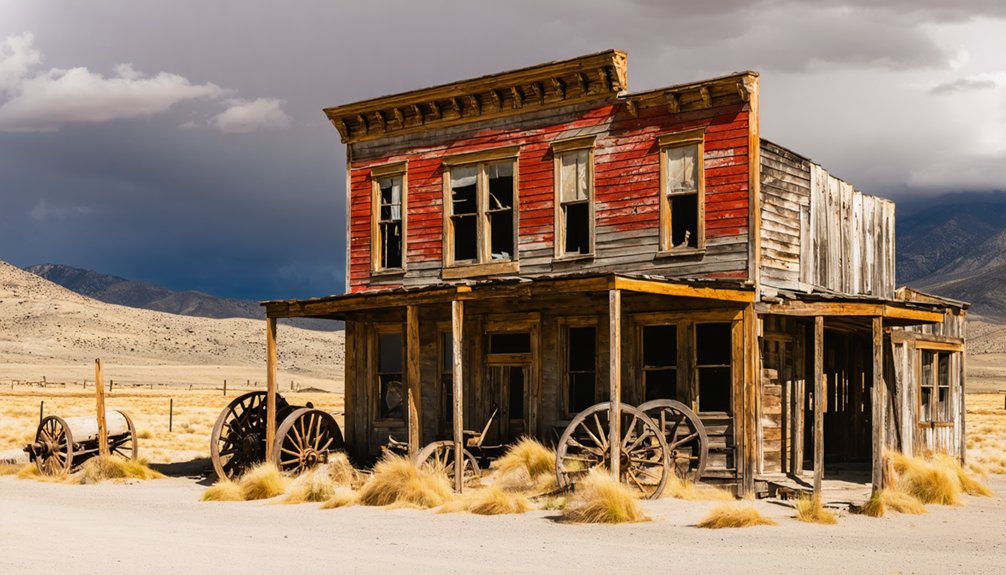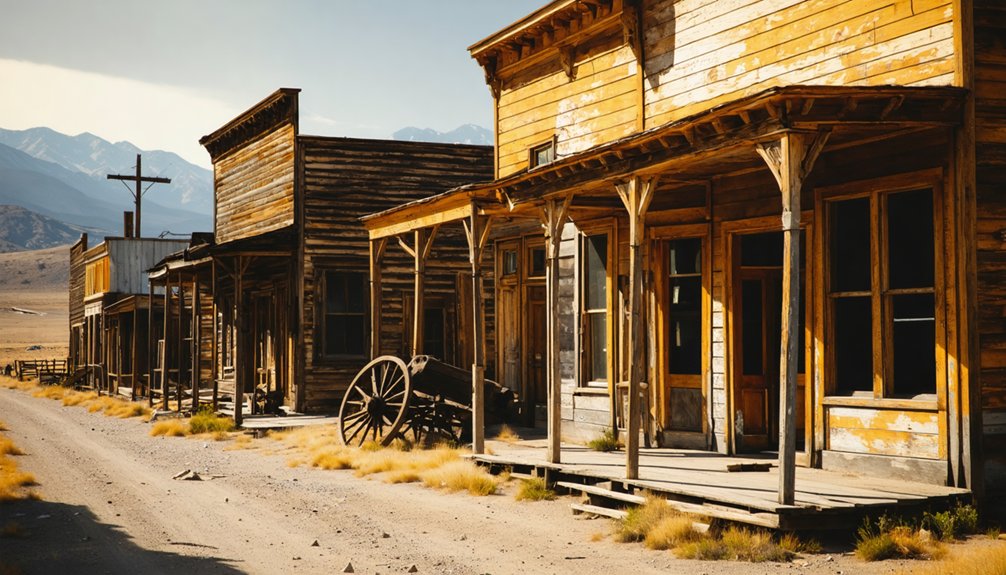
You’ll find America’s largest ghost towns scattered across the West, where resource extraction once fueled explosive growth. Bodie, California preserves over 100 structures from its 10,000-person mining heyday, while Jerome, Arizona plummeted from 15,000 copper workers to near-abandonment after 1953. Virginia City, Nevada supported 25,000 residents during the Comstock Lode’s silver boom. Texas alone counts over 500 ghost towns—roughly four per county—documenting volatile economic shifts driven by railroads, mining collapses, and resource depletion. The patterns behind these abandoned communities reveal deeper truths about frontier capitalism.
Key Takeaways
- Bodie, California reached 10,000 residents during its 1870s gold rush peak, with over 100 structures surviving today.
- Virginia City, Nevada housed 25,000 people and produced $400 million in silver-gold from the Comstock Lode.
- Jerome, Arizona peaked at 15,000 residents from 30 nations during its copper mining boom era.
- Texas contains over 500 ghost towns, with Shafter declining from 1,500 residents in 1943 to 11 by 2000.
- Elkhorn, Montana supported 2,500 residents in the 1880s before epidemics and fires caused its abandonment.
The Rise and Fall of California’s Bodie: From Boom to Barren
In 1859, William S. Bodey discovered gold east of the Sierra Nevada, establishing a mining camp at 8,379 feet elevation. Though Bodey perished in a snowstorm that same year, the settlement bearing his name would explode into legendary status.
You’ll find the transformation remarkable: after Standard Company unearthed massive deposits in 1876, population surged to 10,000 by 1879.
Historical architecture from this era still stands—2,000 buildings once lined these streets, including 65 saloons and the brick-vaulted Bodie Bank.
Community life thrived violently, spawning the phrase “bad man from Bodie.” Yet decline came swiftly; by 1886, only 1,500 remained. The town’s 30 gold mines extracted precious ore during its peak years, employing hundreds of miners who worked the dangerous underground shafts. As fortunes waned through the 1880s, miners departed for other promising towns, leaving behind empty structures and fading dreams.
Today, over 100 structures survive in arrested decay, preserved as California’s premier ghost town symbol of Gold Rush freedom.
Mining Empires Gone Silent: Jerome and Virginia City
While William Bodey’s discovery claimed headlines in California’s high country, parallel mineral empires emerged across the American West that would dwarf Bodie’s production and architectural legacy.
Arizona’s Jerome clung to Cleopatra Hill’s slopes, housing 15,000 souls from 30 nations during its 1900s copper boom. You’ll find records showing United Verde Copper Company extracted $800 million in ore before mine closures shuttered operations in 1953.
Jerome’s copper empire drew 15,000 immigrants from 30 countries before yielding $800 million and vanishing in 1953.
Population decline reduced Jerome to under 100 residents by decade’s end. The town’s revival came through preservation efforts by the Historical Society, which helped transform the abandoned mining camp into a thriving artistic destination.
Nevada’s Virginia City reached even greater heights—25,000 residents harvesting the Comstock Lode’s $400 million silver-gold bounty. Original mining company ledgers document 2,000 claims supporting elaborate theaters and mansions.
Yet population decline mirrored Jerome’s trajectory when high-grade ores vanished, leaving both communities suspended between extinction and preservation. Today, Jerome has transformed into a vibrant artistic community with about 444 residents, attracting tourists to its scenic overlooks of Verde Valley and the San Francisco Peaks.
Montana’s Silver Legacy: The Story of Elkhorn
Two years after Bodie’s founding, Swiss immigrant Peter Wys uncovered silver galena ore in Montana’s Elkhorn Mountains northeast of Boulder, triggering events that would distinguish this settlement from typical Western mining camps.
Norwegian prospector Anton Holter transformed the claim into a thriving operation by 1875, attracting European immigrant families rather than transient fortune-seekers.
Silver mining sustained 2,500 residents by the late 1880s, with infrastructure reflecting genuine community resilience—schools, churches, bowling alleys, and Fraternity Hall hosted Cornish Glee Club concerts.
Yet the 1888-1889 diphtheria epidemic killed 20% of residents, mainly children, while declining ore quality and silver prices accelerated abandonment.
A devastating fire in 1912 destroyed many businesses and the town’s only church, further compounding the community’s decline.
The Northern Pacific Railroad constructed a spur line to Elkhorn in 1889, providing critical ore transportation support that became especially vital after silver devaluation in 1893.
Montana preserved Fraternity Hall and Gillian Hall as its smallest state park in 1980.
Today, approximately twelve residents occupy this privately-owned townsite, maintaining autonomy against governmental expansion.
Texas: The Ghost Town Capital of America
Across Texas’s vast 268,596 square miles, between 511 and 1,000 ghost towns stand as proof to the state’s volatile economic history—more than any other state in the nation. You’ll find approximately four per county, concentrated heavily in Wilson County’s 31 abandoned settlements.
These remnants reflect a time when prosperity seemed within reach, yet they now serve as poignant reminders of dreams deferred. As people explore abandoned towns across the United States, they often uncover stories of resilience and loss, each site a chapter in the larger narrative of American history. In many cases, nature has begun to reclaim these spaces, intertwining the old with the new.
Railroad rerouting destroyed towns like Gomez, which lost its county seat when tracks bypassed it for Brownfield. Mining collapses, military base closures, and oil industry fluctuations created boom-and-bust cycles that emptied entire communities.
Shafter’s population crashed from 1,500 in 1943 to just 11 by 2000. Some communities disappeared entirely through municipal absorption, with towns like Smithfield becoming part of North Richland Hills and McNeil merging into Austin. Yet historical preservation and tourism development offer redemption—Terlingua thrives on Big Bend’s 440,276 annual visitors, while restored saloons and cemeteries attract heritage tourists worldwide, giving these forsaken places economic purpose beyond their original industries.
Frequently Asked Questions
What Happened to the Residents When These Ghost Towns Were Abandoned?
You’ll find Jerome’s population crashed below 100 before survivors formed a Historical Society, preserving freedom through historical preservation. They’d transform abandonment into zombie tourism, while Roosevelt Roads’ residents fled toxic contamination, and Picher’s evacuated after devastating destruction.
Can Tourists Visit and Explore These Ghost Towns Legally Today?
You can legally visit many ghost towns with state historic park or National Monument status, though visiting restrictions apply based on ownership. Preservation efforts have opened sites like Bodie and Bannack, while private properties remain off-limits without permission.
Are Any Ghost Towns Successfully Revitalized Into Thriving Communities Again?
Yes, you’ll find successful revivals through historical preservation and tourism development. Lowell’s mills became thriving studios, while Bethlehem’s steel site now draws millions. These towns transformed abandonment into economic significance by honoring their past while embracing adaptive reuse.
What Determines Whether a Town Becomes “Abandoned” Versus Just Declining Population?
Consider Centralia’s mandatory evacuation orders versus Bodie’s gradual drift—you’ll find “abandonment” means government intervention or environmental hazards forcing departure, while population decline reflects economic shifts. Urban decay becomes official abandonment when historical preservation can’t overcome uninhabitability.
How Do Ghost Towns Impact Local Wildlife and Environmental Recovery?
You’ll find ghost towns create unexpected wildlife habitats through structural abandonment, while environmental regeneration occurs as vegetation reclaims disturbed land. Natural succession processes restore ecosystems, offering species freedom from human interference and demonstrating nature’s resilient recovery patterns.
References
- https://themortgagepoint.com/2024/10/25/americas-new-ghost-towns/
- https://www.loveexploring.com/gallerylist/188219/the-us-state-with-the-most-ghost-towns-revealed
- https://blog.batchgeo.com/ghost-towns/
- https://stephentravels.com/top5/ghost-towns/
- https://www.geotab.com/ghost-towns/
- https://www.youtube.com/watch?v=9sqf1Ayk3N0
- https://joybird.com/blog/top-ghost-towns-in-america/
- https://en.wikipedia.org/wiki/Lists_of_ghost_towns_in_the_United_States
- https://www.bon-voyage.co.uk/activities/jerome_the_largest_ghost_town_in_america
- https://hauntedus.com/california/bodie-ghost-town/