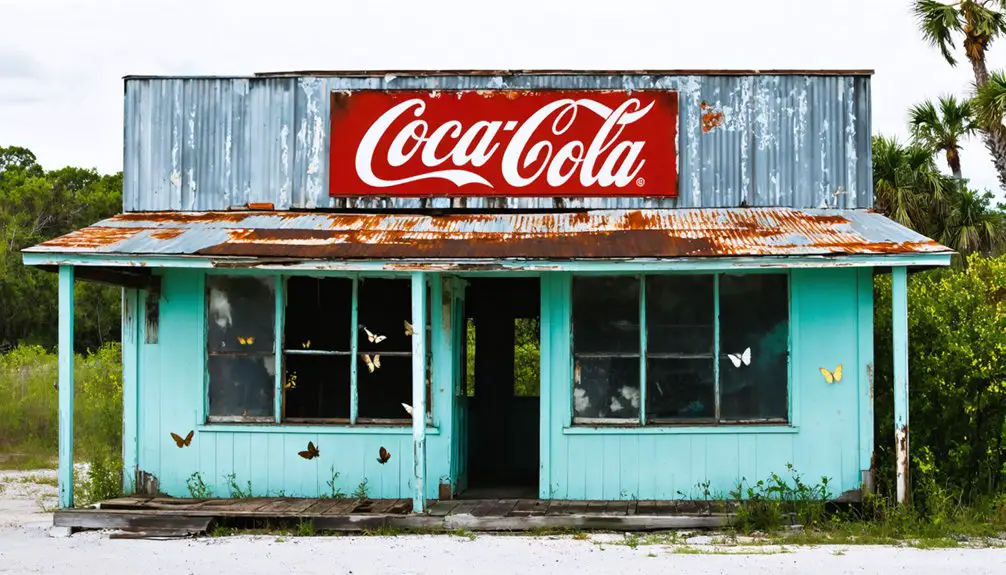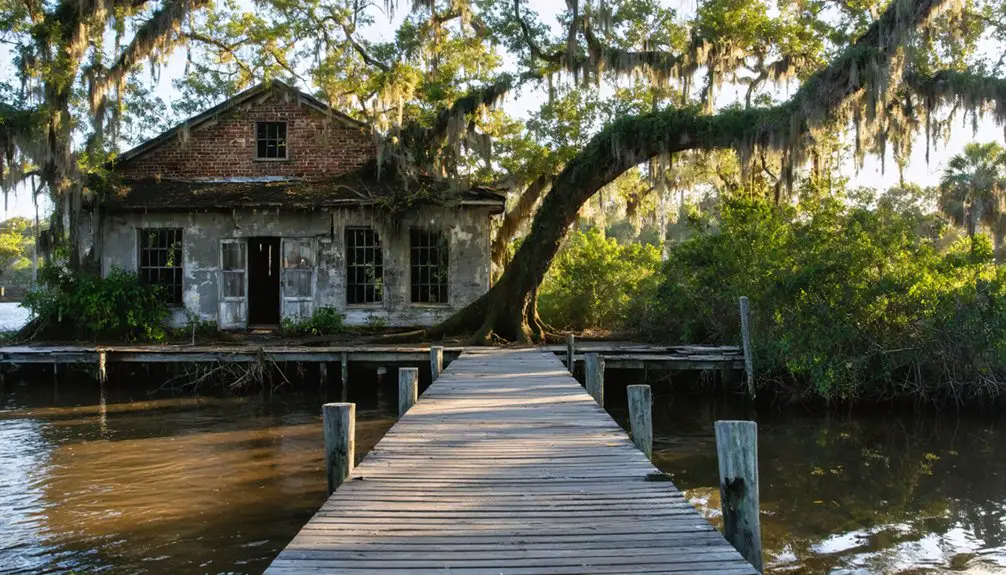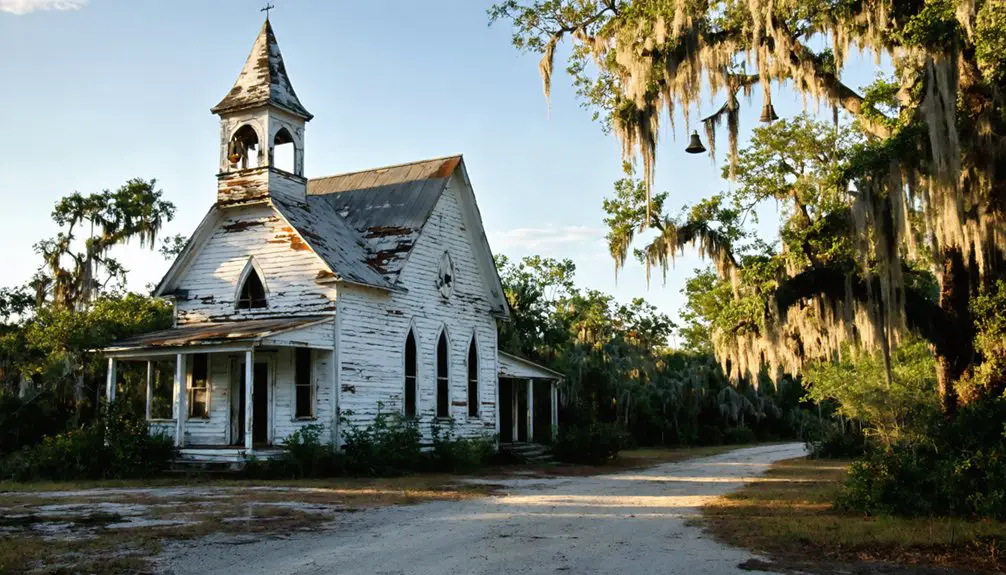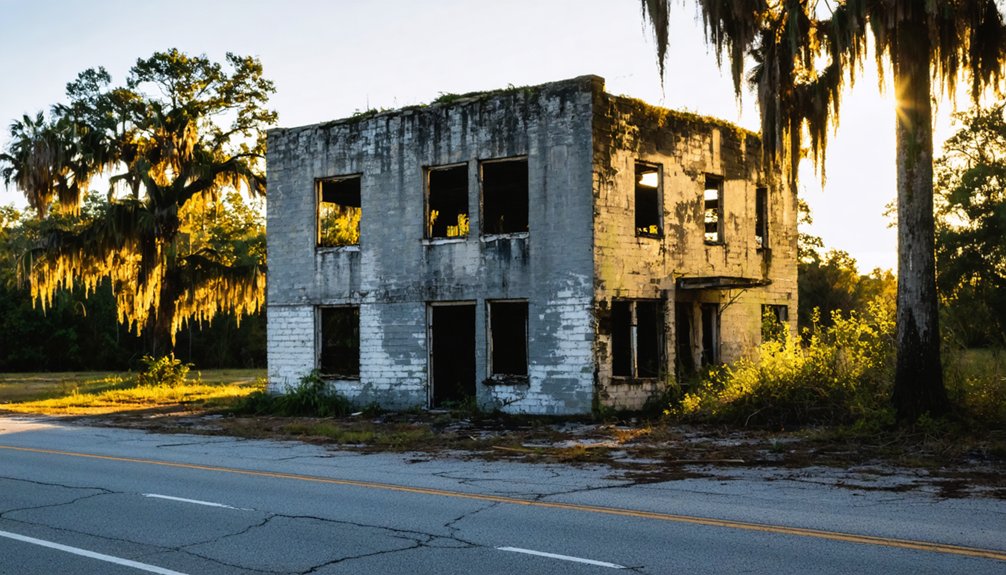
You’ll find Lawtey tucked into Bradford County’s piney flatwoods, a skeletal remnant of what was once a thriving citrus empire founded by thirty Chicagoans who fled south in 1877 seeking warmth and prosperity. Captain Thomas Burrin’s donated acres transformed into an exclusive settlement complete with cotton gins and orange groves until the devastating 1894-1895 freeze shattered everything—turning fruit to ice and land values from $1,000 to $10 per acre. Today, just 704 souls remain among the echoes of gang violence, failed strawberry crops, and notorious speed traps that tell a darker story.
Key Takeaways
- Founded in 1877 by thirty Chicagoans seeking mild winters, Lawtey once thrived with 250 residents, schools, stores, and cotton gins.
- The devastating 1894-1895 Great Freeze destroyed citrus groves, plummeting land values from $1,000 to $10 per acre and forcing mass exodus.
- The Great Depression collapsed Lawtey’s strawberry industry in 1930, shuttering farms and packinghouses as demand vanished and banking systems failed.
- Early 1900s violence, gang warfare, and ineffective law enforcement caused residents to flee, accelerating the town’s depopulation and decay.
- Today, Lawtey is largely abandoned with only 704 residents, known mainly as a speed trap rather than its former prosperity.
The Chicago Settlers: From the Windy City to Florida’s Frontier
How does a city built on frozen lakefront winds transplant itself to Florida’s sandy frontier? In 1877, thirty Chicagoans escaped urban conditions and bitter winters, heading south with dreams of prosperity. Captain Thomas Burrin’s 220-acre donation from his sawmill empire gave them their foundation.
The railroad’s 1850s arrival had already opened this sparsely populated region, creating corridors through wildlife habitats where European settlement had only begun after Spain’s 1821 cession. Native American tribes such as Tumukua and Seino had inhabited the area before European arrival, relying on hunting, fishing, and farming for sustenance.
You’ll find these Chicago transplants weren’t interested in mingling with local “crackers”—they built their exclusive enclave with schoolhouses, stores, and cotton gins. By 1885, the town’s population reached 250, supporting orange and strawberry farming alongside its commercial enterprises.
Captain Burrin’s Vision: Building a Town From Sawdust and Dreams
While Chicago’s wealthy settlers dreamed of orange groves and southern prosperity, Captain Thomas Burrin had already spent years transforming 18,000 acres of Florida wilderness into a timber empire. This jolly Englishman operated sawmills and turpentine stills where pine logs arrived like river rafting expeditions through swampy channels.
In 1877, he donated 220 acres for Lawtey’s townsite and sold additional parcels at five dollars each—prices that’d make modern music festivals seem expensive. His sawmill became the community’s heartbeat, processing timber while settlers hammered together homes from fresh-cut lumber.
The town’s name honored a newcomer’s son-in-law, cementing personal connections into public identity. By 1885, Burrin’s vision materialized: 250 residents, a school, stores, and a cotton gin rising from sawdust and determined independence. The settlement emerged during Florida’s territorial expansion following U.S. acquisition in 1821, when communities sprouted across the newly American landscape. Yet the early 1900s brought violent gangs and frequent shootings that threatened to unravel everything the settlers had built.
Agricultural Prosperity: Orange Groves, Cotton, and Strawberry Fields
By 1885, Lawtey’s sawdust-covered streets gave way to something sweeter—82 acres of orange groves stretching beneath Florida’s relentless sun. You’d find cotton gins humming alongside citrus packinghouses, railroads hauling prosperity northward. The 1925 incorporation sparked agricultural expansion that resisted any notion of urban renewal—this was farming country, pure and simple.
Then winter 1894-1895 struck. Frozen oranges littered the ground like shattered dreams, forcing a pivot that’d define Lawtey’s character. Strawberries replaced citrus, and Tommy King spent fifty years coaxing ruby fruit from North Florida soil, becoming one of the region’s biggest growers. Spanish explorers had first brought oranges to Florida centuries earlier in the 16th century, establishing a legacy that would eventually reach towns like Lawtey.
Through the Great Depression, these fields sustained what schoolhouses and stores couldn’t—a community practicing environmental conservation before anyone coined the term, rotating crops, respecting land that demanded respect. The success of citrus cultivation depended heavily on soil rich in seashell fragments, which provided the alkalinity and nutrients essential for thriving orange groves across Florida’s growing regions.
The Great Freeze of 1894-1895: When Ice Destroyed an Empire
December 27, 1894 arrived with winds that’d haunt Florida’s collective memory for generations. You’d have watched temperatures plunge to 11 degrees in Tallahassee as 25-30 mph gales turned prosperity into devastation.
Lawtey’s citrus empire froze solid—oranges turned to ice, bark split like gunfire across groves. February’s second freeze finished what December started, killing tender new growth to the ground. Production collapsed from six million boxes to 100,000.
Land values crashed from $1,000 to $10 per acre overnight. Half the homes emptied as growers fled north. Train engineers gave extra long whistle blasts to warn residents that another cold wave was approaching.
Some desperate farmers relocated to California with seedless grapefruit varieties discovered near Lakeland, forever altering the western citrus landscape. Today’s ghost town tourism and artistic murals commemorate what ice destroyed—an agricultural empire that’d never recover.
The citrus industry shifted permanently southward, leaving Lawtey’s abandoned packing houses as monuments to nature’s unforgiving power.
High Society Meets the Crackers: Social Division in Early Lawtey
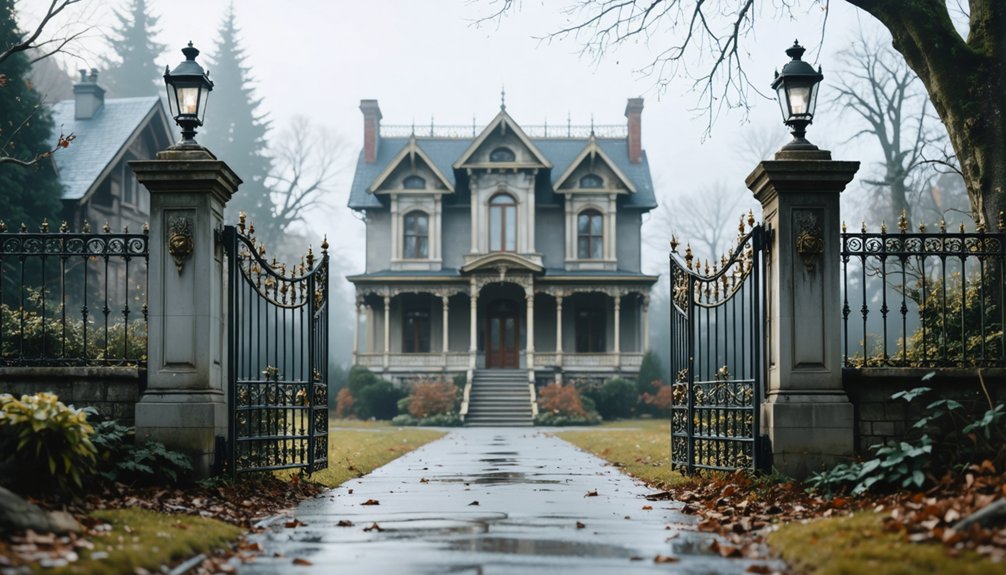
If you’d walked Lawtey’s dusty streets in 1877, you’d have immediately noticed the invisible line dividing Captain Burrin’s planned community. The thirty Chicagoans who purchased land at $5 per acre built stately homes that announced their northern wealth, while they dismissed the Florida crackers working Burrin’s 18,000-acre sawmill operations as social inferiors.
These wealthy transplants maintained exclusive networks through their schoolhouse, stores, and cotton gin—creating parallel worlds that rarely touched, though both groups shared the same small-town boundaries. This era of agricultural expansion mirrored developments across the region, as Dutton Cotton Ginnery began operations in 1882 as a major Sea Island Cotton producer. Just a few miles north, the settlement of New Lawtey appeared on regional maps, suggesting the original community’s influence extended beyond its central district.
Wealthy Northerners Arrive First
When thirty Chicagoans stepped off the train in 1877, they carried more than their trunks and winter coats—they brought assumptions about class, refinement, and their rightful place in Florida’s frontier hierarchy.
You’ll find their architectural heritage still standing in those stately homes they constructed during Lawtey’s boom years, each structure declaring northern superiority through design and scale.
Captain Burrin’s $5.00 land parcels attracted these wealthy settlers first, and they didn’t waste time establishing boundaries—social ones, not just property lines.
They built their grand residences as monuments to cultural preservation, maintaining Chicago’s standards in Florida’s sand.
Segregated Social Spheres Emerge
As Lawtey’s population swelled beyond 250 residents in the late 1880s, the Chicago elite who’d staked their claims first erected invisible barriers more formidable than any fence line. You’d witness social barriers crystallizing between wealthy Northerners and working-class “Crackers,” while racial segregation followed Florida’s 1889 school law mandates.
The town’s social architecture divided sharply:
- Exclusive clubs and social gatherings for Northern property owners
- Separate establishments for local laborers and railroad workers
- Designated spaces reflecting emerging Jim Crow restrictions
These divisions mirrored Florida’s 1885 Constitution provisions, which institutionalized separation across economic and racial lines.
You couldn’t escape the irony—settlers pursuing Florida’s freedom found themselves recreating Northern class structures and embracing Southern segregation policies, fragmenting Lawtey’s community before it fully formed.
Guns and Gangs: The Violent Turn of the 1900s
The peaceful streets of Lawtey transformed into a dangerous frontier by the early 1900s, where the crack of gunfire replaced evening conversations and residents wouldn’t step outside after sunset without a loaded revolver.
Rival gangs battled for territorial control, turning shootings from isolated incidents into daily occurrences. Murder became so frequent that historical records catalog a systematic pattern of organized violence rather than random altercations.
The social divisions between wealthy northerners and marginalized locals created fertile ground for gang recruitment.
As bodies accumulated and law enforcement remained ineffective, families fled. This violent chapter triggered irreversible urban decay—population exodus, economic collapse, and the death of investment.
Lawtey never recovered from this lawless era, its reputation permanently scarred. Today’s ghost town stands as testimony to how quickly civilization can unravel when violence replaces community.
The Great Depression’s Knockout Blow
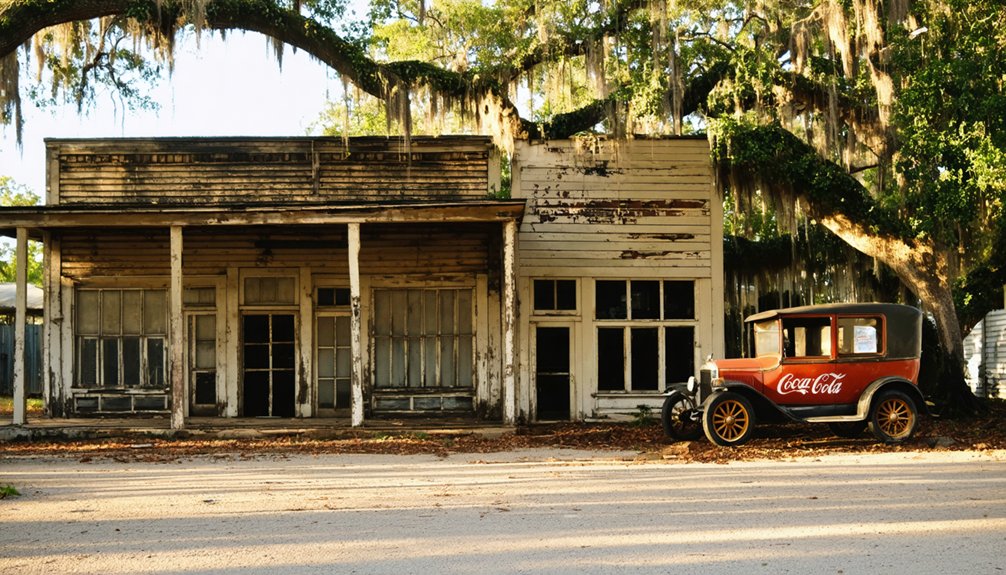
If you’d weathered Lawtey’s violent bootlegging years, you might’ve hoped the strawberry fields would anchor the town through harder times—but the Great Depression crushed that dream entirely.
By 1930, the strawberry industry that once shipped 300 refrigerated railcars north each season had collapsed under plummeting prices and dried-up credit, leaving packinghouses shuttered and fields abandoned.
The knockout blow came swiftly: families who’d survived hurricanes and Mediterranean fruit flies now packed what little they owned and joined the exodus, watching their once-thriving agricultural hub fade into silence.
Strawberry Industry Collapses
When the Great Depression’s shadow stretched across America in the early 1930s, Lawtey’s celebrated strawberry empire crumbled almost overnight.
You’d have witnessed trainloads of berries that once rolled north grinding to a halt as markets vanished. Prices plummeted while fertile fields still produced their sweet harvest—but nobody could afford to buy.
The urban decline hit hard:
- Trainload shipments ceased entirely as agricultural markets collapsed
- Strawberry prices crashed from oversupply meeting vanishing demand
- Family farms like the Crawfords lost their primary income source overnight
Lawtey’s cultural legacy as the “Strawberry Capital of the World” faded into memory.
Small three-acre operations couldn’t weather the storm when buyers disappeared and credit dried up.
The rail infrastructure that’d built prosperity now stood idle, marking the end of an era.
Economic Recovery Never Came
As strawberry fields withered into memory, Lawtey’s chance for economic redemption died with the nation’s banking system. By 1932, you’d find locked bank doors where capital once flowed freely.
Economic stagnation gripped the community as hundreds of Florida banks collapsed, taking depositors’ savings and any hope of business revival.
The investment drought proved catastrophic for small towns like Lawtey. Without banking access, farmers couldn’t purchase seed or equipment.
Merchants operated on barter when currency vanished.
You’d witness families leaving for uncertain prospects elsewhere, while those who remained scraped by on subsistence farming.
Even as Florida’s income crawled from $423 million in 1933 to $1.05 billion by 1941, Lawtey saw little benefit.
Full recovery wouldn’t arrive until World War II—too late for a town already abandoned.
Population Exodus Accelerates
The double blow of Florida’s 1926 land boom collapse followed by the 1929 national crash created an exodus nobody could’ve predicted. You’d have witnessed Jefferson County’s population shrinking as farm economies crumbled, leaving behind historic architecture that stands as silent testimony to better days.
Tampa Bay and rural counties watched their growth rates plummet while unemployment soared.
The bleeding accelerated through the early 1930s:
- Tourism collapsed from three million to one million visitors annually
- 600 desperate workers competed for 100 highway improvement positions
- Statewide earnings bottomed at $423 million in 1933
Environmental preservation wasn’t on anyone’s mind when survival demanded escape. Communities that’d thrived for generations emptied out, transforming vibrant towns into skeletal remains of Florida’s prosperity.
The Silver Bullet Sheriff: When Speed Traps Became Revenue
How did two small Florida towns earn the dubious distinction of becoming America’s most notorious speed traps?
In 1995, AAA’s investigation exposed Waldo and Lawtey as the only two speed trap designations nationwide. You’d discover that profit—not safety—drove enforcement.
Waldo’s seven officers wrote over 11,000 tickets annually, with revenue focus comprising half their budget. Officers worked quotas while poorly marked school zones along US 301 ensnared unfamiliar drivers. The system relied on you paying fines without contest, turning motorists into compelled donors.
When officers missed county court appearances, cases disappeared. Florida’s Department of Law Enforcement eventually investigated these notorious practices.
Waldo disbanded its police in 2014, ending decades of systematic revenue generation that transformed traffic enforcement into municipal fundraising.
Remnants of a Bygone Era: Walking Through Modern Lawtey
Walking Lawtey’s streets today, you’ll find a community of 704 souls inhabiting what remains of Florida’s once-infamous speed trap capital.
The quiet rural landscape tells a story far removed from urban development pressures consuming neighboring regions.
Here, median ages hover at 41.5 years, homeownership reaches 74.2%, and residents embrace slower rhythms Jacksonville and Gainesville abandoned decades ago.
The town’s demographic tapestry reveals:
- White (47.4%), Black (38%), and Asian (11.8%) residents coexisting
- Median household incomes between $51,944-$55,000
- 13.6% poverty rate despite 100% citizenship
Cultural festivals remain scarce in this 829th-ranked Florida city, where two-car households navigate 46.7-minute commutes through Bradford County’s forgotten corridors.
Property values languish at $160,900—economic stagnation preserving what progress destroys elsewhere.
Frequently Asked Questions
What Happened to the Descendants of the Original Chicago Settlers?
You’ll find descendants scattered like autumn leaves across time’s landscape. Through genealogical research, family dispersal patterns reveal they integrated into the multicultural community or migrated elsewhere, their pioneer heritage fading into broader population frameworks after economic decline.
Are Any Buildings From the 1880S Still Standing in Lawtey Today?
No 1880s buildings survive today. You’ll find no architectural remnants from that era in historical preservation records. Fire, demolition, and time erased those early structures, leaving only archival traces of Lawtey’s modest nineteenth-century beginnings.
Can Visitors Explore the Abandoned Structures in Modern Lawtey?
You can’t officially explore inside—no ghost tours operate here, and structures remain cordoned off. However, you’re free to photograph from roadsides, documenting these decaying relics yourself, though locals whisper about haunted sightings among the crumbling architecture.
What Is Lawtey’s Current Population Compared to Its Peak?
You’ll find Lawtey’s current population sits at 705 residents, falling just 25 people short of its 2010 peak of 730. Historical demographics reveal cyclical population decline, with records documenting over a century of fluctuating growth patterns.
How Much Revenue Does Lawtey Generate From Speeding Tickets Annually?
Specific speeding fine revenues aren’t publicly documented in available Lawtey traffic statistics, though you’ll find the town issues roughly 5,000 citations yearly. This enforcement pattern historically supported municipal operations when traditional tax bases declined considerably over decades.
References
- https://www.ghosttowns.com/states/fl/lawtey.html
- https://www.youtube.com/watch?v=VrVR1E99Y-s
- https://cityoflawtey.org/our-history/
- https://motorcycledays.com/2021/12/19/american-desolation-or-ghost-buildings-along-the-road/
- https://abandonedfl.com/city/central-florida/lawtey/
- http://www.encyclopedia.chicagohistory.org/pages/825.html
- https://drloihjournal.blogspot.com/2023/04/settlement-of-chicago-and-how-it-was-incorporated.html
- https://npgallery.nps.gov/GetAsset/5ca87a10-c78a-48c5-8452-81540f92e7f3
- https://stars.library.ucf.edu/cgi/viewcontent.cgi?article=1178&context=fhq
- https://windycityhistorians.com/episode-8-the-first-settler/