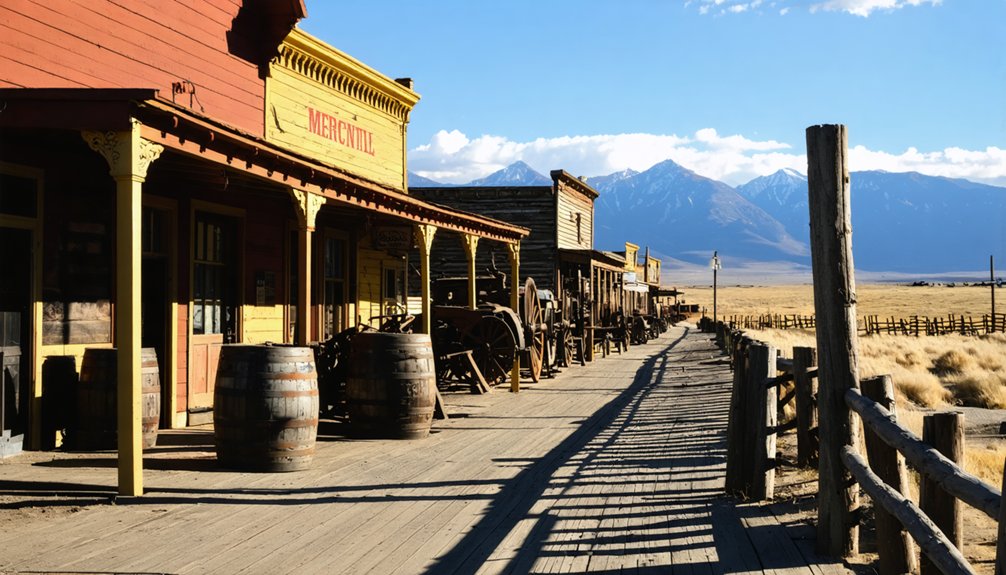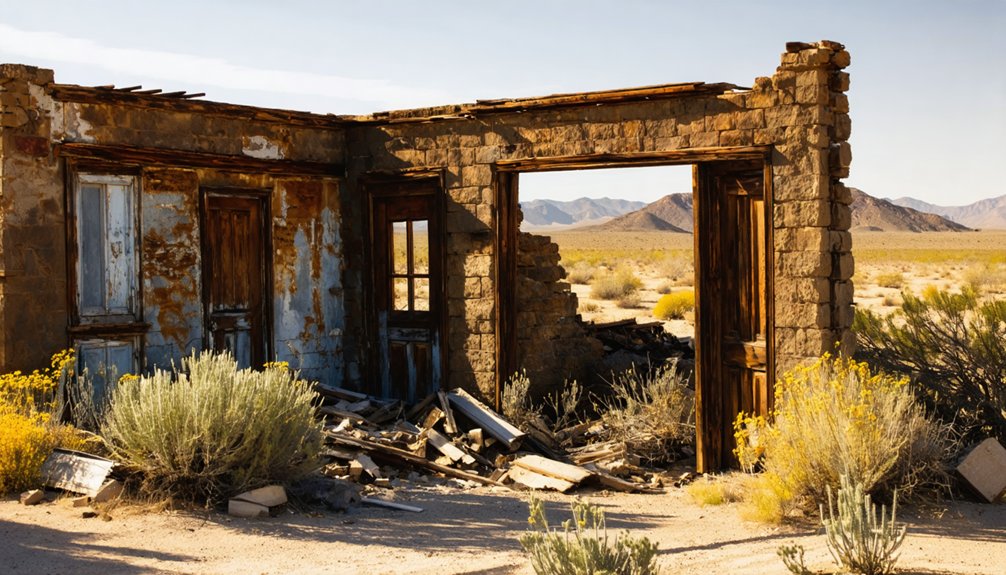
Leadfield is a Death Valley ghost town that boomed briefly in 1926 during a mining promotion scheme orchestrated by C.C. Julian. You’ll find remnants of wooden structures, mill foundations, and sealed mine tunnels that once promised vast lead deposits. The town peaked at 300 residents before collapsing when minimal ore was discovered, exposing fraudulent practices. The site, accessible via Titus Canyon Road, now serves as a cautionary tale of frontier speculation and investment fraud.
Key Takeaways
- Leadfield was a short-lived mining town in California that boomed in 1926 and collapsed by early 1927 due to fraudulent mining claims.
- C.C. Julian’s promotional schemes attracted investors with false promises of rich ore deposits, leading to temporary growth before rapid abandonment.
- At its peak, Leadfield housed approximately 300 residents with basic infrastructure including a post office, boarding house, and newspaper.
- Today, visitors can explore weathered wooden structures, mill foundations, and sealed mine entrances preserved as a U.S. Historic District since 1975.
- The ghost town is accessible via Titus Canyon Road, with October to May being ideal visiting months to avoid extreme temperatures.
The Rise of Leadfield: C.C. Julian’s Mining Venture
The remote enclave of Leadfield emerged from humble beginnings when lead and copper deposits were first identified in 1905, though these initial discoveries proved economically unviable due to the area’s isolation and prohibitive transportation costs.
Everything changed in 1924 when three prospectors established new claims, eventually selling to John Salsberry who founded Western Lead Mines Company.
The enterprise gained momentum when C.C. Julian, a Southern California oil promoter, seized control in February 1926.
Julian’s ambitions transformed the operation through technological advancement—installing a powerful 180-horsepower diesel engine and adding a second air compressor to power machine drills.
These mining techniques represented significant investment, while his simultaneous acquisition of the New Roads Mining Company consolidated his authority over the area’s two largest mines.
Julian’s promotional campaigns, however deceptive, briefly elevated Leadfield from obscurity to notoriety. Through aggressive advertising, Julian claimed potential profits of 100-300 million dollars from the Leadfield mine to attract stock investors. The town experienced a very short boom period in 1925 and 1926, ultimately declining due to the low-grade ore that proved unprofitable for sustained operations.
Boom Town Development: Infrastructure and Population
When Leadfield reached its peak population of approximately 300 residents in 1926, the rapidly assembled town offered rudimentary services including a post office, boarding house, and a local newspaper called the Leadfield Chronicle.
The transportation infrastructure included roughly 15 miles of newly constructed roads connecting to Beatty, Nevada, which facilitated the movement of mining equipment, supplies, and workers to this remote location. A concrete foundation was poured for a stamp mill, indicating the town’s industrial ambitions. The town’s development was largely driven by CC Julian’s promotion, which attracted significant investment and attention to the mining venture.
Despite ambitious plans for a 40-room hotel and water pipeline system, most inhabitants lived in temporary tent structures while the town’s founders focused on developing mining operations rather than permanent civic amenities.
Population at Peak
Approximately 300 residents populated Leadfield at its peak in 1926, marking the zenith of a relatively short-lived mining boom that began in 1925. This rapid population growth coincided with significant mining workforce expansion as Western Lead Mines Company employed approximately 100 men by February 1926.
The town’s population demographics reflected a diverse influx of miners from across the country, including former Alaskan prospectors seeking opportunity.
Key developments during this peak period included:
- Official naming of Leadfield by January 30, 1926
- Post office establishment in July 1926
- Western Lead Mines stock trading opening on San Francisco exchange
- Construction of boarding house facilities for workers
- 40,000 shares sold within twenty-four hours of initial offering
This concentration of activity represented Leadfield’s fleeting moment of prosperity before its precipitous decline. Most residents lived in tents and makeshift structures rather than permanent buildings during the town’s short existence. The ghost town now stands as an easy hiking destination within Death Valley National Park with remarkable mountain views from the slag piles.
Essential Town Services
Despite ambitious infrastructure plans, essential services in Leadfield developed rapidly but incompletely during the town’s brief existence.
You would’ve found basic water infrastructure underway, with pipeline construction from KY Spring beginning in January 1926, though permanent storage facilities never materialized.
Essential utilities remained largely aspirational. While power poles were installed, the electric grid wasn’t completed before abandonment. The town’s mining ambitions became evident through the mine tailings visible throughout the area.
The post office, opened in August 1926, served as the primary administrative center until its closure just five months later.
Community challenges were evident in the gap between promotion and reality. A boarding house and plans for a 40-room hotel reflected commercial ambitions, but no general store, hospital, or school became fully operational.
Mining infrastructure progressed with a compressor plant and tunnels, yet critical processing facilities remained unfinished.
The town’s peak population of 200 represented the height of Leadfield’s short-lived prosperity before its eventual abandonment.
Transportation Network Development
Transportation infrastructure in Leadfield developed through significant investment but ultimately faced insurmountable logistical challenges that contributed to the town’s downfall. The ambitious road construction project employed eighteen men and six trucks to build a steep auto road connecting Titus Canyon to Beatty highway.
Consider these critical transportation challenges:
- Prohibitive hauling costs of $18 per ton from Leadfield to Beatty’s railroad terminal
- Railroad officials refused to construct a spur line, citing insufficient business potential
- Stage service between Johnnie Siding and mining regions required twelve to fifteen hours
- Passengers frequently experienced one to two day delays awaiting stage availability
- Transportation bottlenecks severely limited workforce mobility and ore shipment capacity
These logistical constraints ultimately strangled Leadfield’s economic viability despite significant infrastructure investments. Like other isolated developments of the era, Leadfield lacked the transit district support that California legislation would later enable through the 1956 law allowing publicly-owned transit systems. The town’s isolation mirrors the pre-railroad California era when stagecoach travel was the primary but costly and time-consuming transportation method.
This demonstrates how geographic isolation can doom even well-funded ventures.
Mining Operations and Economic Prospects
Mining operations at Leadfield began with considerable promise in 1905, when lead and copper deposits discovered in Titus Canyon spurred the establishment of nine initial claims.
Death Valley Consolidated Mining Company quickly acquired these claims, selling shares at 2.5¢ each to finance operations that commenced by May 1906.
However, economic challenges soon emerged as transportation costs rendered ore shipping unprofitable.
After nearly two decades of dormancy, Western Lead Mines Company revitalized interest in 1925, implementing advanced mining techniques including compressor-powered air drills.
Despite substantial infrastructure investment—road construction, mill foundation, and power line installation—the operation’s fate was sealed when the main tunnel penetrated the target ledge in late 1926, revealing minimal ore content.
With lead concentrations of merely 5-7% and California halting stock sales, Leadfield’s economic prospects collapsed, transforming it into a ghost town by early 1927.
The Marketing Machine Behind Leadfield
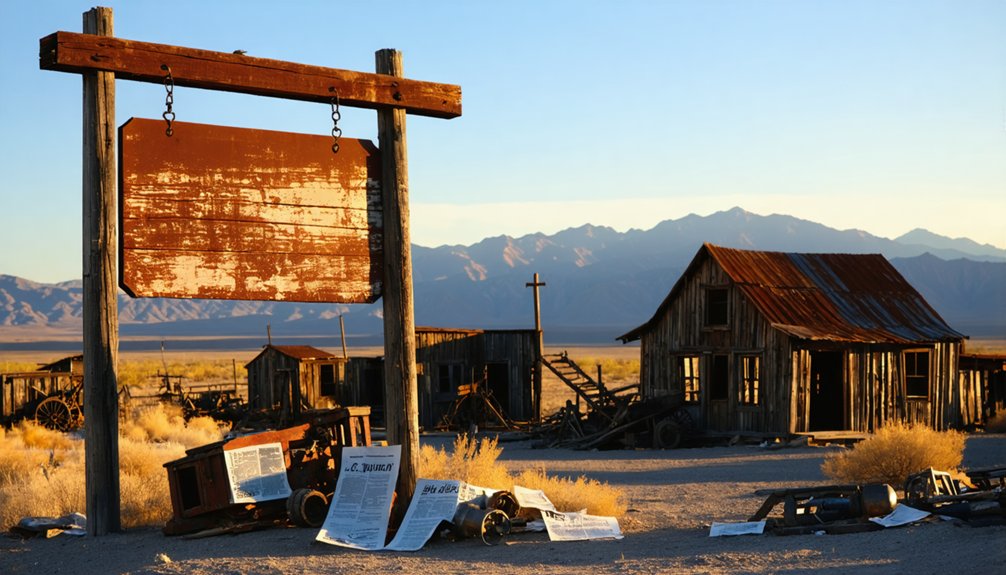
While Leadfield’s mines yielded disappointingly little ore, the town’s most valuable commodity was arguably its masterfully orchestrated marketing campaign.
C.C. Julian, assuming presidency of Western Lead Mines in February 1926, deployed sophisticated promotional strategies that transformed a modest prospecting camp into a speculative boom.
Julian’s investor deception included:
- Advertisements showing abundant ore being hauled from mines
- Marketing materials depicting non-existent steamboats on the dry Amargosa River
- “Salting” mines with ore from other locations
- Distributing exaggerated profitability claims through California
- Orchestrating a special train excursion that attracted 340 selected passengers
These tactics successfully drove stock prices to $1.57 per share before regulatory intervention.
The California Corporation Commission eventually investigated Julian’s practices, ordering cessation of his personal stock sales in June 1926—exposing the carefully constructed illusion of Leadfield’s prosperity.
When Dreams Collapsed: The Fall of Leadfield
Julian’s marketing mirage couldn’t withstand the harsh light of reality forever. When miners finally reached the promised lead ore ledge in October 1926, they discovered minimal high-grade deposits, exposing the fraudulent practices that had fueled the boom.
Simultaneously, California authorities halted Julian’s stock sales for regulatory violations, severing Leadfield’s financial lifeline.
Investor deception quickly unraveled as confidence collapsed. The town’s 300 residents witnessed their dreams evaporate as mines shuttered, businesses closed, and the post office—Leadfield’s last official institution—ceased operations by early 1927.
Workers faced unpaid wages while investors watched their holdings become worthless.
Julian fled amid mounting accusations, abandoning those who’d trusted him. Within months, Leadfield’s brief existence as a mining community had ended, leaving behind only abandoned infrastructure and broken promises.
What Remains Today: Exploring the Ghost Town
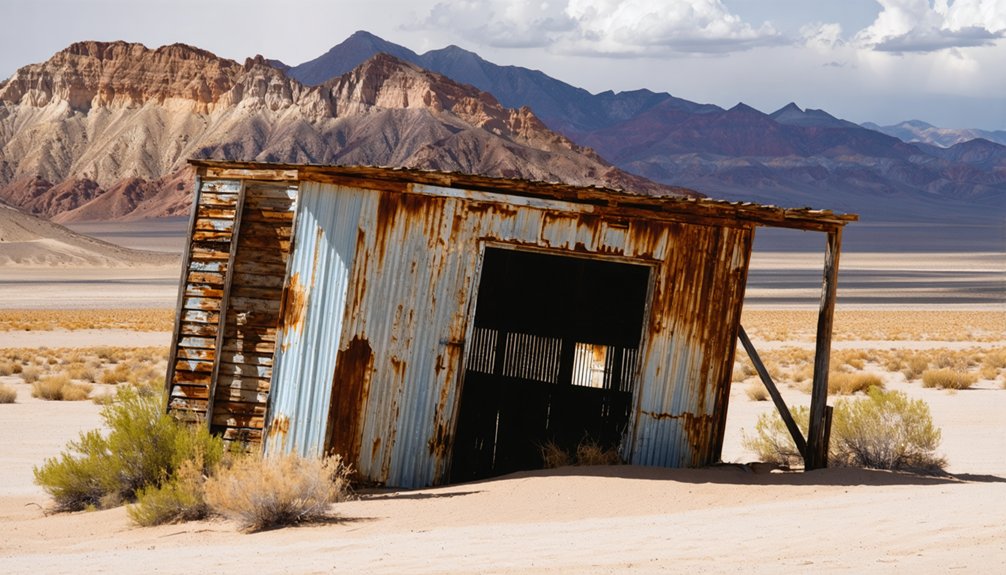
As you traverse the rugged Titus Canyon Road, you’ll encounter the weathered remnants of Leadfield’s brief mining heyday, including scattered wooden and tin structures alongside visible mill foundations.
Several mine entrances persist, though they remain locked for safety, while prospect holes and tailings piles serve as evidence to the town’s frenzied but short-lived mineral exploration.
The site’s designation as a U.S. Historic District since 1975 has preserved these physical artifacts within Death Valley’s harsh desert landscape, offering visitors a glimpse into California’s boom-and-bust mining heritage.
Surviving Mine Entrances
Several mine entrances still dot the landscape at Leadfield, serving as the most tangible remnants of the short-lived mining boom.
As you explore the site, you’ll notice these entrances represent the ambitious yet ultimately futile mining ventures that defined Leadfield’s brief existence. Mine safety concerns prohibit entry into these historic workings, which faced significant geological challenges during their operation.
- The Western Lead Mine’s main tunnel, which penetrated the ledge in late 1926
- Boundary Cone Mine’s incline shaft reaching 200 feet in depth
- Multiple shaft entrances scattered throughout Titus Canyon
- Underground passages marking failed prospecting efforts
- Abandoned tunneling works from September-October 1926 before operations collapsed
These entrances provide vital physical evidence of the mining fraud that earned Leadfield its place on the National Register of Historic Places.
Remnants Among Ruins
The present-day remnants of Leadfield offer visitors a stark reminder to the brevity of human ambition in the harsh Mojave Desert environment.
As you explore the site, you’ll find a handful of rusted wood and tin structures standing defiantly among crumbled ruins, with the weathered barn being the most prominent survivor.
The ghost town‘s skeleton reveals itself through visible mill foundations, the wooden base of the former saloon, and scattered shack remnants that help you visualize the 1920s mining settlement.
Two locked mine shafts, numerous prospect holes, and tailings piles testify to the frenzied extraction attempts.
These abandoned structures and historical artifacts lie exposed to the elements, with sagebrush reclaiming spaces once bustling with activity.
The site’s recognition as a U.S. Historic District preserves this cautionary tale of boom-and-bust economics.
Visiting Titus Canyon
Today, visitors who venture along the rugged one-way Titus Canyon Road encounter Leadfield’s haunting remains approximately 13 miles from the western entrance near Rhyolite, Nevada.
The journey through this scenic corridor rewards you with remarkable geological formations and historical artifacts.
When exploring Leadfield, you’ll discover:
- Rusted wood and tin structures, including an old barn
- Mill foundations scattered across the hillside
- Two sealed mine shafts and numerous prospect holes
- Informative plaques detailing the town’s brief, fraudulent history
- Mine tailings that attest to the failed mineral extraction
The 27-mile drive requires a stock SUV or truck, though conditions occasionally necessitate 4-wheel drive capabilities.
For ideal experiences, plan your visit between October and May to avoid extreme temperatures while enjoying the scenic views through Red Pass at 5,250 feet elevation.
Historical Impact and Preservation Efforts
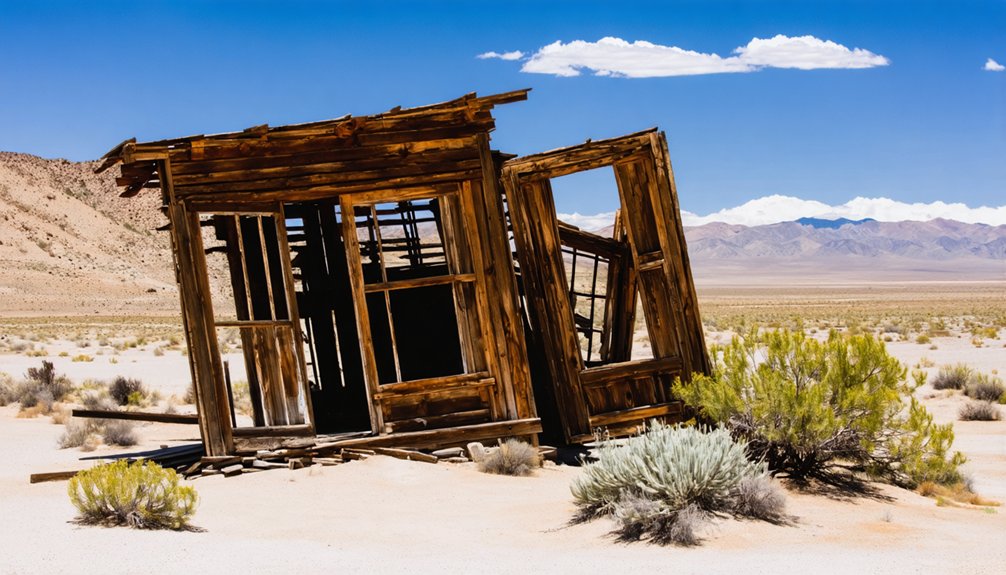
Despite its brief existence, Leadfield’s legacy as one of the West’s most notorious mining scams has secured its place in American frontier history, simultaneously serving as a cautionary tale of speculative excess and a preserved evidence to boom-and-bust mining culture.
The ghost town gained historical significance when listed on the National Register of Historic Places, though its nomination perpetuated certain mythologies rather than complete historical analysis.
Today, you’ll find remarkable remnants including a well-preserved dugout with square-set timbering, cement foundations of the stamp mill, and scattered shacks—all evidence to its mining legacy.
When visiting via the scenic Titus Canyon Road from Beatty, you’ll need to bring your own supplies, as no facilities exist at this remote site where C.C. Julian’s fraudulent scheme collapsed less than a year after its ambitious beginning.
Frequently Asked Questions
What Daily Life Was Like for Residents of Leadfield?
You’d rise early, employing primitive mining techniques throughout exhausting shifts. Your daily routines revolved around prospecting, drilling tunnels, and seeking fortune while enduring harsh desert conditions and limited infrastructure.
Were There Any Schoolhouses or Churches Built in Leadfield?
No, you won’t find any schoolhouse history or church community artifacts in Leadfield. The town’s brief existence (1926-1927) precluded development of social infrastructure beyond mining operations and basic necessities.
How Much Did Leadfield Lots and Mining Stocks Cost?
You’d have found Leadfield prices at a few hundred to thousand dollars per lot, while mining investments typically sold under $1 per share—often becoming worthless as the boom collapsed.
Did Any Families With Children Live in Leadfield?
Historical records don’t confirm if family residences existed in Leadfield or if child education occurred there. You’ll need to consult additional primary sources to establish whether families with children inhabited this short-lived mining settlement.
Were There Any Legitimate Mineral Discoveries in the Area?
Beneath the golden veil of promotional hype, you’ll find that legitimate lead and copper deposits were indeed discovered. Mining techniques revealed economically viable ore, though transportation costs ultimately strangled mineral exploration’s profitability at Leadfield.
References
- https://inspiredimperfection.com/adventures/leadfield-ghost-town/
- https://www.youtube.com/watch?v=o_6qAfGxjr8
- https://www.airial.travel/attractions/united-states/leadfield-ghost-town-fxiKjWrf
- https://www.nps.gov/parkhistory/online_books/deva/section4a8.htm
- https://mojavedesert.net/mining-history/leadfield/
- http://www.ghosttowngallery.com/htme/leadfld.htm
- https://www.onlyinyourstate.com/state-pride/california/abandoned-place-story-death-valley-socal
- https://www.roadtripamerica.com/places/leadfield.htm
- https://www.xanterra.com/stories/mining-history-at-death-valley/
- https://homesteadmuseum.blog/2019/07/22/drilling-for-black-gold-the-strange-saga-of-c-c-julian-part-three/