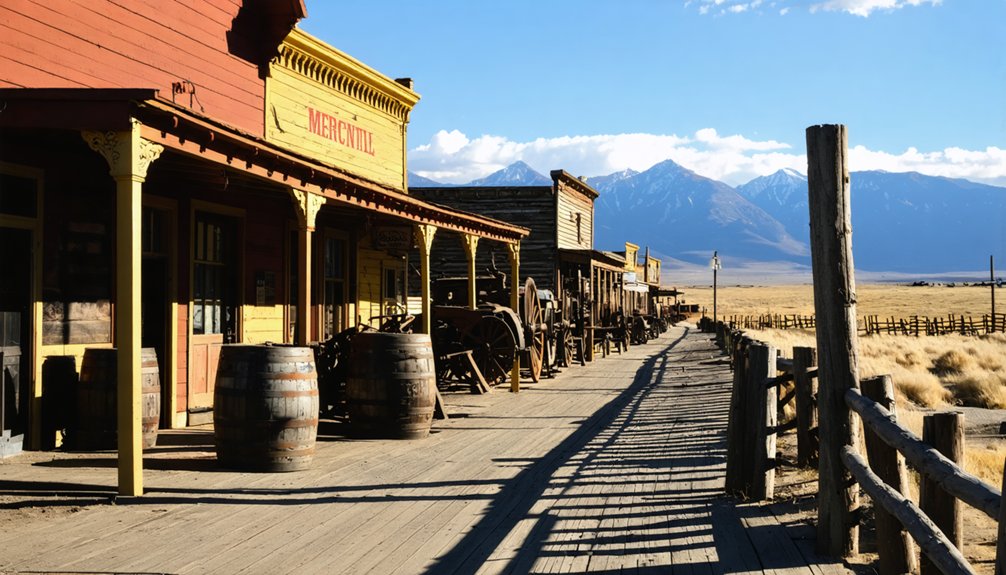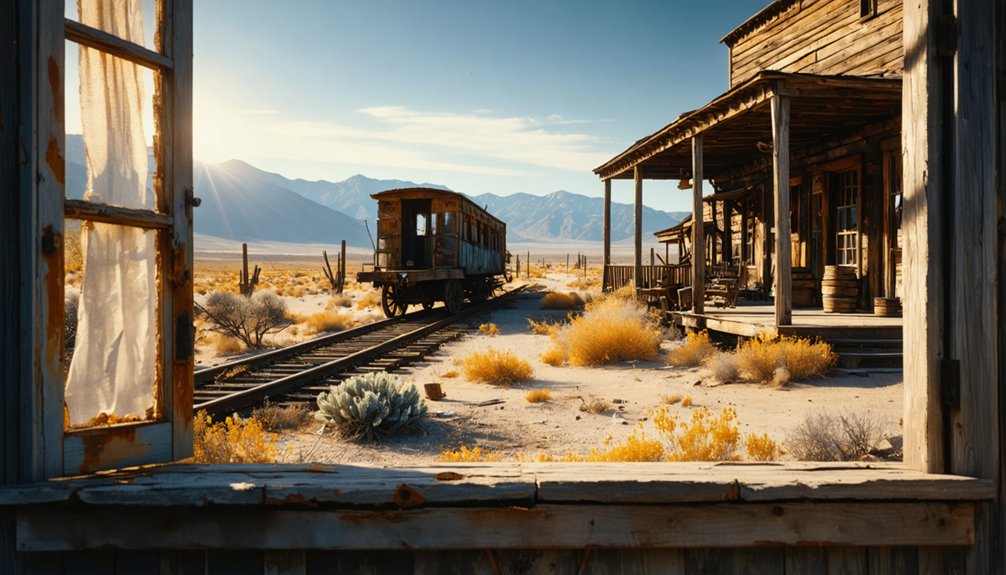
You’ll find Lee on the California-Nevada border, where a gold discovery in August 1904 launched a brief but intense mining boom. Founded by Richard and Gus Lee alongside Henry Finney, the town flourished after their Hayseed and State Line claims led to the formation of the Lee Mining District in 1905. Today, only scattered stone foundations and abandoned mine shafts remain as desert reclaims this once-bustling frontier settlement.
Key Takeaways
- Lee was founded in 1904 after Richard and Gus Lee, along with Henry Finney, located valuable gold claims in California’s Funeral Range.
- The Lee Mining District was formally established in March 1905, creating the foundation for the townsite that straddled the California-Nevada border.
- Mining operations initially yielded gold and silver worth up to $2,000 per ton but faced challenges from water and resource scarcity.
- Daily life in Lee was characterized by harsh desert conditions, limited water, and basic accommodations like wooden structures or canvas tents.
- Today, Lee is completely abandoned with only scattered stone foundations, an old bridge, and empty mine shafts marking its existence.
The 1904 Gold Discovery and Mining District Formation
Four key events propelled Lee, California from obscurity to a bustling mining district within a remarkably short time.
It began on August 9, 1904, when Shorty Harris and Ed Cross discovered the Bullfrog Mine, triggering a prospecting rush throughout southern Nevada and Death Valley.
Inspired by this discovery, brothers Richard and Gus Lee, with Henry Finney, located two gold ledges in November 1904—the Hayseed and State Line claims.
These deposits of greenish-turquoise quartz contained visible free gold at the eastern foot of the Funeral Range.
Following gold discovery patterns common in the Mojave, miners used dry-wash methods to extract gold from the ore-rich soil.
By March 1905, the Lee brothers’ discovery had led to the formation of the Lee Mining District, which became the foundation for subsequent townsite development in the area.
Boom Town Development Across State Lines
The California-Nevada state line created a unique dynamic for Lee’s development, as mining activities spurred growth that spilled across political boundaries.
When miners exhausted claims in one state, they’d simply cross borders to follow promising veins, creating an organic interstate commerce network. Mining migration followed predictable patterns—success in one area would draw prospectors from neighboring states, while busts would push them outward. Similar to how Abe Lee’s discovery of placer gold in California Gulch triggered a massive population surge to 10,000 by summer of 1860.
The fluid movement of prospectors across political lines followed mineral veins, not borders, creating economic patterns that defied state boundaries.
This cross-border mobility characterized Lee’s development, with transportation networks and supply chains evolving to serve communities on both sides of the state line. The boom-and-bust cycle seen in towns like Bodie, where the population peaked at 10,000 in 1880 before declining, was common throughout mining regions.
The Guggenheims and other influential investors didn’t recognize state boundaries when expanding their mining empires.
Rail connections eventually formalized these economic relationships, with hydroelectric projects powering mining operations regardless of which state housed them, demonstrating how boom town economies naturally transcended political divisions.
Daily Life and Infrastructure in a Desert Mining Camp
Life in Lee unfolded as a harsh struggle against the desert’s unforgiving nature, where infrastructure development constantly lagged behind population growth. You’d find yourself hauling water from distant springs, storing precious drops in communal tanks subject to strict rationing during frequent droughts.
Water management centered around mining operations first, leaving households to manage with what remained.
Your living quarters would be sparse—likely a single-room wooden structure or canvas tent with minimal protection from extreme temperatures. Many residents, particularly Mexican workers, lived in these cramped conditions with entire families sharing a single room.
Social hierarchy dominated daily interactions, with mine owners commanding respect while laborers crowded into boarding houses. The town lacked the extensive commercial facilities found in other mining settlements like Bodie Ghost Town, where gambling halls and opium dens once thrived during its peak.
When not working, you’d gather at saloons serving as the town’s social hubs.
Health concerns plagued residents, with poor water quality and limited food variety causing widespread illness.
Medical care remained rudimentary, with serious cases sent to distant towns.
Mining Operations and Economic Challenges
Mining fortunes in Lee began with ambitious prospectors Richard and Gus Lee, who staked valuable claims like Hayseed and State Line in 1904, sparking the creation of the formal Lee Mining District by early 1905.
The Lee brothers’ ambitious 1904 stakes transformed a barren landscape into the organized Lee Mining District by 1905.
You’d have witnessed a flurry of activity when the Lee Townsite & Mining Company organized in 1907, promoting development tied directly to these claims.
The district initially flourished with gold and silver discoveries yielding impressive assays of up to $2,000 per ton.
However, economic viability soon faced serious challenges from scarce water, wood, and electricity.
Like the Furnace District operations that eventually ceased without profit, Lee’s mining ventures struggled to overcome resource limitations.
Mining consolidation became inevitable as companies like McGarry Brokerage acquired multiple claims.
The area’s transportation difficulties mirrored challenges seen in the Mono Basin, where narrow-gauge railroads were needed to move essential resources.
Decline and Abandonment: What Remains Today
While wandering the eastern foothills of the Funeral Range near the Nevada state line today, you’ll find only haunting fragments of Lee’s brief existence as a mining boomtown.
A remnants assessment reveals scattered stone foundations, an old stone bridge, and empty mine shafts as the sole physical testimony to Lee’s past.
The town’s infrastructure has completely vanished—no post office (closed by 1912), stage lines, or water systems remain operational.
You won’t find intact buildings; only mining debris and dugouts dot the landscape. Unlike better-preserved ghost towns like Bodie or Calico, Lee offers minimal structural remains of historical significance.
The site sits quiet and abandoned, with no residents or economic activity, leaving you free to explore its weathered ruins amid the desert’s reclamation. This stark contrast to Bodie’s well-maintained 170 historical structures makes Lee a more challenging but rewarding destination for dedicated ghost town enthusiasts.
Like many California mining towns, Lee experienced a classic boom-bust cycle that ultimately led to its abandonment when ore deposits were exhausted.
Before You Go: Safety at Abandoned Sites
Ghost town structures have stood without maintenance for decades. Floors, stairs and roof timbers fail without warning, and a building that looks solid from outside may not hold your weight. Stay out of standing structures unless the site is actively maintained and open to visitors.
Mine workings are the more serious hazard. Vertical shafts can be hundreds of feet deep, are often unfenced, and may be hidden by brush or capped with rotted boards. Never enter an adit, tunnel or shaft: abandoned workings can hold oxygen-poor or toxic air that gives no warning before you lose consciousness.
Enclosed spaces with rodent droppings carry a risk of hantavirus, which is contracted by breathing contaminated dust. Do not sweep or stir up dust inside old cabins and outbuildings.
Cell coverage at these sites is usually poor or absent. Tell someone your route and expected return time, and carry more water than you think you need.
Frequently Asked Questions
Were Any Notable Historical Figures Ever Associated With Lee?
You’ll find the area’s notable residents were primarily the Lee brothers and Henry Finney, whose gold discoveries gave the town its historical significance. W.F. Patrick’s brief ownership adds to its freedom-seeking narrative.
What Happened to the Original Lee Residents After Abandonment?
You’ll find the original residents scattered after Lee’s abandonment. They relocated to other mining towns like Bodie, returned to their hometowns, joined agricultural communities in Owens Valley, or sought opportunities in larger cities.
Are There Any Ghost Stories or Legends About Lee?
Like a town that vanished into desert dust, Lee hasn’t left behind documented ghost sightings or local folklore. You’ll find no recorded supernatural tales about this abandoned mining settlement in available research.
Is the Site Legally Accessible to Visitors Today?
You’ll find Lee’s access policies unclear and potentially restricted. The site falls under local government jurisdiction with visitor guidelines likely determined by Novato City Council regulations, unlike established ghost towns with formalized access.
Were Any Movies or TV Shows Filmed in Lee?
Unlike 350+ documented California ghost town film locations, there’s no evidence of Lee serving as film locations for movies or television episodes you could explore during your freedom-seeking adventures.
References
- https://www.youtube.com/watch?v=y_0pal_g9LA
- https://www.ghosttowns.com/states/ca/lee.html
- https://www.legendsofamerica.com/ca-deathvalleyghosttownscalifornia/
- https://www.californist.com/articles/interesting-california-ghost-towns
- https://www.desertusa.com/desert-activity/nevada2.html
- https://www.youtube.com/watch?v=OQCENqxYJKs
- https://www.nps.gov/parkhistory/online_books/deva/section4b6.htm
- https://mojaveproject.org/dispatches-item/desert-gold-part-i/
- https://npshistory.com/publications/deva/hrs/section4b.htm
- https://www.parks.ca.gov/?page_id=1081