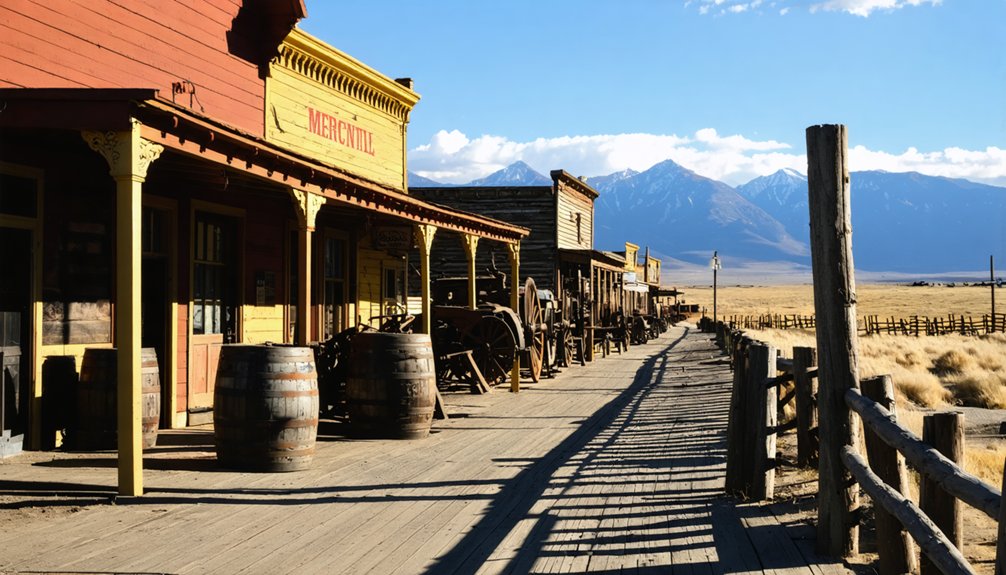
Leon, California emerged as a gold rush boomtown in the 1880s, reaching a population of 7,000-10,000 before declining when gold reserves dwindled. You’ll find it was established after the Leon Mine discovery, receiving postal service in 1888 before operations ceased and the post office relocated in 1911. Unlike Bodie’s protected status, Leon lacks formal preservation, leaving its historical significance increasingly vulnerable to time’s erosion.
Key Takeaways
- Leon was established during California’s 1880s gold rush, growing rapidly to 7,000-10,000 residents following the discovery of the Leon Mine.
- The town declined when gold reserves dwindled, the gold price fixed at $20.67 per ounce, and mining shifted to capital-intensive operations.
- Mining operations ceased and the post office relocated to Perris in 1911, marking Leon’s transformation into a ghost town.
- Miners endured harsh working conditions including 10-12 hour shifts, poor ventilation, and risks of cave-ins and respiratory diseases.
- Unlike protected ghost towns like Bodie, Leon lacks formal preservation status, leaving its historical structures vulnerable to deterioration.
The Rise of Leon: San Diego County’s Forgotten Gold Mining Settlement
While California’s gold rush history often focuses on the Sierra Nevada foothills, the establishment of Leon in San Diego County during the 1880s represents a significant yet overlooked chapter in the state’s mining heritage.
You’ll find that Leon emerged directly from the gold discovery at the eponymous Leon Mine, exemplifying how mineral wealth could transform undeveloped land into vibrant communities almost overnight.
This settlement followed the classic mining migration pattern that reshaped California’s landscape after the 1848 Coloma discovery.
Similar to how gold discovery near Kern River in 1864 attracted families like the Walkers and Burtons to settle in that region, Leon drew its own wave of hopeful miners and their families.
Leon quickly developed the infrastructure necessary for a functioning town—postal service was established on May 4, 1888, validating the settlement’s importance.
The postal establishment of May 4, 1888 legitimized Leon as more than a mere mining camp—it was becoming a proper California town.
The settlement shared a naming convention with numerous other American towns called Leon that can be found across Iowa, Kansas, and New York.
Before boundary reorganization in 1893 placed it in Riverside County, Leon thrived as San Diego County’s response to gold fever.
Mining Operations at the Historic Leon Mine
The Historic Leon Mine, situated at an elevation of 1,581 feet in the Menifee Mining District of Riverside County, operated as an underground gold extraction facility with secondary silver recovery during the late 19th century.
You’ll find this patented private property was part of the broader California gold rush activity that intensified in the 1880s.
While specific mining techniques remain undocumented in historical records, the underground classification suggests miners employed subsurface ore extraction rather than placer operations.
The mine’s development coincided with Leon’s establishment, serving as the economic foundation for the community until operations declined in the early 1900s. Historical data recorded in the USGS Mineral Resources database indicates gold as the primary commodity with silver listed as a tertiary resource.
This decline is evidenced by the post office’s relocation to Perris in 1911, marking the beginning of Leon’s shift to ghost town status.
The mine’s location within the Los Angeles Ranges places it in a geologically significant area of the Pacific Mountain System known for its mineral deposits.
Daily Life in a California Gold Rush Boomtown
You’d find Leon’s miners working grueling shifts underground, emerging coated in dust and exhaustion after hours of backbreaking labor.
When not extracting gold from the earth, these prospectors sought relief in the boomtown’s saloons and gambling halls, where hard-earned gold dust quickly changed hands across gaming tables. By 1851, miners increasingly had to dig several feet deep to find gold deposits, as most of the easy surface gold had been depleted.
Your visit to Leon during its heyday would have revealed the stark contrast between the punishing work conditions and the boisterous evening entertainments that defined the rhythmic pattern of boomtown existence. Similar to Washington’s historic tradition, miners likely participated in the practice of pinning currency to saloon ceilings as a symbol of their fleeting prosperity during the Gold Rush era.
Working Hard Underground
Despite romantic notions of striking it rich, daily life for miners in Leon’s underground workings consisted primarily of grueling physical labor under hazardous conditions.
You’d spend 10-12 hours daily traversing poorly ventilated tunnels, your only light coming from dangerous oil lamps or candles that threatened explosion at every turn. Mine safety was virtually nonexistent, with cave-ins, toxic gases, and flooding constantly threatening your survival. By 1853, many miners had transitioned to using hydraulic mining techniques that utilized high-pressure water hoses to extract gold more efficiently. Many miners, unable to find success in Leon, would eventually make their way to San Francisco’s port where thousands of fortune-seekers arrived in the early 1850s.
Working conditions in Leon’s mines created vivid sensory experiences:
- The deafening percussion of pickaxes against stone, punctuated by dangerous black powder blasts
- Suffocating dust particles dancing in dim lamplight, coating your lungs and fueling widespread respiratory disease
- The constant drip of groundwater from timber supports, creating a perpetual state of dampness that chilled miners to the bone
Leisure After Shifts
After exhausting shifts in Leon’s treacherous mines, where did weary workers find respite from their dangerous toil?
You’d likely head straight to one of Leon’s numerous saloons, the beating heart of boomtown leisure. These establishments served as crucial social hubs where you could throw back whiskey, exchange news, or secure your next job through informal networking. Like other gold rush settlements, Leon witnessed this pattern of rapid economic and social development within just a few years of its founding.
Gambling games dominated after-hours entertainment, with faro and poker tables drawing crowds keen to test their fortune. You might wager an entire day’s earnings on a single hand, contributing to Leon’s reputation for lawlessness. The town’s notorious reputation for crime was regularly documented in local papers under the Last Night’s Killings section.
When not at gaming tables, you’d find diversion at theatrical performances, traveling shows, or community dances. For companionship, brothels operated nearby, completing Leon’s vibrant but vice-ridden nightlife scene where vigilante justice often ruled the darkness.
The Sudden Decline: When the Gold Ran Out
While Leon had once bustled with the feverish activity of fortune seekers, the town’s prosperity proved devastatingly finite as gold reserves began to dwindle in the early 1900s.
The town faced insurmountable economic challenges as the fixed gold price of $20.67 per ounce established in 1913 strangled profit margins. Simultaneously, mining techniques evolved beyond simple placer extraction to capital-intensive lode mining—a shift small operators couldn’t sustain.
The decline manifested in three stark realities:
- Remaining ore required increasingly sophisticated equipment that most miners couldn’t afford.
- Collapsed mine shafts and failing reduction mills stood as monuments to abandoned dreams.
- Businesses shuttered one by one as the population fled, leaving empty buildings to deteriorate.
Notable Figures and Families of Leon’s Heyday
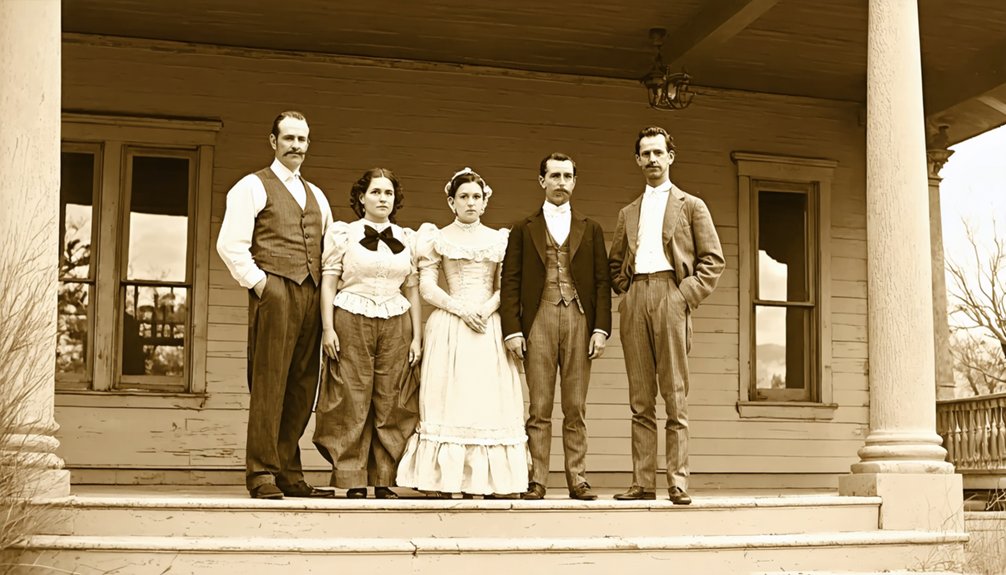
Walking through Leon during its golden era, you’d have encountered influential mining magnates who shaped the town’s economic destiny through their ambitious extraction operations.
Entrepreneurial pioneers established the commercial foundations of this California boomtown, opening establishments from general stores to saloons that served the growing population.
The town’s governing leaders, often wealthy businessmen who shifted into civic roles, managed Leon’s rapid growth while attempting to bring order to this frontier community.
Local Mining Magnates
Despite extensive research into California’s gold mining history, Leon’s specific mining magnates remain largely shrouded in historical obscurity.
Unlike the well-documented mining barons of Northern California, Leon’s local entrepreneurs operated in relative anonymity, leaving behind mining legacies that are difficult to trace. The mine’s private, patented land status further complicates efforts to uncover its ownership lineage.
What we can reasonably infer about Leon’s mining leadership:
- Small-scale operators likely controlled Leon Mine during its 1880s peak, typical of the modest operations that characterized Southern California gold mining.
- Technical experts and capital investors probably replaced initial prospectors as operations matured, following California’s standard mining development pattern.
- Regional mining influence likely came from entrepreneurial figures similar to Mortimer Belshaw, who combined engineering expertise with business acumen.
Entrepreneurial Pioneers
Although Leon’s mining magnates remain historically elusive, the town’s entrepreneurial pioneers formed the backbone of its social and economic life during its heyday.
The immigrant resilience exemplified by Sam Leon, a Chinese-born businessman (b. 1879), illustrates this dynamic perfectly. Following the devastating 1932 fire that destroyed the U.S. Hotel, Leon adapted by opening a bar in 1937, demonstrating remarkable business agility.
Before Leon, the Heist family established the town’s restaurant culture. These family enterprises—cafes, boarding houses, and bars—served as vital community hubs when mining activity waned.
Chinese immigrants, in particular, contributed substantially to Leon’s commercial landscape.
This entrepreneurial legacy transcended mere profit-seeking; these business owners reconstructed community infrastructure after disasters and diversified their ventures beyond mining, ensuring Leon’s continued viability during economic shifts.
Town Governing Leaders
While the annals of Leon’s civic history remain fragmentary, the town’s governance structure appears to have emerged organically from its economic foundations rather than through formal incorporation.
Town leadership centered around the Leon Mine owners, who wielded significant influence over local affairs due to their economic dominance. The establishment of a post office in 1888 created formal administrative positions, but governance remained largely informal and pragmatic.
Mining influence manifested in three distinct ways:
- Mine owners doubled as de facto civic leaders, their economic power translating directly to political authority.
- Postmasters served as essential communication gatekeepers until operations relocated to Perris in 1911.
- Local merchants and service providers formed a secondary leadership tier, balancing commercial interests with community needs.
What Remains Today: Exploring the Ghost Town Ruins
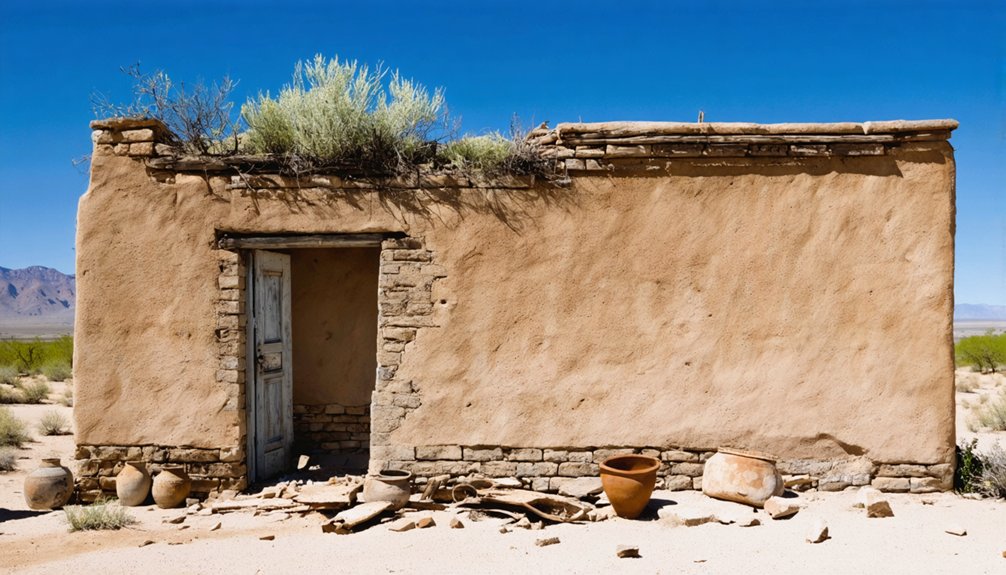
As one ventures into Leon today, the skeletal remains of this once-bustling California mining settlement offer a haunting glimpse into the past.
You’ll discover original wooden cabins with bullet-riddled walls that whisper ghost stories of the town’s turbulent mining days. Stone foundations map the community’s former layout, while scattered historical artifacts—household items, mining tools, and faded signage—illuminate daily life during Leon’s heyday.
Walking these ruins, each bullet hole and rusted tool tells a story of frontier dreams and harsh realities.
The ruins of stamp mills and processing areas reveal the scale of operations that once sustained this community.
While exploring on foot, you’ll notice archaeological remnants like glass and ceramics emerging from the desert soil. For preservation purposes, artifact removal is prohibited.
The absence of modern amenities enhances the authenticity of your experience as you navigate this weathered landscape frozen in time.
Leon’s Place in California’s Mining Heritage
Leon represents a significant chapter in California’s extensive gold mining narrative, emerging during the 1880s as part of the state’s southern desert mineral exploration.
This Menifee Mining District operation exemplifies the shift from placer methods to advanced underground gold extraction techniques that characterized California’s evolving mining technology landscape.
You’ll find Leon’s historical significance embedded within the broader pattern of boom-and-bust cycles that shaped the state’s mining heritage.
- Underground shafts penetrating deep into the hillside northwest of town, where miners once followed golden veins through solid rock
- Rusted machinery remnants that once powered the extraction of precious metals from the California desert
- Stone foundations marking where mining entrepreneurs established their desert outpost in pursuit of mineral wealth
Comparing Leon to Bodie: Tales of Two Ghost Towns

While Bodie thrived as a substantial boomtown with 8,000-10,000 residents and approximately 2,000 structures at its peak, Leon remained comparatively obscure, lacking both the population density and the extensive documentation of its larger counterpart.
You’ll notice stark contrasts in preservation efforts, with Bodie achieving National Historic Landmark status in 1961 and maintaining around 100 original buildings in “arrested decay,” whereas Leon’s remaining structures have received considerably less formal protection and historical attention.
The economic outputs further distinguish these ghost towns, as Bodie’s impressive yield of $38-70 million in precious metals between 1876 and 1941 dwarfed Leon’s mining operations, explaining the significant disparities in tourism development and historical recognition today.
Preservation Status Differences
Unlike the well-documented preservation efforts at Bodie, Leon’s ghost town status lacks the formal protections and management strategies that have preserved its California counterpart.
While Bodie enjoys the privileged position of “arrested decay” under state management, Leon remains vulnerable to natural deterioration and potential vandalism without official preservation techniques guiding its maintenance.
The historical significance contrast is evident in three key areas:
- Bodie’s designation as both a National Historic Landmark and State Historic Park provides legal frameworks that Leon doesn’t possess.
- Bodie’s interiors remain curated with original artifacts protected by preservation policy and “curse” folklore.
- Bodie receives dedicated funding and professional oversight from state agencies, while Leon depends on informal community stewardship.
You’ll find Leon’s unregulated state simultaneously more authentic and more precarious.
Population Size Contrasts
The population trajectories of these two California mining settlements reveal perhaps the most profound contrast in their respective historical narratives. While Bodie’s demographic trends are extensively documented—peaking at 7,000-8,000 residents in 1880 with some estimates approaching 10,000—Leon exists as little more than a geographical designation with virtually no population records.
You’ll find Bodie’s decline meticulously charted: from bustling boomtown supporting 400 businesses and generating $3,000,000 annually in 1880, to 3,000 residents in the early 1880s, 700 by 1910, and merely 120 by 1920.
These population estimates illuminate Bodie’s sustainability, evidenced by its school serving 615 students and diverse commercial infrastructure.
Leon, conversely, vanished without demographic documentation—no census figures, no occupational records, no institutional evidence—leaving a historical void where Bodie offers rich demographic detail.
Tourism Development Disparities
Considering the remarkable disparities between how these two ghost towns have been developed for tourism, one can’t help but notice the dramatic divergence in their contemporary relevance and visibility.
While Bodie thrives as a celebrated National Historic Landmark with systematic preservation efforts, Leon confronts significant tourism challenges with minimal infrastructure and institutional support.
- Imagine standing among Bodie’s 200,000 annual visitors, traversing well-maintained pathways between authentically preserved structures, versus walking Leon’s quiet, deteriorating remnants largely undisturbed by tourism development.
- Envision photographers paying $800 for specialized Bodie tours while Leon’s historic assets remain largely undocumented and unexploited.
- Picture Bodie’s vibrant economic opportunities generating regional revenue while Leon’s limited visitation creates negligible commercial activity.
This preservation-versus-neglect dynamic illustrates how institutional recognition fundamentally shapes a ghost town’s afterlife.
Visiting Leon: Practical Guide for History Enthusiasts
For history enthusiasts seeking to explore California’s gold rush heritage, visiting Leon presents unique challenges and rewards that require thorough preparation. This ghost town exploration demands self-sufficiency—bring water, food, and navigation tools as no amenities exist on-site.
Access the site via Leon Road and Scott Road intersections, but anticipate off-road travel requiring suitable vehicles. Without formal roads or signage, GPS coordinates and historical maps are essential for locating this former mining community.
Historical preservation concerns necessitate respectful visitation—leave artifacts undisturbed and stay mindful of potential private property boundaries.
Visit during daylight hours for safety and best viewing of remaining ruins. Though the post office closed in 1911 marking the town’s decline, the remnants offer valuable insights into California’s mining past.
Preservation Efforts and Future Outlook
Preservation efforts surrounding Leon remain largely undocumented in accessible historical archives, creating significant challenges for researchers and conservation advocates alike.
This information void threatens our collective understanding of this historical site’s status and impedes potential conservation initiatives.
To properly address the preservation challenges facing Leon, further research is imperative:
The preservation of Leon demands immediate investigative action before this historical treasure vanishes completely from our cultural memory.
- Local historical societies must be consulted to uncover any existing documentation of previous restoration attempts or structural assessments.
- California State Parks records need thorough examination to determine if Leon falls under any protected status designations.
- Regional archives should be systematically searched for photographic evidence documenting Leon’s structural evolution over time.
Without these essential investigative steps, future initiatives for Leon’s preservation remain uncertain, leaving this potentially significant historical asset vulnerable to further deterioration or uninformed development.
Frequently Asked Questions
Were Any Famous Films or Television Shows Shot in Leon?
No known film locations or television episodes were shot in Leon. Historical records and industry databases don’t document any productions utilizing this remote San Diego County ghost town’s landscape.
Did Leon Have Any Connection to Native American Populations?
Like shadows of forgotten history, you’ll find no documented connection between Leon and Native Tribes. Research on this ghost town’s relationship to indigenous Cultural Heritage remains inconclusive without specific historical records.
What Natural Disasters or Significant Weather Events Affected Leon?
You’ll find Leon’s history shaped by significant earthquake impacts and devastating flood history, though detailed records of these specific meteorological and seismic events affecting this settlement remain incompletely documented.
Did Any Paranormal Activity or Ghost Stories Originate From Leon?
Despite 100+ documented ghost towns in California, no verified ghost sightings or haunted locations have been historically attributed to Leon. You’ll find its paranormal record conspicuously empty compared with folklore-rich counterparts like Bodie.
How Did Transportation Routes Influence Leon’s Development and Decline?
Leon’s isolation from railroad expansion severely limited its economic growth. You’ll notice its decline directly correlates with transportation marginalization, as mining towns without evolving transport infrastructure faced inevitable economic impact and abandonment.
References
- https://en.wikipedia.org/wiki/Leon
- https://www.wikiwand.com/en/articles/Leon
- https://www.abandonedspaces.com/uncategorized/wild-west-ghost-town-buildings-still-contain-belongings-that-were-left-there-years-ago.html
- https://ayptravels.com/2019-other-side-part-24-bodie-a-mining-ghost-town/
- https://kids.kiddle.co/Leon
- https://www.sunset.com/travel/spirit-of-the-old-west-visit-this-california-ghost-town
- https://www.youtube.com/watch?v=qbdE9nJMP_k
- https://www.sarahcypher.com/blog/blog/my-new-story-the-overkill-on-leon-literary-review
- https://www.historynet.com/blood-feud-in-the-kern-river-country/
- https://learningenglish.voanews.com/a/american-history-gold-land-drive-settlers-west-88285232/115782.html