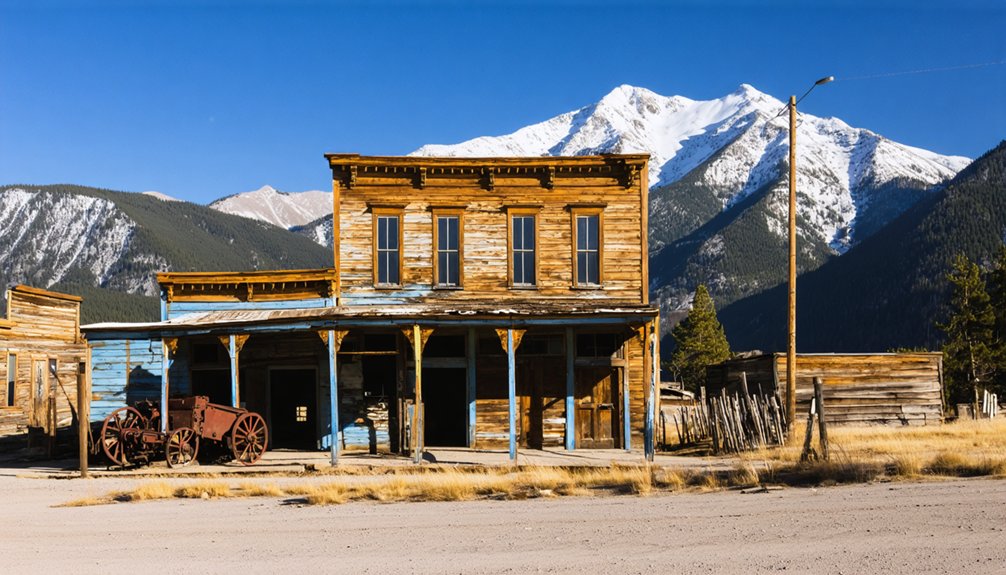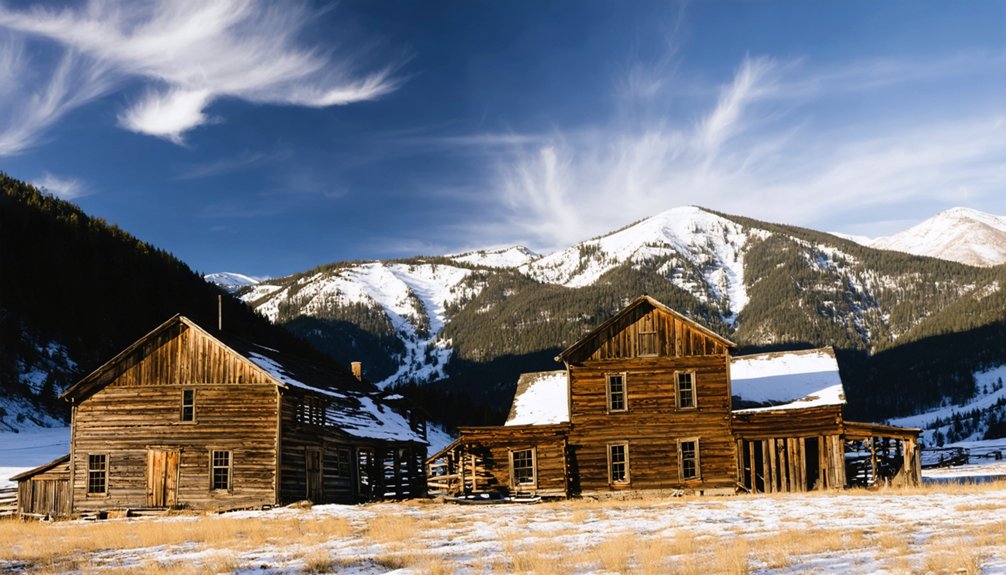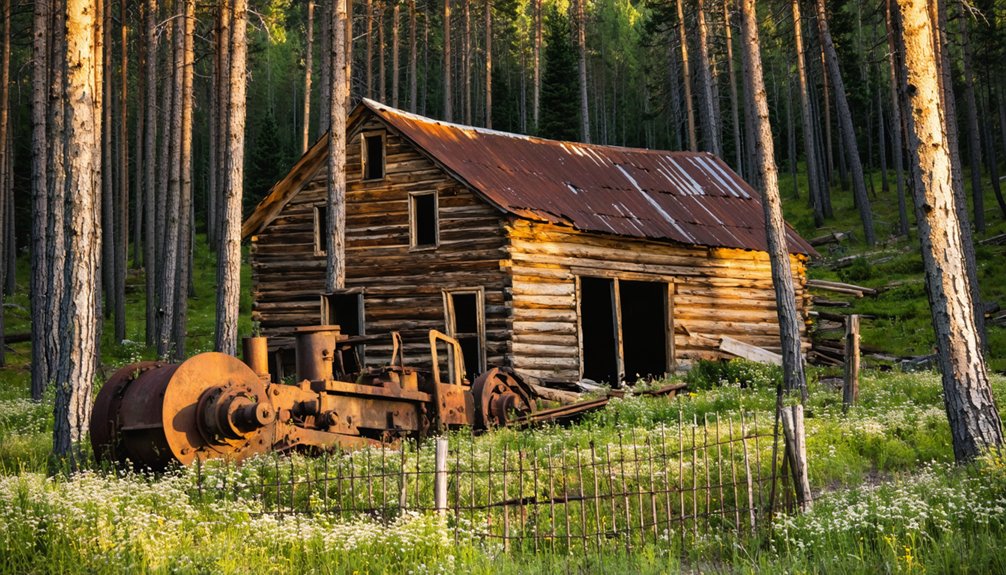
You’ll find Lincoln, Colorado, nestled in Summit County as the area’s oldest mining camp, dating to French Pete’s 1860 gold discovery. The settlement grew from Paige City into Lincoln City, reaching 5,459 residents by 1880 during the silver boom. The Ruby Mine’s exceptional yields of 800-1,200 ounces of silver per ton drove prosperity until the 1893 silver crash devastated the economy. Today, little remains except two off-limits buildings and William Milner’s 1864 grave, though the site’s rich history reveals fascinating stories about pioneer life and mining operations.
Key Takeaways
- Lincoln, Colorado began as Paige City in 1862 following French Pete’s 1860 gold discovery along French Gulch creek.
- Population peaked at 5,459 in the 1880s during the silver boom before declining after the 1893 silver crash.
- The Ruby Mine, discovered in 1897, produced 800-1,200 ounces of silver per ton at its peak in 1898.
- By the late 1890s, fewer than 30 residents remained; the last residents departed in the early 1970s.
- Today, minimal structures remain on private property, though William Milner’s 1864 grave is still accessible near Breckenridge.
From Paige City to Lincoln City: The Early Days of French Gulch Mining
When French Pete struck gold in 1860, he couldn’t have known his discovery would transform a remote Colorado valley into one of the territory’s richest mining districts. You’ll find French Gulch east of Breckenridge, where prospectors established Paige City by 1862, constructing log cabins along the gold-rich creek.
Their prospecting methods focused on placer deposits, extracting gold from stream gravels using simple sluices and pans.
The settlement evolved into Lincoln City as miners refined their mining techniques and expanded operations. By 1861-62, you’d have encountered 8,000 souls scattered across French Gulch’s population centers: Lincoln, Delaware Flats, Georgia, and Breckenridge.
The valley’s tributaries—Gibson, Negro, and Corkscrew Gulches—yielded consistent returns. Georgia Gulch proved particularly rich, with placer discoveries at the $10,000 level attracting miners who crossed the Continental Divide at Georgia Pass. When lode deposits emerged on Farncomb Hill in 1879, the district’s transformation from placer camp to hardrock mining center was complete. The region’s mineral wealth ultimately produced Colorado’s largest nugget, known as Tom’s Baby, cementing French Gulch’s place in gold rush history.
The Rise and Fall of a Mining Community
As Lincoln City flourished during the early 1880s with several hundred residents working its productive claims, the community’s fate remained tied to silver’s market value.
When the Sherman Silver Purchase Act collapsed prices in 1893, mines shuttered abruptly. You’d have found fewer than 30 people remaining by decade’s end.
Environmental challenges compounded economic hardship. Avalanches threatened operations at 13,600 feet on Mount Bross, while inadequate roads forced costly pack transportation.
Mining equipment couldn’t reach remote sites without burro trains navigating Red Mountain Pass’s switchbacks.
The 1898 Ruby claim discovery briefly revived operations with ore yielding 800-1,200 ounces per ton. But by 1916, accessible deposits were exhausted.
Contention existed between Twin Lakes and Leadville communities over control of the gulch’s commerce and transportation routes. The last residents departed in the early 1970s, leaving only foundations and tailings. Today, photographs document the town’s trajectory well into the 21st century, preserving visual records of its structures and landscape through successive decades of abandonment.
Gold, Silver, and the Ruby Mine Era
The 1897 discovery by prospector John Hughes in Lincoln Gulch marked a turning point for the struggling mining district.
You’ll find that initial ore assessments showed $30 per ton in gold, but the real breakthrough came in 1898 when the Ruby Mine yielded 800 to 1,200 ounces of silver per ton.
This sparked intensive development—by 1907, operators had installed gas-powered concentrator mills and advanced mining technology that could process $1,000 daily in ore shipments to Leadville.
The Ruby’s underground workings eventually extended over 1,600 feet, extracting silver, lead, zinc, copper, and manganese.
When the Consolidated Ruby Mining Company incorporated in 1909 with one million shares, it represented large-scale industrial ore processing rather than individual prospecting claims.
The mine’s vein deposits followed a North 20° West trend with steep to vertical dips, characteristic of the Lincoln District’s geological formations.
While the Ruby Mine drove the region’s prosperity, its legacy includes abandoned mine sites in the headwaters that continue to affect water quality in Lincoln Creek today.
Life in Lincoln: Stories of Pioneers and Families
Long before Lincoln Gulch became synonymous with silver strikes, Colorado’s earliest pioneers endured conditions that tested human limits. You’ll find records of miners camping entire winters without shelter in the 1860s.
While Alonzo N. Allen constructed the St. Vrain valley’s first log cabin—a structure serving travelers until 1928.
The September 13, 1888 encounter between two pickaxemen and a mountain lion became part of local legends, illustrating daily dangers alongside avalanches and cave-ins.
Families traveled along country roads following survey lines, crossing cricks and hills to reach their homesteads with farms, barns, and water sources that have since vanished from the landscape. These early settlers lived in temporary dwellings such as wickiups, adapting techniques learned from native inhabitants who had traversed these mountains for centuries.
What Remains Today: Visiting the Lincoln Ghost Town Site
Despite Lincoln’s prosperous past supporting 1,500 residents during the 1880s silver boom, you’ll find minimal architectural evidence of this once-thriving community. A modern house now occupies the site, while two old buildings remain off-limits with trespassing warnings.
The most significant artifacts preservation involves the Reiling Dredge remains, located 0.3 miles beyond town in a self-created bog along French Creek.
Modern accessibility to Lincoln is straightforward from Breckenridge, though private property restrictions limit your exploration. The town sits along French Creek, positioned on the eastern side of Farncomb Hill within Summit County.
You can visit William Milner’s grave—the area’s earliest marked burial from 1864—without documented restrictions. The twenty-four-year-old pioneer’s final resting place provides a tangible connection to the settlement period. A small cemetery lies approximately 2.5 miles northwest of the former town site.
While the site offers limited physical remnants, understanding Lincoln’s historical context enriches your visit to this diminished ghost town.
Lincoln’s Place in Summit County Mining History
When gold seekers first arrived at French Gulch in spring 1859, they established what would become one of Summit County’s earliest mining camps—initially called Paige City, then Lincoln City.
Gold seekers arrived at French Gulch in spring 1859, establishing one of Summit County’s earliest camps—first named Paige City, then Lincoln City.
You’ll find Lincoln predated the Blue River discovery, making it Summit County’s pioneering settlement during the Pikes Peak excitement.
Mining techniques evolved from placer operations along French Gulch creek to hard rock extraction at mines like Sallie Barber.
The distinctive wire gold, including the 13-pound “Tom’s Baby” specimen, attracted prospectors like John and Catherine Sisler.
Community infrastructure developed rapidly as merchants supplied the growing population, which peaked at several thousand during the 1880s boom.
Summit County’s fortunes mirrored Lincoln’s trajectory—rising from hundreds in 1860 to 5,459 residents by 1880, then declining as silver crashed and accessible gold dwindled.
Frequently Asked Questions
How Do I Get to Lincoln Ghost Town From Denver?
Follow the ribbon of I-70 west from Denver, exit near Breckenridge, then head east toward French Creek. You’ll discover historical preservation efforts and local legends amid mine tailings—roughly 90 miles of pure frontier freedom awaits.
Are There Any Guided Tours Available for Lincoln Ghost Town?
Guided tours aren’t specifically available for Lincoln ghost town, so you’ll explore independently. This offers freedom for historical preservation observation and photography opportunities at your own pace. Contact local Lincoln County operators directly for potential seasonal guided options.
Is It Safe to Explore the Old Mine Shafts Near Lincoln?
No, exploring old mine shafts isn’t safe. Colorado’s 23,000 abandoned mines contain deadly gases, unstable structures, and hidden shafts. Mine safety experts strongly discourage entry. You can appreciate historical preservation by viewing sealed sites from safe distances instead.
Can I Camp Overnight Near the Lincoln Ghost Town Site?
You’re in luck—you can camp free near Lincoln Ghost Town in dispersed areas. Camping permits aren’t needed, but practice wildlife safety. Stay self-contained, park within 300 feet of open roads, and move after fourteen days.
What Should I Bring When Visiting Lincoln Ghost Town?
Bring sturdy boots, water, camera, and sun protection for exploring the decaying cabins. Research historical background beforehand since there’s limited on-site information. Apply photography tips for capturing weathered structures against mountain landscapes in natural lighting conditions.
References
- https://summithistorical.org/product/historical-landscapes-ghost-towns-and-townsites-of-summit-county-colorado-lincoln-city-volume-2/
- https://coloradosghosttowns.com/Lincoln City Colorado.html
- https://seelincolncounty.com/ghost-towns-lincoln-county-colorado/
- https://aspenjournalism.org/pitkins-boastful-gulch/
- https://sah-archipedia.org/essays/CO-01-0001-0019
- https://coloradostories.online/f/independence-ghost-town
- http://exhibits.historycolorado.org/lincoln-hills
- https://breckhistoryarchives.org/cou-bha-001-5
- https://westernmininghistory.com/library/38269/page1/
- https://lincolnparkbreck.com/2017/03/27/history-lincoln-park-wellington-neighborhood/