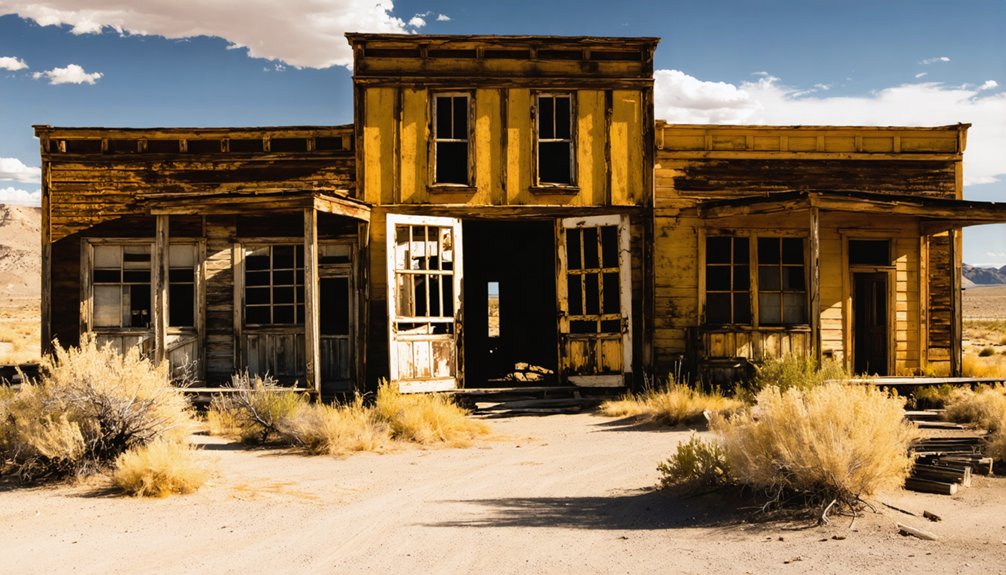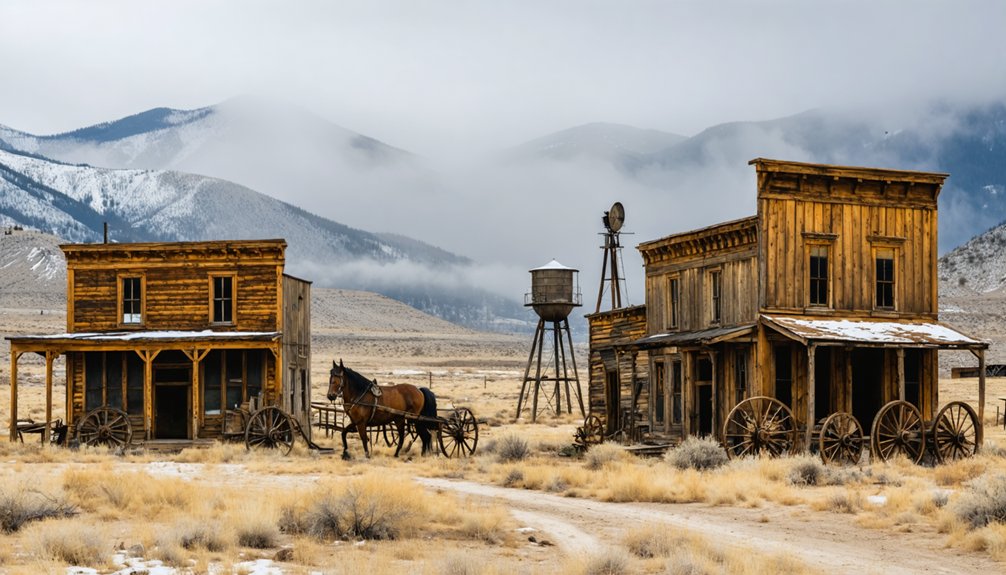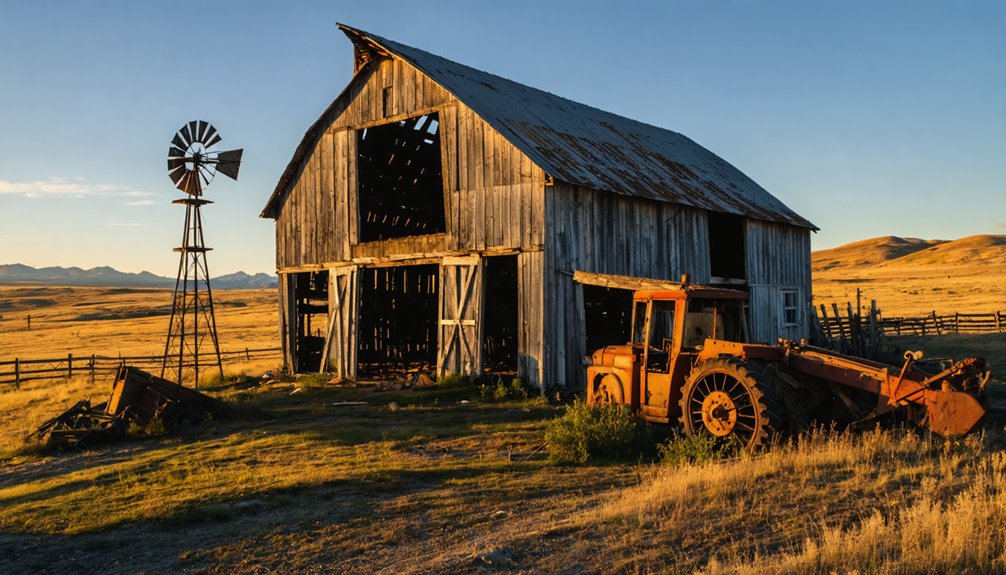
America’s abandoned ranching communities represent a vanishing frontier, with over 150,000 farms lost since 2017 and farmland at its lowest level since 1850. You’ll find these ghost towns throughout the Great Plains and Southwest, victims of market consolidation, aging demographics, and economic pressures. Once-thriving family operations now stand empty as nature reclaims the landscape, creating wildlife corridors while erasing cultural heritage. The story of these forgotten places reveals America’s changing relationship with its rural foundations.
Key Takeaways
- Nearly 2.1 million acres of American farmland disappeared in 2023-2024, continuing the decline of traditional ranching communities nationwide.
- Economic pressures force aging ranchers to sell, with 40% of farmers over 65 and fewer than 22% under 45.
- Abandoned ranch lands create wildlife corridors and undergo ecological succession, potentially sequestering significant carbon if left undisturbed.
- Market consolidation favors corporate agriculture, with fewer than 1% of farms generating 42% of agricultural sales.
- Historic ranching communities face cultural extinction as buildings decay and generational knowledge of land management vanishes.
The Great Exodus: Mapping America’s Vanishing Ranch Lands
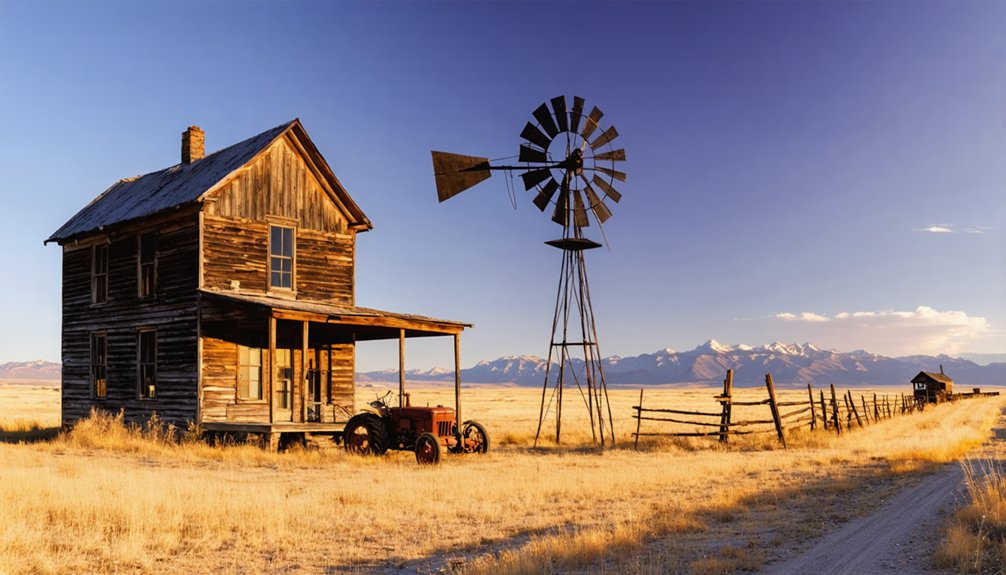
Where have America’s ranches gone? The stark answer lies in USDA statistics: 2.1 million acres disappeared in just one year (2023-2024), with total U.S. farmland plummeting to 880 million acres—the lowest since 1850.
Since 2017, we’ve lost over 150,000 farms while average farm size grew to 466 acres, revealing an alarming land use transformation.
The rural depopulation crisis intensifies as nearly 40% of farmers are now over 65, with few young ranchers stepping in. This aging population often lacks successors with farming interests, creating a generational gap in agricultural stewardship.
Colorado, Texas, and Oklahoma have suffered the most significant acreage losses, with Texas alone losing nearly 18,000 farms between 2017 and 2022—the largest numerical decline in the nation.
Foreign investors, Wall Street firms, and corporate consolidation are reshaping the American landscape, turning once-thriving ranching communities into ghost towns as land transfers to fewer, larger entities.
Ghost Towns of the Great Plains: Communities Left Behind
Across the windswept expanse of America’s Great Plains, the abandoned remnants of once-thriving ranch communities stand as silent witnesses to a vanished way of life.
Further west, the haunting allure of ghost towns in the American West captivates those who seek to uncover the stories etched in decaying buildings. Each deserted street and weathered façade narrates the dreams and struggles of settlers who once called these desolate places home. As explorers wander through these relics, they are often struck by the eerie beauty of forgotten histories that linger in the air.
These ghost town histories reveal how federal land acts sparked settlements in remote, arid regions where homesteaders and ranchers built lives through sheer determination.
When you explore these forgotten places, you’ll encounter:
- Weathered structures like Dearfield’s gas station and lunch counter, slowly succumbing to the elements
- Cemeteries and foundations that mark generations of community resilience
- Sites established by African American, Hispanic, and immigrant settlers seeking autonomy
- Historical markers that inadequately preserve these endangered landmarks
The Dust Bowl and Great Depression emptied these towns as drought and economic hardship forced migrations. Communities like Dearfield, once home to approximately 700 residents by 1920, dwindled to nearly nothing as environmental and economic disasters struck.
Relentless winds and economic collapse transformed vibrant communities into hollow shells, scattering families across the nation in search of survival.
Their stories—overlooked in mainstream narratives—continue through local preservation efforts that honor their struggle.
Dearfield’s founding by Oliver T. Jackson, a successful entrepreneur from Ohio, exemplifies the vision behind many such communities built on aspirations of land ownership and self-sufficiency.
Economic Forces Behind Ranch Abandonment
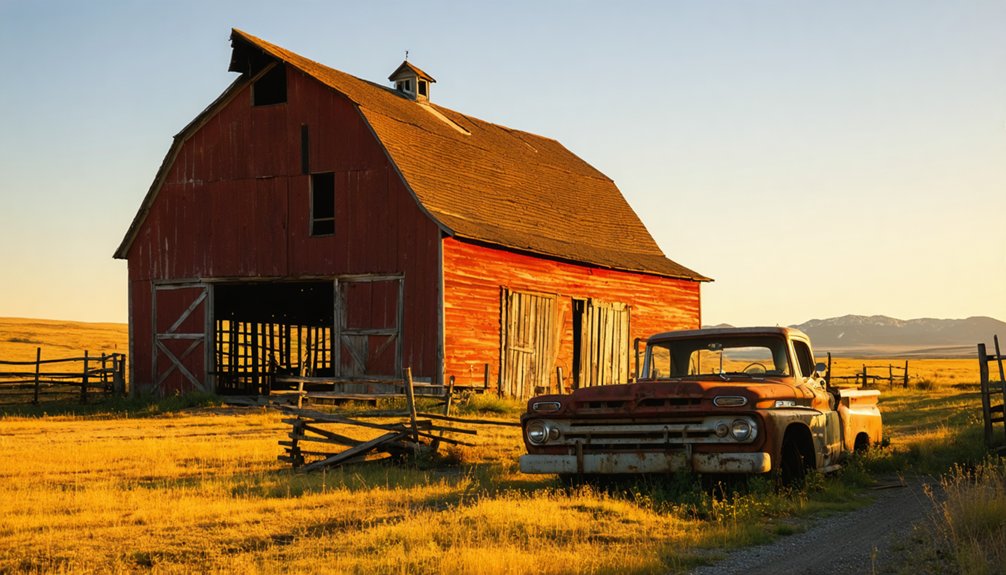
You’ll find the cattle industry’s transformation starkly evident in the market consolidation that has overwhelmingly favored corporate operations with economies of scale over traditional family ranches operating on slim margins.
While family ranches once formed the backbone of rural communities throughout the American West, their viability has diminished as aging ranchers—with an average age now exceeding 57 years—face mounting economic pressures without succession plans. This demographic challenge mirrors the agricultural sector’s broader struggle with rural depopulation as younger generations migrate to urban areas seeking better economic opportunities.
The demographic shift has accelerated abandonment rates, as retirement-age ranchers without heirs interested in continuing operations often sell to larger entities or developers, further hollowing out once-vibrant ranching communities. Economic hardship reminiscent of the Great Depression has forced many ranch families to abandon traditional practices that sustained their operations for generations.
Market Consolidation Realities
A haunting economic reality underlies the abandoned ranching communities dotting America’s rural landscape: systematic market consolidation has dramatically reshaped the agricultural sector over the past seven decades.
You’re witnessing the aftermath of market dynamics that have eliminated 3.75 million farms since 1950—a staggering 66% reduction.
This consolidation impact reveals itself through:
- The loss of 141,733 farms between 2017-2022 alone
- A 34% reduction in dairy operations over just five years
- The disappearance of small producers while operations making over $1 million grew by 36%
- Fewer than 1% of farms now generating 42% of all agricultural sales
With the average farm size increasing to 463 acres, small family ranches have become increasingly unsustainable in the modern agricultural economy.
The physical manifestation of these statistics stands before you in weathered barns and empty pastures—once-vibrant communities sacrificed to efficiency and scale.
Federal policies that provide greater benefits to large operations have created a get big or get out mentality that continues to reshape rural America.
Corporate Vs Family
Nearly every abandoned ranch tells a story of economic disparity between corporate agricultural enterprises and family operations that once sustained rural communities.
You’ll notice the stark reality in places like Idaho, where corporate farming represents just 4.4% of farms yet controls 15% of farmland and 20% of market value.
Family farming operations face increasingly insurmountable obstacles—thin profit margins, limited capital access, and restricted market opportunities.
When you visit these ghost towns, you’re witnessing the aftermath of uneven competition where economies of scale favor corporate entities.
The weathered homesteads stand as monuments to a fundamental economic imbalance.
While government subsidies flow to both operation types, they haven’t prevented the consolidation of land and power that’s emptied countless ranching communities across America’s once-vibrant agricultural landscape.
Despite ninety-seven percent of U.S. farms being family-owned, their struggle for economic sustainability has led to widespread abandonment in rural areas.
The loss of 144,000 acres of working land in Idaho from 2017 to 2022 illustrates the accelerating decline of traditional family farming territories.
Aging Rancher Demographics
While America’s abandoned ranching communities visibly chronicle the physical decline of rural agricultural life, the demographic story behind them reveals an equally troubling pattern of aging producers without successors.
You’re witnessing the consequences of a ranching workforce where nearly two-thirds of agricultural workers exceed age 55, with farm succession increasingly uncertain.
Consider these stark realities:
- The average rancher is now 58.1 years old, over two years older than any other American occupation.
- Only 22% of producers are under 45, creating a critical workforce replacement gap.
- 40% of all farmland belongs to producers 65 and older.
- Beginning farmers require decades to accumulate necessary capital, operating smaller farms with less financial security.
This generational imbalance explains why ghost towns emerge where vibrant ranching communities once thrived.
Environmental Transformation of Former Ranch Lands
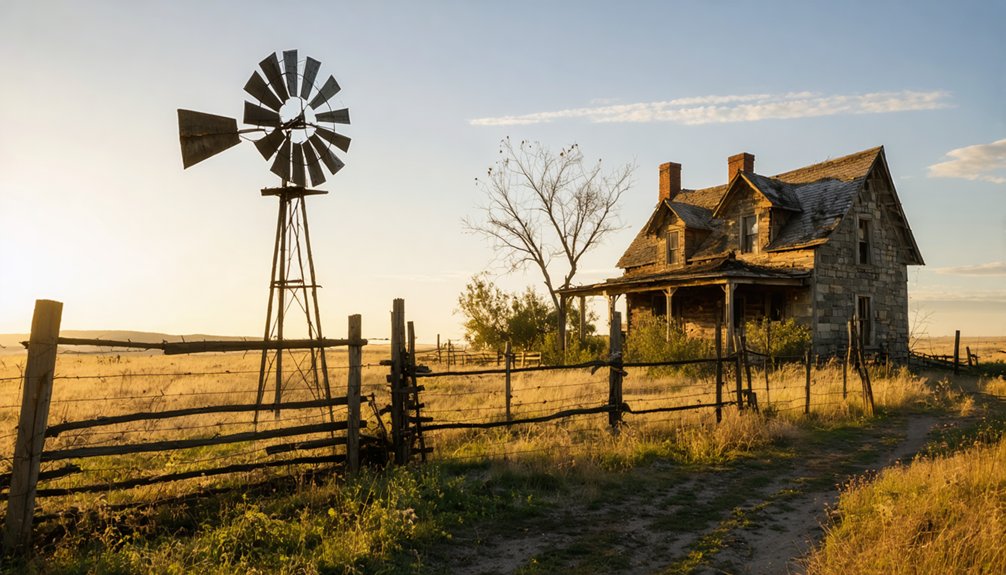
As former ranch lands fall silent across America, nature orchestrates a remarkable transformation through ecological succession, converting once-grazed pastures into diverse grasslands, shrublands, and emerging forests.
You’ll find these regenerating landscapes slowly accumulating carbon in their soils and vegetation—a process that requires decades of undisturbed growth to reach meaningful sequestration levels, yet faces constant threats from recultivation that occurs on nearly half of abandoned properties within thirty years.
These recovering habitats, particularly when concentrated in regional abandonment “hotspots,” create essential wildlife corridors connecting fragmented ecosystems, offering migration pathways and refuge for species adapting to changing environmental conditions.
Ecological Succession Patterns
When abandoned ranching communities return to nature, they undergo a remarkably systematic ecological transformation that scientists have meticulously documented across the American landscape.
You’ll witness distinct succession stages as the land reclaims itself—from crabgrass pioneers in the first year to tree dominance within a decade. Soil recovery proceeds alongside visible changes, with salinity and moisture levels dictating which species thrive.
- Pioneer plants establish within months, followed by larger herbs like Queen Anne’s lace within two years.
- Shrubs like blackberry and sumac colonize by year three, creating wildlife habitat.
- Tree seedlings emerge early but require 25-30 years to create woodland landscapes.
- Soil properties—especially drainage and moisture—determine whether your former ranch becomes forest or prairie.
Carbon Sequestration Opportunities
Beyond the visible transformations of abandoned ranch lands lies their extraordinary capacity to combat climate change through carbon sequestration—a hidden environmental service that’s rapidly gaining scientific attention.
When you walk across former pastures that haven’t seen cattle for decades, you’re treading on soil that accumulates carbon at rates up to 2.3% annually. This carbon storage potential is substantial—abandoned grazing lands could sequester up to 121 GtC by century’s end if protected from recultivation.
Unfortunately, without intervention, most will be returned to production within 30 years, releasing stored carbon and sacrificing future sequestration potential. The decision whether to reintroduce grazing management or allow natural regeneration represents a critical choice for these landscapes.
Thoughtful spatial prioritization of regeneration efforts could triple carbon benefits compared to haphazard approaches.
Wildlife Corridor Emergence
The abandoned fencelines and crumbling corrals of America’s former ranch lands have unexpectedly transformed into critical wildlife highways, connecting fragmented habitats across the nation’s increasingly developed landscape.
You’ll find wildlife corridors emerging where cattle once grazed, providing essential habitat connectivity for species from grizzlies to ocelots.
- Federal agencies have converted 2,831 acres of Arizona ranch land, improving connectivity across 30,000 acres of public lands.
- Montana’s eastern Rockies feature a 7,760-acre conservation easement protecting migratory bird and bear corridors.
- Radio-tracking studies confirm lynx and other predators utilizing these pathways for territory expansion.
- Restored corridors have decreased wildlife-vehicle collisions while enabling species to adapt to environmental changes.
These reclaimed landscapes now serve as nature’s highways, allowing wildlife to move freely between seasonal ranges and expanding gene pools.
Cultural Heritage at Risk: The Human Cost of Decline
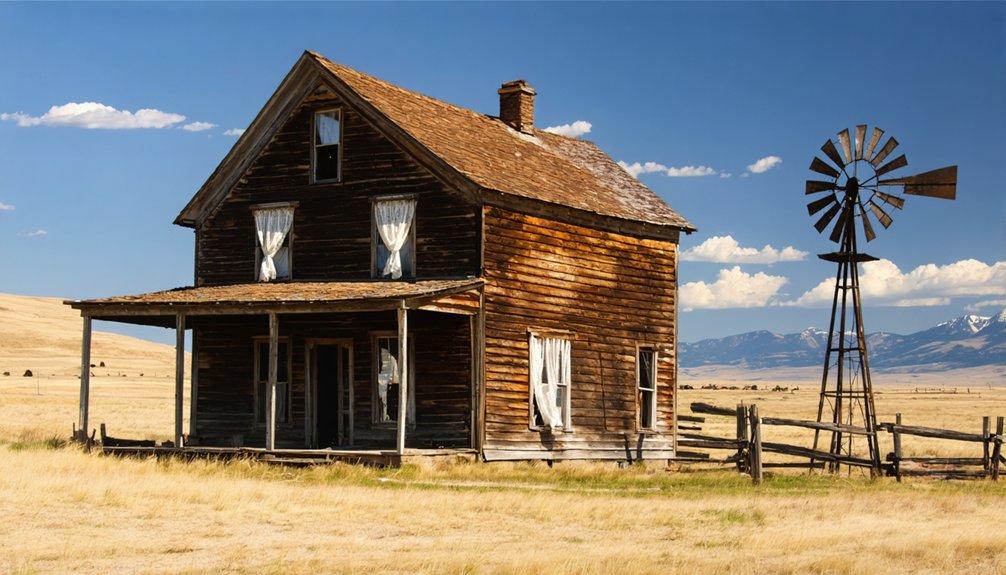
As ranching families throughout America shutter their operations and depart their homesteads, they leave behind more than just empty buildings and untended land—they carry with them generations of cultural knowledge that may never return.
You’re witnessing the unraveling of century-old legacies where traditional knowledge of animal husbandry and land stewardship vanishes with each abandoned property.
The stakes for cultural continuity couldn’t be higher. Historic barns, homes, and water systems—many built with regional techniques and local materials—decay without maintenance, while oral histories and folklore disappear as elders pass away.
These aren’t merely aesthetic losses; they represent the erosion of place-based traditions that defined American rural identity.
Heritage preservation efforts often come too late, after communities have already fragmented and younger generations have relocated to urban centers, taking pieces of America’s ranching heritage with them.
Climate Change and the Future of Abandoned Territories
While cultural erosion reshapes the human landscape of abandoned ranching territories, climate change now emerges as perhaps the most formidable force determining their future.
You’re witnessing a transformation where rural resilience initiatives face unprecedented challenges in regions already vulnerable due to persistent poverty and aging infrastructure.
Rural communities confront climate realities while entrenched socioeconomic vulnerabilities undermine adaptation efforts at every turn.
These territories confront four critical climate realities:
- Catastrophic flooding events occurring with increasing frequency, causing long-term displacement
- Accelerated infrastructure deterioration that isolates communities from essential services
- Agricultural productivity losses that directly threaten already fragile rural economies
- Disproportionate health impacts, with rural residents suffering heat-related illnesses at rates 5-10 times higher than urban counterparts
Without robust climate adaptation strategies, these abandoned lands may represent the vanguard of a broader rural exodus—where environmental justice concerns intersect with the preservation of America’s ranching heritage.
Regenerative Solutions: Pathways to Rural Revival
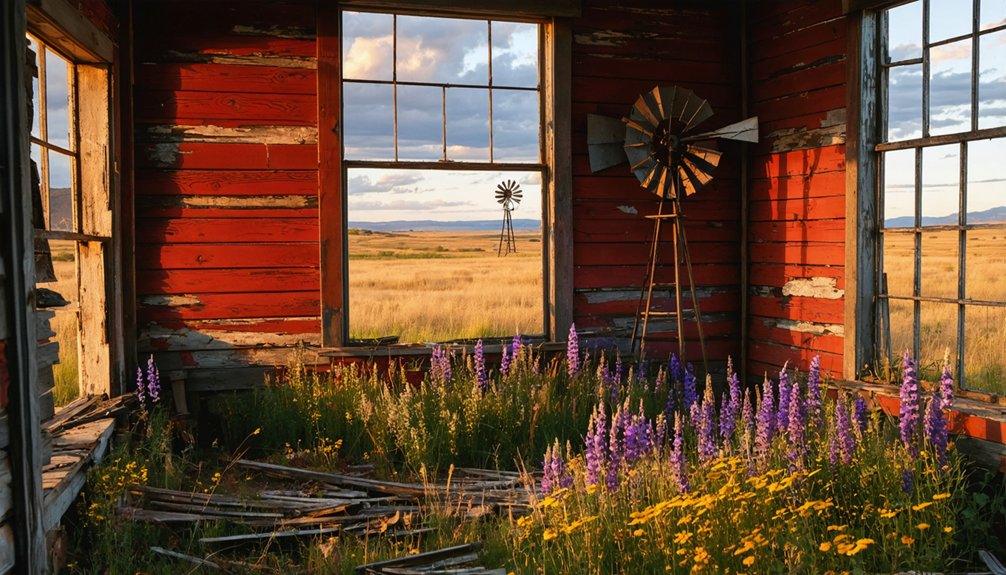
From abandoned ranches to vibrant communities, regenerative agriculture now offers promising pathways toward rural revival across America’s forgotten territories.
You’ll find economic viability where conventional farming failed—studies document up to 120% profit increases for farmers who shift to regenerative practices, despite initially lower yields.
The transformation extends beyond economics. These regenerative practices foster community resilience by improving farmer well-being and attracting younger generations seeking environmentally aligned careers.
Cross-sector partnerships between government, businesses, and civil society have proven essential in building capacity within these revitalized regions.
Environmental benefits further secure this renaissance, as restored soil health and biodiversity create resilient landscapes capable of withstanding climate pressures.
With proper incentives and frameworks supporting shift efforts, America’s abandoned ranching communities stand poised for remarkable rebirth through regenerative principles.
Frequently Asked Questions
How Do Indigenous Land Rights Intersect With Abandoned Ranch Territories?
You’ll find indigenous land reclamation efforts increasingly targeting abandoned ranches, allowing tribes to restore cultural heritage while reclaiming ancestral territories that were fragmented through homesteading and allotment policies.
What Psychological Impacts Affect Residents Who Choose to Stay Behind?
Like seeds in cracked soil, you’ll endure emotional isolation that heightens neuroticism, anxiety, and depression. Yet your community resilience—forged through self-reliance—becomes both shield and prison in these forgotten places.
How Has Technology Enabled Remote Working in Declining Ranching Communities?
You’ve witnessed broadband expansion bringing remote collaboration tools to your community, enabling digital nomadism while preserving your ranching heritage. By 2030, you’ll join the 80% of rural areas with advanced connectivity infrastructure.
Can Abandoned Ranches Become Viable Renewable Energy Production Sites?
With 4,700 TWh potential globally, you’ll find abandoned ranches are ideal for solar farms and wind turbines—they offer existing infrastructure, minimize ecological disruption, and can revitalize struggling rural economies while preserving historic landscapes.
What Specific Tax Incentives Exist for Reclaiming Abandoned Ranching Properties?
You’ll find federal conservation easement deductions, state tax credits up to $300,000, agricultural property exemptions, historic rehabilitation incentives, and various property grants for reclaiming America’s forgotten ranch landscapes.
References
- https://lter.kbs.msu.edu/docs/robertson/xie-et-al-2024-erl.pdf
- https://www.thenewlede.org/2025/06/the-role-of-farming-in-the-exodus-of-rural-america/
- https://www.technologynetworks.com/applied-sciences/news/new-us-map-shows-the-abandoned-farms-that-could-help-fight-climate-change-387249
- https://carnivorebar.com/blogs/carnivore-bar-blog/the-decline-of-american-farms-why-the-future-of-food-depends-on-reviving-regenerative-ranching
- https://www.downsranch.com/blogs/beef-matters/why-47-family-farms-are-lost-every-day-in-the-us-😢
- https://www.thepublicdiscourse.com/2021/03/75087/
- https://news.wisc.edu/abandoned-farmlands-could-play-a-role-in-fighting-climate-change-a-new-study-shows-exactly-where-they-are/
- https://ci.uky.edu/irj/rural-blog/new-tool-finds-abandoned-farmland-could-be-used-fight-climate-change-30-million
- http://www.iowapbs.org/iowapathways/mypath/2422/farm-crisis-1980s
- https://agamerica.com/blog/family-farms/