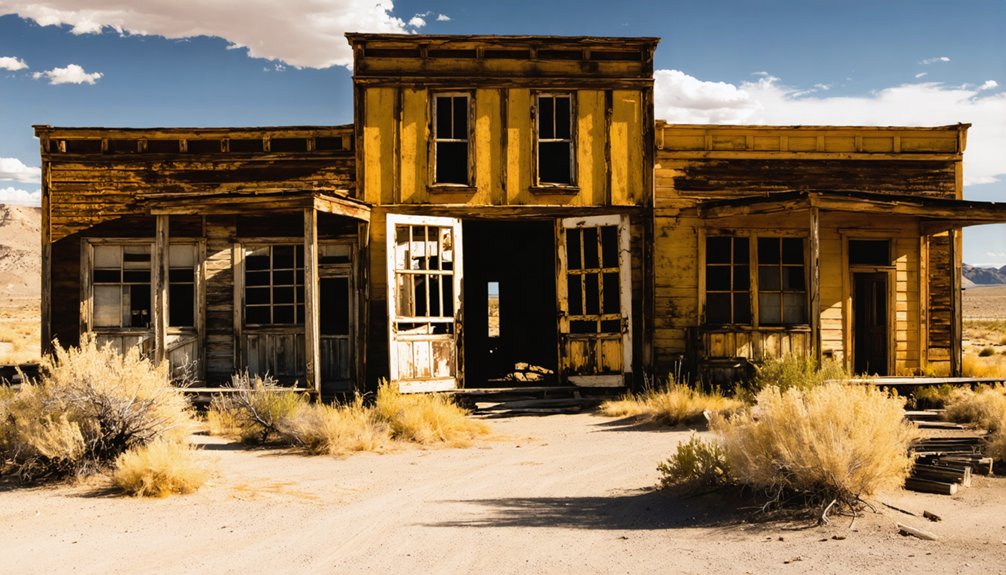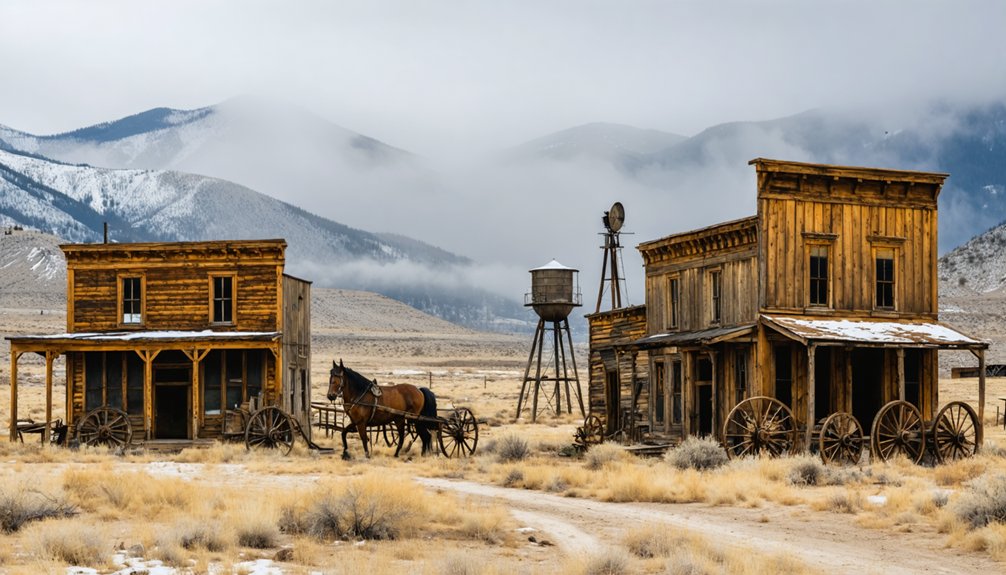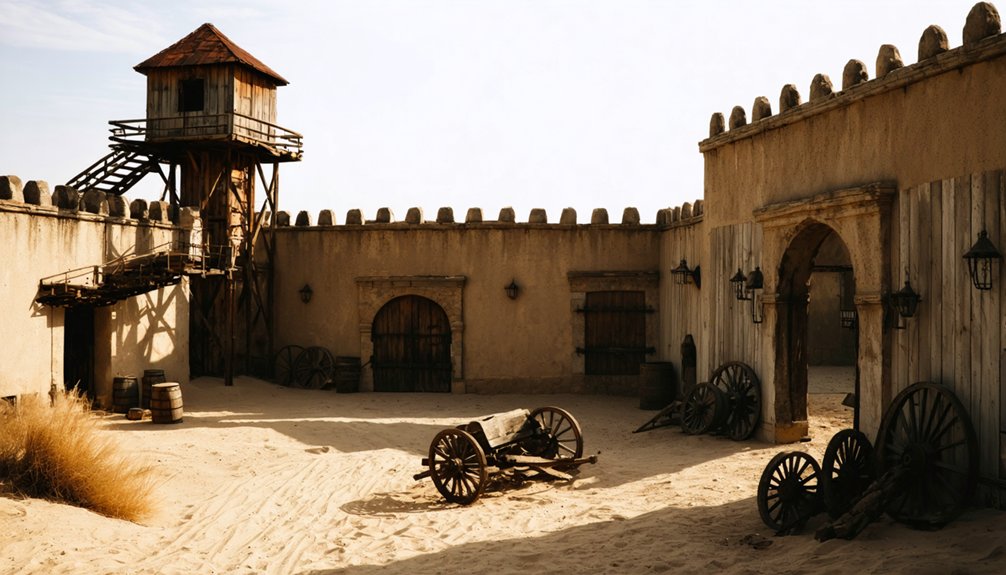
Frontier forts once stood as essential military outposts across the American West, serving as centers for diplomacy, commerce, and tribal relations. You’ll find these abandoned installations transformed from bustling hubs of activity to silent remnants of history, with sites like Fort Supply evolving from campaign bases to economic engines before their eventual decline. Their weathered walls and earthen redoubts chronicle America’s westward expansion, territorial conflicts, and the complex military-tribal dynamics that shaped a nation’s boundaries.
Key Takeaways
- Abandoned frontier forts became ghost towns as settlements expanded, treaties redrew boundaries, and railroads rendered them obsolete.
- Military outposts like Fort Atkinson and Fort Supply transitioned from vibrant communities to historical ruins after their strategic importance diminished.
- Preservation initiatives rescue abandoned forts through structural restoration, archaeological documentation, and adaptive reuse to prevent complete disappearance.
- Remote fort sites often have minimal preservation, requiring visitors to use imagination to visualize the once-thriving military communities.
- Forts that supported economic activities like protecting cattle drives left ghost town remains that reveal the economic networks of frontier America.
The Rise and Fall of Military Outposts in the American West
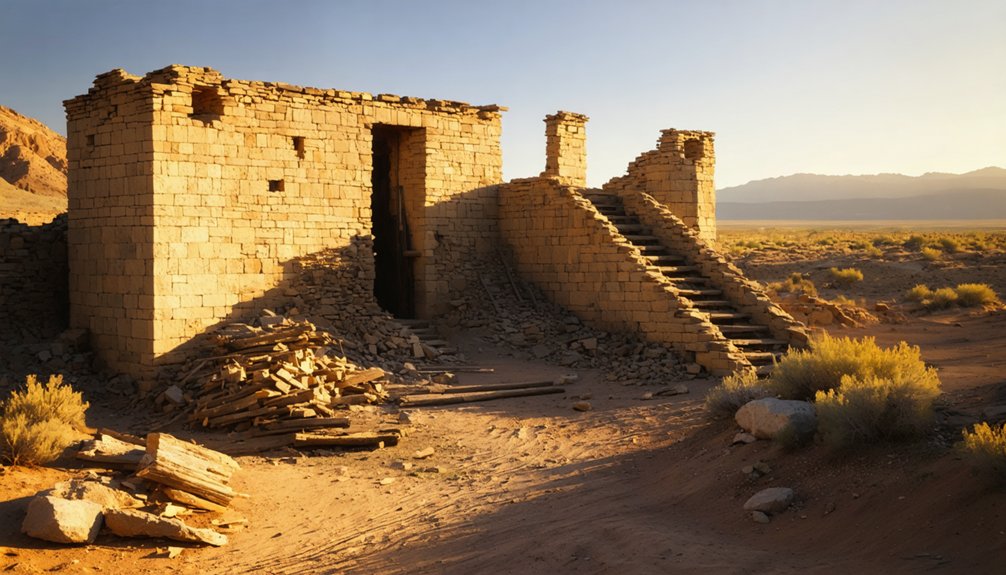
As the American frontier expanded westward in the early 19th century, military outposts began to establish a government presence in previously uncontrolled territories. Fort Atkinson, established in 1820, exemplified this push as the westernmost military post beyond the Missouri River.
These early installations weren’t primarily defensive structures against Native Americans as commonly believed, but centers of frontier diplomacy maintaining peace between tribes and white emigrants. In 1806, the Lewis and Clark expedition returned to Saint Louis after documenting vast territories that would later host these military outposts.
You’ll find that military architecture varied dramatically based on strategic needs and available resources—from imposing masonry structures to simple earthen redoubts. At Fort Atkinson, the rectangular design featured one-story barracks constructed from logs with shingle roofs and gun slits for defense.
As migration intensified and railroads advanced into Native territories, forts shifted from peacekeeping to direct conflict during the mid-1800s, playing significant roles in the Indian Wars.
Eventually, these outposts declined as settlements expanded, treaties redrew boundaries, and railroads rendered them obsolete, leaving behind ghostly remnants of America’s westward expansion.
Fort Supply: Gateway to the Southern Plains
When you examine Fort Supply’s strategic position in western Indian Territory, you’ll find it served as a critical crossroads where military-tribal relations shaped the American frontier.
You can trace how the fort evolved from a campaign base against Southern Plains tribes to become the logistical hub during the Red River War of 1874-1875.
The fort’s economic influence extended beyond military operations as troops protected commercial interests, including cattle drives along the Western Trail and the trading networks that connected Texas to Kansas markets. After the Indian Wars ended, despite recommendations for closure, General Philip Sheridan established the Fort Supply Military Reservation to maintain stability in the region. The installation temporarily served as the seat of government for the Cheyenne and Arapaho Indian Agency during 1869-1870.
Military-Tribal Relations Crossroads
Fort Supply stood at a critical crossroads of military-tribal relations during America’s westward expansion, serving as both a launching point for campaigns against Native peoples and a nexus of diplomatic engagement.
You’ll find this fort’s dual role evident in its history: while it launched Custer’s devastating attack on Black Kettle’s Cheyenne village in 1868, it simultaneously functioned as a center for tribal diplomacy and military negotiations. Located at the confluence of waterways that formed the North Canadian River, the fort occupied a strategically significant position for monitoring tribal movements across the Southern Plains.
The fort witnessed the Northern Cheyenne’s desperate flight in 1878—the last major battle between Plains Indians and U.S. forces in the territory. The military post maintained peace by patrolling against buffalo hunters and whiskey traders who threatened stability in the region.
As tribal communities shifted from nomadic life to reservations, Fort Supply enforced this transformation, mediating disputes between settlers and Indigenous peoples while symbolizing the U.S. government’s forceful policies that ultimately eroded traditional tribal autonomy.
Red River War Hub
The strategic heart of military operations during the Red River War, Fort Supply transformed from a simple camp into an essential supply depot that orchestrated the U.S. military’s convergent campaign against Southern Plains tribes.
You’ll find its military strategy exemplified in how it supported five columns simultaneously during 1874-1875, functioning as the nerve center for troops pursuing Comanche, Kiowa, Cheyenne, and Arapaho forces.
Initially established by Custer’s Seventh Cavalry in 1868, the fort’s supply logistics capabilities expanded dramatically to meet wartime demands. General Philip Sheridan’s strategy of using converging army columns proved decisive in denying tribes any safe refuge.
Troops built roads and telegraph lines that connected this frontier outpost to other military installations, creating a network that denied Native Americans safe havens.
The fort’s ability to maintain provisions, ammunition, and equipment flow despite harsh conditions proved critical to the Army’s ultimate control of the Southern Plains. As a strategic base, Fort Supply also served as a temporary seat for the Cheyenne and Arapaho Indian Agency during 1869-1870.
Trading Post Economics
Beyond its military significance, Fort Supply emerged as a powerful economic engine that transformed commerce across the Southern Plains.
You’ll find that the fort’s strategic location at the confluence of Beaver River and Wolf Creek created ideal trading dynamics throughout the region. From 1868-1894, troops protected essential supply routes connecting Texas cattle drives to Kansas markets while safeguarding stagecoaches, freight haulers, and travelers.
The fort’s influence extended across southwest Kansas, the Texas Panhandle, and western Indian Territory.
As soldiers built roads and telegraph lines, Fort Supply became the commercial nexus for frontier expansion. The military presence policed grazing leases on tribal lands, managed relations with the Cheyenne and Arapaho Agency, and regulated movement through Cherokee territories until the 1893 land opening—ultimately reshaping economic relationships across the Southern Plains. The fort’s establishment supported General Sheridan’s winter campaign against American Indian tribes in the region. The fort’s evolution from a temporary camp to a permanent installation in 1878 solidified its role as a critical economic hub in the region.
Silent Sentinels: Abandoned Presidios of the Southwest
Standing as weathered monuments to Spain’s imperial ambitions, abandoned presidios scattered across the American Southwest tell a complex story of military strategy and cultural conflict.
These fortifications, constructed primarily between the 1500s and 1800s, featured adobe and stone presidio architecture that required constant maintenance against environmental degradation.
You’ll find these outposts were chronically undermanned, with fewer than 300 soldiers spread across the entire frontier at peak times.
Indigenous interactions profoundly shaped their fate—persistent Apache and Comanche raids forced cycles of abandonment and reoccupation at sites like Tubac (1752) and Santa Cruz de Terrenate (1775-1780).
Many presidios housed not just soldiers but families, creating frontier communities that left behind rich archaeological records of daily life before being reclaimed by the desert landscape.
Life Behind Fort Walls: Daily Existence on the Frontier
While soldiers stood guard at bastions and maintained constant vigilance against outside threats, daily life inside frontier forts revolved around rigorous routines that sustained these isolated military communities.
Fort routines blended military discipline with household chores as soldiers chopped wood, hauled water, and maintained fortifications, while women managed cooking, laundry, and childcare.
Social dynamics created a complex microcosm where officers’ families, enlisted men, and civilian traders formed tight-knit communities despite isolation.
Medical practices relied on a combination of trained surgeons and folk remedies, with communication methods limited to letters and messengers.
Educational opportunities and recreational activities provided essential relief:
- Small schools taught by officers’ wives offered basic education
- Dances and dinner parties fostered community bonds
- Outdoor sports like baseball boosted morale
Battlefield Echoes: Military Engagements That Shaped the West
You’ll discover how the frontier’s most consequential battles often occurred far from established settlements, where diverse Native American coalitions frequently determined military outcomes.
Throughout the War of 1812, indigenous fighters proved decisive at engagements like Prairie du Chien and Beaver Dams, establishing patterns of resistance that would continue through subsequent decades of westward expansion.
The Civil War later transformed frontier military dynamics, with forts shifting from their traditional role as bulwarks against Native resistance to strategic positions in a national conflict that redefined America’s understanding of its western territories.
Decisive Plains Engagements
The vast American Plains witnessed several decisive military engagements that fundamentally altered the trajectory of westward expansion during the late 18th and 19th centuries.
From Wayne’s victory at Fallen Timbers in 1794 to the Dakota Territory campaigns of the 1860s, you’ll find these conflicts represent America’s evolving plains strategy against indigenous resistance.
Three pivotal engagements that secured American control:
- Battle of Lake Okeechobee (1837) – Colonel Taylor’s Christmas Day engagement tactics against Seminole forces marked a turning point despite heavy American casualties.
- Battle of Dead Buffalo Lake (1863) – Sibley’s artillery-supported assault during the Dakota campaign.
- Battle of Killdeer Mountain (1864) – General Sully’s decisive victory utilizing combined arms engagement tactics against Lakota warriors.
These conflicts established American military dominance across the frontier.
Native Resistance Campaigns
Throughout America’s westward expansion, Native resistance campaigns emerged as organized responses to territorial encroachment, forming an essential but often overlooked dimension of frontier military history.
You’d find Cherokee campaigns led by Dragging Canoe and John Watts frequently coordinating with Northwest Territory operations before the 1794 Treaty of Tellico Blockhouse ended eastern Indian wars.
Tecumseh’s confederacy represented the most sophisticated pan-tribal alliance, building upon earlier successes when Blue Jacket and Little Turtle defeated U.S. armies under Harmar and St. Clair.
The Prophetstown alliance, established in 1808 at the sacred junction of two rivers, became headquarters for this resistance until William Henry Harrison destroyed it at Tippecanoe in 1811.
Later, Comanche resistance under Quanah Parker challenged reservation policies, triggering the Red River War when bands refused resettlement by 1874.
Civil War Frontier
While Native resistance campaigns were evolving across the western territories, America’s Civil War dramatically altered the frontier military landscape in ways few had anticipated.
The Union’s Frontier Strategy shifted westward as Confederate forces attempted to claim these territories. You’ll discover this strategy evident in forts like Fort Union, which troops rebuilt in 1861 and used as a staging ground for the Battle of Glorieta Pass—the West’s decisive turning point.
Three pivotal developments defined the Civil War Frontier:
- Strategic positioning of forts along migration routes, often two-day rides apart
- Dual-purpose garrisons that defended against both Confederate incursions and Native resistance
- Creation of critical infrastructure networks including telegraph lines centered around military installations
These frontier outposts secured Union control, halting Confederate western expansion while simultaneously managing ongoing territorial conflicts.
From Military Posts to Ghost Towns: Economic Aftermath
As frontier military posts closed their gates across the American West, surrounding civilian settlements experienced devastating economic consequences that would transform thriving communities into ghost towns.
Over time, these ghost towns of the Wild West became haunting reminders of a bygone era, where dreams of prosperity vanished along with the once-bustling streets. Many of these deserted places tell stories of adventure and hardship, drawing in curious travelers eager to glimpse the remnants of what was once a vibrant part of American history. The allure of these abandoned towns continues to spark interest in the cultural narratives and mysteries that surround them.
Fort Maginnis in Montana exemplifies this pattern—after its 1890 abandonment, the customer base for local merchants vanished overnight.
You’ll find this military abandonment created immediate economic decline in formerly prosperous areas. Merchants who’d built businesses serving garrisons suddenly faced empty storefronts.
The ripple effects were devastating: housing markets collapsed, buildings deteriorated, and infrastructure investments became stranded assets.
These frontier communities typically lacked economic diversity, making them exceptionally vulnerable. With military payrolls and procurement contracts eliminated, populations rapidly dispersed.
Towns that had grown quickly during military occupation contracted just as dramatically, leaving behind only echoes of their former liveliness.
Preservation Efforts: Saving America’s Frontier Military Heritage
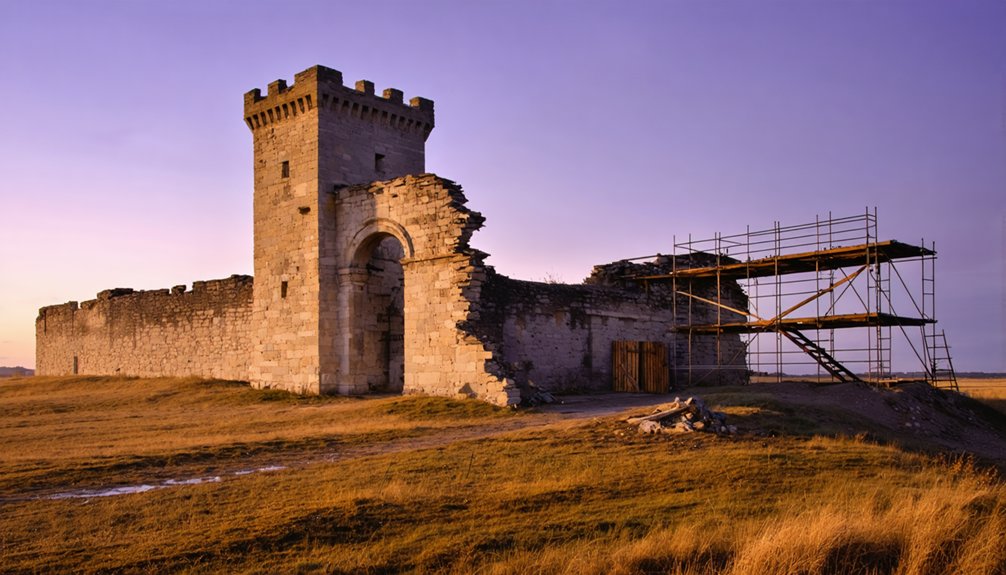
The legacy of America’s abandoned frontier forts might’ve faded entirely if not for dedicated preservation efforts that began in the early 20th century.
Fort preservation initiatives emerged when local citizens recognized the historical significance of these disappearing structures, with Old Fort Niagara’s restoration in 1927 establishing an early model for collaborative conservation.
Three major preservation approaches have proven successful:
- Extensive structural restoration (Castillo de San Marcos, Fort Concho)
- Archaeological documentation to understand construction techniques (Fort Defiance)
- Adaptive reuse through heritage trail development and museum conversion (Fort Buford)
These efforts transformed crumbling military outposts into educational destinations where you can experience authentic frontier architecture.
The Texas Historical Commission’s designation of eight surviving 19th-century forts demonstrates how regional coordination maximizes preservation impact across historically connected sites.
Walking Among Shadows: Visiting Abandoned Fort Sites Today
Scattered across remote landscapes throughout America, abandoned frontier forts stand today as silent witnesses to the nation’s westward expansion, offering visitors a unique opportunity to step back in time.
When starting fort exploration, you’ll find varying levels of preservation and accessibility. Some sites, like Fort McKavett in Texas, feature restored buildings and guided tours, while others like Fort Lancaster remain as evocative ruins with interpretive signage.
Fort Jefferson in Florida requires boat or seaplane access but rewards with impressive brick structures and an isolated atmosphere.
Historical preservation efforts differ dramatically between sites. While established historic parks provide amenities and interpretive programs, more remote locations like Fort Patrick Henry offer little more than scattered foundations and historical markers, demanding your imagination to reconstruct the past.
Frequently Asked Questions
Did Frontier Forts Employ Civilians Alongside Military Personnel?
Yes, you’ll find frontier forts regularly employed civilians in essential roles. These civilian positions complemented military operations through skilled trades, administration, and logistics, greatly enriching frontier life’s interdependent structure.
How Did Extreme Weather Events Affect Fort Operations?
Like a river reshaping landscapes, extreme weather disrupted your frontier forts. Blizzards caused supply shortages, flash freezes required adaptation, droughts necessitated water resource development, and storms prompted improved weather preparedness throughout military history.
What Happened to Military Equipment When Forts Were Abandoned?
When forts were abandoned, you’d find military disposal occurring through manual removal or controlled detonations, while equipment repurposing transformed obsolete items into training aids or preserved them in storage facilities.
Were Indigenous People Ever Employed at Frontier Forts?
Yes, you’ll find Indigenous labor was extensive at frontier forts, serving as interpreters, scouts, guides, traders, and provisioners. This created complex cultural exchange networks throughout colonial and early American periods.
How Did Disease and Medicine Impact Fort Populations?
Disease outbreaks devastated fort populations, with smallpox and malaria causing particularly high mortality. You’ll find military medical practices evolved, but remained insufficient against widespread epidemics that disproportionately affected indigenous communities near forts.
References
- https://www.youtube.com/watch?v=zRfBNdUOgOQ
- https://www.youtube.com/watch?v=c8cqQ-q7t9E
- https://www.okhistory.org/sites/fshistory
- https://www.thc.texas.gov/public/upload/publications/forts.pdf
- https://tubitv.com/tv-shows/200049787/s01-e02-forts-trails-and-battle-sites
- https://www.youtube.com/@ghosttownchronicles/videos
- https://www.youtube.com/watch?v=RNSPYhh_nwI
- https://www.youtube.com/@ghosttownchronicles
- https://en.wikipedia.org/wiki/Timeline_of_the_American_Old_West
- https://nebraskastudies.org/1800-1849/forts-built/