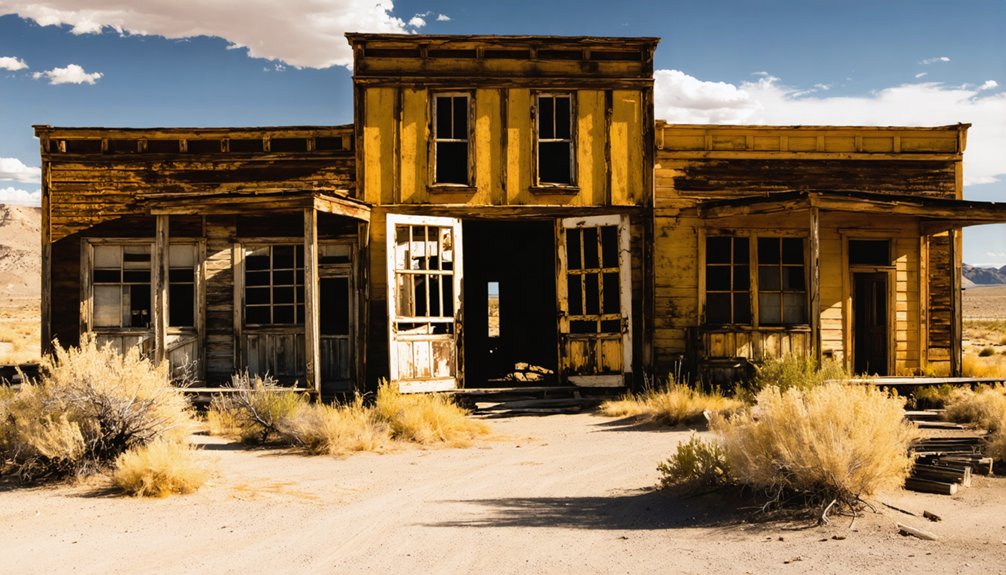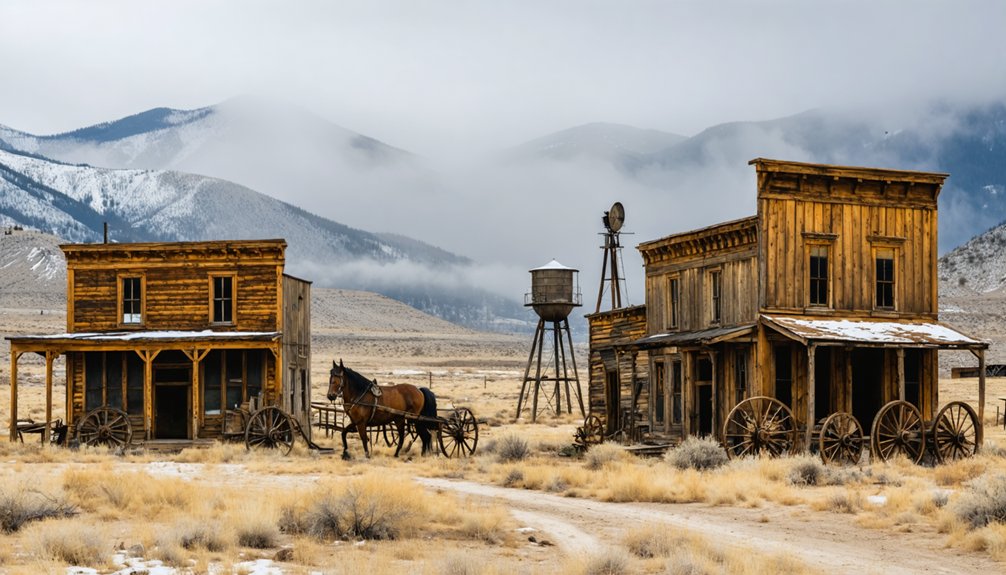
America’s ghost towns emerged from boom-bust cycles of frontier development, where mining, railroads, and resource extraction created temporary prosperity. You’ll find these abandoned settlements now serve as time capsules of frontier ambition and economic vulnerability. Many have found new life through heritage tourism, offering authentic experiences through preserved structures, museums, and cultural festivals. The stories of these resurrected communities reveal deeper truths about America’s relationship with expansion, resources, and sustainability.
Key Takeaways
- Historical ghost towns have been transformed into heritage tourism destinations through strategic preservation of authentic frontier architecture.
- Tourism revitalization creates economic stability through hospitality jobs, guided tours, and souvenir sales that support ongoing preservation.
- Former mining settlements showcase the boom-and-bust cycle of resource-dependent frontier communities that once thrived during gold rushes.
- Ghost towns serve as educational resources about American westward expansion, complete with immersive experiences and historical reenactments.
- Communities like Cahaba, Batsto Village, and others combine historical significance with unique local heritage to attract visitors.
The Gold Rush Legacy: How Mining Created America’s Most Famous Ghost Towns

When gold was discovered at Sutter’s Mill in 1848, it triggered a cascade of human migration that would forever alter the American landscape. You can trace the birth of iconic ghost towns directly to this pivotal moment, as prospectors from diverse backgrounds rushed to establish settlements near promising mineral deposits.
These frontier communities evolved rapidly from crude camps to structured towns with distinct cultural influences from Europe, Asia, and Latin America. Chinese immigrants particularly shaped California’s mining landscape, leaving lasting legacies like Weaverville’s Taoist temple. Similar to these communities, Monte Cristo experienced a rapid boom after Joseph Pearsall discovered gold deposits in 1889, establishing what would become a town of over 1,000 residents by 1894. Visitors to Calico can still explore 500 mine sites that showcase the immense scale of operations during the silver rush era.
Mining techniques determined settlement patterns, with towns strategically positioned along waterways where placer mining thrived. As operations advanced to hard-rock mining, communities expanded with stamp mills and processing facilities.
Bodie, Virginia City, and Rhyolite exemplify this evolution—once-thriving hubs now preserved as monuments to America’s mineral rushes.
From Boom to Bust: Economic Factors Behind Frontier Town Abandonment
You’ll find that America’s ghost towns primarily emerged from dramatic boom-bust economic cycles where mining deposits became exhausted, eliminating the foundation for sustained settlement.
These frontier communities collapsed further when essential railroad connections were abandoned, severing crucial supply chains and economic lifelines.
The remnants of these once-thriving towns now serve as silent reminders of the abandoned ranching history in America. Overgrown fields and dilapidated barns echo stories of a vibrant pastoral life that has long faded into memory. As these landscapes shift, they reveal the struggles and resilience of communities that once depended on ranching for their livelihood.
The rapid depletion of natural resources—whether minerals, timber, or rangeland—triggered mass exoduses as workers migrated to newer opportunities, leaving behind the skeletal remains of once-thriving commercial centers. Many of these settlements initially flourished due to the American ideology of manifest destiny, which drove widespread westward migration and temporary settlement patterns. The decline of these frontier towns was similar to the significant economic reversal experienced by the American South between 1774 and 1840, when once-prosperous regions saw dramatic downturns in fortune.
Economic Boom Cycles
The dramatic rise and fall of frontier towns across the American West followed distinct economic patterns that ultimately determined their longevity.
You’ll find these settlements initially thrived on resource extraction—whether cattle, minerals, or agricultural products—creating rapid economic resilience through specialized industry.
Mining towns exemplified this pattern most clearly, with boom cycles lasting approximately five years before resources depleted. Virginia City and other Nevada silver boomtowns flourished briefly, then collapsed as extraction became financially untenable.
Similarly, cattle-dependent economies like Dodge City prospered until barbed wire and expanding railroads eliminated their strategic value.
These once-bustling frontier towns like Deadwood and Tombstone eventually became ghost towns when their mines were depleted and economic opportunities vanished.
The Permian Basin region experienced similar cycles, with communities expanding rapidly during oil booms only to face economic uncertainty when companies shut down operations and scaled back rigs.
Settlement sustainability depended on diversification beyond primary resources. Towns that failed to adapt as infrastructure evolved—particularly railroad expansion that integrated frontier economies with national markets—found themselves bypassed and abandoned when their singular economic purpose vanished.
Resource Depletion Effects
Resource extraction became the lifeblood and ultimate downfall for countless frontier settlements, illustrating how economic sustainability hinges on more than mere presence of valuable materials.
You’ll find this pattern repeated across the American West, where towns like Bodie and Calico flourished briefly during mineral booms before collapsing when deposits vanished.
The single-industry dependence created economic vulnerability—when mines closed, supporting businesses failed in rapid succession. Labor migration followed predictably as workers sought opportunity elsewhere, leaving ghost towns in their wake. Fortune seekers who were once drawn to these areas by the promise of wealth rapidly abandoned them when valuable mineral deposits were exhausted.
The environmental toll often prevented resettlement, with mining activities leaving unstable ground and contamination. Human intervention through dam construction similarly led to the permanent displacement of residents from once-thriving communities.
This boom-and-bust cycle reveals how transient extraction economies create inherently fragile communities.
Only settlements that diversified beyond their original resource base or leveraged their historical significance for tourism managed to survive the inevitable depletion.
Railroad Abandonment Impact
While railroad expansion initially catalyzed settlement and economic growth across the American frontier, subsequent rail abandonment triggered devastating cascading effects throughout rural communities.
Railroad history reveals a staggering retreat: nearly 40% of U.S. rail networks vanished during the 20th century, with abandonment rates accelerating dramatically following deregulation in the 1970s-80s.
You’ll find the consequences were far-reaching—communities losing rail service suffered quantifiable declines in wages, population, and industrial activity.
The transformation was particularly brutal for rural areas dependent on rail for shipping bulk commodities like wheat. As transportation costs increased, local roads deteriorated under new truck traffic.
Community resilience was tested as policy shifted toward prioritizing railroad profitability over rural needs, contributing to the transformation of once-thriving frontier settlements into ghost towns. Research by Professor Dustin Frye revealed that the Staggers Act of 1980 significantly loosened regulations on railroad companies, allowing them to abandon unprofitable lines more easily. The Transcontinental Railroad, once a symbol of American expansion, became a double-edged sword as its consolidation left many smaller communities without the vital transportation links they needed to survive.
Modern Ghost Towns: Urban Decay in America’s Major Cities
As America’s once-thriving urban centers face unprecedented population decline, a troubling pattern of modern-day ghost towns has emerged in major metropolitan areas across the nation.
San Francisco leads this urban migration exodus, losing over 60,000 residents (7.4%) between 2020-2023, followed by St. Louis (-6.6%), Jackson (-6.5%), and New York (-6.2%).
You’ll find alarming vacancy rates in cities like Montgomery, Alabama, where ZIP code 36104 reports 19.6% vacant homes.
Construction stagnation further signals community abandonment, with Akron experiencing a 69% drop in building permits.
Property values in affected areas have plummeted considerably below state averages—Flint’s median values reaching just 14% of Michigan’s average.
This transformation reflects broader population trends driven by affordability crises, remote work opportunities, and the decline of traditional manufacturing hubs.
Preserved in Time: How Tourism Breathes New Life Into Abandoned Settlements
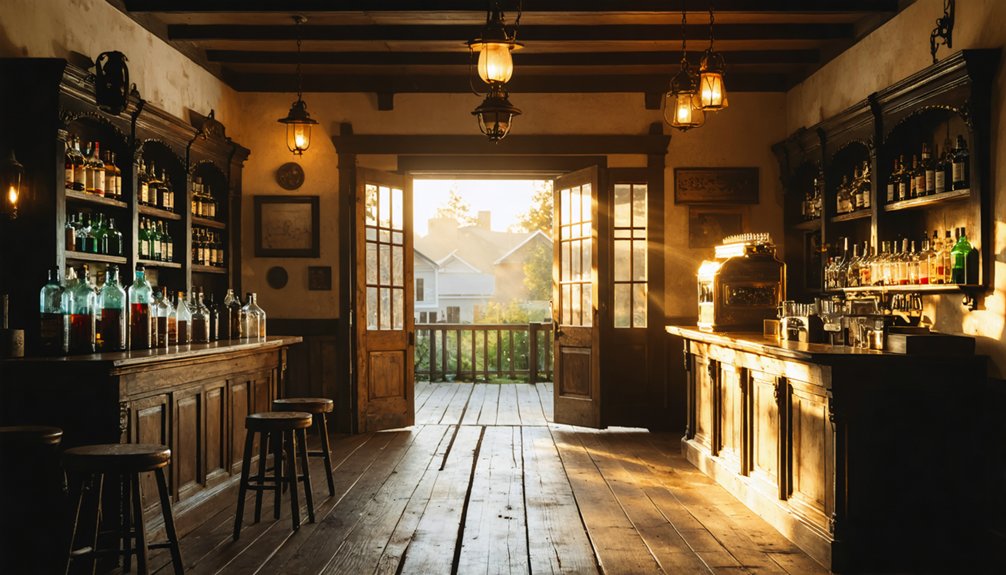
While urban centers continue to lose population, a different phenomenon unfolds in America’s historical abandoned settlements. Through “arrested decay” preservation techniques, ghost towns like Bodie, California and Kennicott, Alaska have transformed from forgotten relics into vibrant heritage tourism destinations.
The tourism impact extends beyond mere visitation—it creates economic stability through hospitality jobs, guided tours, and souvenir sales. Revenue generated supports historical preservation efforts while maintaining authentic experiences of frontier life.
You’ll find communities hosting festivals and events that celebrate their unique mining or ranching heritage.
This careful balance between access and conservation allows you to experience immersive educational opportunities through interpretation centers and reenactments, while preservation techniques protect fragile structures from deterioration.
These ghost towns now serve as living museums where America’s pioneering spirit remains tangibly accessible.
Natural Disasters and Environmental Factors in Ghost Town Formation
You’ll notice that devastating firestorms have historically wiped out entire communities, leaving behind nothing but charred remnants of once-thriving towns.
Water scarcity has proven equally destructive, as settlements built during wetter periods face abandonment when wells run dry and agricultural prospects diminish.
These environmental catastrophes often strike with little warning, transforming populated areas into ghost towns virtually overnight as residents flee for survival rather than choosing gradual relocation.
Firestorms’ Devastating Legacy
The destructive power of firestorms has created a devastating legacy of abandoned communities across North America, fundamentally reshaping human settlement patterns in fire-prone regions.
You’ll find this firestorm impact most pronounced in places like Paradise, California, where the 2018 Camp Fire obliterated over 18,000 structures and claimed 85 lives, forcing mass evacuation and creating instant urban decay.
The economic reality following these disasters often prevents rebuilding. With destroyed infrastructure, contaminated water supplies, and scorched earth, many settlements simply cease to exist.
This pattern repeats throughout the American West, where climate change has doubled the frequency of large wildfires since the 1980s and extended fire seasons by 78 days.
Indigenous fire management practices once mitigated these risks, but their suppression contributed to today’s catastrophic conditions that render landscapes uninhabitable for generations.
Water Scarcity Dooms Towns
Across America’s declining communities, chronic water scarcity represents a silent but devastating force transforming once-vibrant towns into uninhabited shells.
You’ll find infrastructure neglect creating a death spiral where aging water systems hemorrhage resources while struggling communities can’t afford repairs. This systematic collapse particularly impacts poorer regions, where water loss exceeds 60% in places like Highland Park and Jackson, while private providers charge 59% more than public utilities.
- 15 million Americans faced water shutoffs in 2016, primarily in low-income areas
- Southern states and the Midwest suffer the highest disconnection rates
- Contaminated water drives population exodus as seen in Flint, Michigan
- Over 2 million citizens lack basic water access and sanitation
- Communities with 30% poverty rates lose more than 60% of their water supply
Hidden Treasures: Lesser-Known Ghost Towns Worth Exploring

Beyond the well-documented ghost towns that populate tourist itineraries, numerous lesser-known abandoned settlements offer intriguing historical narratives and architectural remnants for the dedicated explorer.
These hidden gems include Cahaba, Alabama’s first capital, with its damp ruins and haunted histories of Civil War prisoners, and Batsto Village, New Jersey’s 18th-century iron-manufacturing site where floating orbs reportedly appear in the cemetery.
Venture beyond tourist traps to discover Cahaba’s haunting Civil War ruins and Batsto Village’s spectral cemetery phenomena.
You’ll find Fayette, Michigan and Flagstaff, Maine harbor paranormal activity amid their historical structures, while Crystal City, Colorado lies buried deep in the Rockies, accessible only by jeep trail.
For those seeking freedom from conventional tourism, these forgotten settlements provide authentic glimpses into America’s past without the crowds that flock to more famous ghost towns.
Frequently Asked Questions
How Do Legal Ownership Issues Affect Ghost Town Preservation Efforts?
Like tangled roots choking a historic foundation, you’ll find ownership disputes create significant preservation challenges through unclear titles, fractional ownership, and legal barriers that impede coordinated restoration efforts and long-term protection planning.
What Supernatural Legends Are Associated With America’s Most Famous Ghost Towns?
You’ll find supernatural sightings abound in America’s ghost towns—from Bodie’s curse afflicting artifact thieves to Centralia’s eerie smoke, St. Elmo’s spirit of Annabelle Stark, and Frisco’s spectral figures with haunted histories.
Can People Legally Live in or Purchase Property in Ghost Towns?
You can purchase and inhabit ghost towns, but your property rights are constrained by unclear titles, multiple ownership claims, and legal restrictions including zoning laws, historic preservation regulations, and infrastructure requirements.
How Have Ghost Towns Been Portrayed in Film and Television?
You’ll find ghost town representation ranges from romantic Western backdrops in films like “Matewan” to documentary subjects exploring cinematic nostalgia, often emphasizing dramatic decline while omitting indigenous displacement narratives.
What Role Did Women and Minorities Play in Frontier Settlements?
Shackles of domesticity obscured pioneering women’s economic independence and leadership. You’ll find minorities and women made substantial cultural contributions through entrepreneurship, education, and social advocacy despite systemic violence and exploitation.
References
- https://themortgagepoint.com/2024/10/25/americas-new-ghost-towns/
- https://www.geotab.com/ghost-towns/
- https://www.youtube.com/watch?v=BCEJSNF6nW8
- https://247wallst.com/housing/2024/04/11/americas-modern-ghost-towns-2/
- https://www.youtube.com/watch?v=odbOj8W4V9o
- https://nightofthejack.com/2025/01/23/top-creepy-ghost-towns-in-america/
- https://www.youtube.com/watch?v=UujbImwiLfA
- https://joybird.com/blog/top-ghost-towns-in-america/
- https://www.youtube.com/watch?v=uVMTCY45z3U
- https://www.christywanders.com/2024/08/top-ghost-towns-for-history-buffs.html