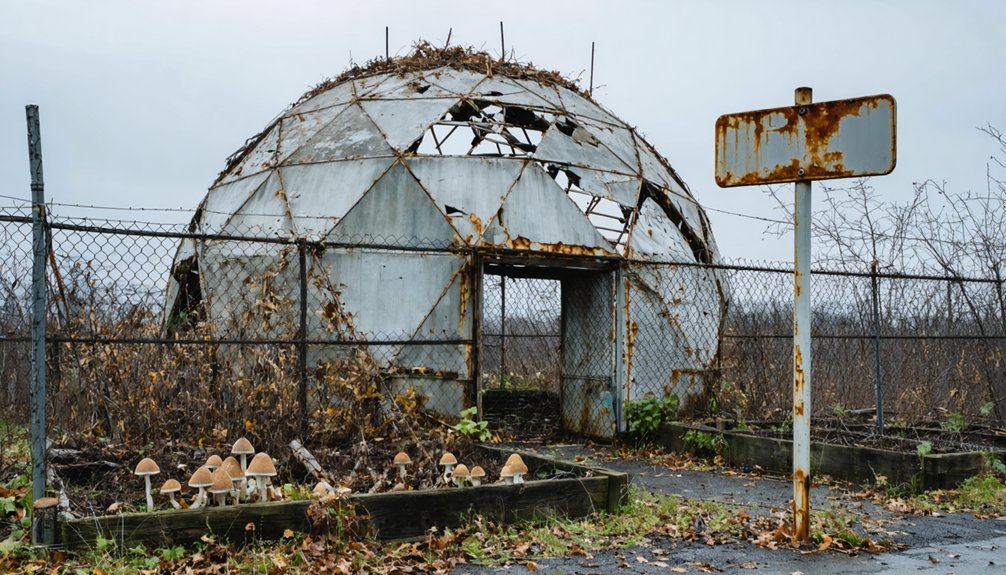
From Plymouth Colony’s communal experiment in 1620 to Jonestown’s tragic end in 1978, America’s utopian communities have repeatedly failed despite their idealistic foundations. You’ll find recurring patterns across diverse experiments like New Harmony, Brook Farm, and 1960s counterculture communes. Economic instability, rigid ideologies, power struggles, and human nature’s complexities consistently undermined these social visions. Each collapse reveals the profound gap between utopian dreams and sustainable community-building—a lesson that continues to echo through similar modern endeavors.
Key Takeaways
- American utopian communities consistently failed due to unsustainable economic models that couldn’t balance communal ownership with individual incentives.
- Religious and secular utopias alike struggled with leadership challenges, often becoming authoritarian or fracturing under ideological disputes.
- Plymouth Colony, New Harmony, Brook Farm, and Fruitlands all collapsed when idealistic visions confronted harsh agricultural and economic realities.
- Class tensions and unequal labor distribution undermined communities’ egalitarian principles, creating resentment between intellectuals and manual workers.
- Demographic sustainability challenges plagued intentional communities, particularly evident in Shaker communities’ celibacy requirement and the 1960s communes’ transient membership.
Plymouth’s Failed Experiment With Communal Living

Necessity and idealism converged when Plymouth Colony was established in 1620, as London investors mandated a communal property system.
All land, food, and supplies would be held collectively for seven years, with profits equally divided afterward. This arrangement echoed Plato’s Republic in its aspirations for social harmony.
The communal challenges quickly became apparent. Without individual incentive, crop yields remained dangerously low.
You couldn’t produce your own food, yet received equal rations regardless of your contribution. With no effective way to enforce labor division, resentment flourished alongside starvation.
Many colonists, especially the young and able-bodied, felt that equal distribution was fundamentally unjust to those working harder than others.
Governor William Bradford later addressed this problem by assigning parcels of land to individual families, creating a private property system that dramatically improved productivity and morale.
New Harmony: Robert Owen’s Shattered Vision
While the Plymouth Colony’s communal experiment failed in America’s early colonial period, a more ambitious utopian vision emerged in the American heartland nearly two centuries later. In 1825, Robert Owen purchased the existing Harmonist settlement in Indiana for $150,000, renaming it New Harmony.
Owen’s ideals centered on creating a “new moral world” founded on equality, cooperation, and rational education. He attracted scientists and intellectuals to his experiment, with William Maclure joining as a key partner focusing on educational initiatives. Owen’s beliefs were shaped by his conviction that human character is formed by one’s social environment.
Community challenges emerged almost immediately. Despite elaborate governance structures, financial strain and ideological conflicts plagued the venture. The community members wore identical clothing and housing as part of their commitment to equality. By 1827, Owen’s communal system had collapsed.
Though the social experiment failed, New Harmony’s legacy endured through scientific research, educational reform, and as headquarters for the U.S. Geological Survey.
Brook Farm and the Transcendentalist Dream

You’ll find that Brook Farm’s intellectual idealism collapsed when the realities of manual labor created tensions between educated reformers and working-class members.
The community’s later adoption of Fourier’s socialist theories in 1844 sparked division among the original transcendentalist founders.
Despite this discord, notable figures like Margaret Fuller frequented the community, contributing to its intellectual vibrancy while advocating for social reform.
The community was financially structured through the sale of stock, with purchasers automatically becoming members of the utopian experiment.
The resulting philosophical shift, coupled with financial strain and the devastating Phalanstery fire in 1846, ultimately led to Brook Farm’s dissolution just six years after its ambitious founding.
Intellectual Idealism Collapses
When idealism confronted practical realities in the 1840s, Brook Farm’s utopian experiment began its gradual descent into failure. The community’s intellectual aspirations collided with communal challenges as financial pressures mounted. The subsequent smallpox epidemic that afflicted the community further weakened their already fragile existence.
Their pivotal 1844 shift toward Fourier’s socialist theories marked a desperate attempt to salvage their vision, renaming themselves a “Phalanx” and restructuring their organization.
You can trace their collapse to specific events: the Phalanstery—their grand central building—consumed their limited funds before being destroyed by fire in 1846.
Without support from influential Transcendentalists like Emerson, who declined membership, and facing chronic underfunding, the community disbanded by 1847. The joint stock company structure with its expensive $500 shares had ultimately failed to generate sufficient capital for the Institute for Agriculture and Education’s ambitious plans.
Their six-year experiment ended as the property transformed into a poor farm, Civil War camp, and eventually an orphanage—leaving behind no original structures but an enduring legacy of American utopianism.
Labor-Class Tensions Emerge
The lofty ideal of equal labor at Brook Farm quickly revealed deeper class tensions that would undermine its utopian vision. Despite paying $1 daily for all work regardless of type, the reality proved harsher than the philosophy.
Members from middle-class backgrounds, particularly intellectuals like Hawthorne, discovered manual labor left little energy for creative pursuits. Hawthorne himself invested $1000 to join the community with hopes of starting a new life with Sophia Peabody. Labor expectations varied dramatically across class backgrounds. Those unaccustomed to physical work found farming tasks exhausting, leading to high turnover and diminished community cohesion.
Meanwhile, gender roles persisted despite claims of equality – women shouldered domestic duties alongside fieldwork, limiting their intellectual engagement. The community’s constitution promised matching labor to individual talents, but economic sustainability demands often trumped personal preference.
As members grew disillusioned with the imbalance between intellectual aspirations and physical demands, Brook Farm’s utopian experiment began unraveling.
Fourierism Sparks Division
Brook Farm underwent a profound ideological transformation in 1844 when its leadership, spearheaded by founder George Ripley, embraced Charles Fourier’s socialist principles.
This shift reorganized the community into the “Brook Farm Phalanx,” emphasizing communal ownership and rigid division of labor.
You would have witnessed internal debates as Transcendentalist ideals gave way to Fourierist principles. The community expanded infrastructure to accommodate this new vision of social reform, but these changes coincided with increasing financial strain and organizational challenges.
The Phalanx required complex administrative structures, creating tension among members with differing views on the community’s direction.
When the central Phalanstery building burned down in 1846, it devastated both morale and finances.
This catastrophe, coupled with the stress of implementing Fourierist principles, ultimately contributed to Brook Farm’s dissolution in 1847.
The Rise and Fall of Fruitlands

You’ll find Bronson Alcott’s 1843 Fruitlands experiment represented one of America’s most idealistic yet impractical utopian ventures, collapsing after just seven months despite its lofty Transcendentalist aspirations.
The community’s strict adherence to ascetic principles—including veganism, prohibition of animal labor, and rejection of commerce—proved catastrophically incompatible with New England’s agricultural realities and harsh winter conditions.
Charles Lane’s departure and mounting food shortages ultimately forced the Alcott family to abandon their “new Eden,” illustrating the profound tension between philosophical idealism and survival necessity that doomed many nineteenth-century communal experiments. Though the original community failed, Clara Endicott Sears later preserved its legacy by opening the red farmhouse museum in 1914.
Bronson’s Failed Experiment
Founded in June 1843 by transcendentalist visionaries Amos Bronson Alcott and Charles Lane, Fruitlands represented one of America’s most idealistic and short-lived utopian experiments.
You’d find their community ideals remarkably rigid: no animal labor, strict veganism, and absolute rejection of materialism. These principles quickly collided with reality.
Three critical factors doomed Fruitlands:
- Impractical agricultural methods left members hungry
- Internal conflicts, especially between Lane and Abby Alcott
- Harsh living conditions with limited food and comfort
After just seven months, the utopian challenges proved insurmountable. Lane departed to join the Shakers following his falling out with Alcott, leaving the family with dwindling resources.
Nature’s Harsh Reality
Despite its lofty Transcendentalist ideals, Fruitlands encountered nature’s unforgiving reality almost immediately upon its founding in 1843.
The community’s name promised abundant orchards, yet when Isaac Hecker arrived in July, he promptly departed, dismayed by insufficient fruit production.
You can see nature’s resilience testing these urban philosophers who possessed mystical wisdom but lacked basic farming knowledge.
Their agricultural lessons came harshly as New England’s climate proved inhospitable to their dietary restrictions and cultivation methods.
The land simply couldn’t sustain sixteen residents through their principled approach of purchasing nothing externally.
Shaker Communities: Celibacy and Inevitable Decline
While the spiritual tenets and communal structure of Shaker communities reflected radical egalitarianism, their strict adherence to celibacy ultimately sealed their demographic fate. Founded in 1747, the Shakers created a society where men and women lived separately but equally, sharing property and authority.
Their community dynamics were progressive, embracing racial equality and pacifism long before mainstream America.
However, celibacy challenges created an existential paradox. To survive, they relied on:
Celibacy required constant outside replenishment, creating a community built on evangelism rather than biological sustainability.
- Conversion of adults seeking spiritual fulfillment
- Taking in orphans and the disadvantaged
- Recruiting struggling families during economic hardships
Despite reaching 6,000 members across 19 villages by the 1840s, their numbers steadily declined.
Oneida’s Complex Marriage Experiment

Unlike the Shakers who embraced celibacy, the Oneida Community developed one of America’s most controversial social experiments: complex marriage. Founded by John Humphrey Noyes after witnessing his wife’s pregnancy struggles, Oneida rejected monogamy as “selfish love” that undermined communal harmony.
You might be surprised to learn how regulated this system actually was. Sexual relationships required elder intermediaries, with strict prohibitions against forming exclusive attachments.
Population control was maintained through careful management of partnerships rather than coitus interruptus, which Noyes condemned.
In 1869, Oneida launched its stirpiculture experiment—America’s first eugenics program—selectively pairing “spiritually robust” individuals for reproduction.
Between 1869-1878, fifty-eight children were born through this program, with Noyes himself fathering approximately ten of them, believing himself evolutionarily superior to other community members.
Helicon Home Colony: Upton Sinclair’s Brief Utopia
The community dynamics were shaped by:
- Communal childcare arrangements where mothers shared responsibilities.
- Professional servants who enjoyed access to colony facilities after work.
- A governance structure controlled largely by Sinclair, who owned 70% of voting shares.
Despite attracting prominent intellectuals, the experiment suffered from exclusionary policies—barring non-whites and manual laborers—and faced scandals that damaged its reputation.
After just six months, a devastating fire in March 1907 destroyed Helicon Hall, ending Sinclair’s brief utopia and leaving him financially ruined.
The Counterculture Communes of the 1960s

Several decades after the fall of Sinclair’s Helicon Hall, a new wave of utopian communities emerged during the cultural upheaval of the 1960s. Rejecting mainstream consumerism and war support, thousands flocked to places like San Francisco’s Haight-Ashbury and rural communes to establish alternative societies based on counterculture values.
These communities emphasized authenticity, individualism, and communal ideals through shared living arrangements, free love practices, and natural connections. Timothy Leary’s mantra to “turn on, tune in, and drop out” guided many participants as they established free schools and organized multimedia gatherings celebrating their vision.
The countercultural revolution created spaces where freedom from convention was more than rebellion—it was a wholly reimagined way of being.
Despite idealistic beginnings, most communes collapsed by decade’s end. Urban centers deteriorated into impoverished areas while rural experiments struggled with sustainability challenges.
The media continued romanticizing their peace-and-freedom ethos while glossing over the harsh realities of their decline.
Jonestown: From Utopian Promise to Tragic End
When Jim Jones founded the Peoples Temple in Indianapolis in 1955, few could have predicted its catastrophic end two decades later.
This integrated religious community initially championed social justice and racial equality, attracting primarily African American members seeking a just society.
After migrating to California in 1965, Jones’s communal ideology evolved as his leadership grew increasingly authoritarian.
By 1978, Jonestown had transformed from a socialist utopia in Guyana to a tightly controlled commune where:
- Members surrendered all assets to the Temple
- A Planning Commission enforced strict discipline
- Dissent faced severe intimidation and punishment
Jones’s paranoia intensified as external scrutiny grew.
On November 18, 1978, over 900 followers died in a mass murder-suicide, drinking cyanide-laced beverage at their leader’s command—a tragic end to what began as a vision for freedom and equality.
Frequently Asked Questions
Did Any American Utopian Communities Actually Succeed Long-Term?
You’ll find few true long-term successes. Most faced sustainability challenges, though Ephrata Cloister branches exist today, and communities like Amana evolved into conventional towns while preserving their cultural legacies.
How Did Children Fare in These Experimental Communities?
You’ll find children’s experiences varied widely. Communal parenting often separated them from parents, while education systems provided structure. Cultural influences shaped their development, but many struggled with identity and later left these communities.
What Happened to the Physical Infrastructure After Communes Disbanded?
You’ll find abandoned structures deteriorating rapidly without communal upkeep. Community remnants typically faced demolition, repurposing, or environmental degradation. Local governments sometimes intervened, but many sites succumbed to pollution and infrastructure collapse.
Exploring abandoned towns in Texas reveals stories of past lives frozen in time. Each site offers a glimpse into the history and challenges faced by those who once inhabited these forgotten places. The haunting beauty of the landscape often draws photographers and adventurers, eager to capture the essence of decay and nostalgia.
How Did Utopian Communities Finance Their Operations Initially?
From stocks to shared wealth, you’ll find utopian communities funded their beginnings through four primary methods: stock sales to investors, pooled community resources, collective land purchases, and wealthy individual entrepreneurs’ initial investments.
Were There Common Psychological Effects on Former Commune Members?
You’ll often experience psychological trauma when leaving communes, including PTSD, depression, and identity confusion. The loss of communal identity creates lasting social difficulties and cognitive challenges requiring intentional recovery work.
References
- https://www.mentalfloss.com/history/failed-utopias
- https://historycollection.com/10-american-utopian-communities-rose-perfection-dramatically-collapse/
- https://fee.org/articles/the-dark-side-of-paradise-a-brief-history-of-americas-utopian-experiments-in-communal-living/
- https://www.yesmagazine.org/health-happiness/2022/06/01/american-communes-failed-experiment
- https://isismagazine.org.uk/2012/05/top-5-failed-utopias/
- https://tools4literature.weebly.com/utopia-failures.html
- https://www.vice.com/en/article/failed-utopias-throughout-history-v25n1/
- https://constitutingamerica.org/90day-aer-americas-founding-knowledge-of-failed-utopian-ideologies-establishing-a-us-constitution-based-on-tradition-and-natural-rights-to-prevent-tyranny-guest-essayist-joerg-knipprath/
- https://www.nps.gov/articles/utopias-in-america.htm
- https://www.hoover.org/research/how-private-property-saved-pilgrims