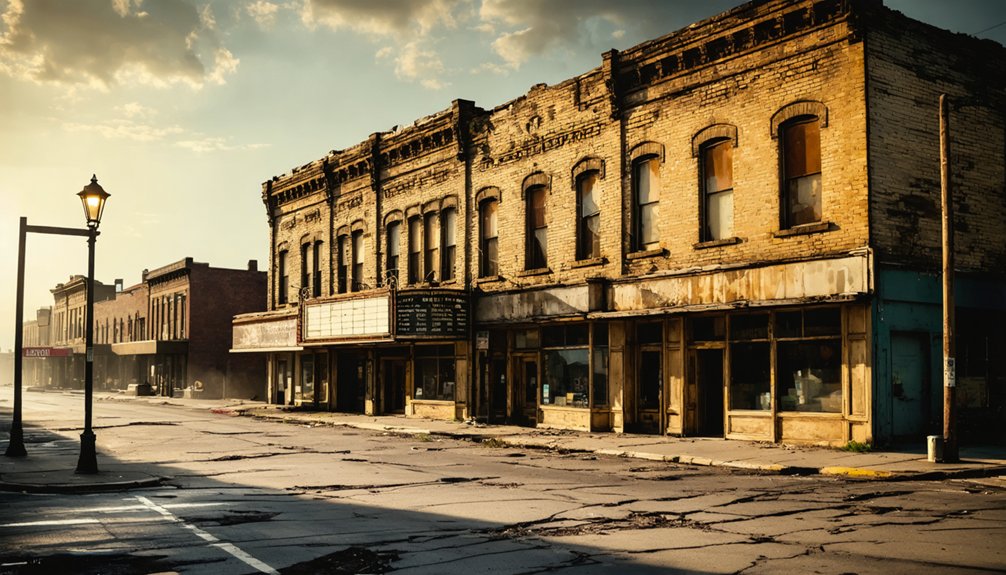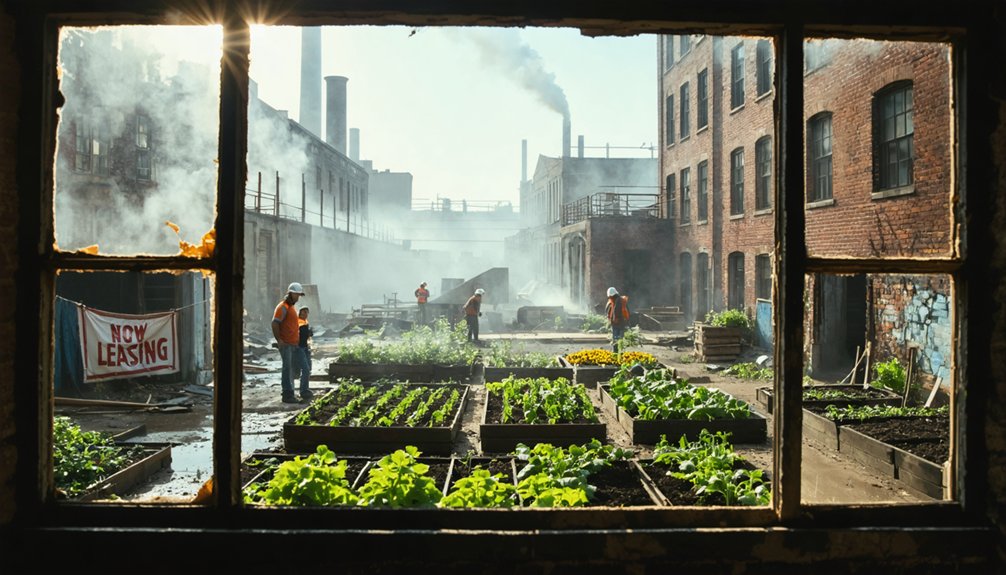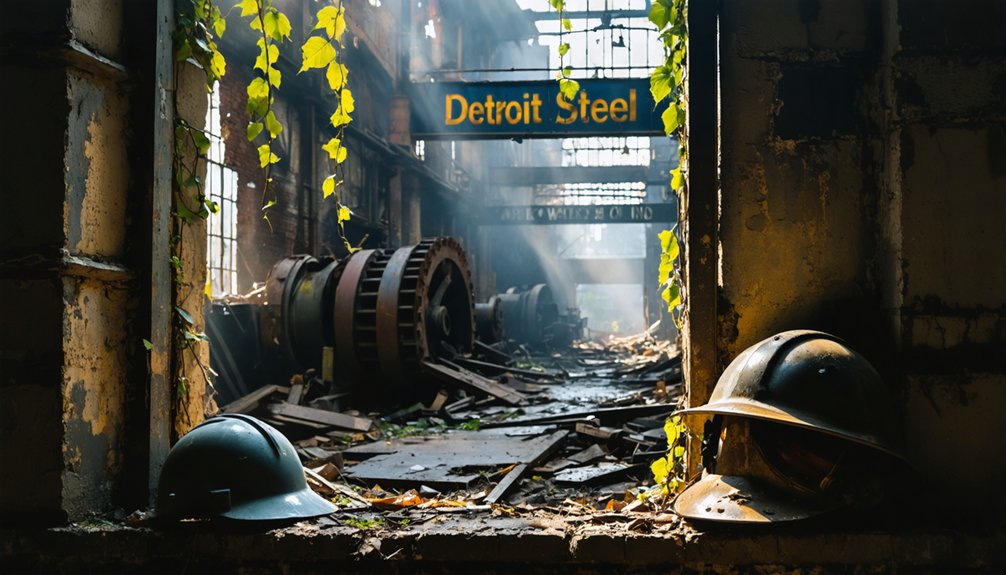
The lost villages of America’s Rust Belt represent essential lessons in industrial decline and urban resilience. You’ll find these abandoned communities showcase how economic devastation rippled through manufacturing hubs, with factory closures triggering massive job losses and population decline of up to 45%. Their empty streets and shuttered buildings tell a story of economic ecosystems that once thrived on innovation but fell to complacency and global competition. These ghost towns hold important insights for preventing similar patterns of decline in modern cities.
Key Takeaways
- Lost villages serve as powerful symbols of America’s industrial decline, illustrating the devastating economic and social impact of deindustrialization.
- These abandoned communities preserve architectural heritage and historical artifacts that document America’s once-dominant manufacturing legacy.
- Lost villages demonstrate how plant closures triggered chain reactions, causing population losses exceeding 30% and widespread community fragmentation.
- They represent cautionary tales about economic dependence on single industries and the importance of diversification for long-term sustainability.
- These sites provide valuable case studies for urban planners developing strategies to prevent similar community collapses in other regions.
The Rise and Fall of Industrial Powerhouses
While abundant natural resources initially sparked the Rust Belt‘s meteoric rise, it was the convergence of geographic advantages and technological innovation that transformed this region into America’s industrial heartland.
You can trace the region’s industrial legacy through its strategic waterways, which connected rich coal and iron ore deposits to emerging manufacturing hubs. Steam engines built at Oliver Evans’ Mars Iron Works Factory in Pittsburgh helped power this early industrial expansion.
Cities like Detroit, Pittsburgh, and Cleveland flourished as revolutionary advances – from Ford’s assembly line to the first industrial robots – reshaped American manufacturing. The region’s economic dominance lasted until the post-World War II boom led to widespread complacency and outdated machinery.
Ghost Towns in America’s Manufacturing Core
The industrial might that once defined the Rust Belt has left behind a haunting legacy of abandoned communities scattered across America’s manufacturing heartland.
You’ll find these ghost town narratives written in shuttered factories, crumbling infrastructure, and empty streets where single-industry communities once thrived on steel, textiles, and auto parts manufacturing.
What you’re witnessing isn’t just physical decay – it’s the collapse of entire economic ecosystems. When major plants closed, they triggered chain reactions: supplier businesses folded, local commerce dried up, and populations fled. Service sector jobs emerged as cities attempted to reinvent themselves, but many communities couldn’t adapt fast enough.
The industrial nostalgia runs deep in these communities, where polluted landscapes and abandoned houses tell stories of European immigrants and Great Migration workers who once built lives around now-silent factories. Cities like Detroit and Cleveland saw their populations plummet with over 30 percent losses between 2000 and 2020.
Empty storefronts and rusting mills echo the dreams of immigrant families who found both promise and hardship in America’s industrial towns.
These lost villages stand as stark reminders of how quickly prosperity can vanish when economic foundations crumble.
Economic Impact on Local Communities
You’ll find the economic devastation of Rust Belt communities began with massive manufacturing job losses that triggered a catastrophic chain reaction throughout local economies.
Only 17 percent of cities that were manufacturing hubs in the United States managed to recover their previous employment levels.
As unemployment surged, the ripple effects decimated small businesses and retail corridors, with family-owned shops and services shuttering their doors after generations of operation.
Property values plummeted as neighborhoods hollowed out, leaving homeowners underwater on mortgages and municipal tax bases severely depleted. Many companies moved production to regions with fewer labor protections, resulting in additional layoffs and economic hardship.
Job Loss Ripple Effects
Manufacturing job losses across Rust Belt communities triggered devastating economic chain reactions that extended far beyond factory closures.
When you examine the job market dynamics, you’ll find that each lost manufacturing position created a domino effect, reducing employment in supporting industries and services throughout local economies.
The workforce shifts proved especially harsh as displaced workers flooded into service sectors, driving down wages across multiple industries.
You’re seeing how these communities couldn’t simply absorb the shock – when major plants closed, local suppliers faltered, retail spending plummeted, and tax bases eroded.
Prior to these devastating losses, the region’s market share dominance had enabled stable employment and prosperity for decades.
This created a vicious cycle where reduced public services and infrastructure maintenance made areas less attractive for new businesses, further accelerating economic decline.
Six states in the region experienced 1.5 million manufacturing layoffs between 2001 and 2010 alone.
The ripple effects transformed once-thriving industrial communities into struggling zones of persistent unemployment and diminished opportunity.
Small Business Closures Impact
While large factory closures initially devastated Rust Belt communities, their aftermath released an equally destructive wave of small business failures that hollowed out local economies.
You’ll find this domino effect particularly evident in downtown districts, where shuttered storefronts tell the story of lost small business resilience. When major employers closed, thousands of workers lost their purchasing power, crushing local retailers and service providers who depended on their patronage.
The lack of economic diversification left these communities vulnerable – as banks, grocery stores, and shops closed, social gathering spaces disappeared. In places like Danville, Virginia, the food stamp recipients tripled after massive manufacturing job losses. Cities saw their tax bases shrink dramatically as businesses shuttered and residents moved away.
You’re witnessing more than just vacant buildings; you’re seeing the erosion of community fabric. These closures triggered a vicious cycle: fewer amenities led to population decline, which further weakened remaining businesses’ chances of survival.
Property Value Sharp Decline
The ripple effects of business closures released a devastating blow to property values across Rust Belt communities. You’ll find property depreciation reaching staggering levels, with cities like Flint seeing values plummet by 50% after the 2008 recession.
This free-fall hasn’t shown signs of reversing in many areas, where investment deterrence creates a vicious cycle of abandonment and decline.
What you’re witnessing isn’t just about numbers – it’s a structural transformation of urban landscapes. When property values crash, tax revenues follow, forcing cities to slash essential services.
Detroit’s ZIP codes tell this story clearly, with median home values as low as $32,300 in some areas. The exodus of residents, often exceeding 40% of the population, has left behind a patchwork of vacant lots and abandoned homes, fundamentally reshaping these once-thriving communities.
Social Fabric and Population Shifts

Since the 1970s, sweeping demographic shifts have dramatically reshaped Rust Belt cities, with major urban centers losing up to 45% of their populations through 2006.
You’ll find the social decline particularly stark in black-majority neighborhoods, where community fragmentation accelerated due to housing instability and economic isolation. The youth migration to Sunbelt states has left behind concentrated pockets of poverty, while racial disparities intensified in abandoned areas.
Educational disparities have become a defining factor in neighborhood revitalization efforts. Cities with higher education levels showed resilience against urban decay, while less-educated regions spiraled downward.
You’re seeing a transformed social landscape where income levels have plummeted by up to 30% in cities like Detroit and Cleveland, creating deeper divides between surviving neighborhoods and challenging traditional patterns of urban development.
Urban Planning Challenges and Solutions
If you’re examining the revival of Rust Belt communities, you’ll find that infrastructure renewal often starts with strategic mixed-use development in former industrial corridors.
You’ll notice how managing suburban sprawl requires careful coordination between city planners and developers to prevent further hollowing of urban cores.
Your analysis will reveal that successful solutions typically combine infrastructure updates with walkable neighborhoods, creating sustainable communities that attract both businesses and residents.
Infrastructure Renewal Strategies
Transforming decaying infrastructure in Rust Belt communities demands a multi-faceted approach that balances environmental sustainability with economic revitalization.
You’ll find that strategic infrastructure investment begins with building reuse and retrofitting, which markedly reduces carbon emissions while creating opportunities for local economic growth. By implementing deep energy upgrades and focusing on low-carbon construction methods, you’re not just preserving historical structures – you’re creating foundations for future prosperity.
Community engagement through local workforce development strengthens these renewal efforts. You can witness this transformation when community colleges partner with manufacturers to provide specialized training, while extension services help small businesses adapt and grow.
This combination of building reuse and workforce development creates a sustainable framework for infrastructure renewal that you’ll see revitalizing neighborhoods and attracting new investment opportunities.
Suburban Sprawl Management
While sprawling suburbs once symbolized progress in Rust Belt communities, today’s urban planners face mounting challenges in managing unsustainable expansion patterns.
As communities grapple with urban decay in southern suburbs, issues such as increased crime rates and declining property values become evident. These challenges often prompt municipalities to explore revitalization strategies to breathe new life into neglected areas. Without proactive measures, the disconnect between urban growth and suburban decline could widen, further complicating the planning landscape.
You’ll find that regional cooperation has become essential, as fragmented local governments shift from competition to collaboration in controlling peripheral growth.
Smart shrinkage strategies now guide your city’s transformation through strategic demolition and infrastructure consolidation, while flexible zoning enables quick adaptive reuse of vacant properties.
You’re seeing growth boundaries emerge as powerful tools for sprawl containment, preserving crucial farmland and green spaces while directing development inward to boost urban density.
Through meaningful community engagement, planners are fostering infrastructure sustainability by balancing neighborhood identity with land preservation needs.
This extensive approach helps create more resilient, compact communities that honor both heritage and future needs.
Mixed-Use Development Solutions
As Rust Belt cities pivot toward sustainable regeneration, mixed-use developments have emerged as powerful catalysts for urban revival. Through adaptive reuse of industrial buildings, you’ll find former factories transformed into vibrant spaces that combine offices, housing, and retail – creating dynamic environments that attract both businesses and residents.
These developments enhance urban livability by integrating green spaces, walkable streets, and public gathering areas. You’ll see how historic masonry walls now house tech incubators and cultural venues, while original architectural features blend with modern sustainability solutions.
The approach creates 18-hour neighborhoods where you can live, work, and play without lengthy commutes. By emphasizing flexible zoning and community engagement, these mixed-use projects don’t just preserve industrial heritage – they’re building resilient communities that support diverse economic activities and lifestyles.
Cultural Heritage and Historical Preservation
Despite decades of industrial decline, the Rust Belt’s architectural heritage remains a powerful monument to America’s manufacturing legacy, offering unique opportunities for urban renewal through preservation.
You’ll find these places tell profound historical narratives through their Victorian architecture, market squares, and repurposed industrial sites. Their cultural significance extends beyond mere buildings – they’re living symbols of community identity and resilience.
When you explore these heritage areas, you’ll discover how adaptive reuse breathes new life into abandoned factories while preserving their authentic character.
The transformation of old rail lines into trails and industrial waterfronts into public spaces creates vibrant connections to the past.
These preservation efforts don’t just protect history – they’re catalyzing economic revival through arts initiatives, cultural festivals, and heritage tourism, proving that embracing the past can forge a path to the future.
Political Implications of Industrial Decline
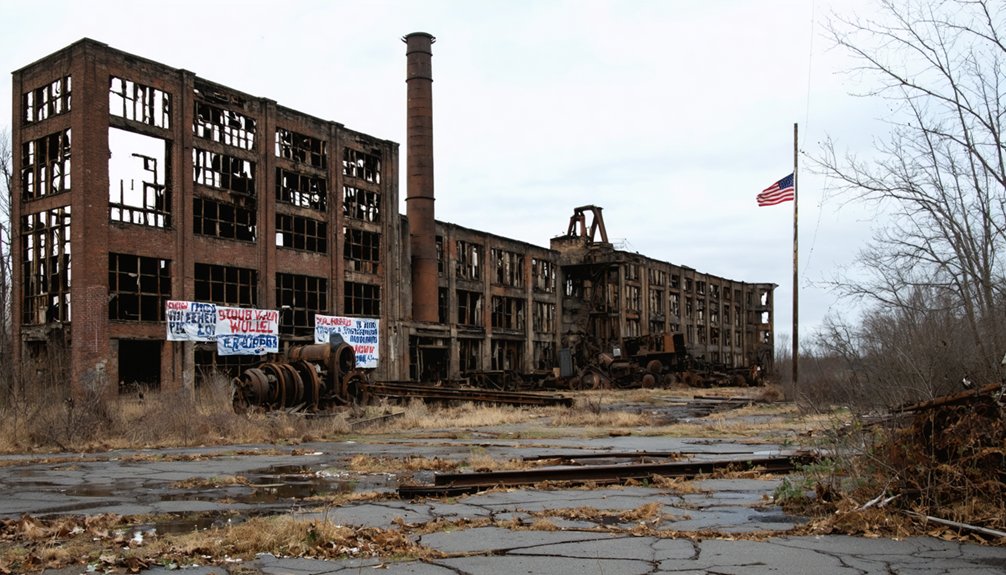
The political transformation of America’s industrial heartland reveals a complex interplay of strategic manipulation and social engineering.
You’ll find that conservative political discourse deliberately crafted narratives of urban dysfunction, particularly targeting majority-Black cities to justify disinvestment and limited autonomy. This manufactured decline wasn’t merely economic – it served as a calculated program to reshape voter behavior and consolidate political power.
Labor conflicts intensified these dynamics, as union-management strife accelerated industrial exodus and worker displacement.
The resulting voter disenfranchisement created a self-perpetuating cycle where reduced state support deepened economic crisis, driving traditionally Democratic voters toward conservative populism.
You’re witnessing the consequences today, as Rust Belt communities remain pivotal electoral battlegrounds, their industrial heritage weaponized in campaigns promising revival while structural inequities persist.
Economic Recovery and Revitalization Strategies
When examining successful economic recovery strategies in former industrial strongholds, multiple interconnected approaches emerge as essential components of revitalization.
You’ll find that strategic investments in targeted tax incentives and special economic zones can attract new businesses while addressing environmental and pension challenges that often plague former industrial sites.
Worker cooperatives offer a particularly promising path forward, keeping wealth circulating within your community while creating sustainable employment opportunities.
Worker-owned enterprises empower communities by anchoring jobs locally and ensuring economic benefits flow directly to resident employees.
By combining these initiatives with university partnerships and innovation hubs, you’re able to retain local talent and foster entrepreneurship.
To make these strategies work, you’ll need sound fiscal management and governance reforms as your foundation.
The key is diversifying beyond traditional manufacturing while building on existing community assets and ensuring local residents directly benefit from new economic opportunities.
Lessons for Modern Urban Development

Learning from Rust Belt cities’ struggles offers critical insights for contemporary urban development, particularly regarding governance structures and community resilience.
You’ll find that successful urban revitalization depends on breaking down political fragmentation and fostering regional cooperation across municipal boundaries.
The most valuable lesson lies in understanding how community engagement shapes a city’s future.
Cities that invest in civic leadership and authentic placemaking have shown greater resilience against economic downturns.
You’ll need to recognize that sustainable urban development requires coordinated action on transportation, zoning, and economic planning across jurisdictions.
The experiences of smaller legacy cities demonstrate that rebuilding civic capacity, alongside state support for technical assistance and economic incentives, creates the foundation for lasting recovery and growth.
Frequently Asked Questions
How Did Organized Crime Influence the Decline of Rust Belt Communities?
Mob influence corroded your industrial cities through labor racketeering and union control, creating systemic corruption that accelerated economic decline while destroying community trust and deterring vital business investment in your neighborhoods.
What Role Did Racial Segregation Play in Shaping Lost Village Demographics?
You’ll find that segregation policies systematically divided communities, forcing demographic shifts that isolated minorities in declining areas while directing resources and opportunities to white-dominated neighborhoods, permanently shaping lost village populations.
How Did Weather Patterns Affect Industrial Development in the Rust Belt?
Like a double-edged sword, weather shaped your Rust Belt’s destiny. You’ll find climate impact was modest – seasonal fluctuations didn’t deter development, as Great Lakes transport advantages outweighed winter’s challenges.
What Environmental Health Issues Persist in Abandoned Rust Belt Neighborhoods?
You’ll find persistent lead contamination in soil from old industrial sites and housing, while abandoned factories continue releasing air pollution. These toxins create ongoing health risks in your deteriorating neighborhoods.
How Did Railroad Companies Influence the Location of Lost Villages?
You’ll find that railroad expansion dictated village locations by establishing key transport hubs and maintenance stops, while companies strategically placed settlements near raw materials, ensuring village accessibility for maximum economic benefit.
References
- https://www.britannica.com/place/Rust-Belt
- https://www.youtube.com/watch?v=orM7mOwy11k
- https://fiveable.me/key-terms/apush/rust-belt
- https://archive.strongtowns.org/journal/2020/11/30/you-cant-understand-the-rust-belt-without-understanding-its-suburbanization
- https://www.clevelandfed.org/publications/economic-commentary/2013/ec-201306-urban-decline-in-rust-belt-cities
- https://smart.dhgate.com/why-is-it-called-the-rust-belt-origins-meaning-explained/
- https://study.com/academy/lesson/rust-belt-history-cities-decline.html
- https://rustbeltrecruiting.com/a-timeline-of-significant-moments-in-american-manufacturing/
- https://www.youtube.com/watch?v=_Cvw5gENzQ8
- https://rustbeltrecruiting.com/a-history-of-the-rust-belt-and-why-its-important/