You’ll find La Grange—not “Louisiana Grange”—along California’s Tuolumne River, a gold rush settlement that served as Stanislaus County seat from 1856-1862. Eli Dye arrived in 1852 after catastrophic floods forced relocation, and the town thrived with 215 merchants, miners, and professionals by 1856. Hydraulic mining operations extracted $3.5 million in gold before ending in 1951. Today, this California Historical Landmark #414 preserves pre-1850 adobe structures, a rustic jail, and trading posts—remnants of frontier ambition now inhabited by just 166 residents who guard stories of devastating floods and boom-era prosperity.
Key Takeaways
- La Grange, established in 1852, served as Stanislaus County seat from 1856-1862 before declining after losing political status.
- Historic structures remain including the Adobe Barn, Rustic Jail, St. Louis Roman Catholic Church, and Inman Trading Post museum.
- The catastrophic 1861-62 flood lasting 43 days transformed California’s Central Valley and devastated the region’s infrastructure.
- Mining evolved from placer operations to hydraulic mining and dredging, extracting approximately $3.5 million in gold before ending in 1951.
- Visitors today can explore remnants of frontier life including abandoned mining equipment, historic cemetery, and preserved 1850s buildings.
From French Bar to Permanent Settlement
The devastating floods of 1851-1852 forced relocation one mile upstream to higher ground.
Eli Dye became the first settler at this new site in 1852, where citizens rebuilt their community.
By December 1854, the settlement gained permanence with its rechristened name—La Grange—and official post office establishment. The name followed a French naming tradition common in California settlements of that era.
Dr. Louis M. Booth served as first postmaster in the Trading Post building, featuring early architecture from winter 1850-1851 that functioned as store, stage stop, and Wells Fargo office.
When the Waters Rose: Devastating Floods of the 1850s and 1860s
While La Grange’s founders had already endured relocation from catastrophic flooding in 1851-1852, the worst devastation still lay ahead. You’ll find water signatures from the Great Flood of 1861-62 forever marked California’s landscape.
The Great Flood of 1861-62 left permanent water signatures across California’s landscape that remain visible today.
For 43 days, rain pounded the Sierra foothills relentlessly. Mining districts received up to 72 inches—three times normal rainfall. The flood damage was catastrophic: one-fourth of California’s taxable property destroyed.
Central Valley transformed into an inland sea 250-300 miles long. Sacramento’s legislature fled the submerged capital.
Throughout Kern County, rivers obliterated bridges and mills. Thousands of cattle drowned while orchards swept to the ocean. Nearly every house across the immense region succumbed to cold, muddy floodwaters. Dead animals mingled with floating debris and wreckage in streets transformed into muddy ponds.
The devastation extended far beyond California’s borders, with the deluge inundating Oregon, Utah, Nevada, Arizona, and Idaho.
America had never witnessed such desolation.
Political Power: The County Seat Years
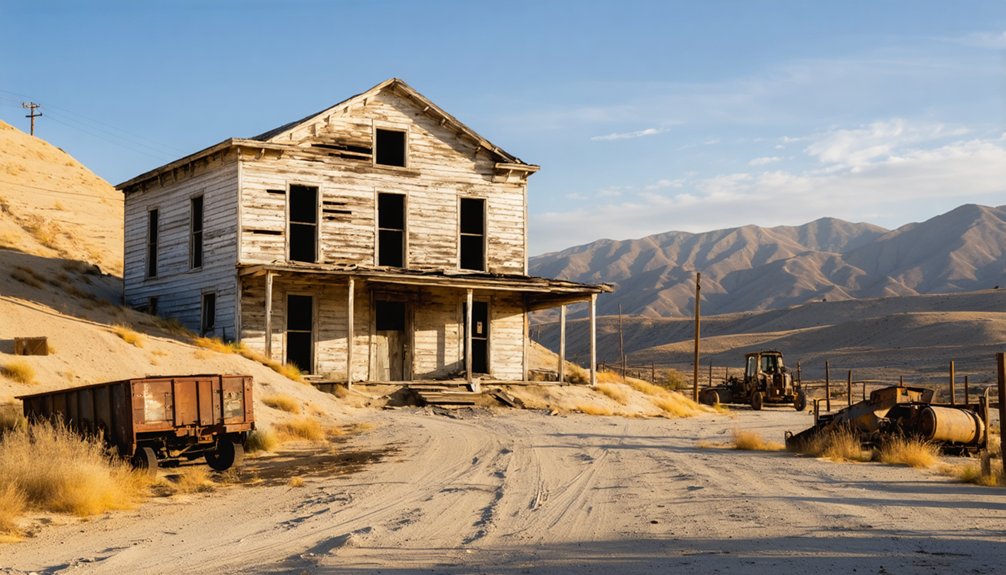
By December 20, 1855, La Grange’s political ambitions crystallized when county officials called an election to determine Stanislaus County’s permanent seat of government. The town’s substantial population—nearly 5,000 residents—provided decisive political influence in the narrow victory over Empire City that January.
As county seat from 1856 to 1862, La Grange’s local government controlled:
- County courthouse operations administering justice and land records
- Rustic jail constructed in 1856, site of William Gregory’s hanging in July 1855
- Post office established December 2, 1854, connecting citizens to broader networks
- Masonic Lodge and Lafayette Lodge No. 65, county’s first Odd Fellows chapter
- Principal administrative functions attracting lawyers, merchants, and businessmen
The designation as county seat transformed La Grange into the largest town in the county, cementing its regional importance during the late 1850s. Multiple stage lines connected the seat of government to nearby towns and cities, facilitating the movement of officials, documents, and citizens conducting county business. This political power ended in November 1860 when Knights Ferry captured 422 votes against La Grange’s 383, transferring the seat in 1862.
Gold Fever: Mining Operations Through the Decades
When you examine La Grange’s mining evolution from 1862 to 1918, you’ll trace California’s technological shift from individual prospectors panning river bars to industrial-scale hydraulic operations processing 100 million cubic yards of earth.
The site began as the Oregon Mountain Group of Claims, where miners worked placer deposits with basic sluice boxes and long toms along Trinity River’s sandy flats.
The operation drew water from Stuarts Fork through 29 miles of ditches, tunnels, and flumes to power the hydraulic monitors that would blast away entire hillsides.
In 1892, the La Grange Hydraulic Gold Mining Company purchased the claims and transformed the operation into one of Trinity County’s most productive gold mines, ultimately extracting approximately $3.5 million in gold.
Early Placer Mining Success
The early operations revealed impressive yields:
- Camp bar consistently delivered the highest returns among competing sites.
- Gold deposits extended beneath the town itself, creating tunnel networks.
- French Bar’s August 1854 discovery sparked explosive population growth.
- Oregon Gulch and tributary streams provided exceptionally rich diggings.
- Hydraulic techniques emerged as surface deposits declined, using pressurized water through sluice boxes.
This independent extraction built fortunes before corporate consolidation transformed the landscape.
Industrial Dredging Operations
Around 1862, pressurized water streams first carved into Oregon Mountain’s gold-bearing gravels, marking the shift from individual miners wielding pans and rockers to industrial-scale extraction. You’ll find this transformation exemplified by the 1893 expansion under Baron Ernest de La Grange, who built California’s largest hydraulic operation after acquiring the property for $250,000.
The water infrastructure spanned 29 miles of ditches, tunnels, and flumes from Stuart’s Fork, delivering pressurized streams under 650-foot head pressure.
Industrial equipment including specialized nozzles directed these powerful flows through open wooden sluice boxes, processing over 100 million cubic yards of gravel. By 1915, this mechanized approach had extracted $3,500,000 in gold from deposits too deep for early placer methods, proving that capital investment could free resources beyond individual prospectors’ reach.
The 12 Gold Dredging Company introduced massive dredge bucket operations starting in June 1938, using 12 cubic foot capacity buckets that operated until around 1949 before abandonment three miles south of town.
Commerce and Daily Life in a Boom Town
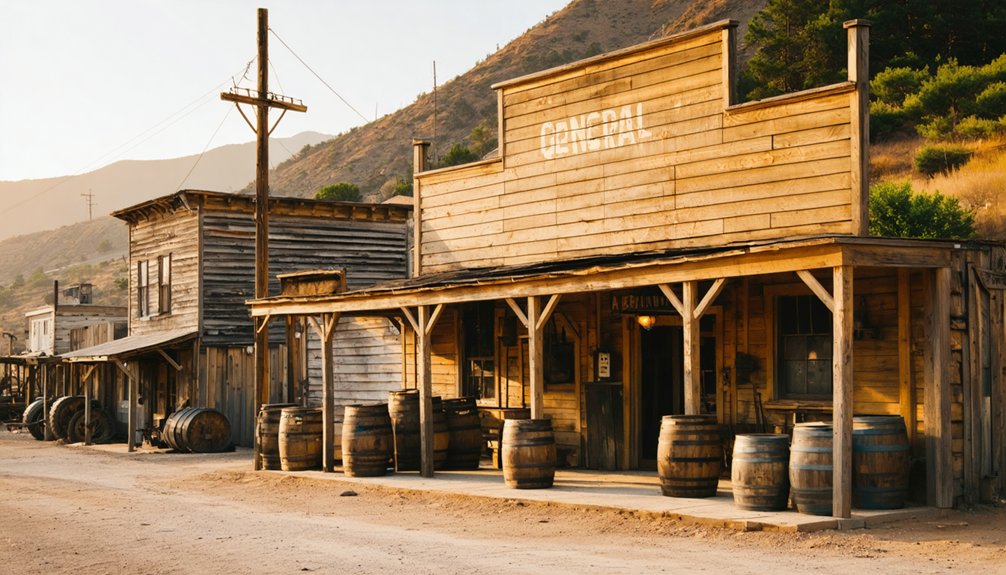
By 1856, La Grange had transformed into a thriving commercial center that served a wide area of Stanislaus County, boasting 215 merchants, miners, artisans, hotel keepers, attorneys, and physicians listed in the Miners and Business Men’s Directory.
By 1856, La Grange boasted 215 merchants, miners, artisans, attorneys, and physicians serving Stanislaus County’s thriving commercial center.
You’d find local markets supporting a diverse population of French, Mexican, and American settlers who built community traditions beyond simple gold extraction.
Daily life centered around:
- Trading posts and saloons where miners conducted business alongside ranchers and farmers
- The substantial Chinatown featuring gambling halls, fan tan games, and frequent feuds
- Professional services including legal and medical practitioners serving thousands of residents
- Hotels and merchant shops operating around the clock during peak mining seasons
- The county seat administration from January 1856 to 1862, handling regional governance
This combination sustained prosperity when other gold-only camps collapsed. Residents could share their experiences and observations through community interaction features that allowed visitors to write comments and provide feedback about local businesses and mining operations.
What Remains: Historic Landmarks and Structures
Though most Gold Rush towns vanished without trace, La Grange’s physical legacy endures through five remarkable structures that span its evolution from mining camp to agricultural community.
You’ll find the Adobe Barn, built before 1850, serving initially as the town’s post office before becoming a stable.
The Inmon Trading Post (1850) now houses ancient artifacts documenting local history.
The 1856 Rustic Jail reveals frontier law enforcement realities.
St. Louis Roman Catholic Church, Stanislaus County’s oldest, maintains its cemetery with tombstones dating to the mid-1800s.
Near the Tuolumne River, abandoned dredge machinery marks 1951’s end of gold operations.
While rumors persist about underground tunnels connecting mining sites, visible tailing piles along riverbanks provide tangible evidence of hydraulic mining’s environmental impact post-1880.
Visiting the Ghost Town Today
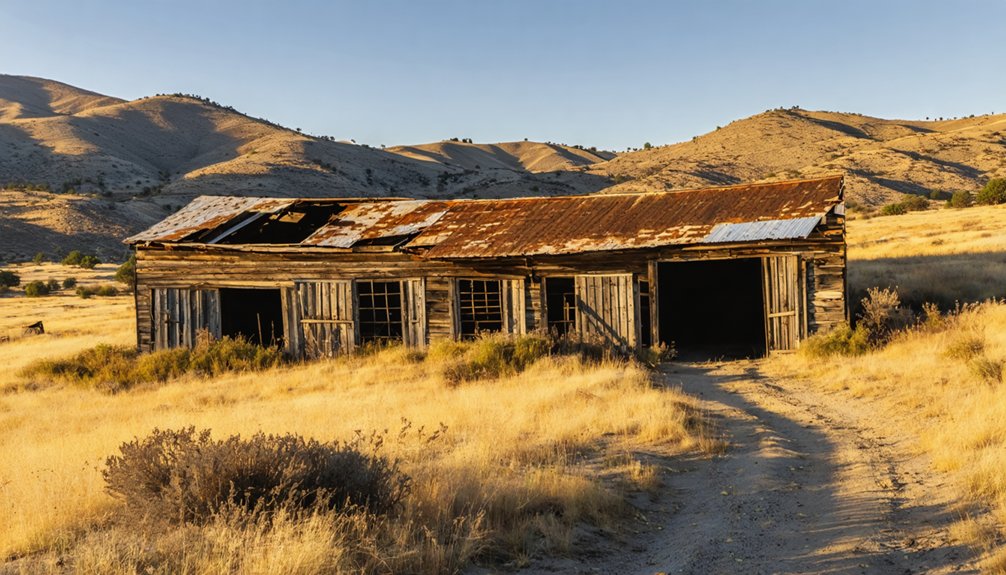
When you visit La Grange today, you’ll find California Historical Landmark #414 at the intersection of La Grange Road and Yosemite Boulevard.
It marks this former Stanislaus County seat established by French settlers after 1852. The site preserves an 1867 historic building and an old bridge from Oakdale that appeared in Highway to Heaven, offering tangible connections to the Gold Rush era.
You can explore the cemetery, examine remaining structures, and access information through the nearby Northern Mariposa County History Center to understand this near-ghost town‘s transformation from a thriving mining community of French Bar to its current population of 166 residents.
You may also want to consider other ghost towns for filming in California, as each offers a unique glimpse into California’s fascinating history. Many of these locations provide stunning backdrops that add authenticity to productions while showcasing the state’s rich cultural heritage. Whether you’re a filmmaker searching for the perfect setting or a history enthusiast, these ghost towns are worth exploring.
Historical Landmarks Still Standing
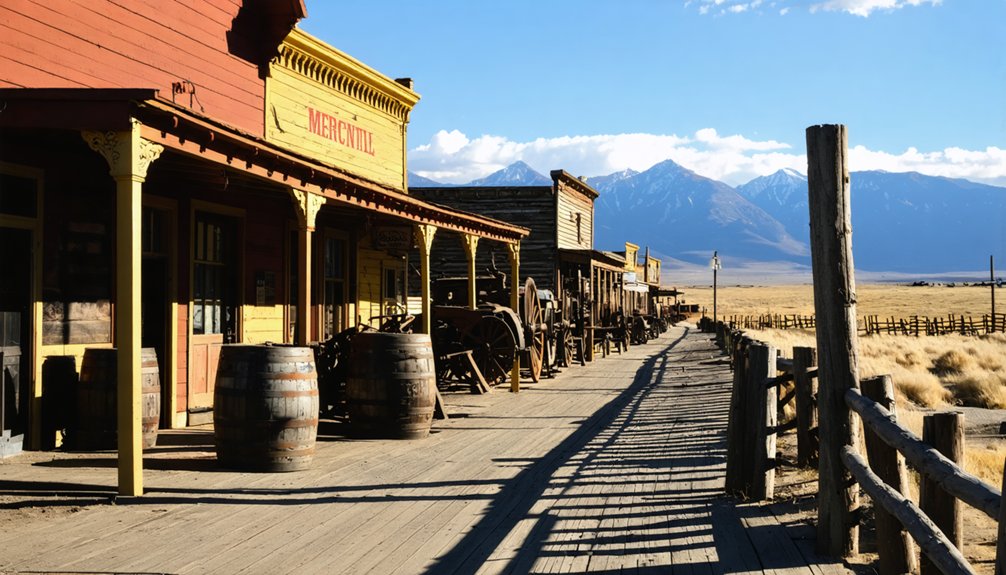
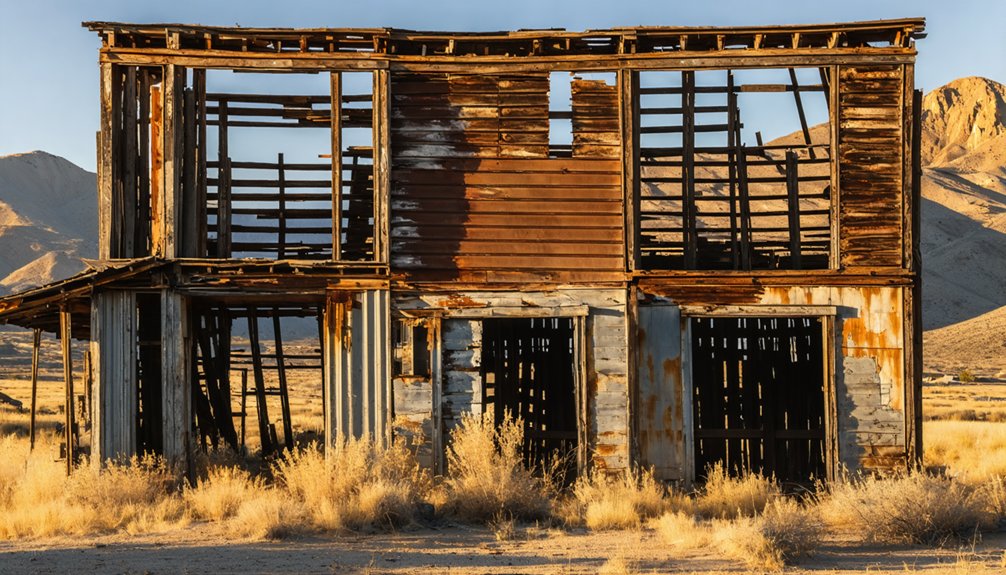
Despite extensive vandalism and natural decay over the decades, La Grange preserves remarkable remnants of its Gold Rush origins that you can still explore today. You’ll discover authentic structures that witnessed the town’s transformation from bustling mining center to quiet settlement.
Key landmarks include:
- Old Adobe Building – Pre-1850 construction featuring massive iron doors that protected the town’s first post office
- St. Louis Catholic Church – Standing monument to frontier faith with striking architectural details
- LaFayette Historical Lodge #65 – Community gathering space showcasing bold period design
- The Old Jail – Sierra Foothills gem where lawbreakers spent uncomfortable nights
- Inman Trading Post – 1850 establishment now functioning as museum with Gold Rush artifacts
Cultural festivals celebrate this heritage alongside local cuisine.
Historic tailing piles along the Tuolumne River reveal extensive mining operations.
Museum and Contact Information
The La Grange Museum, housed within the historic Inman Trading Post established in 1850, offers visitors tangible connections to California’s Gold Rush heritage through carefully preserved artifacts and photographic exhibits.
You’ll find displays documenting the 1948 annual rodeo alongside local art celebrating the town’s frontier past, including Grant Hogan’s cowboy hat from his tenure as Stanislaus County Sheriff.
The museum anchors community events that honor French miners who arrived in 1852 and the trading center that thrived by 1855.
Plan your visit carefully—the museum closes Sundays.
No official hours or direct contact information appears in public records, so you’ll need to check with Stanislaus County historical societies beforehand.
MapQuest provides location mapping, though accessing current details requires local inquiry for this independently-operated historical site.
Cemetery and Bridge Access
Beyond the museum walls, La Grange’s haunting remnants stretch across Highway 49, where you’ll encounter both the town’s earliest burial ground and its modern-day access points.
The French Bar Cemetery, established by miners before 1852’s devastating flood, sits on the town’s outskirts. This first burial ground tells stories that transcend farming traditions—it’s where local legends like Hazard Randall, murdered by his father Rose in 1896, rest eternally.
Today’s cemetery reveals tragic vandalism from the hippie era:
- Cracked sarcophagus exposing disturbed remains
- Decimated grounds with scattered markers
- JB Breca’s headstone marking the roadside entrance
- Early French miners’ graves from 1850s Gold Rush
- Evidence of the original riverside settlement’s relocation
You’ll find unrestricted highway access past dredge sites, connecting you to this unvarnished frontier history.
Frequently Asked Questions
Why Was the Town Called La Grange Instead of French Bar?
The town’s name changed from French Bar to La Grange when you’d see French influence shape town naming customs after 1852 floods forced relocation. Officials established the post office in 1854, honoring France’s General La Grange while reflecting settlers’ heritage.
How Many People Lived in La Grange During Its Peak Prosperity Years?
During peak gold rush prosperity from 1854-1858, you’d find between 4,000 to 5,000 residents in this historic site. The town’s boom years attracted thousands of miners, merchants, and entrepreneurs seeking fortune before becoming one of California’s ghost towns.
What Caused the Decline in Gold Prices That Ended Dredging Operations?
Gold prices didn’t decline—they remained fixed at $35 per ounce while inflation increased operating costs dramatically. You’ll find gold market fluctuations weren’t the issue; dredging technology advancements couldn’t offset rising expenses against government-mandated pricing.
Are There Any Original Buildings From the 1850S Still Standing Today?
Time’s fingerprints remain visible through La Grange’s historic architecture—you’ll find original 1850s stone trading post buildings and adobe structures still standing, their survival affirmation to preservation efforts honoring this gold rush settlement’s independent spirit and commercial heritage.
Can Visitors Access the Abandoned Tuolumne Gold Dredge Site?
You can view the abandoned Tuolumne Gold Dredge from the highway without restrictions. Local historians offer historic tours to explore the massive dredge machinery up close, letting you experience this remarkable piece of California’s gold mining heritage firsthand.
References
- https://westernmininghistory.com/towns/california/la-grange/
- https://www.youtube.com/watch?v=pcbOqYUg_9A
- http://cali49.com/hwy49/2013/10/1/la-grange
- https://blogs.chapman.edu/huell-howser-archives/2010/01/14/la-grange-californias-gold-12010/
- https://goldexplorers.com/la-grange/
- https://www.youtube.com/watch?v=Q2pyiD8SILQ
- https://mercedcountytimes.com/a-history-of-historic-la-grange-1850-2023/
- https://www.ghosttowns.com/states/ca/lagrange.html
- https://www.bbbunny.com/la_grange.html
- https://en.wikipedia.org/wiki/La_Grange