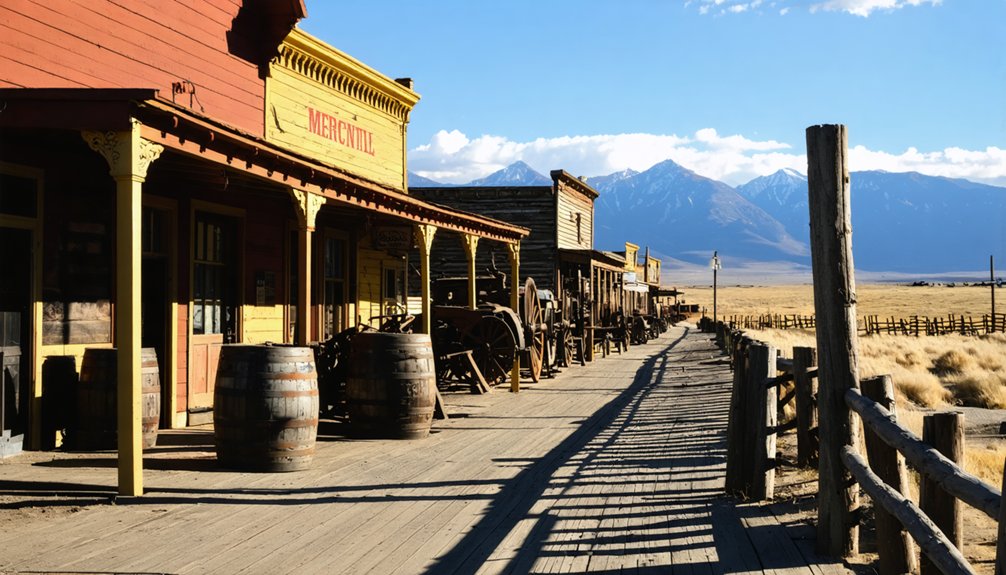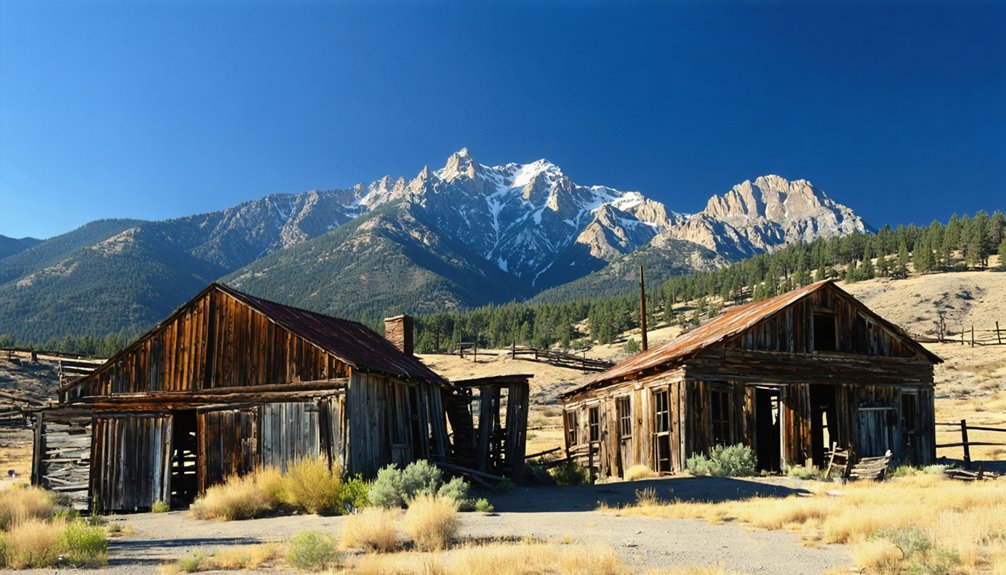
You’ll find Lundy nestled at 7,858 feet in California’s Eastern Sierra, six miles west of Highway 395, where William D. Wasson’s 1879 gold strike sparked a rush that built a town of hundreds virtually overnight. The May Lundy Mine produced over $3 million in gold, supporting a vibrant community with hotels, saloons, and newspapers until twin avalanches in 1911 and economic collapse sealed its fate. Today, scattered mining debris, a pioneer cemetery, and accessible trails through alpine scenery reveal the dramatic story of this high-altitude boomtown’s rise and fall.
Key Takeaways
- Lundy originated from William D. Wasson’s 1879 gold discovery, rapidly developing into a mining district with the productive May Lundy Mine.
- The May Lundy Mine produced over $3 million in gold but faced financial struggles, fires, and ultimately closed in 1941.
- The town featured vibrant infrastructure including hotels, saloons, stores, and a newspaper serving a diverse population during its boom years.
- Devastating avalanches in 1911 and repeated fires throughout the 1880s destroyed infrastructure, accelerating the town’s decline and eventual abandonment.
- Today Lundy remains a ghost town with visible mining debris, foundations, rail tracks, and a pioneer cemetery marking its historical significance.
The Discovery and Birth of a Mining Boomtown
In the spring of 1879, prospector William D. Wasson ventured into Mill Canyon near Lundy Lake, sparking one of Mono County’s notable gold rushes.
C. H. Nye and L. L. Homer soon followed, locating rich ore veins that attracted J. G. McClinton from Bodie with immediate capital.
By October 1879, the Homer Mining District formed with William O. Lundy as its first recorder, establishing mining regulations for the expanding claims.
The district encompassed the May Lundy Mine and surrounding properties on Mt. Scowden’s eastern wall.
While O. J. Lundy’s sawmill had operated since 1878 supplying Bodie, the gold discoveries transformed the canyon.
The first gold strike was made on the south wall of Mill Creek Canyon by C.H. Nye and L.L. Homer in 1879.
The May Lundy Mine, discovered in late summer 1879, was named after William O. Lundy’s sister-in-law rather than his daughter as popular accounts suggest.
The May Lundy Mine: A $3 Million Legacy
The May Lundy Mine, named after sawmill operator W. J. Lundy’s daughter, stands as Lundy’s most profitable venture, producing over $3 million in gold from its discovery on Mt. Scowden’s eastern wall in 1880.
You’ll find its story defined by three distinct phases: a spectacular boom period when weekly bullion shipments reached $5,000, a turbulent ownership handover marked by the devastating 1884 closure, and decades of intermittent operations that finally ended in 1941.
The mine’s infrastructure included three main tunnels developing the ore body along the lode, with the Lake View Tunnel extending approximately 4,000 feet into the mountain.
Ore was transported to processing facilities using tram systems, along with mules and horses, where it underwent crushing, classification, and flotation processing.
This mine’s legacy extends beyond its impressive production figures to reveal the precarious financial reality of even the most promising gold operations in California’s remote eastern Sierra.
Discovery and Early Production
When prospectors stumbled upon gold near the west end of Lundy Lake in 1879, they couldn’t have anticipated the $3 million legacy that would unfold high on Mt. Scowden’s eastern wall. The discovery in Mill Canyon—soon renamed Lundy Canyon—sparked claims throughout the Homer Mining District.
By summer 1880, you’d find tunnels being driven into mineral deposits at 11,000 feet elevation, where the May Lundy Mine extracted ore from Lake Canyon’s spectacular hanging valley.
William O. Lundy’s 1878 sawmill supplied lumber for expanding town infrastructure, including boarding houses feeding 60 miners and essential facilities. The mine operated until 1914, cementing its place as the principal producer in the district.
On October 1, 1880, the mill began weekly bullion shipments worth $5,000. San Francisco investors purchased founders’ interests, injecting capital that transformed this remote alpine location into one of the Eastern Sierra’s most significant mining enterprises. The settlement faced constant challenges from snow slides that threatened both mining operations and the town below.
Mining Operations and Ownership
Among the Eastern Sierra’s most productive mines, the May Lundy operation earned its name from William O. Lundy’s daughter, positioned at 11,000 feet on Mt. Scowden’s eastern wall.
You’ll find its mining geology rooted in Upper Cretaceous host rock, with hornblende dating back 85 million years.
The Homer Mining District founders—Wasson, Nye, and Homer—sold their interests to San Francisco investors who formed the May Lundy Gold Mine company in 1879.
Subsequent owners expanded mineral processing capabilities dramatically.
Jackson and Lakeview Mining Company installed a 10-stamp mill in 1891, while Crystal Lake Gold Mining Company doubled capacity to 20 stamps by 1900.
Despite extracting $3 million in gold and silver, financial troubles plagued operations.
The mine faced $45,000 in attachments by 1884, ultimately closing after Thomas Hanna’s 1942 equipment liquidation.
Decline and Final Years
Financial troubles overwhelmed the May Lundy Mine on August 21, 1884, when creditors attached and closed both the mine and mill to satisfy claims exceeding $12,000 from Rosenwald, Coblentz and Company. Workers hadn’t received wages since early July, while total debts reached $45,000.
Brief revivals followed—lessees operated from 1887-1888, though an avalanche destroyed the tram. The Jackson and Lakeview Mining Company modernized operations in 1891 with rebuilt mining technology and a 10-stamp mill.
Crystal Lake Gold Mining Company expanded capacity to 20 stamps in 1900, but rising production costs prevented profitability. Despite a $48,000 federal loan in 1935, government orders halted gold mining in 1941 as non-essential wartime activity.
The mine ultimately yielded $3 million in precious metals before equipment liquidation in 1942.
Life in the Homer Mining District
On September 15, 1879, prospectors gathered at William D. Wasson’s residence on Emigrant Flat to establish the Homer Mining District. You’ll find this mining legislation emerged from practical necessity—Tioga District’s recorder was simply too far away.
The district honored L.L. Homer, who’d struck a significant vein with C.H. Nye on Mill Creek Canyon’s south wall that year. Tragically, financial troubles drove Homer to suicide in San Francisco just months after this achievement.
Town planning began swiftly in 1880 with two east-west streets paralleling Mill Creek. Main Street formed the settlement’s backbone, with Bonanza Street nearby and another crossing the creek.
About twenty log houses and tents sprouted on subdivided lots, clinging to steep talus slopes near Lundy Lake‘s western end—a precarious location that would prove deadly. The settlement sat approximately six miles west of Mono Lake on the east slope of the Sierra Nevada. The town included hotels, saloons, a stage office, and various accommodations to support the growing mining population.
Saloons, Newspapers, and Daily Commerce
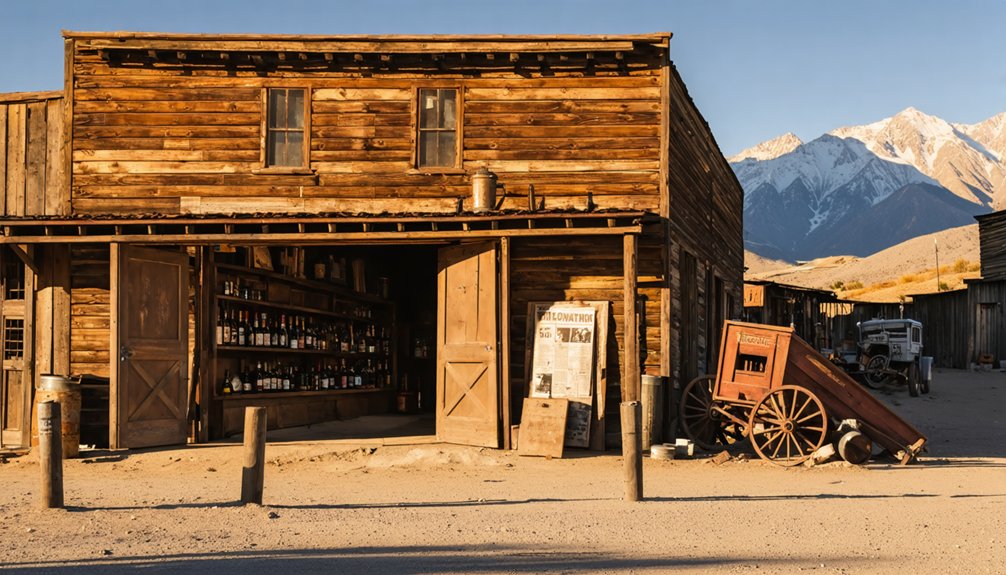
During Lundy’s peak years from 1879 to 1884, you’d find a thriving business district where seven saloons operated as central social hubs for the mining community.
The town’s daily commerce extended beyond drinking establishments to include boarding houses, general stores, and various mercantile operations that supplied miners working the steep talus slopes near Lundy Lake.
The Homer Mining Index, published weekly, documented camp life and mining operations, providing essential communication in this remote alpine settlement at 7,858 feet elevation.
The community even supported its own Chinatown, reflecting the diverse population drawn to work the gold deposits discovered at the May Lundy mine. Unlike many remote mining camps, evidence of long-term human presence from Mesolithic to medieval times has been documented at various historical sites.
Boom Town Business District
As miners poured into Lundy’s canyon during the 1880-1881 boom, a thriving business district emerged to serve the population that swelled by fifteen to twenty newcomers daily between April and June 1880. You’d find two general merchandise stores operating from the start—one beginning in a tent before permanent structures rose.
These establishments supplied daily necessities with minimal business regulation, allowing entrepreneurs to establish services quickly. Two lodging houses and several boarding houses accommodated the influx, including the prominent May Lundy Hotel (also called Lundy Hall) and the Lakeview Hotel, which burned in 1880 but was rebuilt.
Two bakeries, a butcher shop sourcing meat from Bodie and Bridgeport, an assay office, and a blacksmith shop rounded out essential services.
Community events centered around these establishments until the devastating 1887 fire destroyed twenty-five structures.
Seven Saloons Serve Miners
Seven saloons operated in Lundy’s business district by 1880, outnumbering bakeries, hotels, and general stores combined—a ratio that reflected the hard-drinking culture of California’s mining camps. These establishments formed the social heart of Homer Mining District, where you’d find miners spending their wages after grueling shifts underground.
Saloon architecture featured simple wood-frame construction, erected rapidly alongside the sawmill that enabled town development. Miner social customs centered around these drinking houses, where workers exchanged information about ore strikes, job opportunities, and mining conditions.
The seven saloons thrived during peak population growth when 15-20 people arrived daily between April and June 1880. This concentration of drinking establishments sustained commerce until the May Lundy Mine’s 1884 shutdown scattered the workforce.
Homer Mining Index Weekly
Every Saturday from 1880 to 1884, the Homer Mining Index rolled off its press in Lundy, documenting the Homer Mining District’s boom years with reportage that extended across the Tioga Mining District to neighboring camps like Bodie.
You’ll find this well-conducted weekly served as the primary chronicle of mining legislation, ore extraction updates, and cultural influences shaping the camp’s character. Its publishers predicted 100 stamp mills and 5,000 residents within a year—ambitions reflecting the frontier optimism that drew you here.
The paper tracked everything from the May Lundy Company’s $3 million sale to London investors on November 3, 1883, to Chinese immigrant contributions and winter machinery transport. Only 85 issues survived before operations ceased in November 1884, making them invaluable records of this ephemeral mountain community.
Nature’s Wrath: Avalanches That Shaped Lundy’s Fate
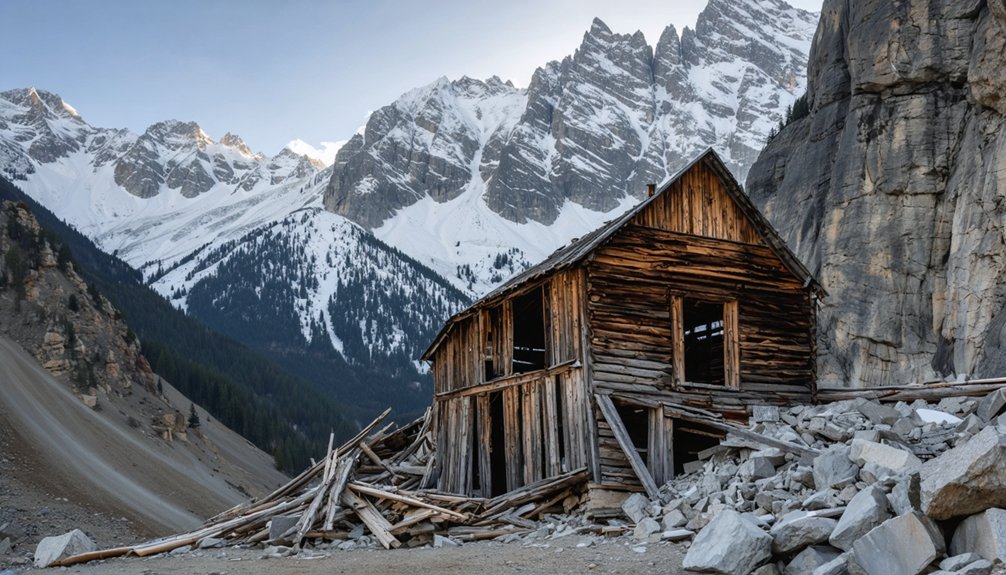
The twin avalanches that devastated Lundy on March 7, 1911, weren’t isolated tragedies but rather the culmination of decades of mounting snow slides that repeatedly claimed lives in this high Sierra mining camp. You’ll find evidence of earlier catastrophes dating to 1881, when slides buried the Mockingbird Mine cabin in Homer District.
Snow accumulation during the harsh winter of 1910-11 created perfect conditions for disaster. The first avalanche struck at 10 pm, slicing through upper Lundy, followed two hours later by a second that hit the town center.
Avalanche hazards weren’t limited to Lundy—nearby Masonic and Golden Gate camps suffered similar fates that winter. The small graveyard overlooking Jordan meadow contains marble headstones fashioned from powerhouse switchboards, marking where seven victims rest.
The Devastating Fires of the 1880s
While avalanches would eventually seal Lundy’s tragic fate, fire proved to be the more persistent threat throughout the 1880s, testing the resilience of this remote mining camp at every turn.
Fire haunted Lundy throughout the 1880s, repeatedly testing the mining camp’s determination to survive against mounting natural and man-made disasters.
The 1880 Lakeview Hotel fire served as your first warning—rebuild and carry on. The 1883 and 1884 blazes spared your business district, where seven saloons and countless enterprises thrived without proper fire safety measures.
You’d built next to Lundy Lake yet lacked hydrants or a fire department. On August 6, 1887, flames of suspicious origin consumed the May Lundy Hotel at midnight, mushrooming into an inferno that destroyed twenty-five commercial buildings.
This catastrophe, combined with the 1884 mine closure, proved fatal. Without infrastructure development or economic incentive, you wouldn’t rebuild—you’d simply walk away.
The Slow Demise of a Once-Thriving Camp
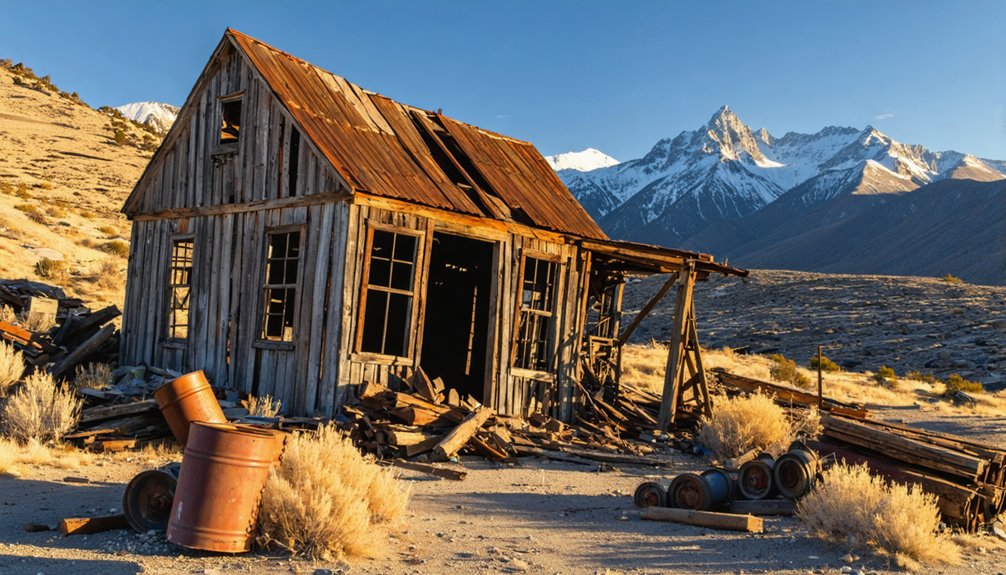
Following the fires, Lundy’s economic foundation crumbled when the May Lundy mine suspended operations in 1884 under the weight of $35,000 to $40,000 in debts and mounting operational costs. The sheriff closed the mine at noon and the mill at 9 PM that year to secure creditor claims, effectively ending the town’s primary source of livelihood.
Nature compounded this economic collapse—avalanches destroyed homes, mines, and the power plant, with the catastrophic March 1911 slide annihilating what remained of Lundy camp.
Economic Collapse and Abandonment
By 1883, San Francisco investors had seen enough—they advertised the May Lundy Mine for sale, signaling the beginning of the end for the camp’s economic lifeblood. The sale dragged on until 1887, leaving workers unpaid by early July 1884. When creditors attached the mine and mill for $12,000 that August, the town’s single-industry economy collapsed immediately.
You’d witness the exodus firsthand—miners abandoning homes for distant prospects, business owners vacating empty storefronts, the Homer Mining Index ceasing publication by November. Despite advances in mining technology and railroad development transforming other camps, Lundy couldn’t overcome its fatal dependency on one operation.
The national recession compounded local devastation. Though operations briefly resumed in 1900, high production costs forced final shutdown in 1915.
Natural Disasters Accelerate Decline
Just as Lundy struggled to recover from its economic devastation, nature delivered a crushing blow that would seal the town’s fate. On March 7, 1911, a series of catastrophic avalanches swept through the area during the brutal 1910-1911 winter.
The slides killed nine miners regionally, including seven at Jordan’s power plant where an estimated 4 million tons of snow carved a quarter-mile-wide path. Equipment weighing tons was thrown 500 feet downslope.
Agnes Mason survived the Jordan cabin’s destruction in an air pocket created by a steamer trunk, though she lost her leg to gangrene.
Today, wildlife conservation efforts and cultural preservation initiatives protect the site’s small graveyard—marked by reclaimed marble headstones—and scattered ruins that commemorate this final disaster.
From Gold Rush to Ghost Town
When gold was discovered near the west end of Lundy Lake in 1879, prospectors established the Homer Mining District and launched what would become the principal May Lundy Mine operation on a steep talus slope.
You’ll find this operation extracted an estimated three million dollars in gold and silver through 1914, employing hard-rock mining technology that replaced earlier placer methods from California’s 1848 gold rush era.
The settlement architecture reflected both ambition and impermanence—structures built without regard for the avalanche-prone terrain that would ultimately claim lives and destroy homes, mines, and power plants.
Exploring the Ruins and Remnants Today
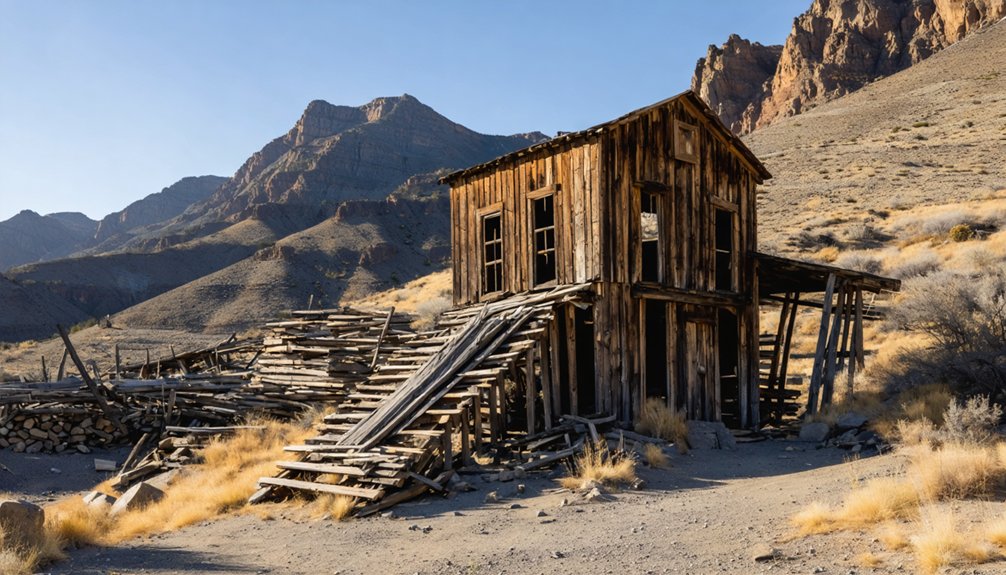
Today’s visitors to Lundy encounter a ghost town that nature has been steadily reclaiming since mining operations ceased in 1914. You’ll find scattered remnants at 7,854 feet elevation—water tank foundations, tipple debris, and exposed rail tracks along the canyon floor. The pioneer cemetery remains visible from the road, while machinery from the May Lundy mine lies scattered on the mountain above.
The ghost town history in California serves as a poignant reminder of the boom-and-bust cycles that defined the mining era. As visitors explore the remnants of Lundy, they can reflect on the lives that once flourished here and the dramatic changes that led to its abandonment. This unique site draws history enthusiasts and curious travelers alike, all eager to uncover the stories behind the decaying structures.
Lundy Lake’s dam submerged much of the original settlement, including a stagecoach at Stagecoach Corner that scuba divers have confirmed in the icy waters. Avalanche paths from the devastating 1911 slide that destroyed the power plant remain evident.
Today, wildlife habitats and geological formations integrate seamlessly with stone walls and mining debris, creating an atmospheric alpine landscape where you’re free to explore responsibly along trails accessing the upper canyon.
Visiting Lundy: Access, Activities, and Attractions
Located 6 miles west of Highway 395, Lundy sits at 7,858 feet elevation in a scenic alpine canyon that’s accessible to most visitors during summer months. You’ll turn onto Lundy Lake Road seven miles north of the Tioga Pass intersection, following it five miles to reach camping, fishing, and trailhead access.
The May Lundy Mine trail climbs 3.2 miles through original 1880s wagon routes into Hoover Wilderness, gaining 1,700 feet to explore Mining Legends at 9,500 feet. You’ll find Lundy artifacts scattered throughout upper canyon sites.
Activities include:
- Wild brown trout fishing in Mill Creek’s crystalline waters
- Camping among aspen groves with nearby Mono Lake and Bodie exploration
- Diving Stagecoach Corner where a submerged stagecoach rests beneath Lundy Lake’s surface
Winter snow closes access until spring reopening.
Frequently Asked Questions
Are There Any Surviving Descendants of the Original Lundy Family Today?
You’ll find documented Lundy family history through genealogical databases like FamilySearch and Ancestry.com, where descendants’ genealogy extends into the 20th century. However, current living descendants haven’t been publicly identified in available historical records or contemporary documentation.
What Happened to the Chinese Residents After Chinatown Was Destroyed?
Like scattered seeds after a storm, the Chinese residents dispersed when Chinatown burned. You’ll find no documented trail of where they went—only Chinese cultural remnants hint at their presence. Town demolition legacy erased their stories, leaving freedom-seekers without answers.
Can Visitors Explore Inside the May Lundy Mine Shaft Safely?
No, you can’t safely explore the May Lundy mine shaft. The USFS dynamited the entrance shut specifically for visitor safety due to documented mine safety hazards including unstable structures, oxygen depletion, and collapse risks at this abandoned site.
Were Any Famous Old West Outlaws Known to Visit Lundy?
No documented evidence exists of Wild West legends visiting Lundy. While the remote location could’ve served as one of many historic outlaw hideouts, historical records focus on mining operations rather than criminal activity in this isolated mountain town.
What Wildlife Species Commonly Inhabit the Lundy Ghost Town Area?
Like nature reclaiming forgotten territory, you’ll find abundant wildlife diversity here—deer roaming canyons, beavers engineering marshlands, mountain lions prowling wilderness trails, and bird species including Townsend’s Solitaire soaring overhead, plus lizards traversing rocky terrain.
References
- https://westernmininghistory.com/towns/california/lundy/
- https://www.ghosttowns.com/states/ca/lundy.html
- https://www.youtube.com/watch?v=OwpYCVO-HWI
- https://en.wikipedia.org/wiki/Lundy
- https://www.huntington.org/collections/lib-244984
- https://www.atlasobscura.com/places/may-lundy-mine
- https://sweetamericanasweethearts.blogspot.com/2016/03/the-may-lundy-mine.html
- https://sierranewsonline.com/hiking-with-sally-from-lundy-lake-to-the-may-lundy-mine/
- https://www.starbuck.org/may-lundy-mine/
- https://www.youtube.com/watch?v=rRdccJqnfUo