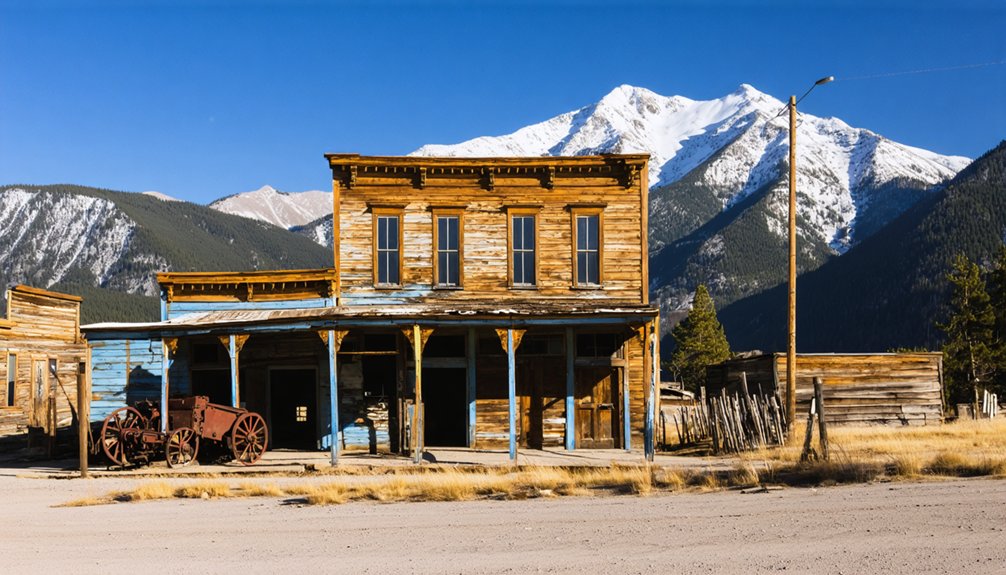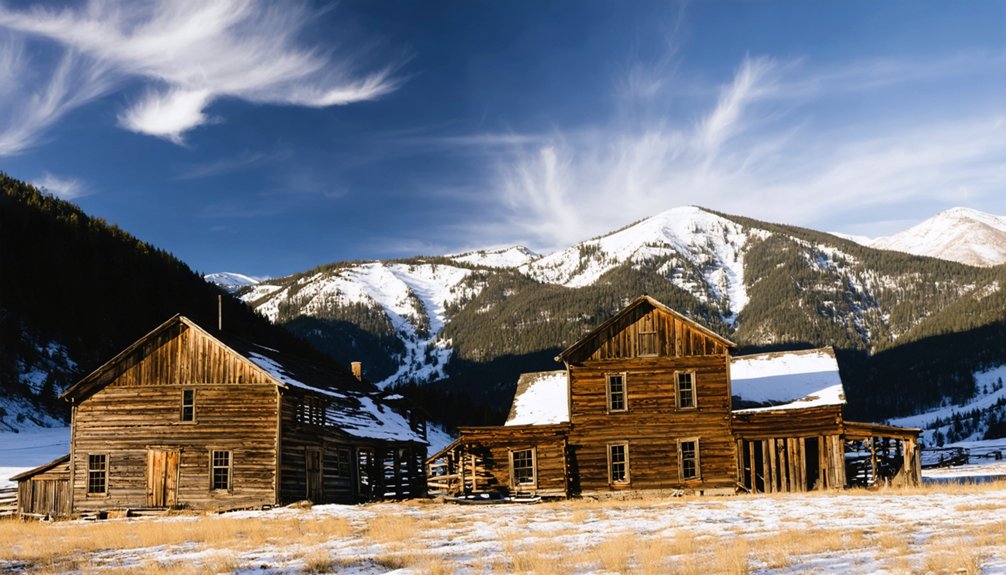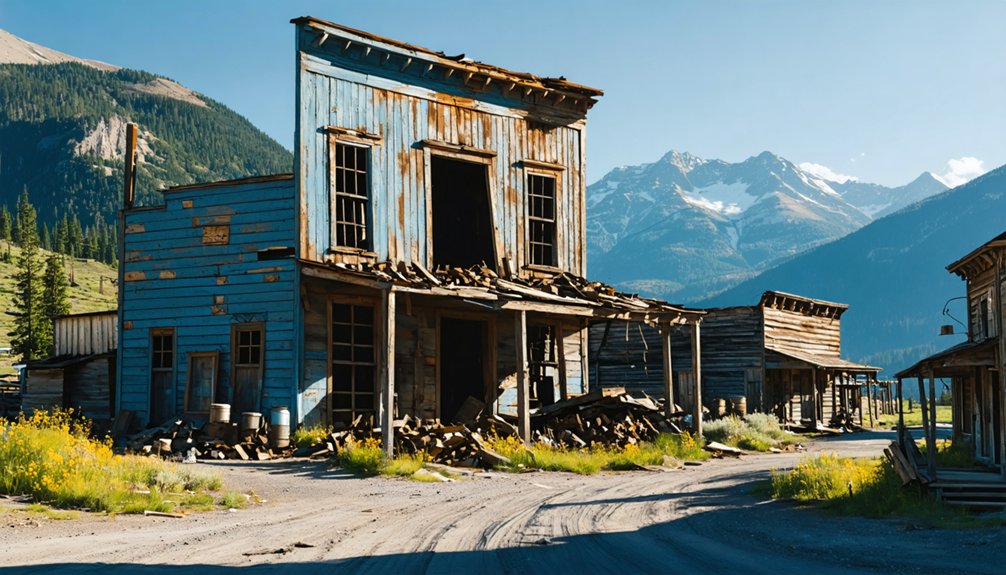
McConnellsville emerged in 1882 as a bustling railroad stop on the Denver and New Orleans line. You’ll find this agricultural ghost town boasted nine daily passenger trains by 1900, with thriving businesses and massive potato shipments. The catastrophic 1935 Memorial Day flood, followed by drought, triggered its economic decline. Unlike mining ghost towns, McConnellsville’s wide streets and community-centered buildings tell a story of prairie pragmatism and changing market forces rather than resource depletion.
Key Takeaways
- McConnellsville was established in 1882 as a train stop on the Denver and New Orleans Railroad line.
- The town thrived with nine daily passenger trains by 1900 and was a hub for agricultural shipping.
- The devastating 1935 Memorial Day flood severely damaged railroad infrastructure, leading to the town’s decline.
- Unlike mining ghost towns, McConnellsville’s abandonment resulted from changing market forces and agricultural challenges.
- Today, remnants include the repurposed Presbyterian church, Eastonville Cemetery, and traces of the old railroad grade.
From Easton to McConnellsville: A Tale of Two Town Names
When you travel through the rolling plains of eastern Colorado today, you’ll find barely a trace of what was once a bustling settlement caught between two identities. This ghost town’s story begins in 1872 when settlers established Easton around Weir’s Sawmill, complete with its own post office.
The town’s name evolution started when postal officials objected to “Easton” because it sounded too similar to “Eaton,” another Colorado town. By September 1883, residents officially adopted “Eastonville” to maintain mail service.
A name too similar to exist – postal bureaucracy forced Easton to become Eastonville, preserving their postal identity.
Meanwhile, a significant train stop called McConnellsville appeared in 1882 a few miles northeast, connected to the Denver and New Orleans Railroad. John Brazelton served as the first postmaster when the official name change occurred.
The town relocation followed a practical “relocate or perish” decision, as residents abandoned the original site to capitalize on railroad access that would ultimately define their community’s fate. At its peak, the town welcomed nine to ten trains daily, facilitating both passenger travel and agricultural shipping.
The Railroad That Shaped a Community
When confusion with another town led officials to rename it Eastonville in 1884, the community flourished.
Nine daily passenger trains and numerous freight cars serviced nearly 500 residents by 1900. You could witness whole trainloads of potatoes departing and southern cattle arriving each spring. John W. Black was a notable buyer of the region’s potato crops.
The Russel Gates Mercantile Company, lumber yards, and creameries thrived alongside the tracks—until drought, automobiles, and the devastating 1935 Memorial Day flood washed away this railroad-dependent prosperity. The local rail line’s demise mirrored the larger abandonment pattern seen across Colorado, where the last narrow gauge operation ended on August 25, 1943.
Agricultural Roots in Colorado’s Plains
As you stand in McConnellsville’s windswept plains today, you’re witnessing land where pioneer families once coaxed winter wheat and sorghum from the semi-arid soil, transforming Native American hunting grounds into productive homesteads.
You’ll notice the remnants of irrigation ditches that brought life-giving water to crops, evidence of the agricultural ingenuity that sustained families through harsh seasons and economic downturns. These irrigation systems were part of larger transformation projects that converted previously arid lands into fertile agricultural areas throughout Colorado.
Cattle operations defined the community’s character too, with ranchers adapting Texas longhorn practices to Colorado’s unique landscape after the railroad made livestock shipping viable in the 1880s. Similar to Native Plains peoples, settlers implemented fallow periods to restore soil fertility when crop yields declined.
Prairie Farming Heritage
Though historians have found no evidence of agricultural activity in McConnellsville, the surrounding Colorado plains tell a different story. As you stand amid the swaying prairie grasses, you’re witnessing the same landscape that once challenged and rewarded the region’s hardy settlers.
Neighboring communities embraced innovative crop rotation techniques that sustained their farms through harsh seasons when traditional methods failed. You’ll notice remnants of boundary fences where prudent livestock management separated grazing cattle from precious wheat fields.
The prairie farming heritage surrounding McConnellsville represents American self-reliance at its core—men and women who worked unclaimed soil into productive homesteads without government interference.
Their agricultural wisdom, passed down through generations, reminds you that true freedom springs from understanding the land and responding to its rhythms.
Family Homesteads Flourished
Unlike McConnellsville’s mining-focused economy, the family homesteads that dotted Colorado’s eastern plains transformed untamed wilderness into a patchwork of productive farmland.
Through innovations like Turkey Red wheat and dryland farming techniques, families cultivated sustainability where others saw only harsh terrain.
You’d recognize these homesteads by their:
- Diversified crop systems—corn, wheat, and potatoes buffering against market volatility
- Evolved orchard practices with grafted varieties replacing unpredictable seedlings
- Family traditions of land stewardship passing knowledge through generations
- Agricultural innovations born of necessity, including cooperative marketing
As railroads connected these isolated homesteads to broader markets, farming families adapted constantly, bringing scion wood from their homelands and trading horticultural knowledge. Similar to McConnells’ development after the Kings Mountain Railroad in 1848, these transportation networks facilitated significant economic growth for rural communities. Much like the McConnell Ranch established in 1908, these homesteads required tremendous effort to transform raw desert land into productive farms.
These weren’t merely farms but institutions—anchors of community where agricultural innovations merged with family traditions, creating resilient communities across Colorado’s plains.
Cattle Country Beginnings
Before McConnellsville emerged on Colorado’s plains, cattle operations had already staked their claim on the sweeping grasslands that would later nurture the town’s agricultural identity.
You could trace this cattle ranching tradition back to 1872, when the first settlers arrived in nearby Eastonville, establishing a distinctly agricultural economy that stood in contrast to Colorado’s mining boomtowns.
Unlike the gold-rush communities that dotted the mountains, this region’s agricultural heritage took root in the fertile soil east of Black Forest.
When residents relocated in 1882 to what would become McConnellsville, they brought their farming and ranching expertise with them.
The railroad promised to connect their cattle and crops to distant markets, temporarily transforming their economic prospects.
This agricultural foundation, rather than mineral wealth, defined the community’s character and ultimately its fate, similar to Keota which thrived from 1880 to 1929 as part of Colorado’s Great American Desert region.
Like many other farming towns on the eastern plains, McConnellsville would eventually succumb to rural depopulation trends that left numerous communities abandoned.
Daily Life in a Farming Settlement
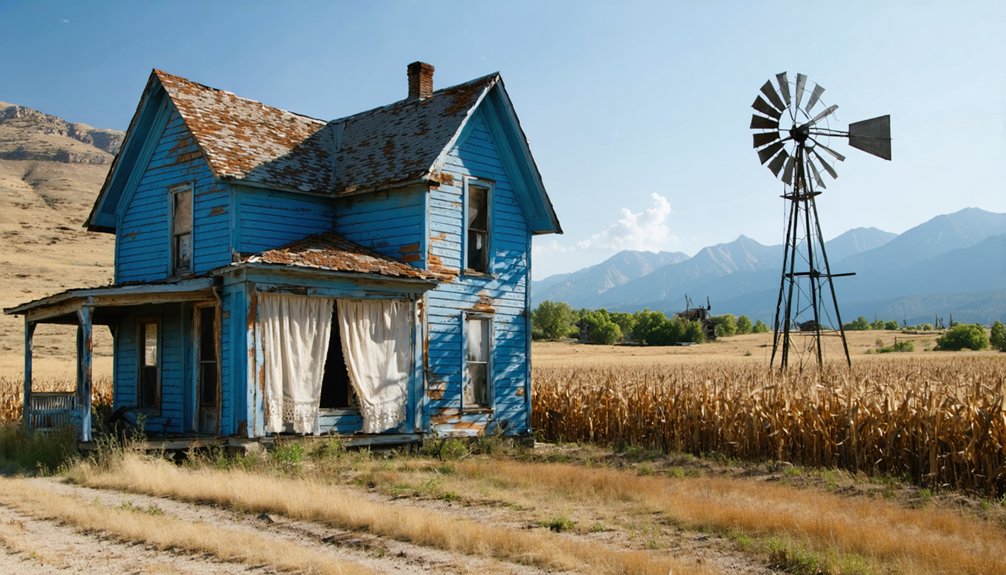
As dawn broke over the rolling plains of McConnellsville, families rose to begin their daily routines centered around the demanding yet rewarding rhythm of agricultural life.
You’d find yourself tending two-pound potato crops and grain fields, the lifeblood of this bustling settlement. Community gatherings like annual potato bakes strengthened bonds between neighbors, while agricultural fairs showcased prized butter and cheese from the award-winning creamery.
- The railroad depot buzzed with activity as ten freight and passenger trains passed daily
- By 1904, you could arrange telephone service in your home or business
- Irrigation systems transformed the landscape, maximizing yields from dry land crops
- Trainloads of potatoes left regularly, bound for distant markets as sought-after seed
The 1935 Flood: A Turning Point for Survival
If you’d visited McConnellsville on May 30, 1935, you’d have found a sleepy farming settlement unaware of the violent change about to occur overnight.
When the Republican River overflowed its banks by nearly a mile, rushing water swept away homes, livestock, and human lives in a catastrophic deluge that left little standing in its wake.
The settlement’s economy, already weakened by drought, couldn’t recover from this decisive blow—fields were ruined, animals lost, and infrastructure destroyed—marking the beginning of McConnellsville’s shift into the ghost town you’d recognize today.
Devastating Overnight Destruction
The tranquil Republican River transformed into a merciless force of nature on May 31, 1935, when unprecedented rainfall released what would become McConnellsville’s defining catastrophe.
Within a mere 36 hours, you’d have witnessed the gentle stream swell over 1000 times its normal flow, carving a path of historical significance through the heart of your community.
- Waters spread a mile wide, devouring homes off their foundations
- Bridges collapsed under the torrent’s might, isolating survivors clinging to treetops
- Livestock perished by the thousands, creating sanitation nightmares
- Entire families, like the Petitts, were lost when rescue proved impossible
This moment tested McConnellsville’s community resilience like nothing before.
The flood didn’t just reshape the landscape—it rewrote destinies, determining which towns would survive and which would fade into memory.
Local Economy Permanently Derailed
When floodwaters finally receded from McConnellsville’s streets in June 1935, they left behind more than mud and debris—they revealed the skeleton of a once-thriving economy that would never fully recover.
You’d scarcely recognize the bustling town it once was. Railroad tracks—lifelines of commerce—lay twisted and broken, severing crucial trade connections. Local businesses shuttered permanently, including the century-old mercantile. Farmers abandoned fields where silt-covered soil refused to yield crops. The workforce scattered like seeds in the wind, seeking livelihoods elsewhere.
Despite scattered attempts at economic recovery, McConnellsville’s resilience couldn’t overcome the catastrophic blow. Property values collapsed. Tax revenues dried up.
The community’s fabric unraveled as schools closed and families departed. What you’re witnessing in these empty streets isn’t just abandonment—it’s the aftermath of an economic tsunami from which the town never resurged.
The Presbyterian Church: Last Standing Sentinel
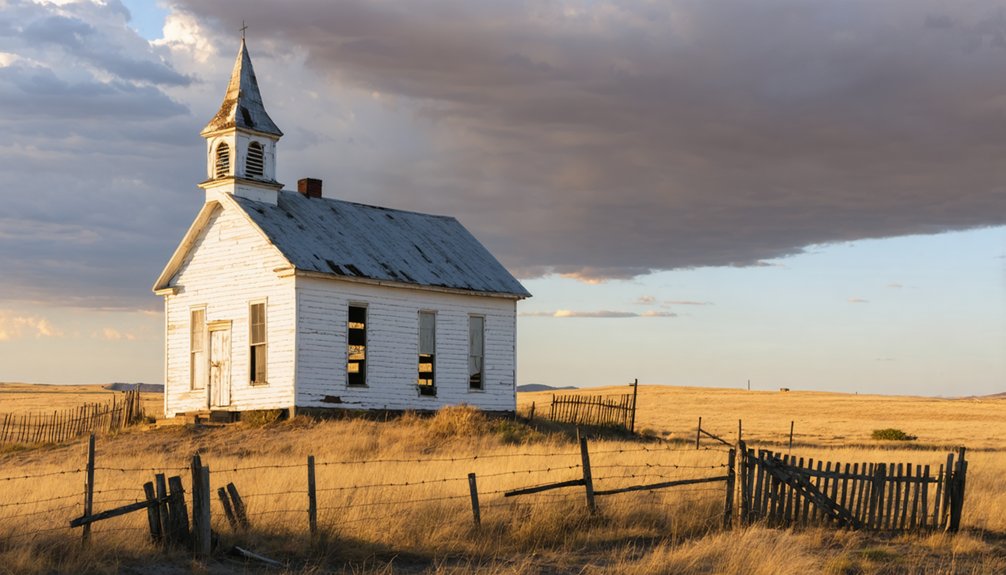
Standing sentinel against time’s relentless march, McConnellsville’s Presbyterian Church remains the sole structural witness to a once-thriving frontier community. Built when Easton relocated to become McConnellsville in the 1880s, this enduring symbol of Presbyterian heritage has weathered decades of abandonment while its neighboring structures succumbed to time.
- You’ll find it served not just as a place of worship but as the town’s social anchor, even after population decline.
- The church represents a broader Presbyterian expansion that shaped America’s frontier religious landscape.
- Despite the town’s collapse when railroad influence waned, community resilience kept this building intact.
- While residents dismantled and relocated their homes, they chose to preserve this sacred space, underscoring its significance.
Eastonville Cemetery: Where History Rests
Beyond the solitary Presbyterian Church lies another, more solemn memorial to McConnellsville’s past—Eastonville Cemetery, established in 1865 when the settlement was still known simply as Easton.
As you walk through the entrance archway, you’re stepping into a chronicle of over 150 years of regional heritage. More than five hundred souls rest here, including baby Willie Musser, the earliest marked burial from 1886.
The cemetery’s historical inscriptions reveal the lineages and patterns of settlement that defined this once-thriving agricultural community.
Located at the northeast corner of Meridian and Latigo roads, this enduring landmark carries immense cemetery significance—it’s the most tangible connection to Eastonville’s peak era.
While the town has faded into memory, the stories etched in stone remain, whispering tales of freedom-seeking pioneers who made this land their home.
Economic Decline After the Rails Departed
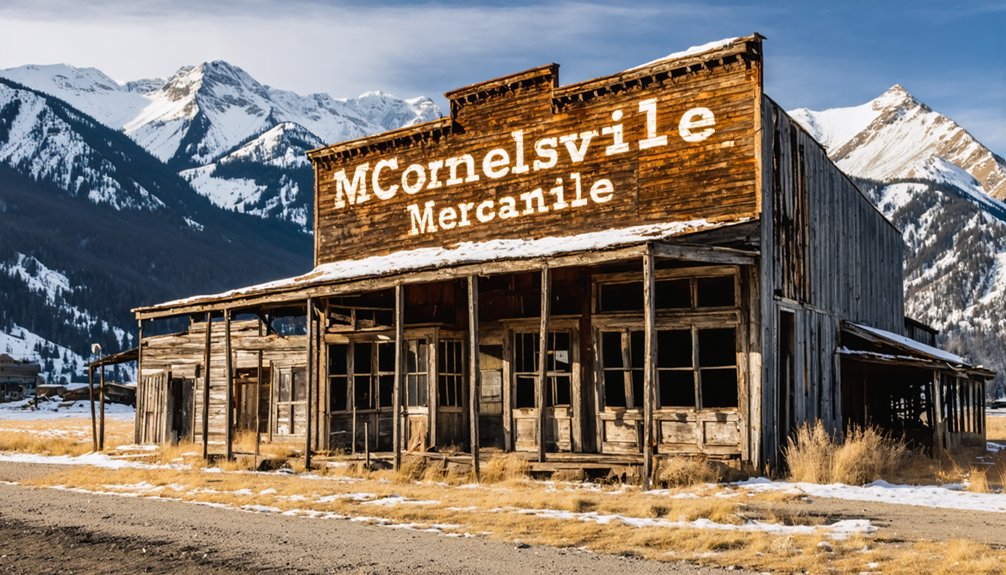
You’re witnessing the remains of a town that crumbled after its economic lifeline was severed—Eastonville’s bustling mercantiles and warehouses couldn’t survive once the Colorado and Southern Railroad ceased operations following the devastating 1935 flood.
The flood’s destruction of rail tracks between Eastonville and Elbert delivered the final blow to a town already struggling with diminished passenger service, agricultural hardships from the 1931-34 drought, and rising competition from automobiles.
What was once a thriving hub of commerce with 9-10 daily trains now stands abandoned, its prosperity having departed on the last locomotive that rumbled through town.
Rail-Dependent Town Failed
As the Denver & New Orleans Railroad gradually reduced its service to Eastonville in the 1920s, the town’s economic lifeline began to wither.
You could witness the railroad impact firsthand as fewer trains stopped at the once-bustling depot where 9-10 daily trains had previously connected the community to markets near and far.
Economic shifts hit this rail-dependent town with devastating precision:
- Rerouting of trains to competing Santa Fe Railroad lines stripped away essential passenger traffic
- Rising popularity of automobiles and trucks created unexpected competition for rail transport
- Agricultural drought (1931-1934) decimated potato crops, eliminating freight shipping needs
- Without rail traffic, businesses lost connectivity to larger markets
The town had staked its entire existence on the railroad’s presence, and as the tracks fell silent, Eastonville’s fate was sealed.
1935 Flood’s Fatal Blow
The devastating floods of 1922 delivered what many locals called “the final deathblow” to Eastonville’s struggling economy.
While I can’t confirm specific details about McConnellsville, Colorado’s flood history from the available facts, this type of catastrophic event typically ravaged infrastructure that small rail-dependent towns couldn’t afford to rebuild.
Without railroad connections, such communities often faced insurmountable economic consequences.
In similar ghost towns across America, flood impacts extended beyond immediate destruction. Water damage to commercial buildings, homes, and essential services frequently accelerated population exodus.
What might’ve been a slow decline turned into rapid abandonment as flood waters receded, leaving mud-caked remnants of once-thriving businesses.
You can still see evidence of this sudden end when visiting these forgotten places—foundations exposed by erosion and weathered structures standing as silent testimony to nature’s power.
No Mercantile Without Trains
Three critical blows sealed McConnellsville’s economic fate when the railroad abandoned its once-bustling tracks. The town’s fundamental railroad reliance became its undoing, as passenger rerouting to Santa Fe lines severed the town’s human connections.
You can still imagine the empty platform where travelers once disembarked, bringing life and commerce to local shops.
- Potato farmers lost direct access to distant markets, watching harvests waste without efficient transport.
- Daily freight shipments dwindled as trucks claimed the roads, bypassing the town entirely.
- The 24/7 depot—once the heartbeat of commerce—fell silent, jobs vanishing overnight.
- Local merchants shuttered storefronts as customer traffic evaporated.
This economic downturn wasn’t simply about reduced income—it represented the death of a way of life that had defined the community for generations.
What Remains Today: Traces of the Past
Ghostly remnants of McConnellsville stand as silent witnesses to a once-thriving frontier community, inviting today’s visitors to glimpse shadows of the past among scattered foundations and weathered structures.
You’ll find the Presbyterian church still standing—now repurposed as a community center—demonstrating both historical significance and community resilience.
The Eastonville Cemetery remains active with over 500 interments, preserving names of those who once called this place home.
Names etched in stone speak volumes, connecting us to souls who once walked these same paths.
Though the devastating 1935 flood swept away the railroad tracks that had been the town’s lifeline since 1881, you can still trace the old grade in the landscape.
Foundation outlines and interpretive signage guide you through this historical landscape where nature has gradually reclaimed what civilization briefly held.
Distinguishing Features of a Non-Mining Ghost Town
What distinguishes McConnellsville from Colorado’s more common mining ghost towns? Unlike its mineral-extracting neighbors, McConnellsville’s story isn’t one of depleted ore veins but of dramatic economic shifts that rendered its original purpose obsolete.
As you explore the remnants, you’ll notice the absence of stamp mills and mine shafts, replaced instead by structures that once supported community significance.
- Wide, planned streets designed for commerce rather than mining operations
- Prominent civic buildings including the town hall and schoolhouse that speak to its community-centered design
- Agricultural infrastructure like grain silos and livestock pens that reveal its farming heritage
- Architectural styles reflecting prairie pragmatism rather than boom-town hasty construction
McConnellsville’s abandonment came not from exhausted resources but from changing transportation routes and market forces that slowly drained its lifeblood.
Frequently Asked Questions
Were There Notable Crimes or Lawlessness in Mcconnellsville’s History?
In a million years of searching, you’d find zero crime incidents in McConnellsville. Historical records reveal no lawlessness requiring law enforcement. The town thrived through orderly railroad commerce—freedom without chaos until nature intervened.
What Indigenous Peoples Inhabited the Area Before White Settlement?
You’d recognize the Ute Tribe as the primary indigenous inhabitants, with their nomadic lifestyle perfectly suited to the mountain terrain. The Arapaho’s influence remained largely peripheral, as they dwelled eastward.
How Did Residents Access Healthcare and Education?
You’d journey miles for rural healthcare, nursing hope in wagon-rides to Colorado Springs while your children’s education challenges meant homeschooling or trudging to neighboring settlements for sporadic schooling. Neighbors became your lifeline.
Were Any Famous Historical Figures Associated With Mcconnellsville?
You won’t find any famous historical figures associated with this prairie settlement. Historical records don’t document notable visitors or significant historical events beyond the everyday struggles of determined pioneers seeking their independence.
What Recreational Activities or Celebrations Did Townsfolk Enjoy?
Like TikTok dances of their day, you’d have joined community gatherings around the train depot, seasonal festivals marking harvests, and church socials where townsfolk shared stories and homemade spirits.
References
- https://digging-history.com/2015/03/25/ghost-town-wednesday-eastonville-colorado/
- https://www.coloradolifemagazine.com/printpage/post/index/id/172
- http://coloradorestlessnative.blogspot.com/2013/08/eastonville-rich-in-history-ghost-town.html
- https://en.wikipedia.org/wiki/List_of_ghost_towns_in_Colorado
- https://kids.kiddle.co/List_of_ghost_towns_in_Colorado
- https://www.youtube.com/watch?v=e07GnE8W9nQ
- https://www.colorado.com/articles/colorado-ghost-towns
- https://ghosttownmuseum.com/our-story/
- https://newfalconherald.com/eastonville-the-town-that-disappeared/
- https://en.wikipedia.org/wiki/Eastonville