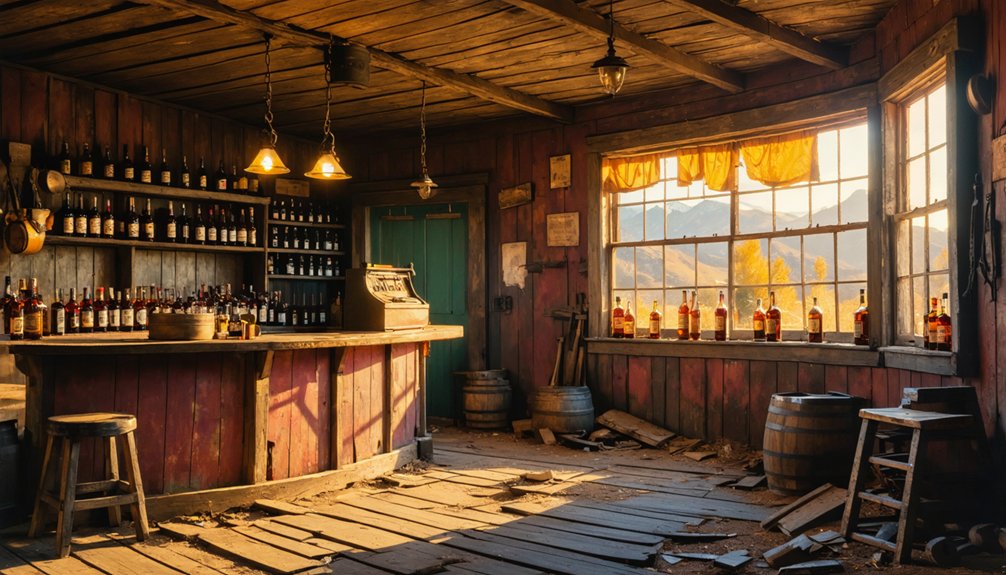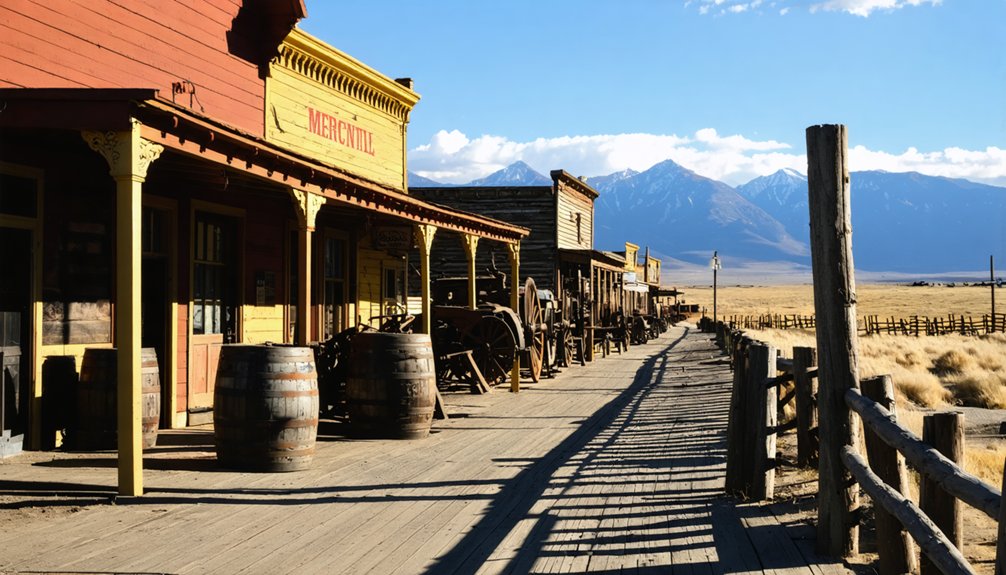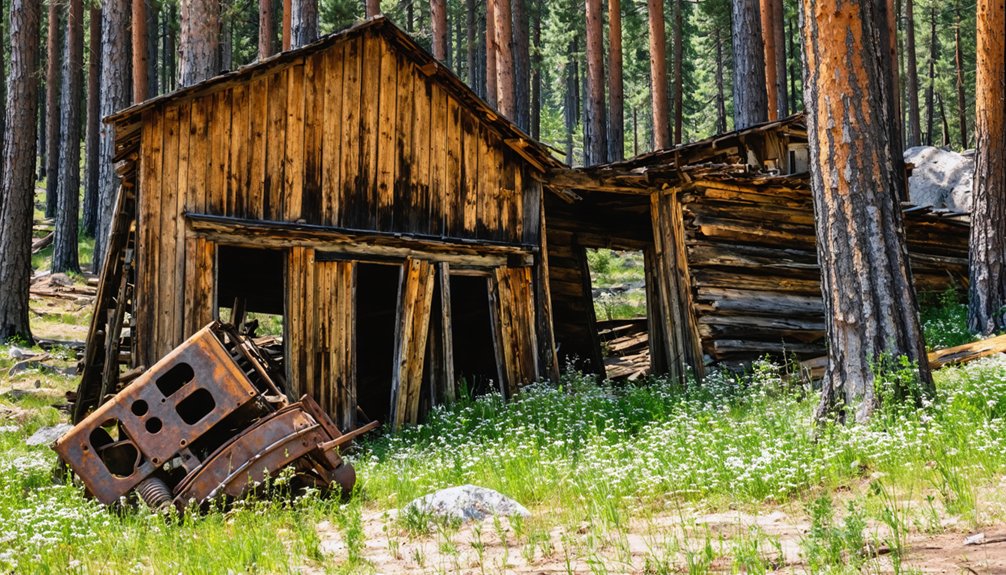
You’ll discover Meadow Lake nestled at 7,418 feet in California’s Sierra Nevada, where a bustling gold rush town of 5,000 residents thrived briefly from 1865 to 1869. What began with Henry Hartley’s hermit cabin in 1860 exploded into 500 buildings, 80 saloons, and a Wells Fargo bank—before unprofitable mining and brutal winters drove everyone away. Today, you’ll need a 4WD vehicle to navigate nine miles of rugged forest roads to reach the scattered stone foundations, old dam, and cemetery that whisper tales of this ambitious mountain community’s spectacular rise and fall.
Key Takeaways
- Gold discovery in 1863 sparked rapid growth from wilderness to 5,000 residents by 1866, with 500 buildings and 80 saloons.
- Inefficient mining economics—$30 spent per $1 of gold earned—combined with harsh winters led to abandonment by 1869.
- Located at 7,418 feet in Tahoe National Forest, accessible only via rugged nine-mile dirt roads requiring 4WD vehicles.
- Site features foundation remnants, an old dam, ancient petroglyphs, and an active cemetery from the 1860s boom era.
- Best visited July through October; federally protected with strict no-souvenir rules to preserve historical and environmental integrity.
The Discovery of Gold in 1863
In 1863, prospectors scaling the Sierra Nevada crest at 7,000 feet noticed something promising in the granite ledges—thin flakes of free gold glinting from spongy, decomposed surface rock.
You’d find this rugged, exposed territory forty miles from Nevada City unforgiving, where harsh weather patterns tested anyone seeking fortune beyond civilization’s reach.
The local flora—hardy pines and alpine scrub—offered little shelter from Sierra storms.
Yet those gold flakes represented something miners craved: untapped wealth waiting for bold souls willing to endure the elements.
What’s remarkable? This discovery didn’t trigger an immediate stampede. Two years would pass before word spread and fortune-seekers descended on the area.
Henry Hartley became the first settler at this remote location, establishing a presence that would shape the area’s future development.
Those early prospectors kept their secret well, working quietly while others chased played-out claims elsewhere. The site would eventually share its name with multiple geographical entities across North America, requiring careful distinction in historical records.
Henry Hartley: The Hermit Who Started It All
While prospectors whispered about gold deposits in the high country, one man had already claimed this remote territory as his sanctuary. Henry Hartley built his cabin near Meadow Lake in 1860, seeking relief from respiratory ailments in the pristine mountain air at 7,254 feet.
He’d live here as a hermit for three years, studying local flora and tracking wildlife patterns while trapping mink, martin, foxes, and otter. His survival depended on understanding nature’s rhythms—a primitive form of wildlife conservation born from necessity rather than sentiment. During winter months, he maintained his traps using skis across the deep snow that blanketed the mountain terrain.
When weather permitted, he’d snowshoe eight miles to Cisco, fiddle in hand, entertaining settlers before returning to his solitude. Nevada City residents admired the gloves, caps, and victorines he crafted from the pelts he collected. This self-reliant existence prepared him perfectly for what’d come next.
The Boom Years of 1865-1866
You’d have witnessed an astonishing transformation if you’d stood at Meadow Lake in June 1865, watching a wilderness camp of 270 souls explode into a bustling town of 5,000 residents within mere months.
The hammering never stopped—sawmills screamed day and night to feed the construction frenzy while entrepreneurs raced to open hotels, saloons, assay offices, and butcher shops along muddy streets that hadn’t existed weeks before. Unlike typical mining camps that grew haphazardly, Meadow Lake was surveyed and planned with prepared streets laid out in advance.
Population Surge to 5,000
News of Henry Hartley’s 1864 discovery—gold flakes glinting in black granite veins—traveled slowly at first, but by 1865, rumors had exploded across California like wildfire.
One newspaper claimed $55,000 in gold and silver per ton.
Unemployed hard-rock miners from Comstock Lode abandoned their played-out claims, seeking fortune in fresh territory.
The population surge transformed wilderness into boomtown:
- 4,000-5,000 residents arrived by mid-summer 1866
- Five new houses built daily as hordes pushed through lingering snow
- Over 1,200 mining locations claimed across the district
- 600+ buildings constructed within months
Today’s historical signage marks where thousands once staked their dreams.
Cultural preservation efforts honor these fortune-seekers who chose independence over security, trading comfort for possibility in Nevada County’s high country.
The district officially incorporated Meadow Lake as a town in 1866, marking the peak of its explosive growth and legitimizing its status as a major Sierra Nevada mining center.
The town’s grid pattern streets converged on a 9,000 square foot plaza along the lakeshore, giving structure to the chaotic settlement.
Infrastructure and Business Development
As fortune-seekers flooded into Meadow Lake during 1865 and 1866, a bustling commercial district materialized from thin air. You’d have witnessed over 600 buildings rising within fifteen months, their construction limited only by severe lumber shortages that scarred the surrounding forests—an environmental impact that forever altered the landscape.
Hotels, salons, and restaurants lined eighty-foot-wide streets radiating from a central plaza. Wells Fargo arrived in February 1866, followed by a bank that spring. You could’ve bought city lots for $25 in early 1865, then watched prices skyrocket to $2,500 by 1866. At the peak of speculation, some lots commanded prices reaching $3,000 per parcel.
Cultural traditions took root quickly: a newspaper launched, stagecoaches ran daily, and optimistic citizens even opened a stock exchange, transforming wilderness into civilization practically overnight.
Mining Claims Explosion
How quickly could wilderness transform into a speculator’s paradise? You’d have witnessed the answer in Meadow Lake’s explosive 1865-1866 rush, where fortune-seekers staked their dreams faster than surveyors could map boundaries.
The claim-staking frenzy reached staggering proportions:
- Over 1,000 claims materialized within three months, eventually swelling to 11,000 by 1866’s peak.
- Companies like California Co. and Enterprise Co. raced to establish operations, creating inevitable legal disputes over overlapping boundaries.
- Six ore-processing mills hammered away by midsummer 1865, their environmental impact scarring pristine forests.
- Claim values skyrocketed from $25 lots to $2,500 properties, while mills and operations consumed over $2 million in capital.
You’d have seen every promising granite outcrop transformed into someone’s ticket to wealth—at least in theory. The Meadow Lake Mill and Mining Company, incorporated on July 25, 1865, exemplified this speculative fervor by simultaneously pursuing mining operations, sawmill ventures, and toll road development through its Meadow Lake Turnpike Company. Notable operations included the French Mill at Meadow Lake, which represented significant capital investment in the district’s quartz-processing infrastructure.
A Thriving Mountain Community at 7,293 Feet
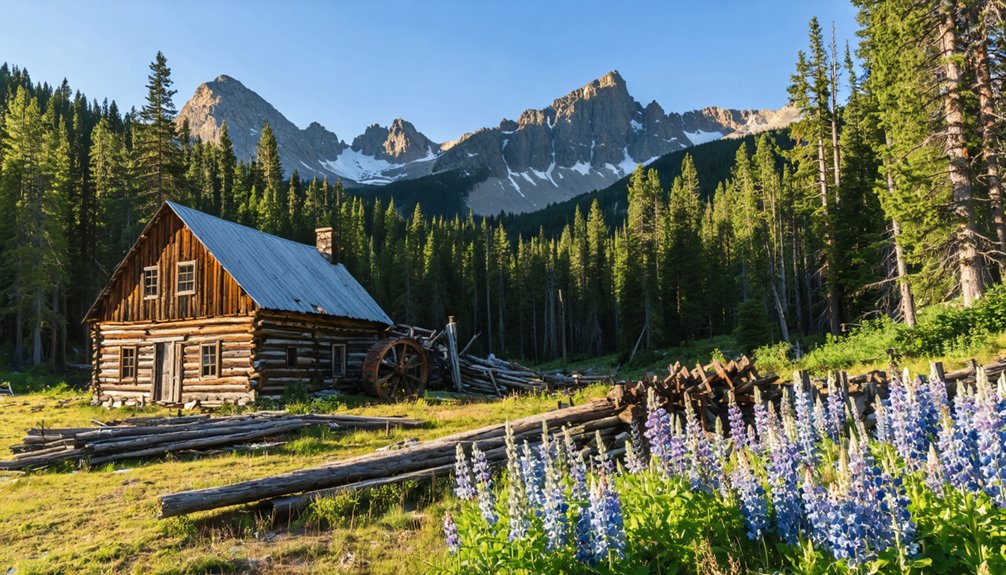
At its 1866 zenith, you’d find yourself steering a remarkably civilized settlement perched nearly 7,300 feet above sea level—a grid of streets lined with 500 buildings, including a dozen brick hotels that defied the remote alpine location.
The business district sprawled with 80 saloons competing for miners’ attention alongside a stock exchange where speculation ran as high as the elevation itself.
Yet this veneer of sophistication masked a harsh reality: winter snows could trap you for months in temperatures that collapsed roofs and tested even the hardiest residents who’d wagered their fortunes on Hartley’s gold-flecked granite.
Peak Population and Infrastructure
When Henry Hartley stumbled upon gold-bearing ore in June 1863, he couldn’t have imagined that his discovery would transform a pristine alpine meadow at 7,293 feet into Nevada County’s most ambitious—and short-lived—boomtown. By 1866, exaggerated gold reports triggered demographic shifts that swelled the population to 5,000 fortune-seekers who established cultural traditions befitting a legitimate settlement.
The infrastructure they built was staggering:
- 500 buildings sprawled across 160 acres in a grid pattern.
- A stock exchange facilitated speculative trading alongside daily newspaper operations.
- Property values skyrocketed from $25 to $2,500 per lot within months.
- An 8,000-square-foot plaza anchored commercial activity along the lakeshore.
You’d find 200 business houses, numerous saloons, and pack trains defying 30-foot snowdrifts to maintain supply lines to Dutch Flat throughout brutal winters.
Business District and Amenities
Despite its remote location above 7,000 feet, Meadow Lake’s business district rivaled California’s lowland towns in both scale and sophistication. You’d have found 200 business houses lining pretentious streets—10 hotels, 80 saloons, and restaurants serving local cuisine alongside billiard halls.
The book and stationery store, cigar shop, and wholesale hardware establishments created an urban atmosphere few expected in the high Sierra.
Public transportation came via an excursion vessel ferrying revelers to four hurdy-gurdy houses at the lake’s upper end, where brass bands played nightly.
Professional services included a post office, stock exchange, daily and weekly newspapers, and Judge Jones’s court.
Five lumberyards, three sawmills, and blacksmith shops supported the miners’ freedom to strike it rich, while building lots commanded $1,500 each during the heyday.
Mountain Living Challenges
The grandeur of Meadow Lake’s commercial establishments couldn’t shield residents from the mountain’s harsh realities. At 7,293 feet, you’d face challenges that tested your pioneer spirit daily. While today’s scientists warn of wildfire risks and climate impacts reshaping these elevations, nineteenth-century settlers battled their own environmental adversaries.
Mountain living demanded constant adaptation:
- Brutal winters buried cabins under snow drifts that lasted months, isolating you from supply chains.
- Limited access to medical care meant minor injuries could become life-threatening emergencies.
- Dried vegetation and lightning strikes sparked fires that consumed timber stands essential for shelter and mining operations.
- Unpredictable weather at high elevation turned routine tasks into survival challenges.
You couldn’t simply order supplies online or retreat to lower elevations when conditions deteriorated—you endured or abandoned your claims.
The Economic Engine: Quartz Mining and Mills
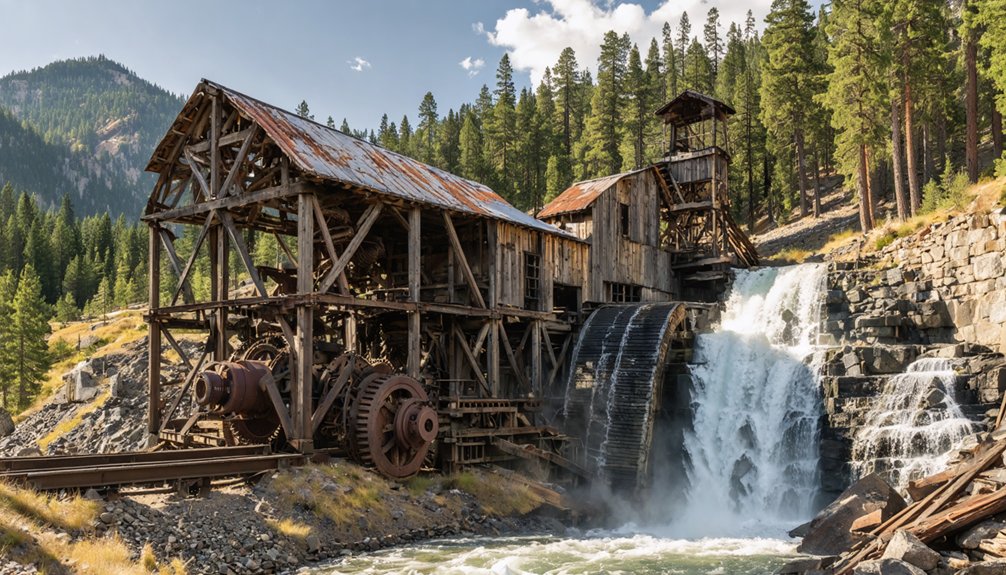
Gold-bearing quartz veins threading through granite caught Henry Hartley’s attention in 1863, and what he saw glittering in those black streaks would set off one of the Sierra’s most ambitious—and ultimately heartbreaking—mining ventures.
By 1866, eight stamp mills with seventy-two stamps pounded rebellious ore day and night, their thunderous rhythm echoing through the canyon. Miners drilled deep into the veins, blasting tunnels and hauling ore by mule car to the processing facilities.
The economic impact seemed promising initially—Excelsior shipped $25,000 in bullion from low-grade ore alone.
But harsh mathematics told the real story: $100,000 produced meant $30 spent for every dollar gained. The environmental consequences scarred the landscape as mills consumed timber and contaminated streams, leaving behind only crushed rock and broken dreams.
Famous Visitors: Mark Twain and Orion Clemens
You’d find Orion Clemens settling into Meadow Lake on March 17, 1866, fresh from his stint as Nevada’s territorial secretary, ready to practice law and prospect.
While his famous brother Samuel was making waves as Mark Twain in Virginia City.
That summer, Mark himself rode up “over a villainous road” through the pines to spend at least one night with Orion in this high Sierra camp—a brief stopover that’d become another chapter in the writer’s Western chronicles.
Orion Clemens’ Post-1866 Residence
After departing Carson City on March 13, 1866, Orion Clemens arrived at Meadow Lake just four days later with hopes of reinventing himself in the Excelsior mining district.
You’ll find his story reflects the boomtown’s fleeting promise:
- He opened Mollie’s legal practice in what proved to be the West’s least productive, most litigious mining district.
- Despite Judge Jones presiding over a proper court with jail, marshal, and lawyers, no mining suits were filed by late May.
- The Meadow Lake architecture couldn’t match their former Carson City home—a wood-frame Greek Revival and Italianate dwelling they’d sold at a loss.
- By early June, Orion hoped to sell out and return home by July.
The couple departed aboard the Golden City steamer on August 30, 1866, leaving before winter’s devastating isolation.
Mark Twain’s Mining Camp Visit
When Samuel Clemens arrived at Meadow Lake’s townsite at 9 P.M. in 1866, the stagecoach journey over villainous mountain roads had already shown him the precarious optimism of yet another Sierra boomtown. Writing as Mark Twain for the San Francisco Bulletin, he documented what he called “the wildest exemplar of speculation” he’d encountered—a painted town built for 3,000 residents despite barely $30,000 in bullion shipped.
The rugged timbered mountains sheltered local flora against weather patterns that dumped six feet of winter snow, yet five quartz mills still processed modest monthly shipments reaching $10,000 by October. He’d witnessed this recklessness before at Washoe and Kern River.
Now Meadow Lake’s bright streets stood melancholy, abandoned by speculators who’d built extensively then fled.
The Rapid Decline After 1868
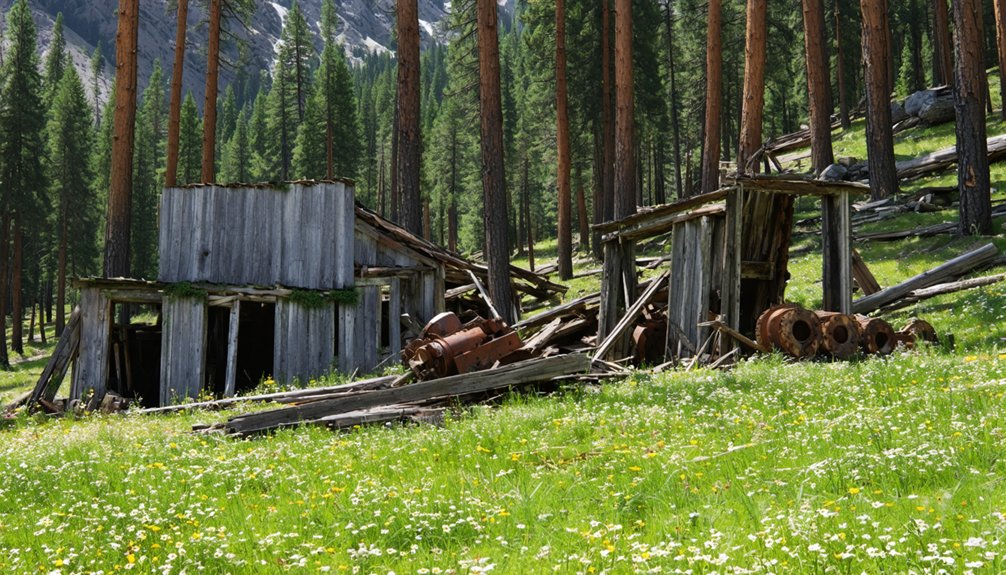
The population hemorrhage began even before most residents would admit defeat—as early as 1866, when the first wave of disillusioned miners realized the rebellious ore wouldn’t surrender its gold.
What followed wasn’t gradual decline but wholesale abandonment:
- From 5,000 souls in 1866 to merely 80 by July 1869
- Seven families rattling around 300 empty houses by early 1869
- The newspaper shuttered in 1867—cultural influences evaporated overnight
- Building construction ceased mid-1866 as optimism collapsed
Winter became the executioner. Thirty feet of snow in 1866–1867 buried dreams alongside buildings.
Climate change through seasons forced exodus after exodus.
By 1873, fires consumed what snow hadn’t crushed.
Henry Hartley remained alone, a hermit among ghosts, until opium poisoning claimed him in 1892.
Why the Mines Failed: Technical Challenges
Gold locked itself away in Meadow Lake’s mountains like a miser’s secret fortune, bound so tightly to iron and manganese that nineteenth-century mining techniques couldn’t pry it loose. The rebellious ore composition formed sulphurets that neutralized mercury amalgamation—the standard extraction method of the era.
You’d have needed stamp mills to crush the granite ledges, but none existed locally. Hauling ore to Virginia City or Nevada City ate profits faster than miners could dig.
Deep tunnels demanded heavy machinery, ventilation systems, and hoisting equipment the prospectors couldn’t afford. When crushed rock finally yielded gold, returns fell short of predictions.
The environmental hazards they left behind—mercury contamination, acid drainage, heavy metals—proved as stubborn as the ore itself, lingering long after the last miner abandoned hope.
The Final Years and Complete Abandonment
Like dominoes toppling in slow motion, Meadow Lake’s collapse began the moment miners realized their gorgeous mountain gold wouldn’t surrender to standard extraction methods.
You’d have witnessed a stunning reversal—from 5,000 hopeful souls in 1866 to fewer than 50 by 1869.
Urban decay consumed the town relentlessly:
- Heavy snows crushed abandoned homes throughout brutal winters
- The 1873 Excelsior Hotel fire gutted what remained of downtown
- Empty buildings rotted where dreamers fled without looking back
- Mail carriers still trudged through ghost streets via “Zack’s Snowshoe Express”
When founder Henry Hartley died from opium poisoning in 1892, no permanent residents remained.
The environmental impact scarred alpine meadows, leaving scattered timber frames and rusted equipment—$200,000 in gold extracted, countless fortunes lost.
Visiting Meadow Lake Ghost Town Today
Perched at 7,418 feet above Meadow Lake’s pristine waters, the ghost town’s scattered remains demand genuine commitment from modern visitors. You’ll need 4WD and serious backcountry gear—winch, shovel, CB radio—to navigate logging roads from July through October when snow finally retreats.
The allure of these abandoned places is undeniable, with many enthusiasts drawn to the number of ghost towns in California. Each town tells a unique story of ambition and decline, inviting exploration and a deeper understanding of the state’s history. As you wander through the remnants, you may uncover artifacts from a bygone era, adding to the haunting charm of the landscape.
This isn’t a casual Sunday drive—reaching Meadow Lake’s ruins requires genuine backcountry skills and proper 4WD equipment.
Highway 89 north from Truckee connects to Henness Pass Road, then it’s nine rugged miles southwest.
What awaits? Foundation stones hiding in forest shadows, an old dam, petroglyphs left by Martis people, and an active cemetery marking Sierra Nevada history.
The wildlife habitat surrounding these cultural artifacts stays protected under federal law—volunteers and trail cams monitor the site.
You can’t pocket souvenirs, but you’ll capture something better: unfiltered connection to California’s mining past within Tahoe National Forest‘s untamed wilderness.
Frequently Asked Questions
What Happened to the 500 Buildings That Once Stood in Meadow Lake?
The abandoned structures you’re seeking vanished through fires, crushing snowfalls, and natural decay. By the 1940s, historical preservation wasn’t prioritized—those 500 buildings had completely disappeared, leaving only faint street traces and memories of gold rush freedom.
Can You Still See Henry Hartley’s Grave When Visiting the Site?
Yes, you’ll find Henry Hartley’s grave among well-preserved markers at the hillside cemetery. Local stewards maintain this historical preservation site, honoring the hermit trapper whose story became one of Meadow Lake’s most enduring local legends.
What Is the Best Time of Year to Visit Meadow Lake?
You’ll find July through October ideal for exploring, when you can freely navigate accessible roads and capture scenic photography of mining remnants. Fall’s golden aspens frame the historical significance beautifully, while fewer crowds let you wander undisturbed through memories.
Are There Any Camping Facilities Near the Ghost Town Today?
I can’t confirm camping facilities exist at this ghost town since there’s no verified evidence Meadow Lake was ever abandoned. You’ll need to research historical records first, then check current camping regulations and wildlife preservation requirements for accurate information.
What Evidence of the 1858 Dam Can Still Be Seen?
You’ll find impressive historical dam remains including exposed granite boulders from the original 1858 construction on the back side, while archaeological evidence shows the concrete-covered front face and the dam’s 50-foot height still standing strong.
References
- https://www.youtube.com/watch?v=eNbAI1_Jmc4
- https://ingasadventures.com/2009/08/25/meandering-toward-meadow-lake-ghost-town-of-the-gold-rush-era/
- https://twainsgeography.com/chapter/sacramento-meadow-lake
- http://www.donnersummithistoricalsociety.org/pages/bookreviews/Meadowlake.html
- https://westernmininghistory.com/mine-detail/10310646/
- https://archive.nevadacountyhistory.org/search/?q=indian&Id=20353&Collection_Type=Videos&ShowWeakResults=Y&ShowTranscript=Y
- https://www.paranormalghostsociety.org/MeadowLakeCalifornia.htm
- https://metalcloak.com/blog/magic-at-the-meadow
- https://kids.kiddle.co/Meadow_Lake
- https://en.wikipedia.org/wiki/Meadow_Lake