You’ll find Merced Falls as weathered foundations along the Merced River, once a thriving industrial center that began as a simple river crossing. In its 1920s heyday, this bustling town supported 1,000 residents with schools, modern conveniences, and the massive Yosemite Lumber Company operation. The 1945 closure of the Yosemite Valley Railroad marked the community’s final decline. Trace the crumbling mill structures today and you’ll step back into California’s forgotten industrial past.
Key Takeaways
- Merced Falls transitioned from a thriving industrial hub with 1,000 residents to a ghost town after its lumber mill closed in 1927.
- The community’s decline accelerated when the Yosemite Valley Railroad made its final run on August 24, 1945.
- Once featuring schools, stores, and theaters, Merced Falls now contains only scattered foundations and minimal remnants of its industrial past.
- The lumber industry’s collapse during the Great Depression caused mass exodus of workers and their families from the settlement.
- Originally developed around river-powered mills and later a major lumber operation, Merced Falls exemplifies boom-and-bust industrial town development.
From California Ranche Crossing to Industrial Hub
Before the bustling industrial center it would eventually become, Merced Falls began as California Ranche Crossing, an essential river ford where travelers and stagecoaches crossed the Merced River in the mid-19th century.
This strategic location connected San Joaquin Valley settlements, its historical significance growing as the Gold Rush brought waves of fortune-seekers through the region.
As gold fever subsided, you’d have witnessed a remarkable industrial evolution unfold. The rushing waters that once guided prospectors soon powered flour and wool mills. The establishment of the Yosemite Lumber Company in 1911 further cemented the area’s industrial importance.
The crossing transformed from a simple ford to a vibrant community with schools and housing, leveraging both river power and later rail connections to thrive economically.
While neighboring mining operations faded, Merced Falls reinvented itself, setting the stage for decades of prosperity before its eventual decline in the early 1940s when it became a ghost town following the lumber mill’s closure.
The Rise of Merced Falls’ Lumber Industry
As the gold boom faded into California’s history, Merced Falls underwent a dramatic industrial transformation with the arrival of the Yosemite Lumber Company in 1911. Founded by Bay Area entrepreneurs, this ambitious venture transported nearly 950 tons of machinery to establish an electrified mill that would redefine the town’s purpose.
You would have witnessed a bustling community at its peak in the 1920s, when the mill employed 700 workers and produced up to 50 million board feet annually. The Yosemite Valley Railroad became the lifeblood of operations, hauling timber from higher elevations along the Merced River. The sawmill was considered the most modern facility in the entire western United States at the time of its construction. The company and town thrived with diverse attractions including theaters, hotels, and restaurants that served both workers and visitors.
Despite prosperous years, the lumber market ultimately succumbed to multiple challenges—devastating fires, the Great Depression, and depleted timber resources.
Life in a Booming Mill Town
You’d find a bustling community of 1,000 workers at the height of Merced Falls’ mill operations, with accommodations ranging from simple barracks for seasonal laborers to more comfortable housing for managers and skilled workers.
After long shifts processing the impressive 40-50 million board feet of lumber each season, workers unwound in the town’s theaters, hotels, and restaurants that formed the social heart of this industrial settlement.
The electrified town, powered by the mill’s 600 horsepower plant, offered a surprisingly modern and vibrant lifestyle despite its remote location, creating a temporary home where diverse workers built community amid the rhythmic sounds of the sawmill. The Yosemite Lumber Company provided employment for residents from 1912 until 1943, making it a cornerstone of the local economy. This industrious spirit came to a devastating halt when the town was destroyed by fire in August 1895, though the community would later rebuild.
Company Housing Hierarchy
Every industrial town across America had its unspoken map of social standing, and Merced Falls was no exception.
As you walked through town, the housing hierarchy revealed itself in plain view. Management personnel occupied the sturdier homes with better views, while skilled workers and supervisors settled into modest but comfortable quarters nearby.
If you’d been among the general laborers or seasonal workers who formed the backbone of the 1,000-strong workforce during peak operations, you’d have found yourself in the barracks—temporary structures that embodied the uncertain nature of logging work.
When snow cleared and the mills roared to life, these accommodations swelled with occupants; when winter came or markets faltered, they emptied just as quickly.
Your address in Merced Falls told everyone exactly where you stood in the company’s pecking order.
Entertainment and Leisure
Life in Merced Falls wasn’t all work and sawdust despite the constant hum of machinery that defined the town’s purpose.
After long mill shifts, you’d find respite at the local movie house, where flickering films transported you beyond the town’s boundaries. The Merced River offered cooling relief during hot summers—swimming holes and fishing spots became natural gathering places where stories flowed as freely as the water.
Social gatherings often centered around company-sponsored events, creating bonds among families who shared the lumber life. You could catch a train to Yosemite for weekend adventures, returning with tales of majestic wilderness. Some residents would journey through the area Lieutenant-General Gabriel Moraga once called The Mariposa due to its abundance of butterflies. Families often made day trips to nearby historic Gold Rush town Mariposa to explore its preserved 1850s structures and museums.
The general store doubled as a social hub where leisure activities were planned over purchases of fishing tackle or picnic supplies. In this working town, moments of freedom were carved out like the lumber that built it.
Vibrant Community Life
The heartbeat of Merced Falls during its prime wasn’t just the rhythmic sawing of timber—it was the pulse of nearly a thousand souls who called this lumber boomtown home.
You’d witness a vibrant tapestry of ethnicities and backgrounds forming tight bonds through community gatherings at the town’s theaters and restaurants.
As seasons shifted, so did the town’s population—swelling during busy milling months and contracting in winter.
Seasonal festivals likely marked these changes, bringing together families living in company-built housing near the mill.
Powered by their own 600-horsepower electric plant, residents enjoyed early electrification that many rural communities lacked.
The Yosemite Valley Railroad connected this diverse workforce to the outside world, carrying both their lumber products outward and bringing news and visitors inward.
The Yosemite Valley Railroad: Lifeline of the Community
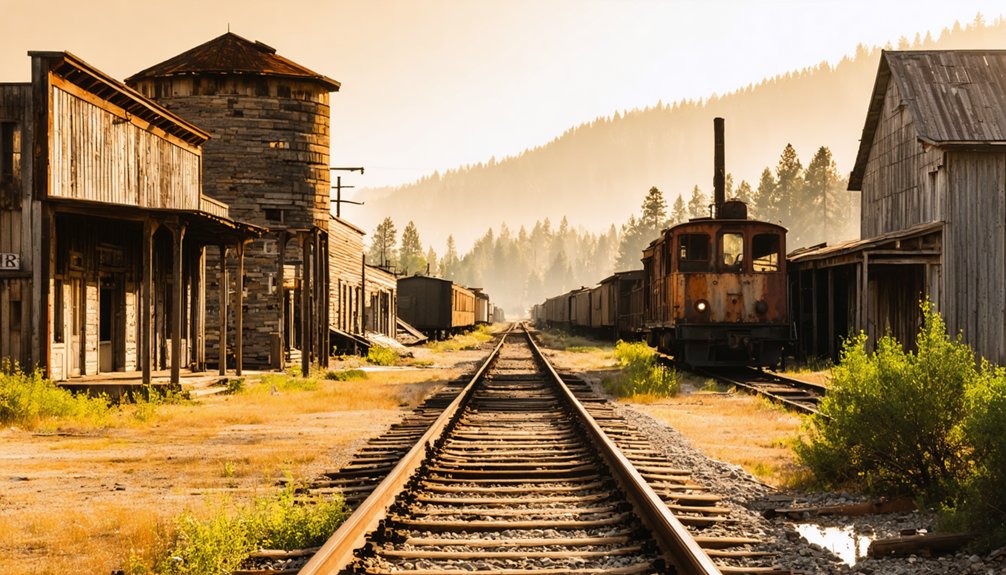
For seventy-seven miles, the Yosemite Valley Railroad carved its way through the rugged Merced River Canyon, serving as the essential artery connecting Merced Falls to the outside world.
Beginning regular service in May 1907, this significant line transformed travel to Yosemite from a grueling stagecoach journey into a comfortable 3.5-hour ride.
You would’ve witnessed Merced Falls transform through railroad expansion into a bustling commercial hub. The two-story depot, turntable, and busy freight yard buzzed with activity as lumber operations flourished. The area once served as a busy hub for lumber freight, reflecting the economic importance of timber industry in the region.
This community connectivity doubled the railroad’s revenue between 1910-1920, linking you to San Francisco and Los Angeles through connections with larger railways.
The YVRR wasn’t just transportation—it was freedom, bringing prosperity until its final run on August 24, 1945, when the whistle blew one last time.
The completion of modern highways in 1926 significantly impacted the railroad, leading to a sharp decline in passenger revenue as tourists increasingly opted for automobile travel.
Indigenous Presence and Cultural Interactions
Before Merced Falls emerged as a bustling mill town, the area served as home to Sierra Miwok and Ahwahnechee peoples who established permanent villages along the river’s rich fishing grounds.
You’d find their settlements strategically positioned to harvest acorns, hunt game, and access the river’s abundant resources—a way of life dramatically altered when the 1851 treaties forced many onto reservations between the Merced and Tuolumne Rivers.
Walking through the ghost town today, you’re treading on ground where indigenous families later adapted to changing times by working in the mills while maintaining cultural connections to lands they’d inhabited for thousands of years.
Original Miwok Settlements
Long before the gold-seekers and settlers arrived in what’s now called Merced Falls, indigenous Miwok peoples had established complex settlement patterns spanning across distinct ecological zones along the Merced River basin.
You’d have found Plains Miwok settlements concentrated in the lowlands, while the Southern Miwok inhabited the river’s lower banks.
Miwok architecture featured conical bark houses with central fire pits, positioned near creeks and springs in villages of 100-300 people. Chiefs’ dwellings stood larger, accommodating community gatherings, while ceremonial roundhouses served religious functions.
Indigenous subsistence relied heavily on deer hunting and acorn harvesting from black oaks.
The Miwok practiced seasonal migration, moving to higher elevations during summer months for food gathering. Their sustainable resource management supported populations across three major river systems for thousands of years before European contact.
Reservation History Timeline
As American authorities established control over California in 1850, the Indigenous peoples of Merced Falls found themselves caught in a dramatic transformation of their ancestral lands.
The timeline of reservation development unfolded rapidly:
- 1850 – Indigenous resistance erupted when Yosemite groups attacked James Savage’s trading post near the Merced River, triggering military responses from American settlers.
- March 1851 – Six tribes reluctantly signed reservation treaties following negotiations backed by military pressure.
- April-May 1851 – Sixteen additional tribes between the Chowchilla and Kaweah Rivers were forced into treaty agreements.
- 1851-1852 – Approximately 695 Indigenous people were relocated to the area between Merced and Tuolumne Rivers, creating a complex cultural intersection where ancient traditions confronted a new colonial reality.
The Great Depression’s Impact on Merced County’s Industrial Center
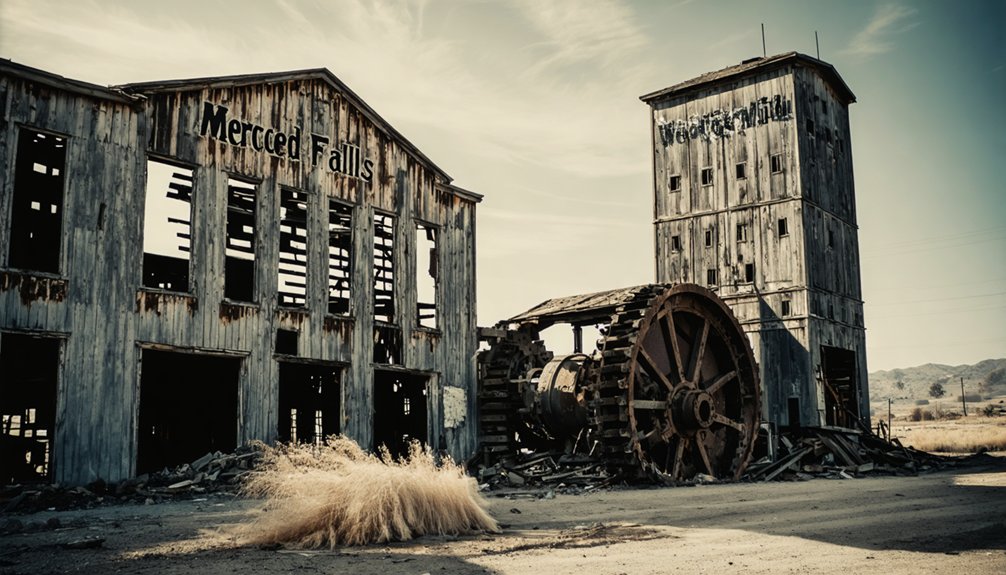
When the Great Depression swept across America in the early 1930s, Merced County‘s budding industrial center faced devastating economic challenges that would reshape its future for decades to come.
You’d have witnessed the once-thriving Yosemite Lumber Company struggling amid plummeting demand, while the Merced Irrigation District grappled with a crippling bond crisis that prevented crucial infrastructure improvements.
Economic hardship wasn’t just statistical—it manifested in labor struggles throughout the county as unemployment soared.
The industrial landscape changed dramatically when federal relief finally arrived through PWA projects, offering jobs and modernizing public facilities.
Though these efforts couldn’t prevent some industries’ collapse, including the lumber mill’s eventual 1942 closure, they planted seeds for the post-war transformation that would forever alter Merced’s industrial identity.
Fires, Conservation, and Economic Challenges
Fire brought dramatic transformation to Merced Falls long before its ghost town status, completely engulfing the settlement in August 1895 and destroying the wool and flour mills that had established the area’s industrial reputation.
The cycle of destruction and rebirth would become familiar to residents as fires’ impact on local industry created a recurring pattern of economic instability.
When you explore Merced Falls’ industrial decline, you’ll discover four primary challenges that sealed its fate:
- Destructive fires repeatedly ravaged local operations
- Conservation challenges limited timber harvest as Yosemite expanded
- Post-WWI lumber markets collapsed, devastating profitability
- Highway development made railroad-dependent operations obsolete
Conservation movements ultimately triumphed over industrial interests, with the Yosemite Sugar Pine Lumber Company’s 1942 closure marking the end of an industrial era.
The Final Days: Why the Town Was Abandoned
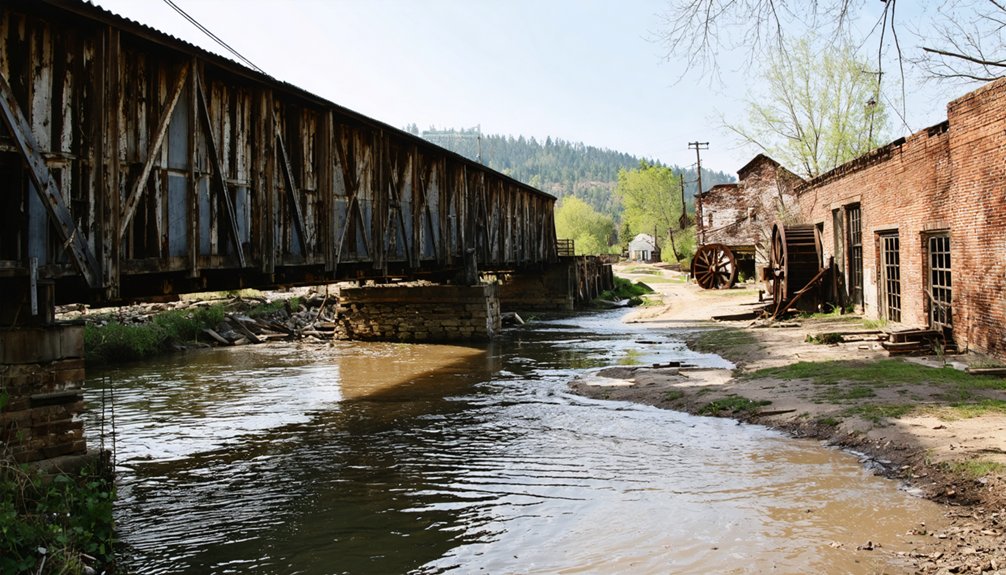
The final chapter of Merced Falls’ once-thriving community began with the slow, inevitable decline of the lumber industry that had been its lifeblood since 1911.
As logging restrictions tightened in the 1920s and the post-WWI lumber market weakened, the economic foundation crumbled beneath residents’ feet.
The Great Depression delivered the decisive blow, while the closure of the Yosemite Lumber Company in 1927 signaled the beginning of the end.
When the Yosemite Valley Railroad ceased operations following the mill’s final shutdown in 1942, your connection to the outside world was severed.
You’d have witnessed the painful community decline as families departed, leaving behind empty homes and silent streets.
From a bustling 1,500 residents to just a handful, including a lone barkeeper, Merced Falls transformed from vibrant town to forgotten memory.
What Remains Today: Exploring a California Ghost Town
Today’s visitors to Merced Falls will find a haunting stillness where industry once hummed with life. The north bank of the Merced River now cradles only brick foundations and scattered debris behind protective fencing, visible from the Hornitos Bridge but restricted for close exploration.
For those seeking to understand this vanished community, consider:
- Visit the Merced County Courthouse Museum to view the exhibit of restored photographs
- Observe the mill remnants from the roadside, respecting private property boundaries
- Appreciate the historic preservation work done by UC Merced researchers
- Photograph the ruins from permitted vantage points
Despite limited visitor accessibility, the ghost town offers a powerful glimpse into California’s industrial past—a freedom to imagine life in this once-thriving riverbank community.
Exploring ghost towns in California history reveals the stories of those who once called these places home. Each abandoned structure and weathered street bears witness to the hopes and dreams that once flourished in these now-silent landscapes. As you wander through these remnants of the past, it’s impossible not to feel connected to the lives lived and lost in these forgotten corners of the state.
Frequently Asked Questions
Can Visitors Access the Merced Falls Ghost Town Site Today?
Remember those forgotten places calling your name? Yes, you can access the ghost town site via public roads, though visitor guidelines are limited. You’ll find foundations and ruins viewable from roadside areas.
Were Any Famous People Associated With Merced Falls?
You won’t find famous residents or national historical figures associated with Merced Falls. The town’s notable personalities were regional lumber and railroad industrialists who’ve faded into the whispers of California’s forgotten past.
Did Any Supernatural Legends or Ghost Stories Emerge From Merced Falls?
You won’t find documented ghostly encounters or substantiated local folklore from Merced Falls. Unlike other abandoned towns, it hasn’t cultivated supernatural legends that would beckon thrill-seekers to its weathered remains.
What Natural Disasters Besides Fires Affected the Town’s Development?
You’d find your freedom challenged by devastating floods that swept away homes and earthquake impacts that shook foundations. The Merced River’s 1997 flood damage fundamentally altered the town’s future development path.
Were Any Movies or Television Shows Filmed in Merced Falls?
You won’t find cinematic history here—no movies or shows were filmed in Merced Falls. Unlike other ghost towns that became popular film locations, this forgotten place never attracted Hollywood’s attention.
References
- https://www.ghosttowns.com/states/ca/mercedfalls.html
- https://www.hmdb.org/m.asp?m=46956
- https://www.mercedmuseum.org/exhibits/past/ghost_towns_in_merced_county.shtml
- https://calisphere.org/collections/26976/
- https://en.wikipedia.org/wiki/Merced_Falls
- https://experience.arcgis.com/experience/23dcb503c3be43ea9bcba0bb224955cf/page/Merced-Falls-and-Snelling
- https://provostevc.ucmerced.edu/news/2018/local-ghost-town’s-past-display-new-collaborative-exhibit
- http://kissackadventures.blogspot.com/2020/06/ghosts-of-merced-falls.html
- https://www.cityofmerced.gov/government/about-merced/history
- http://www.mercedmuseum.org/exhibits/past/yosemite_lumber_company.shtml