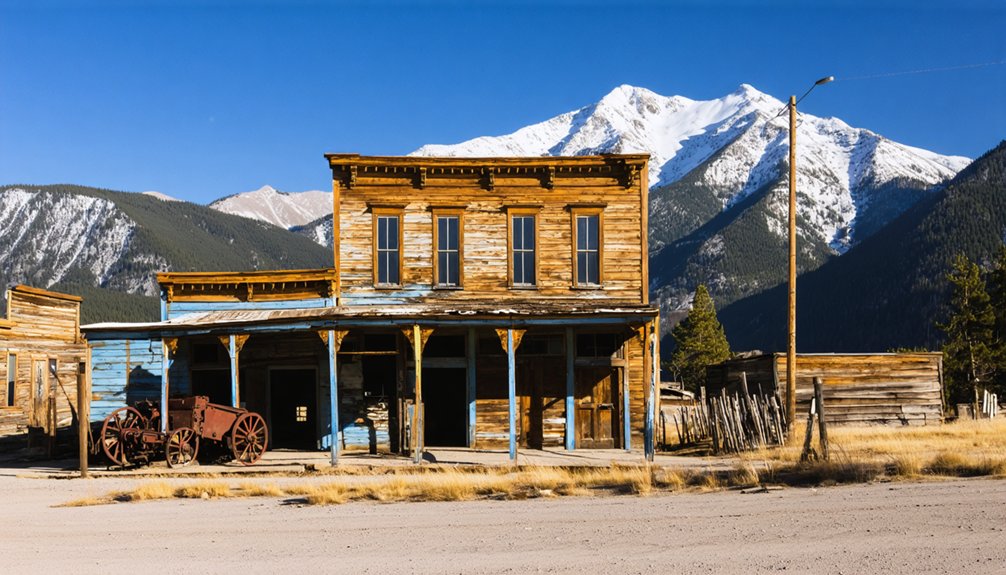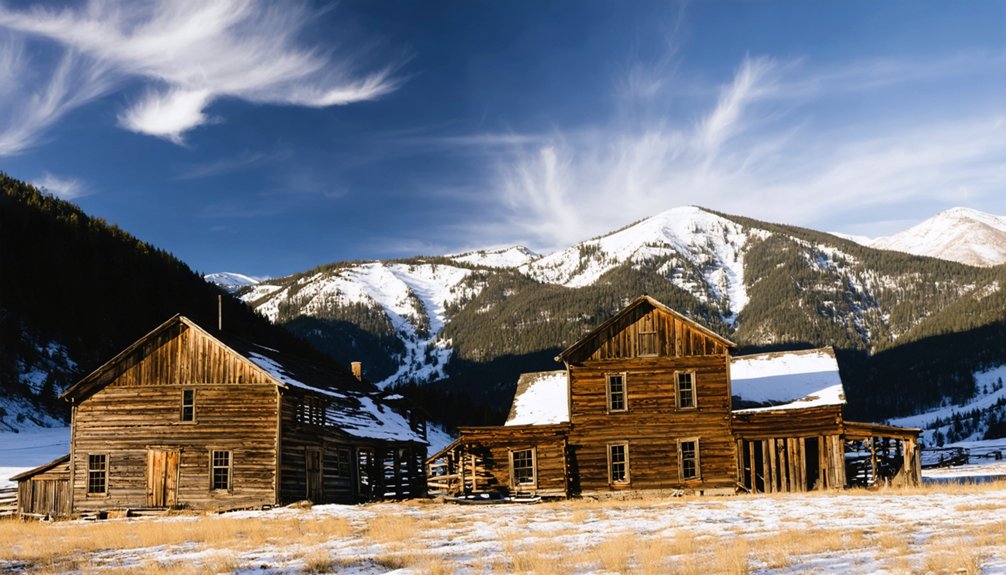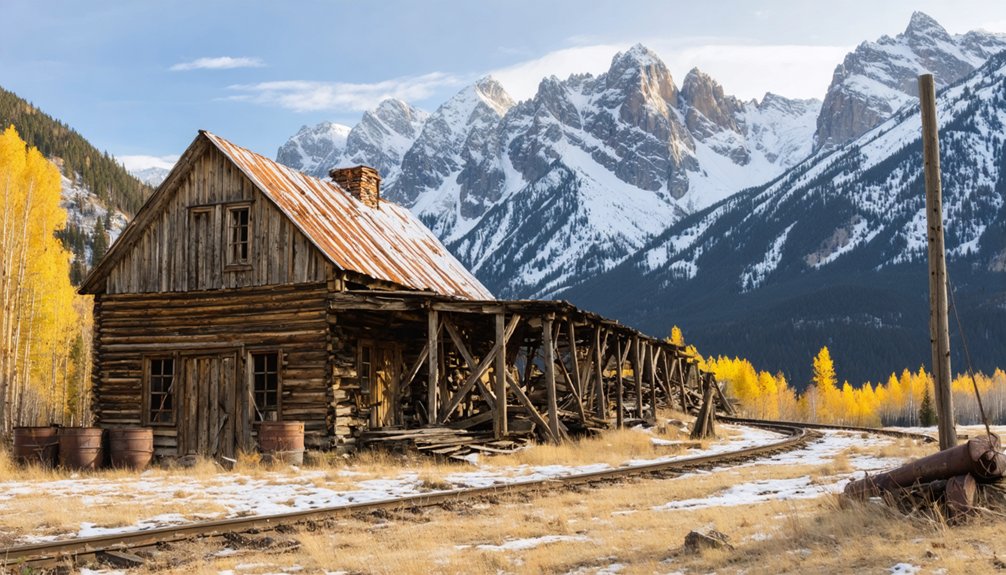
Colorado’s mountains conceal more than 600 abandoned mining towns, each one a time capsule from the Silver Rush era of the 1870s and 1890s. You’ll find weathered cabins, rusting machinery, and crumbling infrastructure scattered across elevations reaching 11,000 feet. Towns like St. Elmo, Alta, and Guston collapsed when silver demonetization hit in 1893, emptying once-thriving communities overnight. Understanding their histories, accessibility requirements, and seasonal considerations will transform your ghost town experience from a casual drive into something far more rewarding.
Key Takeaways
- Colorado’s mining ghost towns, like St. Elmo and Gilman, emerged during the 1870s–1880s Silver Rush and were later abandoned due to economic decline.
- Notable ghost towns include St. Elmo, Alta, Guston, Goldfield, and Gilman, each offering unique historical structures and cultural heritage.
- Elevations range from 9,600 to 11,060 feet, requiring proper gear, navigation tools, and four-wheel-drive vehicles for safe exploration.
- Summer and fall are the best visiting seasons, as high-elevation roads remain open and weather conditions are most favorable.
- Visitors should carry topographic maps, GPS devices, and emergency supplies, as cellular service is virtually nonexistent in these remote areas.
Why Colorado Ghost Towns Are Worth the Drive
Colorado’s ghost towns aren’t just abandoned settlements — they’re open-air museums where the architecture, artifacts, and landscapes tell a story no textbook can fully capture.
When you walk through these sites, you’re stepping into living history shaped by ambition, hardship, and eventual silence. From St. Elmo’s well-preserved storefronts to Alta’s weathered cabins perched above 11,000 feet, each location offers hidden treasures you won’t find behind velvet ropes or admission counters.
Local legends surrounding miners, booms, and busts add human depth to the physical remains. You’ll explore on your own terms, at your own pace, without crowds dictating your experience.
These towns reward the curious, the independent, and the historically minded — making every mile of the drive genuinely worthwhile.
The History Behind Colorado’s Mining Ghost Towns
When you examine Colorado’s ghost towns, you’ll find their origins tied directly to the Silver Rush of the 1870s and 1880s, when prospectors flooded the Rocky Mountains after significant ore discoveries.
Towns like Gilman, founded in 1886, and St. Elmo, established in 1880, emerged almost overnight as mining operations scaled rapidly, drawing thousands of workers and supporting entire economies.
You’ll recognize the boom-and-bust pattern clearly: once ore deposits depleted or commodity prices collapsed, populations evaporated just as quickly as they’d arrived, leaving behind the skeletal infrastructure you see today.
Colorado’s Silver Rush Origins
The discovery of silver in Colorado during the late 19th century set off one of the most transformative economic episodes in the American West.
Silver mining reshaped entire landscapes, drawing thousands seeking fortune and freedom. Towns erupted almost overnight, fueling remarkable economic growth before collapsing just as rapidly.
Three defining characteristics shaped Colorado’s silver rush:
- Rapid urbanization – Towns like Gilman reached 2,000 residents within years of founding.
- Infrastructure development – Communities quickly established telegraph offices, schools, saloons, and smelters.
- Sudden abandonment – Economic decline and environmental concerns left towns frozen in time.
Ghost town preservation efforts today let you witness these dramatic episodes firsthand.
Colorado’s abandoned settlements aren’t merely ruins—they’re tangible evidence of ambition, independence, and humanity’s relentless pursuit of opportunity.
Boom And Bust Cycles
Rapid urbanization and sudden abandonment weren’t random phenomena—they were predictable consequences of boom-and-bust cycles that defined Colorado’s mining economy.
When silver or gold discoveries surfaced, towns like Gilman and St. Elmo erupted practically overnight, drawing thousands seeking fortune. Infrastructure, commerce, and community followed swiftly.
Yet when ore prices collapsed or deposits depleted, you’d watch entire populations dissolve just as rapidly.
The economic impacts were devastating and irreversible. Federal silver demonetization in 1893 gutted towns almost simultaneously.
Environmental contamination forced others, like Gilman, into EPA-mandated closure by 1984.
What remains today isn’t failure—it’s cultural heritage preserved in weathered timber and rusted machinery. These towns document humanity’s relentless pursuit of wealth and the sobering consequences when that pursuit exhausts itself.
St. Elmo: Colorado’s Best-Preserved Ghost Town
Nestled in Chalk Creek Canyon at 9,600 feet elevation in Chaffee County, St. Elmo stands as Colorado’s most intact ghost town. Established in 1880, it once supported 2,000 residents across 50 active mines.
St. Elmo’s architecture reflects authentic frontier construction, while St. Elmo’s legends draw curious explorers seeking untamed history.
You’ll find these defining features worth noting:
- Historic Infrastructure – Original telegraph office, town hall, saloons, and hotels remain structurally preserved.
- Active Commerce – The general store still operates, connecting present visitors to the town’s living past.
- National Recognition – Listed as a national historic district in 1979, confirming its cultural significance.
You can walk its streets freely, experiencing a rare, unfiltered glimpse into Colorado’s independent mining spirit.
Gilman: The Colorado Ghost Town You Can’t Enter
Founded in 1886 during Colorado’s Silver Boom, Gilman sits in Eagle County as one of the state’s most enigmatic ghost towns—one you’ll never walk through.
Gilman history centers on lead and zinc extraction, with the Eagle Mine driving its economy and sustaining a peak population of 2,000 residents.
Gilman mining operations ultimately poisoned the town itself; toxic pollutants rendered the land uninhabitable, prompting an EPA-mandated evacuation in 1984.
Today, private property restrictions and environmental contamination keep you permanently locked out. You can glimpse its deteriorating structures from a distance, but entry remains strictly prohibited.
Unlike Colorado’s accessible ghost towns, Gilman represents something rarer—a place frozen not by abandonment alone, but by governmental intervention, industrial consequence, and the hard reality that some freedoms, once surrendered to industry, aren’t recoverable.
Alta, Guston, and Goldfield: Three Colorado Ghost Towns Worth the Detour
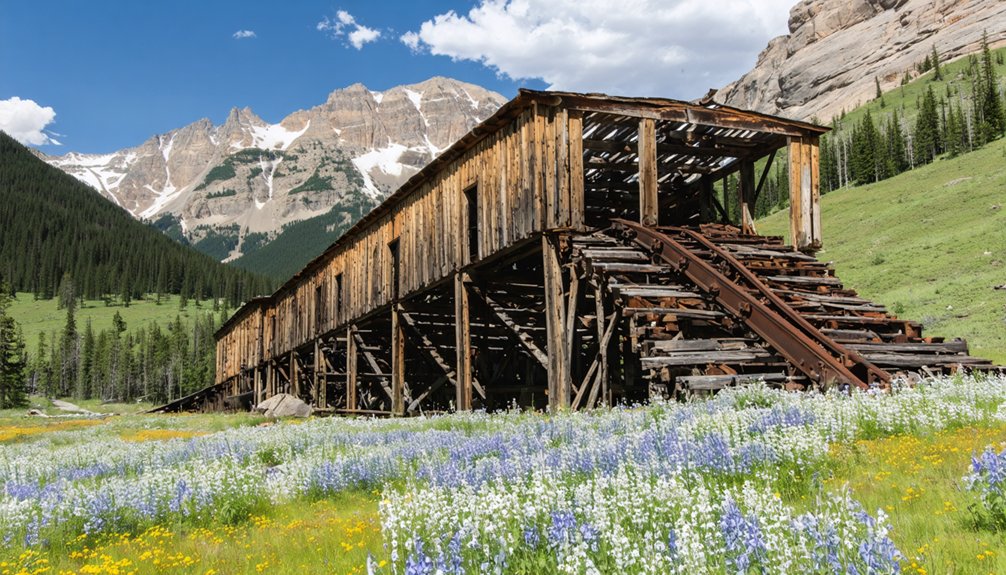
Three ghost towns—Alta, Guston, and Goldfield—reward Colorado explorers willing to venture beyond the well-worn tourist circuits. Each site offers distinct Mining Mysteries that illuminate Colorado’s turbulent extraction economy.
- Alta Adventures: Perched at 11,060 feet in San Miguel County, Alta’s original cabins and boarding house stand preserved near Telluride, listed on the National Register of Historic Places.
- Guston Ghosts: Nestled in the San Juan Mountains near Ouray, Guston’s weathered cabins and mine structures once served three major silver and gold operations, housing 1,000 residents.
- Goldfield Treasures: Founded in 1895 in Teller County, this union mining town of 3,000 residents relied on the Portland Mine before abandonment by 1932—its structures remain visible from County Road 81.
Vicksburg and Winfield: Colorado’s Twin Ghost Towns Frozen in Time
While Alta, Guston, and Goldfield each stand as isolated monuments to Colorado’s mining ambitions, Vicksburg and Winfield offer something distinct: a paired experience where two ghost towns sit within the same canyon, letting you trace the arc of a boom-and-bust economy across a single landscape.
Vicksburg history reveals a second-largest settlement in Clear Creek Canyon, supporting 600–700 residents, complete with a post office, school, and two billiard halls.
Just beyond it, Winfield architecture anchors a town that peaked at 1,500 residents by 1890, featuring three saloons, a church, school, mill, and smelter. Discovered in 1881, Winfield represents the canyon’s economic apex.
Together, both towns let you move freely through Colorado’s raw frontier past, reading each abandoned structure as a direct chapter in regional mining history.
What to Pack for Visiting Colorado Ghost Towns
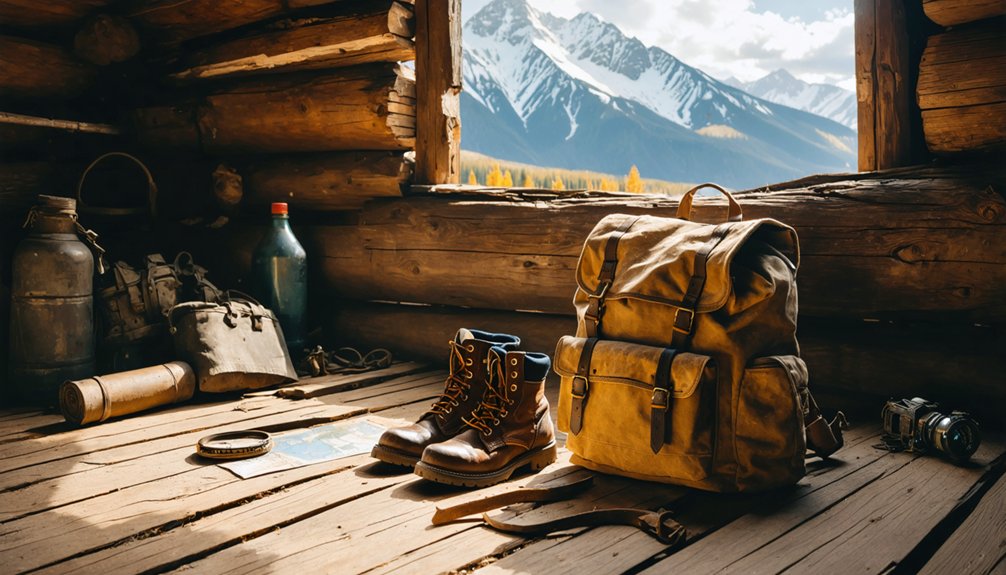
Exploring Colorado’s ghost towns demands deliberate preparation, since elevations ranging from 9,600 feet at St. Elmo to 11,060 feet at Alta create serious physiological challenges.
You’ll navigate unpredictable weather, rugged terrain, and genuine wildlife encounters across these remote sites.
Pack these three essentials:
- Navigation and safety gear – Carry topographic maps, a first-aid kit, and bear spray for wildlife encounters near San Juan Mountain sites like Guston.
- Photography equipment – Bring wide-angle and macro lenses for capturing weathered cabins, mine structures, and dramatic mountain backdrops; photography tips include shooting during golden hour for ideal lighting on aged timber.
- Layered clothing and provisions – Pack moisture-wicking base layers, a waterproof shell, high-calorie snacks, and two liters of water minimum.
Your freedom to explore depends entirely on your preparation.
How to Reach Colorado’s Most Remote Ghost Towns
Reaching Colorado’s most remote ghost towns requires you to navigate unpaved, high-clearance roads that often demand four-wheel-drive vehicles, particularly for sites like Alta at 11,060 feet or St. Elmo deep in Chalk Creek Canyon.
You’ll want to equip yourself with detailed topographic maps and a reliable GPS device, as cellular service is virtually nonexistent across Chaffee, San Miguel, and Eagle Counties.
Before you set out, confirm seasonal road closures, since many access routes remain buried under snow well into late spring and can reopen unpredictably depending on annual snowpack.
Remote Access Routes
How you reach Colorado’s most remote ghost towns often determines the quality—and safety—of your experience. Hidden trails and scenic routes reward those who prepare thoroughly.
- Alta and St. Elmo require high-clearance vehicles on unpaved mountain roads, particularly during early spring when snowmelt creates unstable terrain.
- Guston and Gilman demand advance research—Gilman remains private property, so you’ll need to confirm legal access points before approaching Eagle County roads.
- Goldfield and Winfield are accessible via County Road 81 and Clear Creek Canyon respectively, though seasonal closures can restrict passage without warning.
Always carry detailed topographic maps, since cellular service disappears quickly at elevation.
Your freedom to explore these forgotten landscapes depends entirely on your preparation and respect for posted boundaries.
Before you set out for Colorado’s most remote ghost towns, securing a reliable combination of USGS topographic maps and a GPS device calibrated to offline mode is non-negotiable, since cellular coverage vanishes within miles of towns like St. Elmo and Alta.
Download navigation apps like Gaia GPS or onX Offroad before departing, loading full regional terrain data.
Road safety demands you assess seasonal closures—many access routes above 10,000 feet remain snowbound through June. Always verify your vehicle’s clearance against published road ratings; Alta sits at 11,060 feet on surfaces unsuitable for standard sedans.
Carry printed backup maps since digital devices fail in extreme cold.
Tell someone your exact itinerary, including expected return time, before entering roadless corridors around Guston or Winfield.
The Best Times of Year to Visit Colorado Ghost Towns
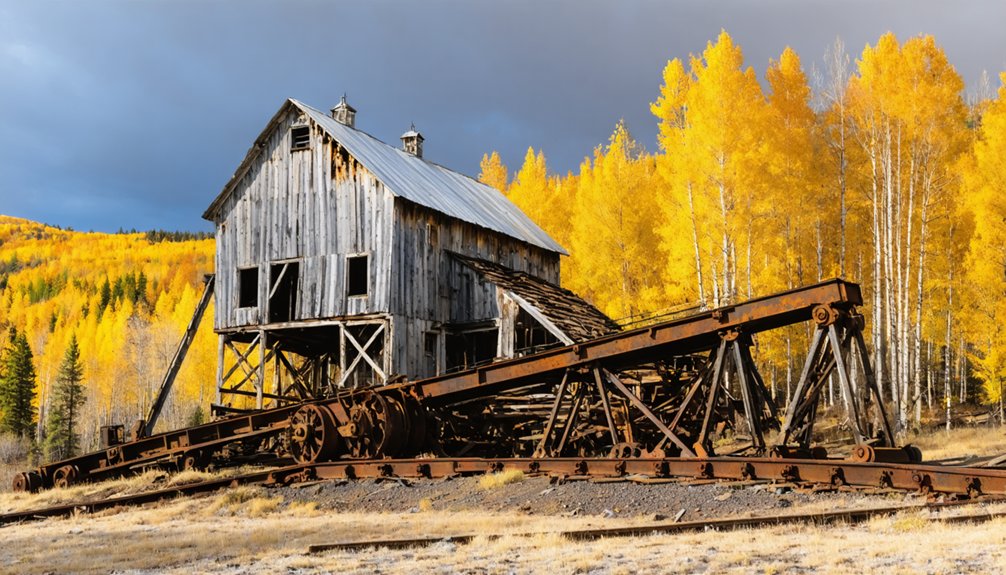
Timing your visit to Colorado’s ghost towns greatly shapes the quality of your experience, as the state’s dramatic elevation changes and alpine climate create conditions that vary widely across seasons. Knowing the best visiting seasons helps you maximize access and seasonal activities:
- Summer (June–August): Roads to high-elevation sites like Alta (11,060 ft) open fully, offering ideal hiking and exploration weather.
- Fall (September–October): Cooler temperatures and golden aspen foliage create stunning backdrops at sites like St. Elmo and Vicksburg.
- Winter (November–March): Deep snowpack closes most mountain roads, restricting access but rewarding snowshoers with uncrowded, atmospheric solitude.
Spring remains unpredictable; late snowstorms frequently strand unprepared visitors on remote canyon roads.
Frequently Asked Questions
Are There Any Ghost Town Guided Tours Available in Colorado?
You’ll find ghost town history comes alive through various guided tour options across Colorado. Local historical societies, private companies, and jeep tour operators actively offer immersive experiences exploring iconic sites like St. Elmo and Cripple Creek.
Can You Metal Detect or Collect Artifacts at Colorado Ghost Towns?
You’ll find metal detecting regulations are a labyrinth of rules! You must respect artifact preservation laws—you can’t collect items at historic sites without permits, as violations carry serious consequences protecting Colorado’s irreplaceable ghost town heritage.
Are Colorado Ghost Towns Accessible for Visitors With Mobility Limitations?
Accessibility varies widely across these sites. St. Elmo’s general store’s flat terrain accommodates adaptive equipment, while Alta’s 11,060-foot elevation challenges mobility. You’ll find historic preservation efforts don’t always prioritize accessibility, so research each town beforehand.
Do Any Colorado Ghost Towns Offer Overnight Camping Within Town Limits?
You can’t camp within most ghost town limits due to strict camping regulations, but Alta’s proximity to Alta Lakes lets you access town amenities while enjoying nearby overnight camping opportunities freely.
Are Pets Allowed When Visiting Colorado’s Historic Ghost Town Sites?
The knowledge doesn’t specify pet-friendly policies or ghost town regulations for these sites. You’ll want to check each location’s specific rules, as they vary—Gilman’s private property status likely restricts all visitor access entirely.
References
- https://es.uchealth.org/today/ghost-towns-abound-in-colorado/
- https://www.youtube.com/watch?v=e07GnE8W9nQ
- https://www.visitouray.com/ghost-towns
- https://www.colorado.com/articles/colorado-ghost-towns
- https://www.coloradolifemagazine.com/printpage/post/index/id/172
- https://en.wikipedia.org/wiki/List_of_ghost_towns_in_Colorado
- https://www.uncovercolorado.com/ghost-towns/
- https://leadville.com/the-ghost-towns-of-leadville-and-beyond/
- https://findinggoldincolorado.com/gold-rush-ghost-towns/