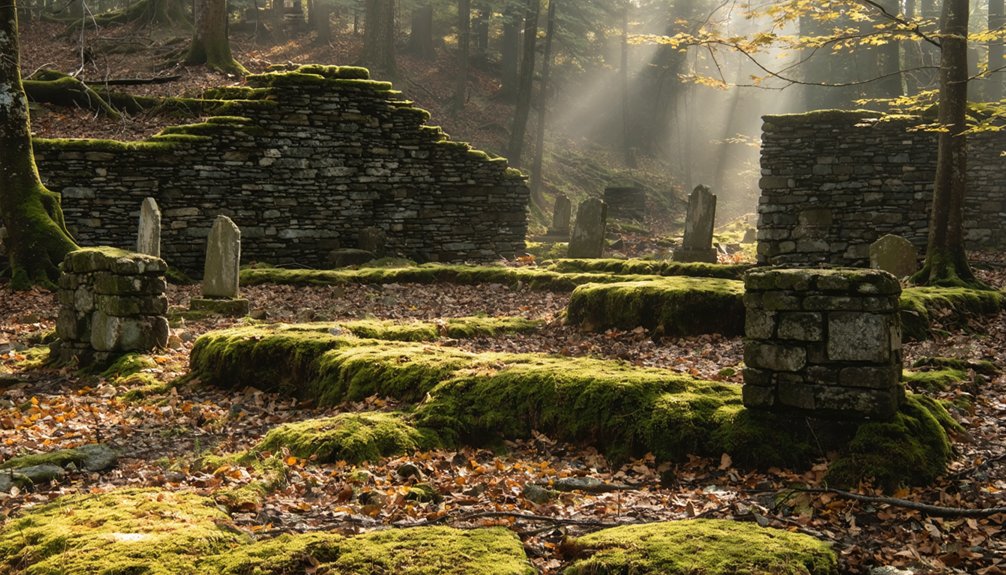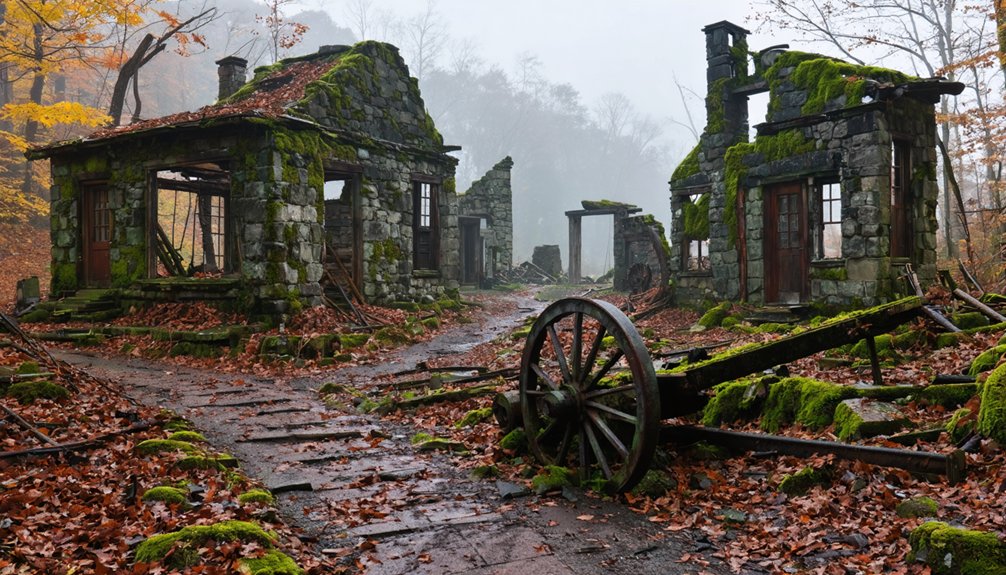
You’ll find Connecticut’s mining ghost towns hidden beneath suburban developments and forest floors, where 19th-century operations left networks like Cheshire’s four-mile barite tunnel system that now causes residential sinkholes. Colonial copper camps from the 1730s survive as foundation stones near Wallingford, while Old New-Gate’s 1707 workings became America’s first state prison. Cobalt’s flooded chambers and Salisbury’s Revolutionary War iron sites mark where German miners and colonial industrialists extracted ore that armed independence, though urban sprawl has consumed most remnants that forest reclamation spared.
Key Takeaways
- Cheshire’s Barite Mining Complex features over four miles of tunnels beneath Peck Mountain, now causing sinkholes under modern development.
- Old New-Gate transformed from America’s first chartered copper mine in 1707 into Connecticut’s first state prison in 1773.
- Salisbury’s Ore Hill supplied iron that armed the Revolutionary War, producing approximately 850 cannons for the Continental Army.
- Cobalt’s flooded Great Hill chambers contain Governor Winthrop’s 1640s gold mining sites and later cobalt extraction operations from 1770.
- Colonial copper fever in the 1730s created speculative mining camps across Connecticut Valley, leaving stone foundations now reclaimed by forests.
Cheshire’s Abandoned Barite Mining Complex Beneath Peck Mountain
Beneath the modern residential streets of Cheshire’s Peck Mountain and Jinny Hill neighborhoods lies a labyrinthine network of mining tunnels that represents one of Connecticut’s most significant 19th-century industrial operations. From 1813 to 1878, Yankee laborers and over 200 Cornish miners extracted snow-white barite ore through shafts exceeding 600 feet deep, creating over four miles of documented passageways.
You’ll find their legacy in local stone walls built from leftover ore blocks, but you’re also facing ongoing sinkhole hazards as rotted timbers collapse and surface subsidence continues. A 14-foot-wide asphalt rift valley mars an old basketball court where invisible streams trickle into voids below.
Despite environmental remediations, recently cleared entrances now permit 21st-century exploration of these pre-safety regulation tunnels.
Old New-Gate: From Colonial Copper Mine to Connecticut’s First Prison
Where the Metacomet Ridge slopes westward in present-day East Granby, America’s first chartered copper mine opened in 1707 with German miners extracting ore from tunnels that wealthy stakeholders—including Massachusetts governor Jonathan Belcher—hoped would generate colonial fortunes. Poor-quality ore and primitive mining methods doomed commercial operations by mid-century.
Connecticut’s General Assembly then purchased these abandoned shafts in 1773, transforming them into the colony’s first state prison. You’ll find that designers believed the underground labyrinth would prove escape-proof, yet first convict John Hinson fled after eighteen days when an accomplice lowered rope down the well shaft.
Between 1775 and 1782, twelve riots and sixty-two escapes exposed the facility’s failures. Dehumanizing prisoner conditions—twelve-hour underground confinement, shackled solitary cells, corn mush rations, and flogging—characterized operations until reformers publicized the institution’s brutality.
Cobalt’s Flooded Workings and the Legend of Governor’s Gold Ring
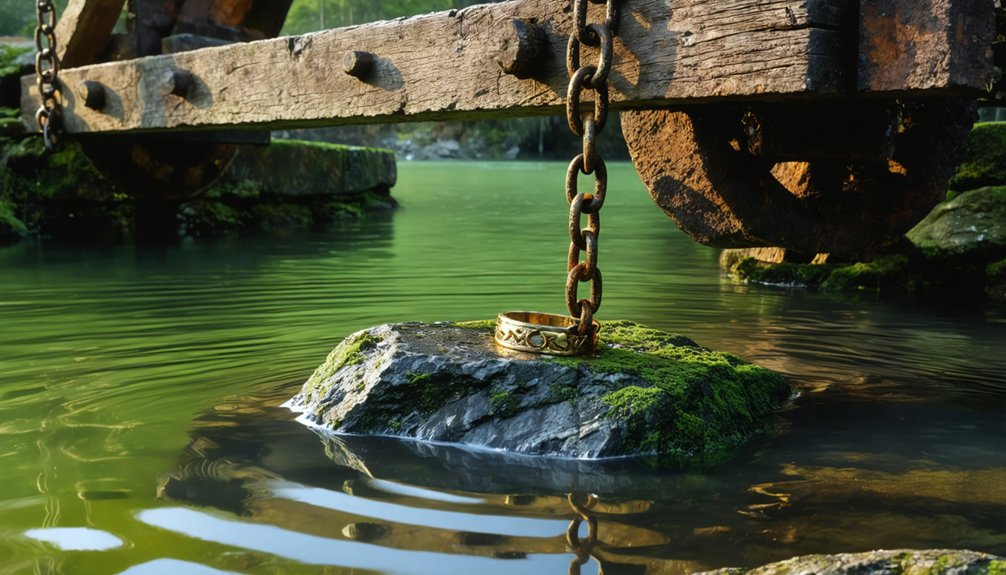
Four miles south of New-Gate’s notorious tunnels, the Metacomet Ridge conceals older workings still—shafts and adits that predate Connecticut’s copper prison by more than a century.
You’ll find Great Hill’s flooded chambers honoring Governor Winthrop’s gold mining history, where Connecticut’s first governor allegedly extracted precious metal in the 1640s and 1660s. The University of Connecticut confirmed native gold here in 1985, validating three centuries of whispered legend.
German prospectors shifted focus to the geology of cobalt deposits in 1770, extracting twenty tons before abandoning operations. Seth Hunt’s 1818 trenches and Francfort’s 120-foot shafts followed, all chasing cobalt for Chinese pottery glazes.
Today, remotely operated vehicles navigate 1,000 feet of submerged passages—testimony to ambitions that neither flood nor economic failure could completely erase.
Forgotten Colonial Copper Operations Across the Connecticut Valley
Long before New-Gate’s prison tunnels became Connecticut’s most infamous mining legacy, a copper fever swept the Connecticut Valley during the 1730s, transforming sleepy colonial settlements into speculative mining camps that would exhaust their investors and vanish within a generation.
You’ll find traces of these early mining boom experiments scattered across East Granby, Woodbury, Wallingford, and Manchester—operations backed by wealthy merchants and clergy who leased farmland for mineral rights. Thomas Cranne’s 1731 lease on John Crissey’s fourteen acres exemplifies the era’s speculative optimism, complete with complicated profit-sharing arrangements and elaborate milling deals.
Labor management challenges plagued these ventures. English and German miners worked shallow deposits using crude 18th-century techniques, while consortiums petitioned the Connecticut Colony Assembly for corporate charters that rarely translated into sustained profitability.
Iron Ore Extraction Sites That Armed the Revolutionary War
You’ll find that Salisbury’s Ore Hill supplied iron to the Ancram furnace twelve miles northwest, where workers forged 1,200 feet of defensive chain stretched across the Hudson River in 1778. The district’s furnaces produced approximately 850 cannons—representing 75-80% of domestically manufactured colonial artillery—through continuous 24-hour operations financed by Governor Trumbull’s Committee of Safety. This output earned Salisbury the designation “Arsenal of the Revolution,” though the region’s 43 furnaces would later face title disputes as the Barnum Richardson Company consolidated control over twelve facilities and their associated mining claims.
Ore Hill Chain Production
When surveyors first detected erratic compass behavior in northwestern Connecticut’s Salisbury district during 1731-1732, they’d stumbled upon what would become the region’s largest and richest iron ore deposits. Ore Hill’s superb limonite and goethite ore fed a 191-year mining operation that transformed raw earth into revolutionary firepower.
The Forbes brothers, John Hazeltine, and 23-year-old Ethan Allen constructed the region’s first blast furnace at Lakeville in 1762, dramatically increasing production capacity from bloomery forges’ 400 pounds daily to tons. By the Revolution’s outbreak, this furnace produced 75-80% of domestic patriot cannons—approximately 850 pieces firing nine, twelve, and eighteen-pound projectiles.
Despite technological innovations elsewhere, Connecticut’s failure to modernize, combined with diminishing ore quality, ultimately shuttered operations in 1923.
Cornwall Furnace Supply Network
Eight years before Ore Hill’s first blast furnace transformed Connecticut’s iron industry, Peter Grubb established the Cornwall Furnace in Pennsylvania’s Lebanon County—a charcoal-burning operation that would become the Continental Army’s primary armaments supplier. You’ll find its origins trace to Grubb’s 1734 purchase of iron-rich land, forming the Cornwall Ore Banks that fed his furnace from 1742 onward.
Under ore bank ownership of Curtis and Peter Grubb Jr., the facility cast 42 naval cannon and tons of ammunition, producing 28 tons of iron weekly during peak Revolutionary War years. Colonial iron shipments from this network armed Washington’s forces while Connecticut’s Salisbury District independently supplied USS Constitution components.
Robert Coleman assumed ownership by 1798, maintaining operations until 1883.
Mine Title Dispute Legacy
While copper mining ventures at Simsbury attracted shareholders through ecclesiastical profit-sharing schemes as early as 1706, the enterprise’s poor-grade deposits proved far less momentous than Salisbury’s iron ore beds discovered in 1731.
You’ll find the Revolutionary War’s most significant dispute over furnace control arose when Governor Jonathan Trumbull seized Englishman Richard Smith’s Salisbury operation after his December 1775 departure. This contested mine ownership rights transfer proved strategically essential—Trumbull’s Committee of Safety financed round-the-clock production that yielded 850 cannon by war’s end, comprising three-fourths of colonial artillery output.
The furnace cast its first cannon May 27, 1776, producing 9-, 12-, and 18-pound shot weapons that established Salisbury as the Arsenal of Revolution, while Simsbury’s copper works languished before conversion into Connecticut’s first prison in 1773.
Industrial Ruins and Abandoned Communities Near Historic Mining Districts
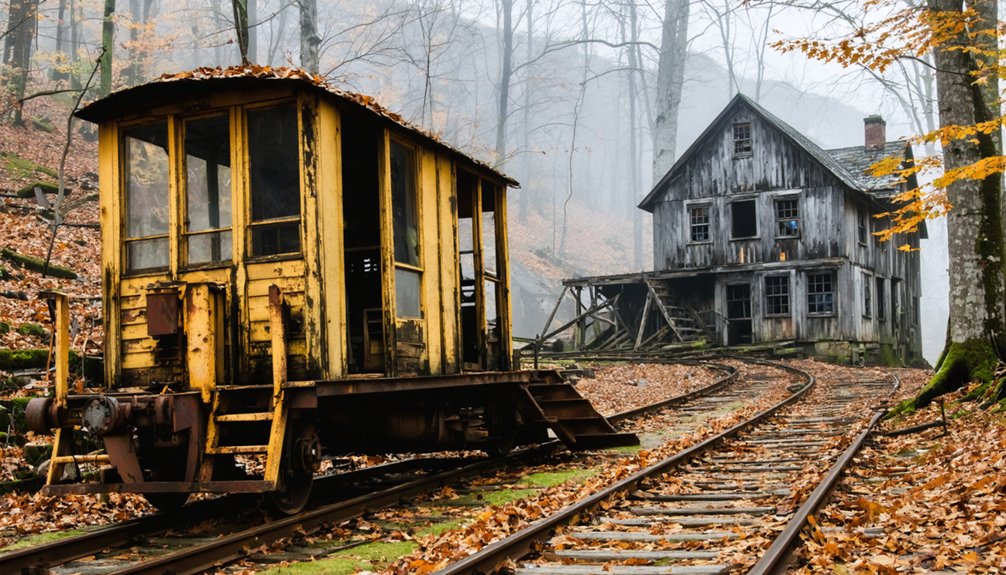
You’ll find Connecticut’s mining legacy extends beyond abandoned shafts into entire vanished communities, where Victorian-era mill towns like Johnsonville stand frozen in decay after industrial collapse.
The state’s copper and barite extraction sites spawned worker settlements that nature has steadily reclaimed—stone foundations from 1730s colonial mines near Wallingford emerge through forest undergrowth, while Saugatuck Reservoir’s 1920s construction permanently submerged Valley Forge’s iron-producing infrastructure beneath its waters.
Modern development has consumed other mining districts entirely, as Connecticut’s expanding urban infrastructure built over former extraction zones leaves only archival records and occasional sinkhole reminders of 600-foot-deep Cheshire barite shafts.
Victorian Mill Communities Decay
You’ll find these remnants throughout the state:
- North Stonington’s mill district – Once featuring woolen mills, gristmills, and blacksmith shops along Shunock River, now reduced to foundation stones and overgrown millraces
- Chalybes boom town – Hundreds of immigrant workers’ housing at Mine Hill’s base, abandoned after the 1872 furnace closure
- Killingly’s transformed villages – Post-Civil War brick mills replaced by empty shells after textile exodus
- Johnsonville’s frozen Victorian structures – East Haddam’s 62-acre ghost town preserving complete industrial architecture, listed for $1.9 million
Forest-Reclaimed Settlement Foundations
Connecticut’s mining operations left behind more than industrial buildings—the excavations themselves created underground labyrinths that now pierce the forest floor like forgotten catacombs. You’ll find New-Gate’s 80-foot vertical shafts extending into horizontal tunnels beneath East Granby’s woodlands, now accessible as reclaimed woodland attractions where carved caverns emerge from overgrowth.
Cheshire’s Barite Mine honeycomb spreads four miles beneath residential streets—600-foot shafts that still cause sinkholes where rotted timbers collapse. Stone walls built from polychrome ore blocks mark where streams disappear into unseen voids.
Salisbury’s Ore Hill and Tuttle Mine foundations hide near Cornwall Bridge, industrial heritage relics supporting Ethan Allen’s 1762 furnace operations. Golden Parlor and Wallingford’s shaft sites vanished completely, their locations lost among cemeteries and natural reclamation.
Urban Infrastructure Swallows Towns
Where Connecticut’s colonial mining frontiers once thrived in rural isolation, suburban expansion now consumes their remnants—parking lots pave over shaft houses, split-levels perch atop honeycomb voids, and municipal infrastructure erases what forest reclamation couldn’t finish.
You’ll find preserved landmarks struggling against development:
- Old New-Gate Prison’s 1707 copper workings now neighbor urban sprawl, flooded shafts beneath museum grounds marking where Connecticut’s first chartered mine operated.
- Trumbull’s Old Mine Park lost portions to Home Depot construction, tungsten-era crystals exposed during excavation of 1828-1946 workings.
- Cheshire’s barite mines hide 600-foot shafts beneath subdivisions—over four miles of passages collapsing into suburban yards, streams vanishing into abandoned 1813-1878 operations.
- Cobalt’s distillery site disappears under roads, 1700s timbering failures buried by pavement thirty years after 1775 abandonment.
Frequently Asked Questions
Are Any Connecticut Mining Sites Safe for Public Exploration Today?
You’d think exploring abandoned quarry sites would be your right, but Connecticut’s bureaucracy says otherwise. Industrial pollution concerns, structural hazards, and private property restrictions block access—legally speaking, you’re barred from these historical landmarks without explicit permissions.
What Happened to the Cornish Miners After Cheshire’s Barite Operations Closed?
You’ll find no specific records tracking the Cornish miners’ relocation after 1878, though mining company operations’ end scattered families throughout Connecticut’s changing community dynamics. Many likely integrated into industrial work or returned to Cornwall seeking new opportunities.
Can Visitors Access the Flooded Cobalt Mine Workings?
No, you can’t access the flooded workings—they’re entombed like Tutankhamun’s sealed chambers. Abandoned mining equipment rests underwater beyond reach, with restricted public access enforced by collapsed passages and safety hazards. Only ROV expeditions document what humans haven’t witnessed since the 1700s.
Were There Any Fatal Accidents in Connecticut’s Colonial Mining Operations?
No fatal accidents from Connecticut’s colonial mining operations were documented. You’ll find that rudimentary mineral extraction procedures and absent mining safety standards characterized this era, though sparse record-keeping means smaller incidents could’ve gone unrecorded in archival sources.
How Did Mining Closures Impact Local Connecticut Economies and Populations?
Mining closures triggered unemployment rates exceeding state averages, forcing you to witness population decline as residents fled ghost towns. You’d see shifting job opportunities emerge slowly—maritime, agriculture, and tourism sectors eventually generated thousands of positions, though rural mining areas persistently lagged behind.