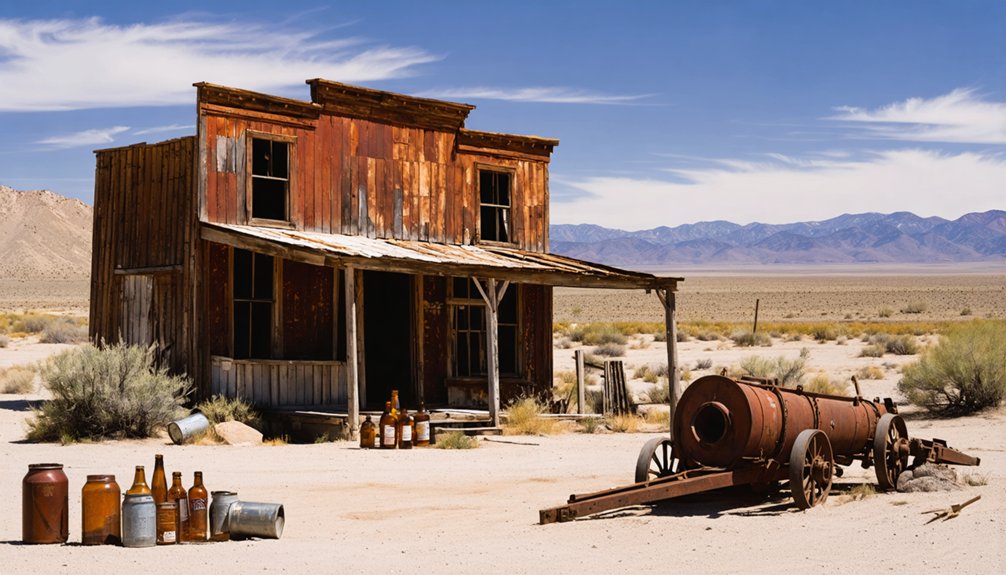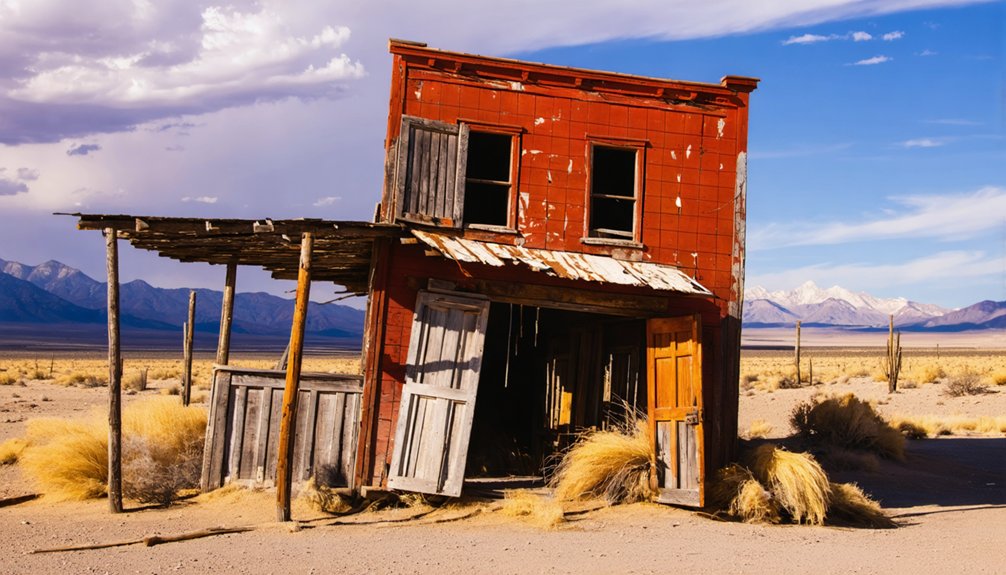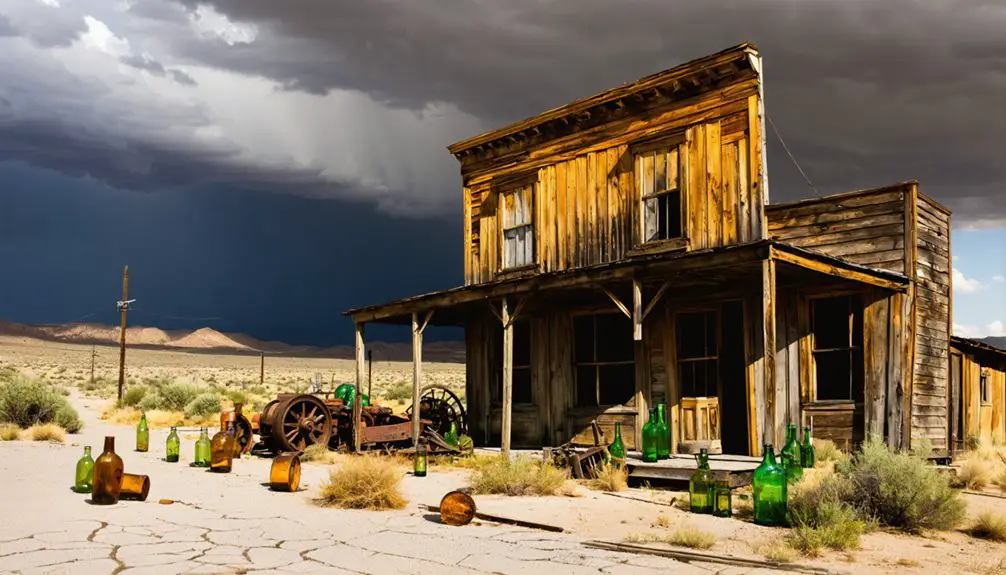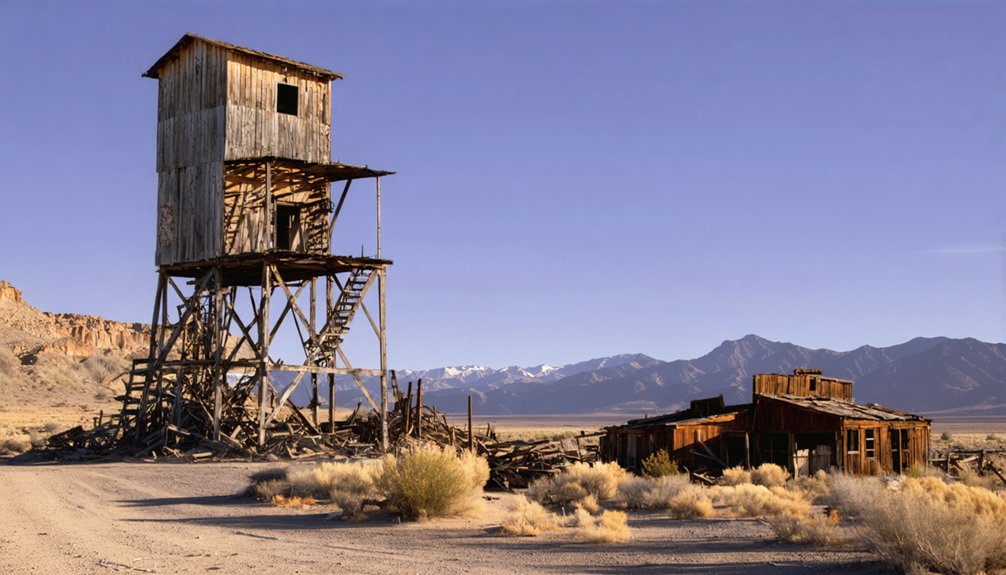
You’ll find over 600 documented mining ghost towns scattered across Nevada, where prospectors extracted $10 billion in ore between 1850 and 1945. Sites like Berlin offer self-guided tours through preserved stamp mills, while Goldfield‘s remnants recall daily $10,000 production runs that once supplied 30% of Nevada’s gold output. Techatticup Mine in Eldorado Canyon and Eureka’s 16 smelters stand as archaeological records of vertical shaft operations. The state parks system now protects key sites with seasonal tours and interactive exploration databases covering mineral deposits and historic coordinates.
Key Takeaways
- Nevada hosts over 600 documented ghost towns, with notable sites including Berlin, Goodsprings, Jarbidge, and Rhyolite featuring preserved mining structures.
- Techatticup Mine produced $10 million in ore by 1900, while Goldfield generated 30% of Nevada’s gold output in its prime.
- Berlin-Ichthyosaur State Park offers self-guided tours and Diana Mine exploration within a protected historic mining townsite.
- Specialized ghost town maps with interactive databases help explorers locate mineral deposits, town coordinates, and plan systematic regional itineraries.
- Historic sites like Rhyolite’s Cook Bank Building and Thompson Smelter provide accessible opportunities for archaeological exploration and photography.
Berlin: A Ghost Town Frozen in Time
In May 1863, silver discoveries in Union Canyon sparked the first mining activity in what would become one of Nevada’s most remarkably preserved ghost towns. Berlin emerged in 1897 within Nye County’s Union Mining District, named after Germany’s capital by homesick prospectors.
The Nevada Company’s 1898 acquisition transformed it into a thriving company town of 250 residents—miners, woodcutters, and skilled tradesmen who extracted $849,000 in precious metals through three miles of tunnels.
You’ll find preserved mining artifacts throughout the site, from the stabilized 30-stamp mill to the Diana Mine’s underground passages. The historic town layout remains intact, with original structures including the supervisor’s house, assay office, and machine shop. Visitors can explore the remaining buildings on a self-guided tour and take a guided tour of the Diana Mine on weekends from May to September. The 1907 financial panic triggered abandonment by 1911, freezing this settlement in time for future exploration. Today, Berlin is protected within Berlin-Ichthyosaur State Park, which was established in 1957 to preserve both the mining town and remarkable prehistoric marine reptile fossils.
Goodsprings: Where Mining Heritage Meets Modern Community
Unlike Berlin’s frozen-in-time abandonment, Goodsprings evolved from Nevada’s oldest lode mining operation into a living community that still echoes with industrial heritage. You’ll find mining heritage significance embedded in every corner—from the 1856 Potosi mine through the district’s $188.6 million production legacy. The town’s 800-person peak in 1916 has settled to 229 residents who’ve chosen freedom over urban constraints.
What sets Goodsprings apart is its evolving modern identity. You’re not visiting ruins; you’re experiencing a functioning settlement where mining-ranching traditions persist. The district produced Nevada’s greatest mineral variety—zinc, lead, gold, silver—accounting for one-third of Clark County’s metal output. The western portion concentrates the district’s most significant operations, including the Yellow Pine, Prairie Flower, and Alice mines. The narrow-gauge Yellow Pine Railroad connected Jean to Goodsprings in 1911, slashing transportation costs for oxidized zinc minerals and accelerating the district’s growth. Today’s renewed gold operations prove these 13,000-foot stratified deposits haven’t surrendered their wealth. It’s heritage you can touch, not just photograph.
Jarbidge: Remote Gold Rush Outpost Near the Idaho Border
You’ll find Jarbidge tucked against the Idaho border, where Dave Bourne’s 1909 discovery of what he estimated as $27 million in visible gold triggered two successive stampedes that brought over 2,700 prospectors to this canyon outpost by 1911.
The district’s production records tell a remarkable story—between 1919 and 1921, these remote workings outproduced every other gold camp in Nevada, with the Elkoro Mining Company alone extracting approximately $10 million before operations ceased in 1932. The Jarbidge mountain range had been prospected sporadically since the late 1860s, with the first gold and silver deposits discovered near the Bruneau River.
Today’s backcountry roads lead you to a skeleton town where permits reissued in 2013 have sparked renewed exploration, though the original buildings stand as primary evidence of a rush that represented one of the American West’s final frontier episodes. The town sits at an elevation of 6,218 feet in Nevada’s Elko County, maintaining its status as a near ghost town with fewer than the 1,500 miners who once crowded its streets during the initial boom.
Gold Strike of 1909
During the latter half of 1909, prospector Dave Bourne made the discovery that would ignite Nevada’s last great gold rush when he struck ore in the remote Jarbidge Canyon near the Idaho border. You’ll find the first significant strike recorded on August 19, 1909, following decades of unsuccessful explorations in the 1860s and 1880s. The canyon’s name derives from Bourne’s mishearing of the Shoshone word “Tsawhawbitts,” which he interpreted as “Jahabich” before it evolved into “Jarbidge.” The discovery triggered wild speculation and exaggerated stories that drew thousands of prospectors to the isolated region. A rush through the snow in March 1910 was followed by a swift exodus in May, though many gold seekers returned in another inbound rush by June.
Boom to Bust Timeline
Following Bourne’s August 1909 discovery, the spring 1910 stampede transformed Jarbidge Canyon into a sprawling tent city almost overnight. You’ll find over 1,500 men battled through fifteen-foot snow to stake 500 claims by mid-April 1910, yet exaggerated richness reports triggered a rapid exodus by summer.
The camp’s fortunes reversed when Elkoro Mining Company consolidated operations in 1918, propelling Jarbidge to lead Nevada’s gold production for three consecutive years (1919-1921). Production records show 355,000 ounces of gold extracted from 800,000 tons averaging 0.45 ounces per ton. Miners extracted ore through underground techniques, sinking shafts up to 610 meters to reach the gold-bearing veins.
However, ore production decline devastated the district by the late 1920s. Remote winter isolation and dwindling yields forced complete mining cessation in 1932, reducing the once-thriving camp of 2,000 to mere hundreds. The town witnessed the last stagecoach robbery in Western history on December 5, 1916, when bandits struck just a quarter-mile south of Jarbidge in the canyon.
Scenic Backcountry Access Today
Remote beyond most Nevada ghost towns, Jarbidge sits cradled in the Jarbidge Mountains of northern Elko County, where the rim-rock canyon of the Jarbidge River carves through dramatic volcanic terrain just miles from the Idaho border.
You’ll find remote backcountry access via Rogerson, Idaho, following the county-aided road that winds along the river through towering canyon walls. This engineered route avoids the punishing grades that once challenged early prospectors, though year round road conditions remain unpredictable.
Winter storms frequently seal off the basin, transforming this already-isolated outpost into an unreachable fortress of snow and ice. The harsh terrain that once protected miners from outside interference now offers you genuine escape from modern constraints—no easy path leads here, and that’s precisely the point.
Techatticup Mine: Spanish Colonial Gold in Eldorado Canyon
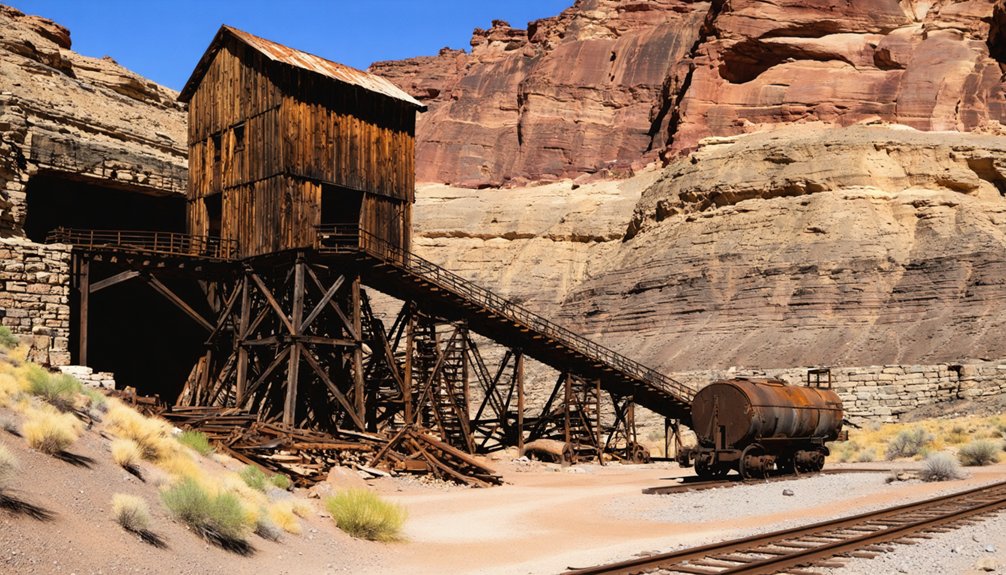
You’ll find Techatticup Mine’s origins predating Nevada statehood, as Spanish explorers named the site “Eldorado” in 1775 after discovering precious metals, though they abandoned it as unproductive.
The 1861 discovery of the Salvage Vein transformed this canyon into one of Nevada’s longest-operating mines, with production continuing from 1858 through 1945 and generating approximately $10 million in ore by 1900.
Today’s mine tours allow you to walk through candlelit chambers where seventy years of pickaxe work extracted gold from vertical ribbons of ore, while examining the original fifteen-stamp mill constructed in 1883 to process minerals on-site.
Spanish Mining Heritage 1700s
Legend shrouds the Techatticup Mine’s earliest origins in tales of Spanish prospectors working Eldorado Canyon’s gold deposits as early as 1775, though historians have largely discredited these accounts. These disputed historical claims suggest Franciscan explorers, allegedly sent by Father Junípero Serra around 1770, mined placer gold and silver throughout Clark County. However, unverified Spanish accounts lack archival substantiation—no confirmed Spanish parties reached Nevada until Father Francisco Garcés possibly crossed its southern tip in 1776.
The persistent folklore reflects broader patterns of colonial-era prospecting across the Southwest:
- Indian guides reportedly led Spanish miners to promising outcrops
- Spanish explorers abandoned sites after finding chiefly silver rather than gold
- Pre-1849 Franciscan mining operations remain undocumented
- American prospectors later rediscovered these supposedly “Spanish” deposits
You’ll find these origin stories more myth than documented reality.
Modern Historical Mine Tours
Today’s Techatticup Mine stands as Southern Nevada’s most accessible window into nineteenth-century hard rock mining, transforming violent industrial history into guided heritage tourism. The Werly family’s 1994 purchase salvaged decades of abandonment, establishing mine safety protocols that allow you to walk directly into the original quartz veins where Salvage ore generated millions.
You’ll encounter remnants of gold and silver still embedded in tunnel walls—tangible evidence of extraction that powered Southern Nevada from 1861 to 1942. The site’s modern commercial opportunities extend beyond standard tours: filmmakers utilize authentic structures, couples exchange vows amid industrial ruins. Located forty-five minutes from Las Vegas, this accessible ghost town democratizes mining heritage that once thrived on lawlessness, claim-jumping, and vigilante justice among five hundred desperate prospectors.
Goldfield: Rise and Fall of Nevada’s Largest Boomtown
When prospectors Stimler and Marsh staked their claims at the base of the Columbia Mountains in 1902, they couldn’t have anticipated that their discovery would transform a barren stretch of Nevada desert into the state’s largest city within just six years.
Goldfield’s mineral wealth extraction reached extraordinary heights by 1904, producing $10,000 daily and accounting for 30% of Nevada’s gold output. The spring 1904 stampede brought 10,000 fortune-seekers pursuing independence through prospecting.
Peak infrastructural development between 1905-1908 established:
- Three competing railroad lines
- Five banks and two mining exchanges
- Over 250 incorporated mining companies
- Five-story commercial buildings throughout downtown
Eureka: Silver-Lead Capital of the 1870s
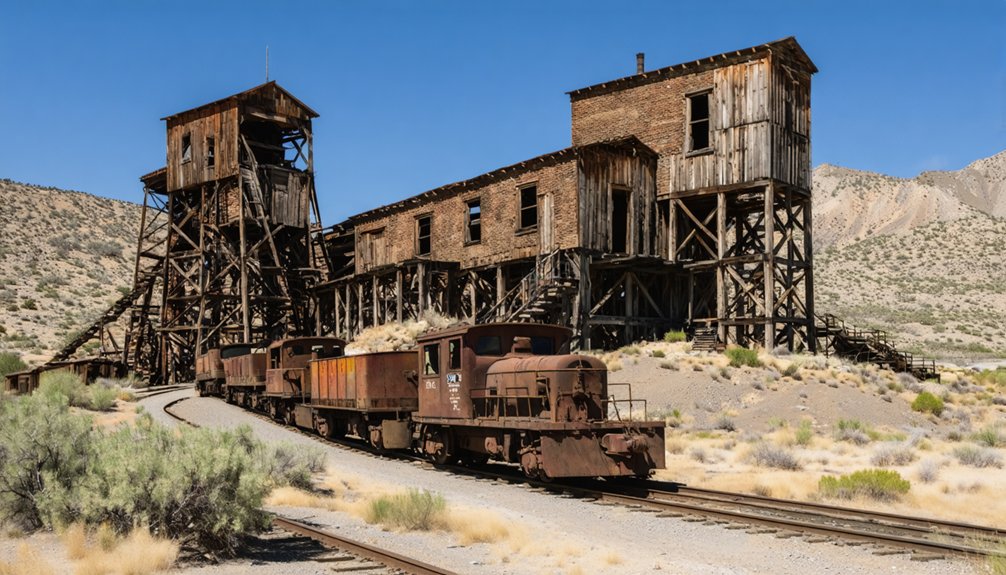
While Goldfield dominated Nevada’s mining landscape in the early twentieth century, the state’s silver boom decades earlier had already established a pattern of rapid urban development in remote desert locations. You’ll find Eureka exemplified this transformation after 1864’s silver-lead discovery on Prospect Peak.
By 1878, nine thousand residents supported sixteen smelters processing 745 tons daily, producing $5.2 million annually. The “Pittsburgh of the West” earned its nickname from perpetual smoke covering the district.
Water management challenges emerged in 1881, dramatically increasing pumping costs as ore bodies depleted. Unionized labor conflicts peaked during 1879’s charcoal burners’ strike, when Italian and Swiss immigrants protested price reductions. Their armed resistance culminated in Fish Creek’s deadly ambush, killing five deputies.
Despite these disruptions, production maintained previous years’ levels until smelters closed in 1891.
Exploring Preserved Mining Structures and Tours
Nevada’s abandoned mining camps offer unprecedented physical access to industrial archaeology, with structures ranging from 1870s brick courthouses to early twentieth-century cyanide mills standing in various states of preservation.
You’ll find remarkable preservation efforts at these sites:
- Berlin State Park provides self-guided tours through furnished miner cabins and weekend Diana Mine tours May-September
- Belmont Courthouse opens seasonally with Friends group tours showcasing 150-year-old architecture
- Rhyolite’s Cook Bank Building stands protected since the 1930s, featuring in early Hollywood films
- Thompson Smelter offers unrestricted archaeological exploration with climbable staircases overlooking Mason Valley
Tunnel Camp’s five-stamp mill and brick office remain accessible for independent investigation. These sites balance public access with structural integrity, letting you examine stamp mills, smelter foundations, and administrative buildings without excessive regulation.
Planning Your Nevada Ghost Town Adventure
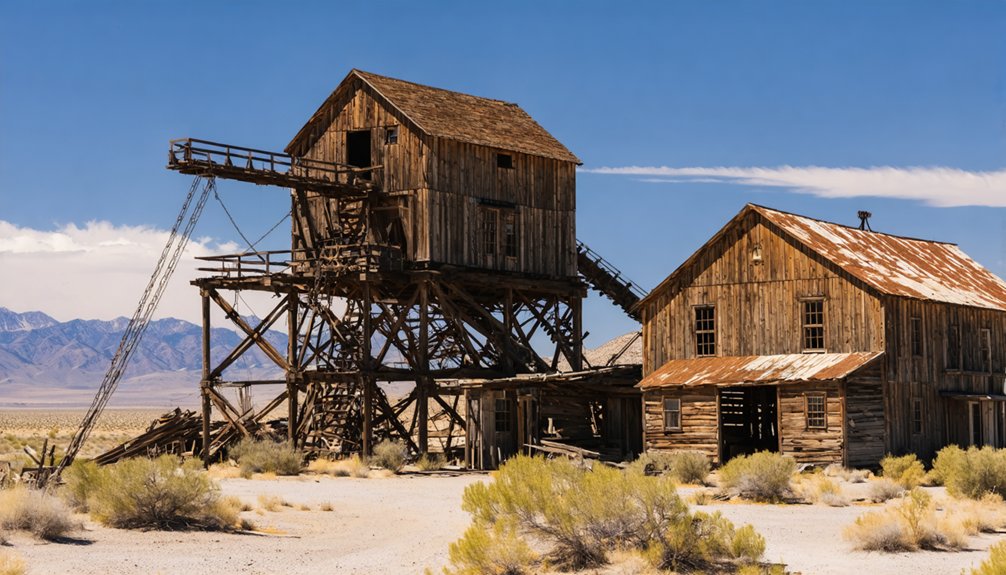
Before launching your expedition into Nevada’s mining past, you’ll need cartographic resources that match the territory’s scale—with over 600 documented ghost towns outnumbering the state’s living communities, extensive mapping becomes essential rather than optional. Specialized ghost town maps include interactive databases covering 800+ sites across Nevada and California, complete with archival photographs and operational timelines.
For backroad navigation challenges, tear-resistant printed maps prove invaluable—the 1976 Authentic Map marks mineral deposits alongside town coordinates. County-specific breakdowns help you tackle regions systematically, from Nye’s central ruins to Clark’s southern sites. Base yourself strategically in Reno, Las Vegas, or Elko to access multiple quadrants. Remember: mapped locations approximate actual coordinates.
Combine mining camps with historic trails like the Pony Express Route for thorough itineraries spanning 1860s-1950s industrial archaeology.
Frequently Asked Questions
What Safety Precautions Should Visitors Take When Exploring Nevada Ghost Towns?
Ghost towns aren’t museums—they’re living hazards. You’ll need proper protective equipment like sturdy boots and first-aid supplies, while respecting local regulations adherence. Pack ample water, avoid unstable mines, and leave artifacts untouched for genuine freedom through responsible exploration.
Are There Accommodations Available Near Nevada’s Remote Mining Ghost Towns?
You’ll find nearest lodging options at Gold Point’s restored miners’ cabins and Goldfield’s historic structures, though transportation availability proves limited. Most remote sites require your own vehicle, as public transit doesn’t reach these freedom-seeking destinations.
Which Nevada Ghost Town Is Best for Families With Children?
Virginia City offers your family the best experience with its hands-on mine tours, cowboy shows, and old-time photo opportunities. You’ll discover unique historical features throughout town while children enjoy scenic landscapes and interactive activities celebrating authentic gold rush heritage.
Can Visitors Legally Collect Artifacts or Minerals From Ghost Town Sites?
No, you can’t legally collect artifacts or minerals from ghost towns. Artifact ownership regulations and historic preservation concerns prohibit removal from both private property and BLM public lands without permits, protecting these sites from destruction and ensuring future access.
What Is the Best Time of Year to Visit Nevada Ghost Towns?
Visit during spring (March-May) or fall (September-November) when you’ll find ideal mining season temperatures of 60-80°F. These periods offer comfortable exploration conditions while supporting ghost town preservation efforts—you’ll avoid extreme heat that damages both visitors and fragile historic structures.
References
- https://savingplaces.org/stories/explore-wild-west-mining-history-in-nevada-ghost-towns
- https://findingnevadawild.com/goldfield-the-old-west-lives-in-nevadas-best-ghost-town/
- https://nevadamining.org/nevada-mining-towns-eureka/
- https://en.wikipedia.org/wiki/List_of_ghost_towns_in_Nevada
- https://westernmininghistory.com/state/nevada/
- https://www.nevadaghosttownsandmininghistory.com
- https://pubs.nbmg.unr.edu/category-s/1945.htm
- https://en.wikipedia.org/wiki/Berlin_Historic_District_(Berlin
- https://westernmininghistory.com/towns/nevada/berlin/
- https://offroad.vegas/featured-mining-town-berlin-nevada/