New Mexico’s mining ghost towns offer you direct access to sites where $3 billion in precious metals and coal were extracted between 1828 and 1950. You’ll find Lake Valley’s legendary 1882 Bridal Chamber that yielded $15,000-per-ton silver ore, Pinos Altos where miners defended against Cochise’s warriors with nail-loaded cannons in 1861, and Dawson where 383 coal miners died in two catastrophic explosions. These preserved camps span from 700 AD Pueblo turquoise operations at Cerrillos to 1890s lawless Mogollon, where territorial records document gunfights, payroll heists, and frontier justice that shaped each community’s ultimate abandonment.
Key Takeaways
- Lake Valley yielded $15,000-per-ton silver ore from its 1882 Bridal Chamber discovery before the 1893 gold standard crash ended operations.
- Mogollon became one of New Mexico’s most lawless camps in the 1890s, attracting gamblers, claim jumpers, and Black Jack gang members.
- Dawson coal mining town grew to 9,000 residents but suffered two catastrophic explosions in 1913 and 1923, killing 383 miners total.
- Chloride’s 1879 silver discovery sparked a boom reaching 3,000 residents before the 1893 Silver Panic reduced the population to just 125.
- Visitors should secure detailed navigation, verify road conditions, and prepare for unstable structures, limited cell coverage, and private property boundaries.
Lake Valley: From Bridal Chamber Riches to Abandoned Streets
In 1878, cowboy prospector George W. Lufkin discovered silver ore that’d transform Lake Valley into one of the West’s legendary mining camps. You’ll find the town’s fame rests on the 1882 Bridal Chamber discovery—a forty-foot-deep pocket yielding ore assayed at $15,000 per ton. The mineralization methods revealed stephanite, proustite, and pyrargyrite within Lake Valley Limestone’s geological formations.
Sierra Grande Mining Company extracted 2.5 million ounces from this single deposit, paying $100,000 monthly dividends. However, economic factors devastated operations when 1893’s gold standard implementation crashed silver prices. The 1895 Main Street fire sealed Lake Valley’s fate.
Today, you’re free to explore BLM-preserved structures where prospectors once pursued fortunes valued over $5 million.
Pinos Altos: Gold Rush Town That Refused to Die
You’ll find the legendary Roy Bean operated a merchandise and liquor store in Pinos Altos before his infamous “Law West of the Pecos” days in Texas.
On September 27, 1861, your predecessors witnessed the Battle of Pinos Altos when Arizona Guards militia repelled Chiricahua Apache warriors led by Mangas Coloradas and Cochise, deploying a cannon loaded with nails and buckshot that killed up to 30 Apaches while sustaining 12 casualties.
These conflicts intensified throughout the 1860s as U.S. Army troop withdrawals during the Civil War restricted prospectors to a half-mile radius from town center.
Judge Bean’s Mercantile Days
Among the colorful characters drawn to Pinos Altos during its 1860-61 boom, Samuel G. and Roy Bean established a merchandise and liquor dealership that showcased remarkable mercantile goods variety. You’ll find records documenting their operation featured a fine billiard table—unusual luxury for frontier mining camps. Bean’s entrepreneurial spirit thrived in this remote settlement where miners paid in gold dust for everything from whiskey to hardware.
The Mesilla Times advertised these establishments in 1861, confirming the camp’s commercial sophistication. While Samuel ran the Pinos Altos operation, Roy Bean would later gain fame as “The Law West of the Pecos” in Texas. Their venture represented the kind of independent enterprise that transformed raw mining strikes into functioning communities, proving commerce followed gold wherever prospectors staked claims in Grant County’s rugged mountains.
Battle Against Cochise’s Warriors
While Bean’s enterprise flourished during Pinos Altos’s 1860-61 boom, the town’s commercial success directly threatened the Chiricahua Apache homeland. Mangas Coloradas and his son-in-law Cochise mobilized approximately 400 warriors for a decisive strike on September 27, 1861. You’d have witnessed miner resistance that defied conventional expectations—defenders deployed a cannon loaded with nails and buckshot, even enlisting available women in combat operations.
The Mesilla Times documented the engagement’s brutal arithmetic: thirty Apache casualties against a dozen miners killed or wounded. The aftermath effects proved transformative. Apache forces withdrew, and mining operations expanded dramatically beyond placer gold to silver, copper, lead, and zinc deposits. By 1869, Pinos Altos claimed sufficient civic importance to serve as Grant County seat, evidence that armed defiance had secured its survival.
Mogollon: Where Outlaws and Miners Clashed in the Mountains
You’ll find that Mogollon’s population explosion to between 3,000 and 6,000 residents in the 1890s transformed it into one of New Mexico’s most lawless mining camps. The town’s isolation deep in the Mogollon Mountains attracted gamblers, claim jumpers, and members of the Black Jack gang, creating a volatile mix of mineral wealth and frontier violence.
On a single day in 1912, outlaws stormed the Mogollon Mercantile during an Ernestine Mining Company payroll robbery, making off with over $3,500 and killing two men before Deputy Sheriff Baca tracked them down.
Wild West Reputation
Deep in the Mogollon Mountains, this isolated mining camp earned its reputation as one of New Mexico’s wildest settlements through a deadly combination of Apache warfare and frontier lawlessness.
You’ll find Mogollon’s notoriety stemmed from three distinct factors:
- Harsh living conditions in extreme isolation attracted gamblers, claim jumpers, and stagecoach robbers alongside legitimate miners
- Dangerous mining operations at Little Fannie Mine caused widespread Miner’s Consumption, creating constant population turnover among the 3,000-6,000 transient residents
- Cyanidation methods introduced toxic poisoning risks that compounded the camp’s already deadly environment
The 1912 Mogollon Mercantile massacre exemplified this volatility—two clerks died defending the Ernestine Mining Company’s $3,500 payroll. Sheriff James killed bandit Juan Gregorio Torrango in the subsequent shootout, recovering $2,000 from his body. Accomplice Granado faced New Mexico’s first hanging since 1907.
Famous Outlaw Visitors
Between 1890 and 1920, Mogollon’s extreme isolation transformed the mining camp into a refuge for some of the Southwest’s most notorious criminals. Stagecoach robbers established the town as their operational base, targeting transportation routes throughout the region.
In 1912, bandits killed two clerks at Mogollon Mercantile while robbing the Ernestine Mining Company’s $3,500 payroll—a sheriff’s pursuit ended in a fatal shootout with the perpetrators.
Pancho Villa’s 1910-1920 raids demonstrated Villa’s impact on local families, though he spared the Waynes due to prior friendship, unknowingly leaving their gold bullion hidden beneath beds. The claim jumper’s threat to mining operations remained constant as corrupt miners attempted seizing established claims. You’ll find desperadoes, gunmen, and gamblers comprised significant portions of Mogollon’s 3,000-6,000 residents, matching the lawlessness of America’s most infamous frontier towns.
Violence and Lawlessness
Beyond the colorful characters who passed through town, Mogollon’s daily reality centered on bloodshed and brutality that would shock even hardened frontier veterans. You’ll find violence woven through every aspect of this mountain settlement, where troubled labor relations and unsafe work conditions created perpetual tension.
The historical record reveals three distinct sources of carnage:
- Apache conflicts – April 1880’s Alma Massacre claimed James C. Cooney and 38 others under Chief Victorio’s raids
- Mining disasters – Little Fannie’s cave-ins buried workers alive when support beams cracked from rushed timbering
- Criminal violence – February 19, 1912’s payroll heist left Clark and Freeman executed point-blank, their office blood-soaked
Between 1872-1873, stagecoaches suffered 23 robberies by one persistent outlaw. Over a dozen saloons and two red-light districts fueled routine gunfights among claim jumpers and desperados.
Dawson: A Coal Town’s Tragic Rise and Fall
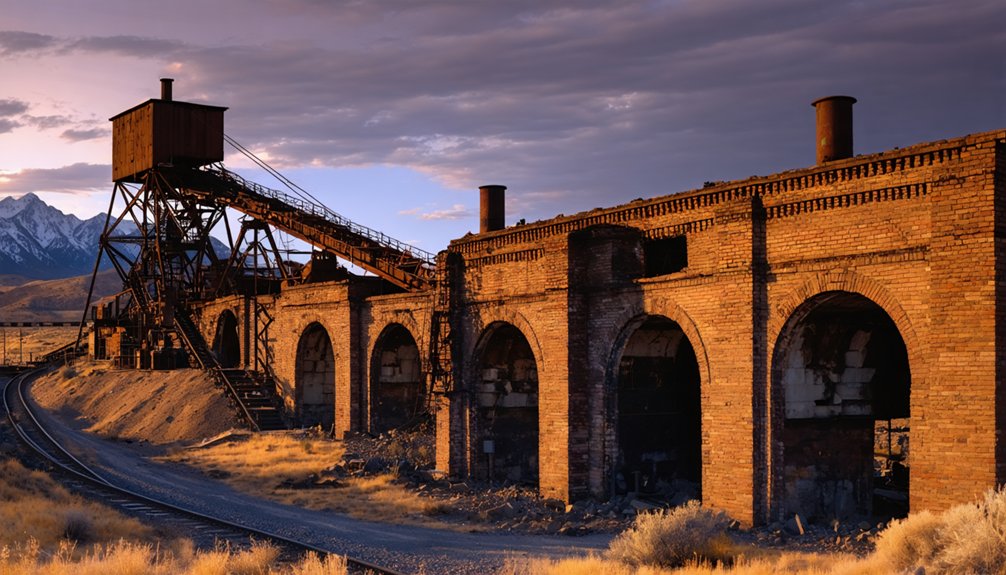
When J.B. Dawson opened his first coal mine in 1901, you’ll find the operation quickly transformed 3,700 acres into New Mexico’s most ambitious mining venture. By 1905, Phelps Dodge Corporation controlled mining operations that employed 650 men extracting 423,000 tons annually. The community development was extraordinary—9,000 residents enjoyed a three-story mercantile, opera house, hospital, and golf course.
Then tragedy struck twice. On October 22, 1913, an illegal dynamite blast ignited coal dust in Mine No. 2, killing 263. February 8, 1923 brought another explosion in Mine No. 1—120 dead after a derailed car struck timber supports while the sprinkler system sat frozen.
Despite producing 33 million tons total, you’d watch diesel locomotives eliminate 60% of customers. The mines closed April 28, 1950.
Cerrillos: A Thousand Years of Mining History
Long before Spanish conquistadors claimed the Southwest, Pueblo Indians extracted turquoise from Cerrillos’ hills around 700-900 AD, establishing what you’ll recognize as North America’s oldest documented mining operation. By 1150 AD, entire villages functioned as specialized refinement camps.
Pueblo Indians pioneered turquoise mining in Cerrillos around 700-900 AD, creating North America’s oldest documented mining operation centuries before Spanish arrival.
Spanish exploitation triggered the 1680 Pueblo Revolt, ending Governor Vargas’s 1695-established mining district.
The 1879 gold strike transformed Cerrillos into New Mexico’s most significant boom town, where you’d find:
- Over 2,000 territorial mines filed across Cerrillos Hills
- Peak populations reaching 3,000 prospectors by mid-1880s
- 21 saloons and sophisticated mining technology extracting gold, silver, lead, zinc
Mineral deposits exhaustion gradually shifted economic dominance to coal operations from nearby Madrid. What remains today represents a millennium of mineral wealth that once made Cerrillos a contender for territorial capital.
Chloride: Silver Strikes and Frontier Justice
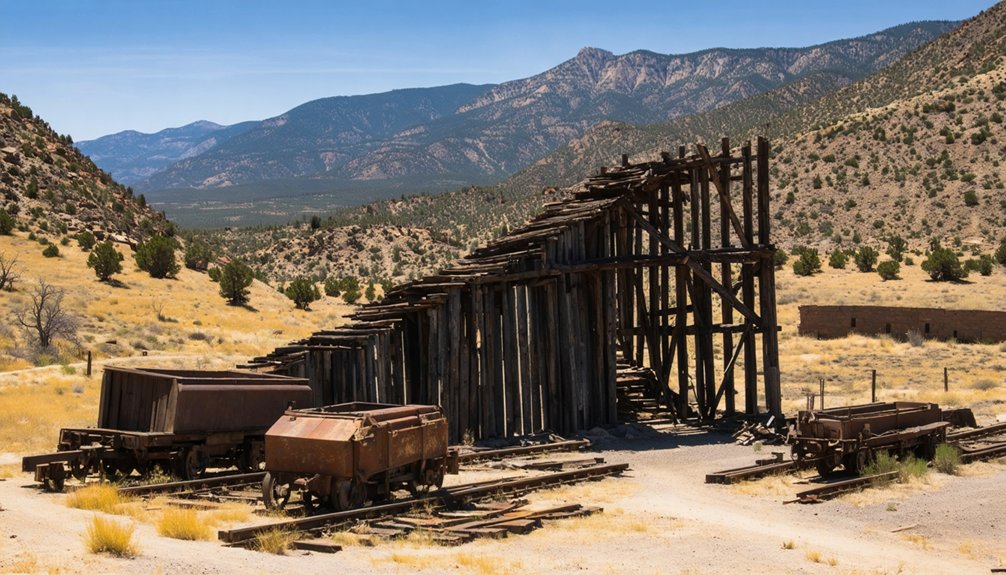
While freighting supplies for the U.S. Army between Hillsboro and Camp Ojo Caliente in 1879, Harry Pye discovered high-grade silver chloride float in the Black Range Mountains. He’d assayed the samples and kept his find secret until returning in 1881 with Forbes and Elliot to stake the Pye Lode—the mother lode that’d spark a silver boom.
By 1883, Chloride’s population reached 3,000. The Apache Mining District’s 480 claims became 42 working mines, supporting eight saloons, stores, and a newspaper called the Black Range. You’ll find frontier legends woven through every street: Apache raids, tar-and-feathering incidents, and Pye’s own death at Apache hands before profiting from his discovery.
The 1893 Silver Panic devastated the town. Silver dropped from $1.81 to eighteen cents per ounce by 1896, leaving just 125 residents.
Exploring New Mexico’s Mining Heritage Today
The silver crashes that emptied towns like Chloride left behind a vast archaeological record across New Mexico’s mining landscape. You’ll find preservation efforts protecting sites like Real de Los Cerrillos, founded in 1695 and recognized as America’s oldest official mining community. Since its 1973 placement on the State Register of Cultural Properties, sustainable tourism has allowed you to explore these historic grounds firsthand.
Today’s accessible resources include:
- New Mexico Mines Database – Compiling photographic documentation and mine data since 1927
- Cerrillos Hills Historic Park – America’s first public park dedicated exclusively to mining history
- BLM-managed mineral estates – 44.5 million acres preserving 1,000+ years of extraction heritage
Population growth continues bringing outdoor enthusiasts to districts where Spanish governors like Oñate and Vargas once directed operations personally.
What to Expect When Visiting Ghost Town Sites
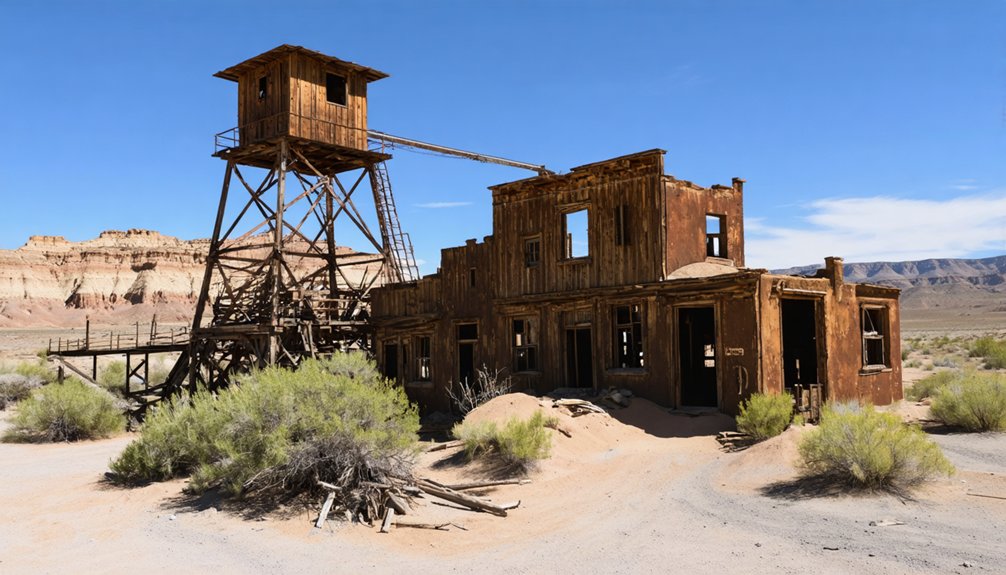
Visiting New Mexico’s ghost towns demands realistic expectations about accessibility, preservation conditions, and physical challenges awaiting modern explorers. You’ll encounter sites ranging from BLM-managed locations with interpretive signage details and restored structures to vandalized ruins displaying “No Trespassing” warnings.
Visitor safety precautions prove essential—Mogollon’s 7,000-foot elevation road tests nerves, while remote sites lack cellular service entirely. Some destinations like Shakespeare Ghost Town operate structured tours (10am, 12pm, 3pm MT, $15 adults), whereas Lake Valley permits Monday-Thursday self-guided exploration.
Expect wind-swept solitude punctuated by banging tin, private property boundaries limiting interior access, and wildlife encounters on trails. Cell service disappears in mountain locations. Abandoned structures tempt entry but often harbor structural instability and squatting evidence, particularly in unmanaged towns like Cuervo.
Planning Your New Mexico Ghost Town Adventure
Before setting out on New Mexico’s ghost town circuit, secure detailed navigation resources since remote sites test even GPS-equipped vehicles. New Mexico Tourism provides printable PDF maps, while UNM EDAC maintains interactive databases documenting site conditions.
Understanding local travel conditions proves essential—cell coverage disappears in backcountry, and weather transforms passable routes into impassable terrain without warning.
Your preparation checklist includes:
- Download offline maps showing historic centers, stage stops, and rail depot locations with modern road overlays
- Verify current road conditions and property access requirements before departure
- Prepare vehicles for unpaved, weather-damaged routes requiring high clearance
Protecting historic structures demands respecting posted signage and obtaining permission before entering private property. Many documented mining sites from the territorial period sit on restricted land, making advance research non-negotiable for responsible exploration.
Frequently Asked Questions
Are New Mexico Ghost Towns Safe to Visit With Children?
You’ll need strict hiking precautions and family safety guidelines before visiting. Historical records document structural hazards, environmental contamination since 1960, and remote locations without emergency access. Many sites aren’t suitable for children without extensive preparation and risk assessment.
What Photography Equipment Works Best for Ghost Town Exploration?
You’ll need full-frame mirrorless cameras for challenging lighting conditions, wide-angle lenses (16-35mm), sturdy tripods for long exposures, and weather protection through rugged bags. Pack headlamps, backup batteries, and lens cleaning kits for dusty environments.
Can You Camp Overnight Near These Historic Mining Sites?
You can camp near most ghost towns on BLM and National Forest lands without fees, but you’ll need local permits required for State Trust Lands. Always verify current campfire safety regulations, as restrictions vary seasonally across jurisdictions.
Do Any Ghost Towns Charge Admission or Entrance Fees?
Picture your wallet weeping at ghost town gates—yes, you’ll pay admission fees. Shakespeare charges $7-$15 (mandatory guided group tours, 575-542-9034), while Madrid offers self-guided tours from $6-$7. Some sites remain gloriously free for wanderers.
Which Ghost Town Has the Most Original Buildings Still Standing?
Chloride retains the most original buildings, with its Main Street’s false fronts and adobe structures preserved since the 1880s. You’ll find architectural preservation efforts prevented salvaging building materials that destroyed other mining camps’ heritage.