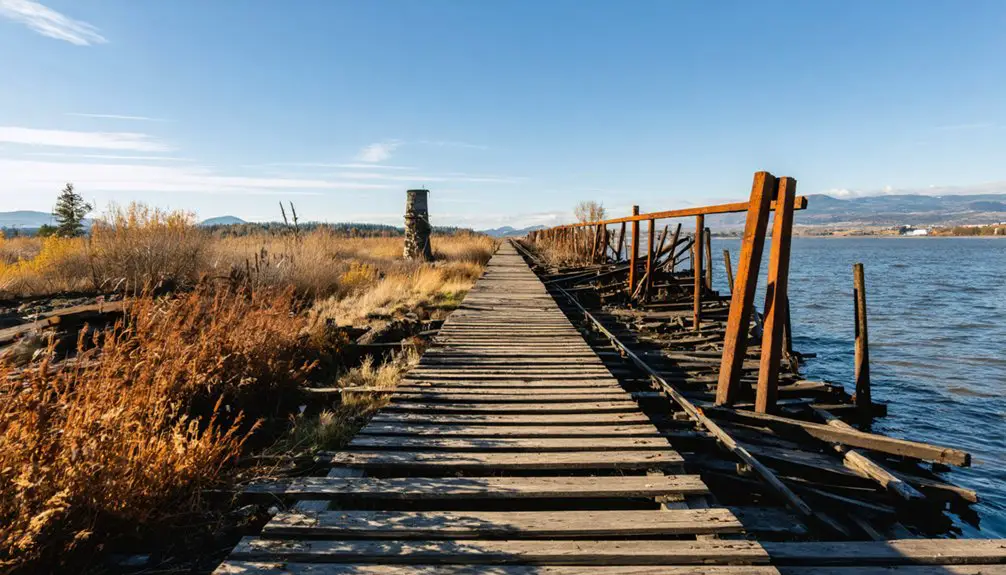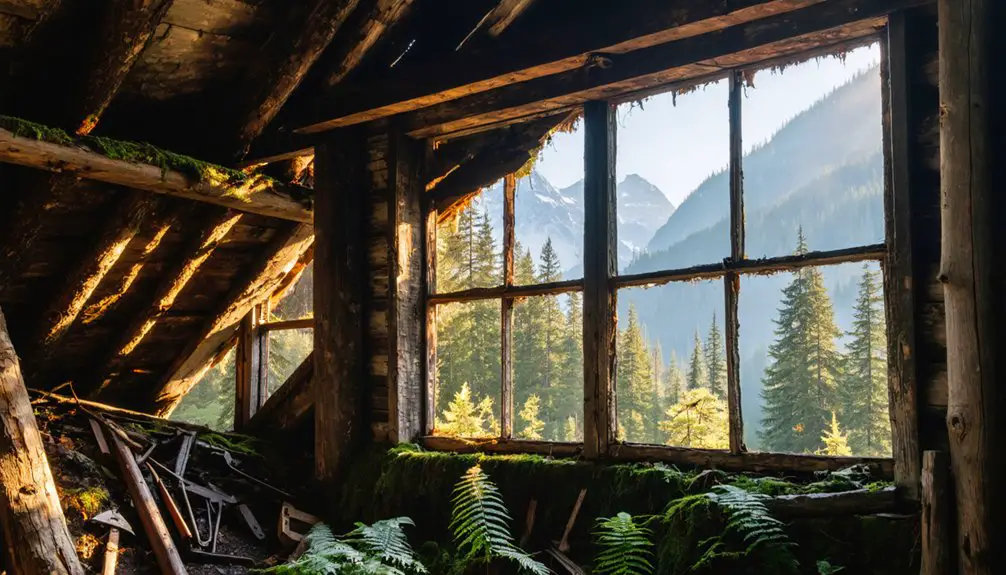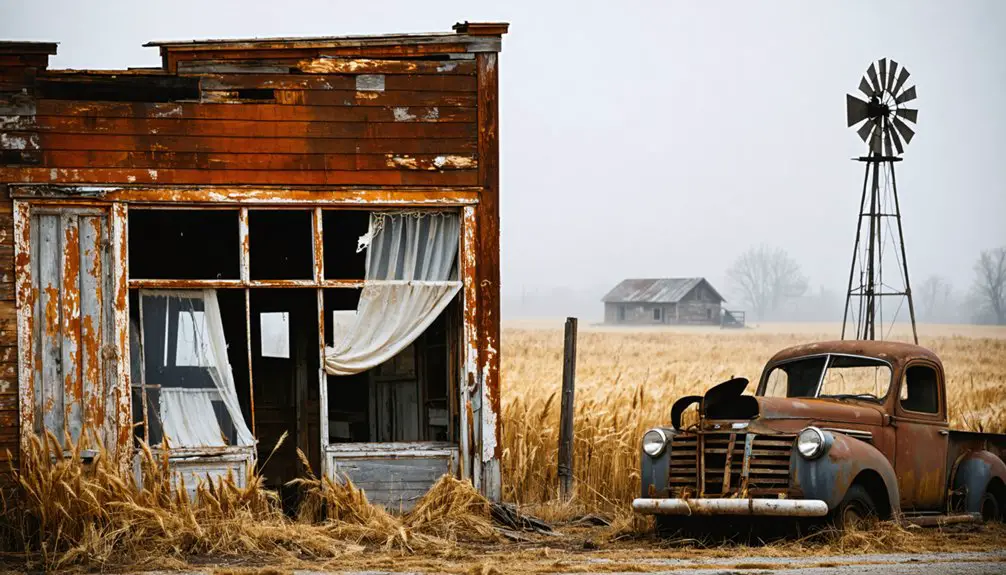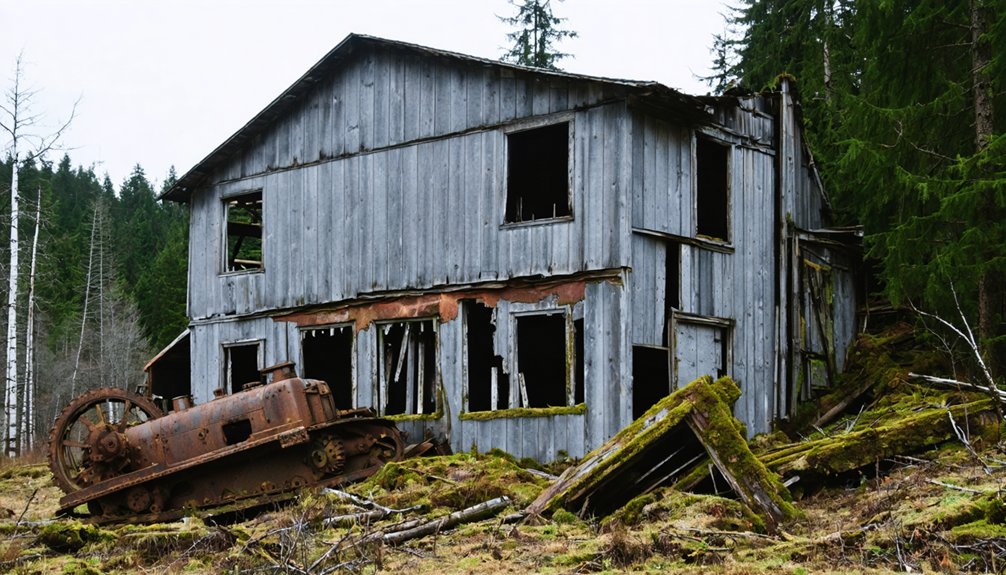
Washington’s mining ghost towns pull you straight into the boom-and-bust cycles that once transformed remote wilderness into thriving industrial communities overnight. You’ll find silver towns like Monte Cristo, coal settlements like Franklin, and Okanogan County clusters including Molson, Nighthawk, and Bodie — each preserving hotels, machinery, foundations, and tunnels that document the region’s extraction economy. These sites demand careful planning and respect for fragile terrain. Stick with us, and you’ll uncover everything you need to explore them.
Key Takeaways
- Washington’s mining ghost towns formed through boom-and-bust cycles driven by gold, silver, and coal discoveries in remote mountainous regions.
- Notable sites include Monte Cristo, Molson, Nighthawk, Bodie, and Ruby Townsite, each preserving remnants of industrial mining history.
- Physical remains such as intact buildings, underground tunnels, machinery, and foundations serve as tangible records of past mining operations.
- Ghost towns are concentrated in two regions: the Cascades, featuring Monte Cristo, and Okanogan County, featuring several preserved sites.
- Visitors should prepare for remote conditions, carrying water, fuel, and maps, while respecting preservation boundaries to protect fragile sites.
What Made Washington a Ghost Town State?
Washington’s rugged terrain and buried mineral wealth made it a natural incubator for boom-and-bust settlements. Gold, silver, and coal drew prospectors and laborers into the Cascades and northeastern highlands during the late 19th century. Communities formed fast, complete with hotels, saloons, post offices, and sawmills. When the ore ran out, residents left just as quickly.
You can trace this cycle across dozens of abandoned sites still standing today. Unlike urban development, which erases the past to build something new, these towns froze in time. That’s what makes them valuable.
Cultural preservation efforts now protect surviving structures, machinery, and foundations, giving you direct access to the raw history of Washington’s mining era. These ghost towns aren’t failures — they’re honest records of how the state was built.
Why These Towns Boomed, Then Disappeared
When you trace the origins of Washington’s ghost towns, you’ll find a single engine driving almost every one: resource extraction. Gold, silver, and coal pulled thousands of settlers into remote mountain terrain.
Those resources built hotels, saloons, sawmills, and post offices almost overnight. But once the ore ran out or the market collapsed, you watched those same communities empty just as fast as they’d filled.
Resource Extraction Drove Growth
The discovery of gold, silver, and coal transformed Washington’s remote highlands into thriving settlements almost overnight. You can trace the pattern clearly: prospectors arrived, staked claims, and mining techniques scaled rapidly from hand tools to industrial machinery.
Settlement patterns followed the ore—camps appeared within months, complete with hotels, saloons, sawmills, and post offices. Monte Cristo saw 13 mines and 40 claims by 1891, expanding to 211 claims by 1893.
Coal towns like Franklin sustained peak populations of 1,100 workers tied to 50-million-year-old seams. Each community existed because extraction made it profitable.
When the ore ran thin or markets collapsed, the economic logic evaporated. Workers moved on, buildings emptied, and the land reclaimed what commerce had briefly interrupted. The resource drove everything—including the eventual silence.
Ore Depletion Ended Towns
Once the ore ran out, these towns had no reason to exist. Mining technology could extract wealth fast, but it couldn’t create new veins where none remained. Monte Cristo shut down by 1907. Franklin’s coal operations ceased in 1922. Bodie faded after its mine closed. The pattern repeated across Washington’s mountains and valleys without exception.
You’ll notice that collapse wasn’t gradual — it was decisive. When a district stopped producing, companies abandoned equipment, workers relocated, and structures deteriorated quickly.
The environmental impact lingered long after residents left: scarred hillsides, tailings piles, and contaminated creek beds marked where extraction had occurred.
What remains today are foundations, rusted machinery, and dilapidated buildings — physical records of communities built entirely around finite resources that eventually ran out.
Boom-And-Bust Economic Cycles
Mining towns across Washington didn’t collapse by accident — they were built on a model that guaranteed it. When ore ran out or mining technology failed to keep pace with costs, capital fled and populations vanished. Understanding this cycle protects cultural preservation efforts today.
The boom-and-bust pattern followed four predictable stages:
- Discovery — Prospectors struck gold, silver, or coal, triggering rapid settlement
- Investment — Outside capital funded infrastructure, swelling populations fast
- Peak extraction — Mining technology maximized output until deposits thinned
- Abandonment — When profits dropped, companies left overnight, towns emptied
You’re looking at an economic system designed for extraction, not endurance. Washington’s ghost towns aren’t failures — they’re honest records of what unchecked resource economies ultimately produce.
Monte Cristo: Washington’s Most Famous Silver Ghost Town
If you’re tracing Washington’s mining heritage, Monte Cristo stands out as the gold-and-silver camp that defined the state’s boom-and-bust era.
Prospectors first struck ore on the west slopes of the Cascades in 1889, and by 1893 the district had exploded to 211 active claims.
Monte Cristo’s Mining Origins
Tucked into the rugged west slopes of the Cascade Range, Monte Cristo earned its reputation as Washington’s most notable gold-and-silver ghost town through a remarkably compressed boom cycle. Active from 1889 to 1907, it stood as the first live mining camp on those slopes. Town preservation efforts today let you witness what that era left behind.
Key milestones that shaped Monte Cristo’s mining origins:
- 1889 – Gold and silver extraction began, drawing prospectors and capital.
- 1891 – Mining techniques supported 13 active mines and 40 claims.
- 1893 – Claims expanded dramatically to 211, marking peak ambition.
- 1907 – Operations ceased permanently, sealing Monte Cristo’s identity as a classic boom-and-bust settlement.
You’re walking through compressed industrial history every time you visit.
Boom-And-Bust Timeline
Four decades defined Monte Cristo’s entire arc—from first strike to final silence. Gold and silver draws pulled prospectors in by 1889, and by 1891 you’d have found 13 active mines and 40 claims carved into those Cascade slopes.
Claims exploded to 211 by 1893, signaling peak ambition. But economic decline hit hard, and by 1907 operations had permanently ceased. That compressed timeline—less than 20 productive years—captures exactly how volatile boom-town economics were.
You can still walk those grounds today, though preservation challenges remain constant. Remote terrain, harsh winters, and limited funding threaten the machinery, foundations, and structures that survived. Without sustained effort, Monte Cristo’s physical record disappears alongside its economic one.
The land doesn’t wait for anyone to decide it matters.
Franklin and Carbonado: Coal Ghost Towns Frozen in Time
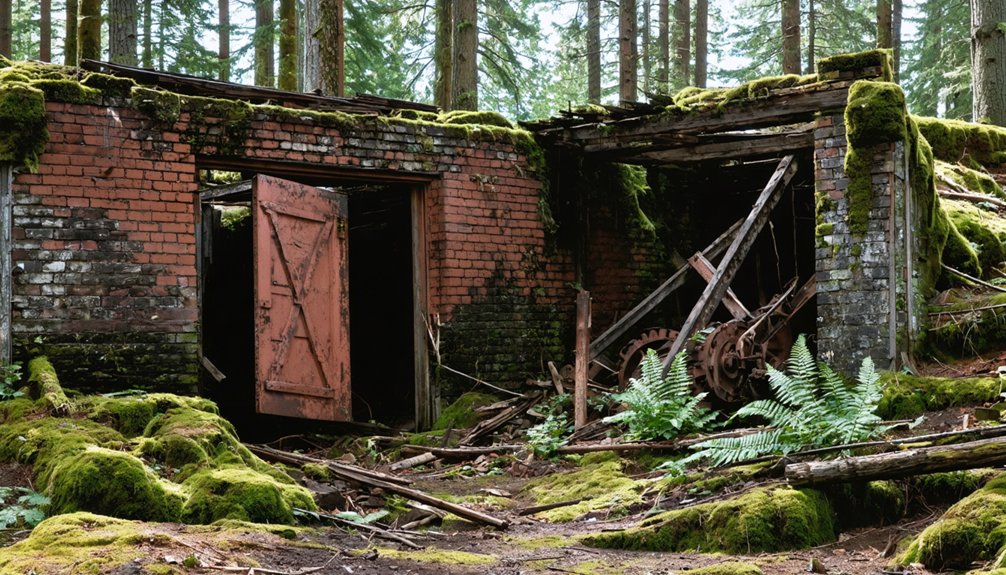
While gold and silver camps dominate Washington’s ghost town lore, the coal towns of Franklin and Carbonado tell a quieter but equally striking story of industrial rise and collapse. Both communities rose from coal mining demand and fell when the seams no longer paid. Heritage preservation efforts now keep their memories alive.
Here’s what defines these two towns:
- Franklin operated from 1885 to 1922, peaking at 1,100 residents before complete abandonment.
- Franklin’s coal seams formed roughly 50 million years ago, long before any settlement arrived.
- Carbonado recorded over 100 mining deaths, including 31 killed in a single disaster.
- Both towns remind you that industrial progress carried a heavy human cost worth remembering.
Okanogan County’s Dense Cluster of Washington Ghost Towns
Where do Washington’s ghost towns cluster most densely? Head to Okanogan County. This northeastern region delivers an unmatched concentration of abandoned mining settlements, each preserving fragments of the boom-and-bust era you won’t find elsewhere.
Molson now operates as an open-air museum, anchoring cultural preservation efforts across the county. Nighthawk still stands with its original hotel, schoolhouse, mining office, and mill intact. Ruby Townsite once housed six general stores and multiple saloons; today, only stone foundations mark where commerce thrived.
Chesaw, with roughly 200 residents, remains a living near-ghost town.
Beyond history, these sites sit within expansive wildlife habitats, letting you explore both industrial heritage and natural landscapes simultaneously. Okanogan County rewards those who value freedom, open terrain, and unfiltered regional history.
Bodie, Molson, and Nighthawk: Three Ghost Towns Up Close
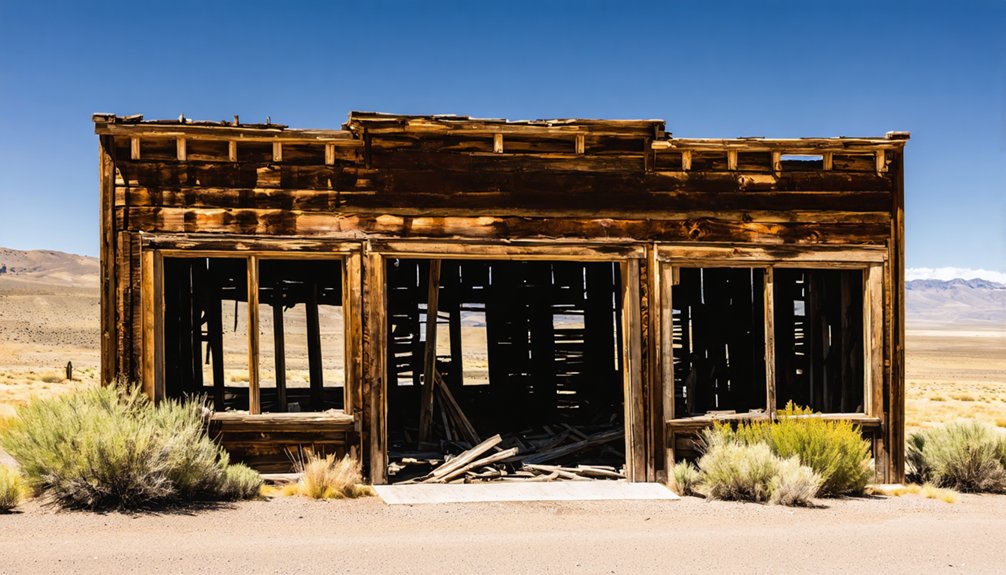
Three of Okanogan County’s ghost towns deserve a closer look. Each site reflects distinct mining techniques and varying degrees of town preservation, giving you direct access to the region’s raw industrial past.
- Bodie – Founded after an 1896 gold discovery, it operated under the Wrigley-backed Bodie Mining Company until production collapsed, with closure dates ranging from 1917 to 1934.
- Molson – Now an open-air museum, it protects original structures and machinery, making town preservation its defining purpose.
- Nighthawk – Still standing are its hotel, schoolhouse, mining office, and mill, offering a rare, intact snapshot of camp life.
- What connects them – Each town rose on gold extraction, then fell when ore bodies gave out, leaving you their bones to read.
Standing Structures and Ruins Still Visible Today
Scattered across Washington’s mining districts, the physical remains of boom-era towns still hold their ground—some as intact buildings, others as foundations half-buried in brush.
At Nighthawk, you’ll find an original hotel, schoolhouse, mining office, and mill still standing.
Ruby Townsite leaves only stone foundations where six general stores once operated.
Molson functions as an open-air museum, preserving structures and ancient artifacts from its active years.
Monte Cristo retains machinery and mining relics that document its 1889–1907 run.
Franklin, once home to 1,100 residents, offers remnants tied to coal seams 50 million years old.
Across these sites, underground tunnels and collapsed shafts mark where ore was extracted.
If you explore these places, you’re reading Washington’s industrial past through the structures that refused to disappear.
Access, Conditions, and What to Know Before You Go
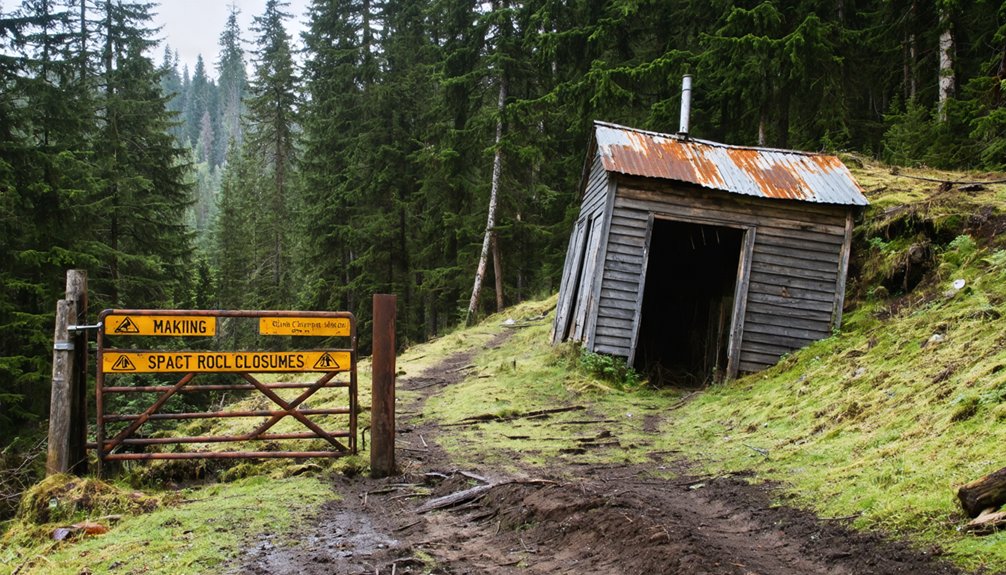
Seeing these ruins in person takes more planning than a typical day trip. Many sites sit on remote mountain roads, seasonal closures, or unstable terrain where visitor safety isn’t guaranteed.
These ruins don’t come easy. Remote roads, seasonal closures, and unstable terrain separate the prepared from the rest.
Historical preservation efforts vary widely—some sites have signage and trail access, others have none.
Before you go, prepare with these four essentials:
- Check road conditions — Forest Service and county roads frequently wash out or close seasonally
- Carry a paper map — Cell service disappears fast in Okanogan County and the Cascades
- Respect posted boundaries — Trespassing damages preservation efforts and exposes you to legal risk
- Bring your own supplies — No services exist at most sites; water, fuel, and food are your responsibility
You earn these places by preparing for them.
Planning a Washington Ghost Town Road Trip
Washington’s ghost towns don’t cluster into one convenient corridor, but two regions anchor any serious road trip: the Cascades, where Monte Cristo defines the western mining legacy, and Okanogan County, where Molson, Nighthawk, Bodie, and Ruby Townsite sit within a drivable loop.
Plan your Cascade leg around Monte Cristo’s trail access, understanding that seasonal road closures affect entry.
For Okanogan County, base yourself in Oroville or Tonasket and work outward.
Respect posted boundaries at each site — cultural heritage preservation depends on visitors not disturbing foundations, machinery, or remaining structures.
Stay aware of environmental impact; fragile soils and aging structures don’t recover quickly from foot traffic.
Carry detailed maps, since cell service disappears in remote terrain.
Move deliberately, document thoroughly, and leave every site exactly as you found it.
Frequently Asked Questions
Are Any Washington Ghost Towns Located on Private Property Requiring Permission?
Yes, some Washington ghost towns sit on private property, so you’ll need to respect land ownership before exploring. Always secure permission from landowners to access these sites freely and legally.
Can You Legally Collect Artifacts or Relics From Washington Ghost Towns?
You can’t legally collect artifacts from Washington ghost towns without permission — legal restrictions protect historical relics, and artifact theft carries serious penalties. Always respect site rules to preserve the region’s irreplaceable mining heritage for future generations.
Were Any Washington Ghost Towns Ever Considered for Full Restoration?
Like echoes frozen in time, yes—sites like Molson transformed into open-air museums, blending historical preservation with tourism development. You’ll find communities actively revived these haunted remnants, reclaiming Washington’s mining legacy for future generations to freely explore.
Do Any Washington Ghost Towns Have Guided Tours Available Year-Round?
Year-round guided tours aren’t widely confirmed at Washington’s ghost towns, but you’ll find seasonal historical preservation programs at sites like Molson, where tourist attractions bring regional mining heritage to life through structured, self-guided exploration opportunities.
Have Any Washington Ghost Towns Been Featured in Films or Documentaries?
Like silent reels frozen in time, yes, you’ll find Washington’s ghost towns have drawn filmmakers and documentarians. Monte Cristo and Molson’s weathered bones serve as compelling film locations, their historic preservation capturing the region’s raw, untamed mining legacy onscreen.
References
- https://stateofwatourism.com/ghost-towns-of-washington-state/
- https://www.youtube.com/watch?v=CuEIWySDQ20
- https://www.youtube.com/watch?v=JaCRKivIsv4
- https://www.islands.com/2080468/okanogan-highland-ghost-towns-washington-county-series-eerie-abandoned-mining-chilling-see/
- https://www.youtube.com/watch?v=FVveO9uJBvc
- http://okanoganhighland.blogspot.com/p/bodi.html
- https://seattletravel.com/6-abandoned-mining-towns-still-hiding-in-washingtons-mountains/
- https://okanogancountry.com/ghost-towns
- https://www.yahoo.com/lifestyle/ghost-towns-sit-abandoned-across-204352735.html
- https://www.worldatlas.com/cities/6-old-timey-mining-towns-in-washington.html