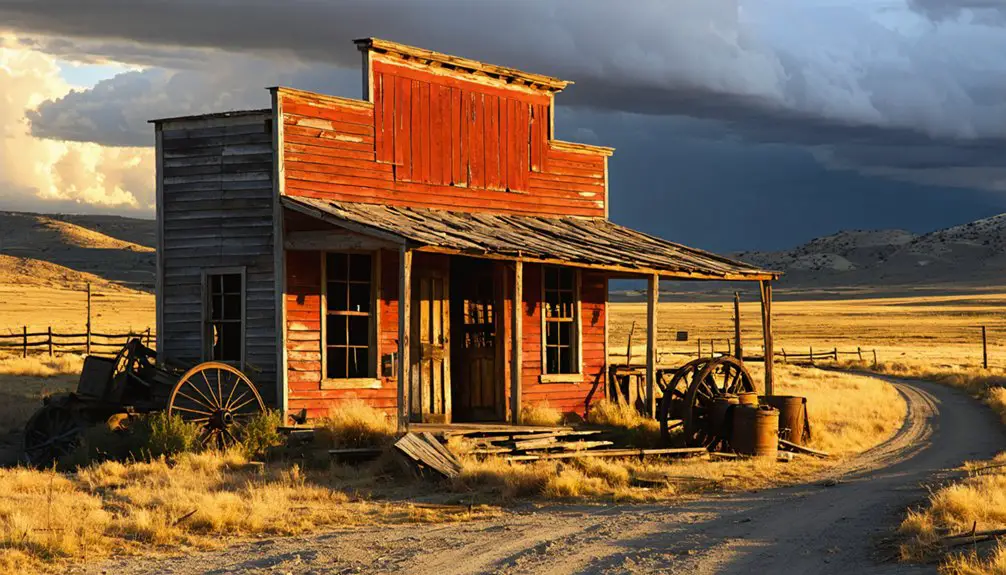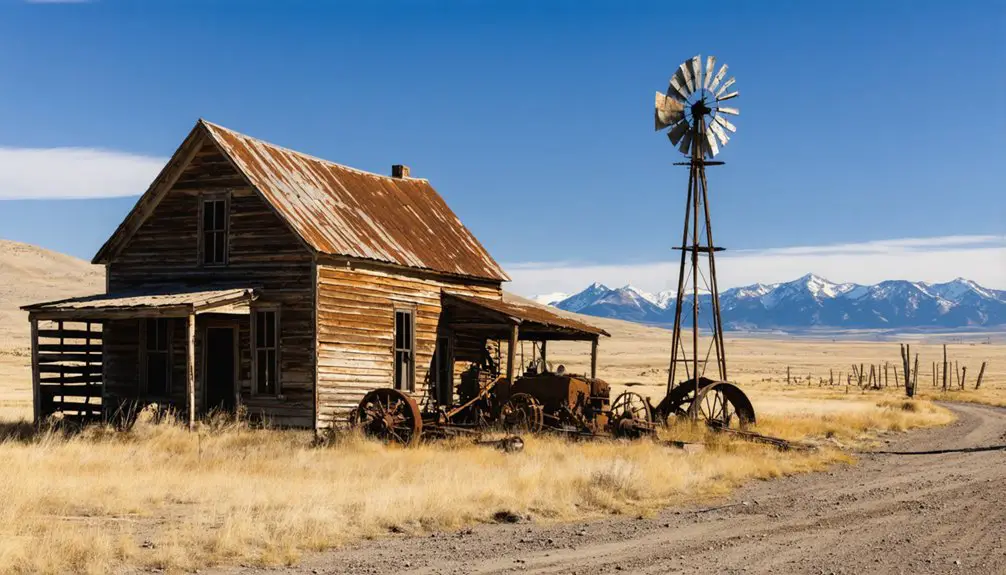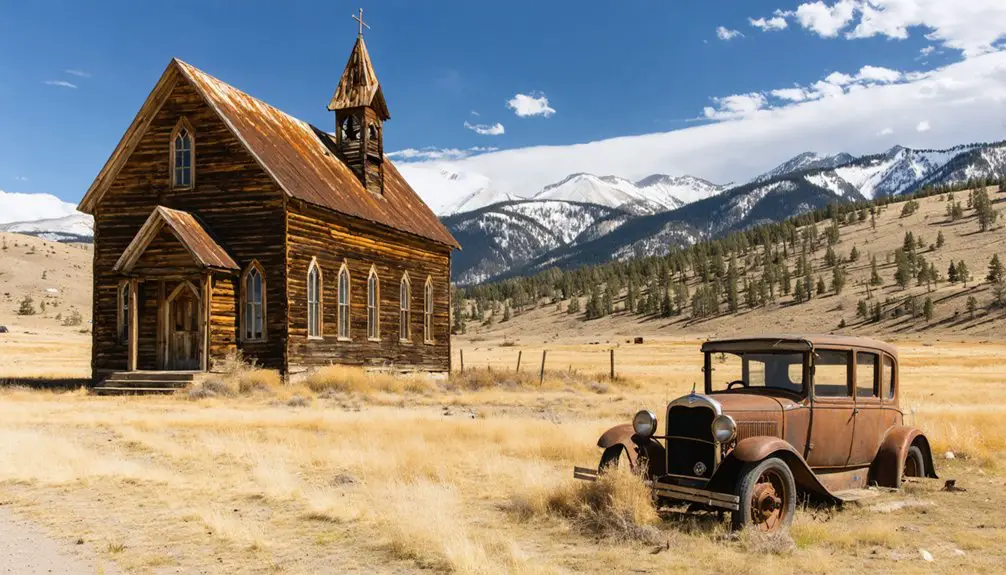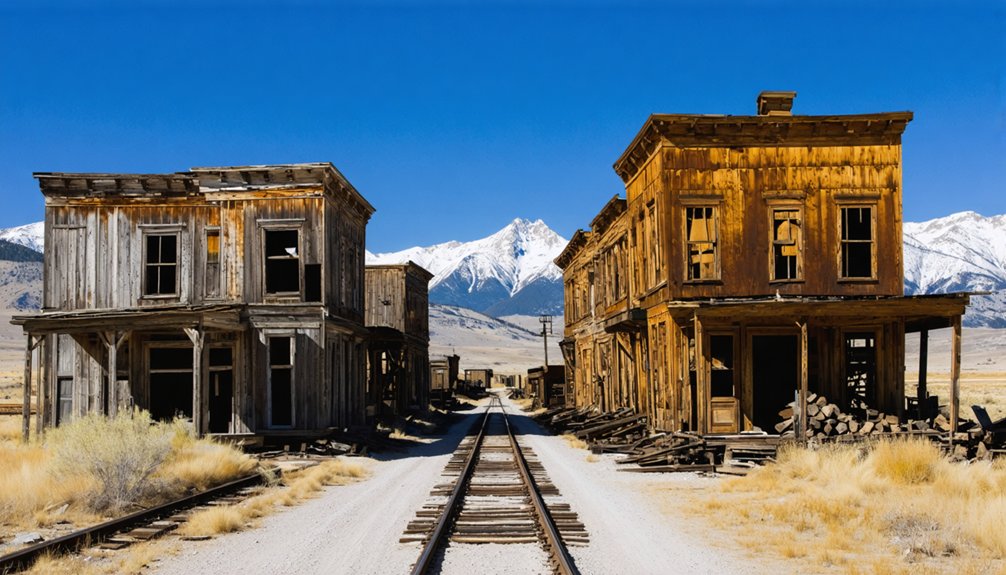
Wyoming’s mining ghost towns reveal the West’s most volatile boom-bust cycles, where you’ll find communities like Atlantic City that crashed from 2,000 residents to just 100 within two years of its 1868 gold discovery. You can trace this pattern across the landscape—from South Pass City’s brief tenure as territorial hub to coal towns that vanished after Union Pacific switched to diesel locomotives in the 1950s. The physical remains of breweries, mills, and mine works document how quickly prosperity turned to abandonment when mineral deposits exhausted.
Key Takeaways
- Wyoming’s coal mining economy boomed with Union Pacific Railroad in 1867 but declined sharply during the 1950s diesel transition.
- Atlantic City experienced dramatic population swings from 2,000 during the 1868 gold rush to just 100 by 1872.
- South Pass City peaked at 2,000-3,000 residents after 1867 gold discovery but collapsed to hundreds within five years.
- Both Atlantic City and South Pass City featured essential mining infrastructure including breweries, saloons, and mills during boom periods.
- South Pass City remains a preserved ghost town documenting Wyoming’s gold mining history and territorial development.
The Rise and Fall of Wyoming’s Coal Mining Economy
Long before Wyoming earned its reputation as America’s leading coal producer, early explorers and mountain men stumbled upon the state’s vast deposits in their journals and daily survival practices. Jim Bridger fired his forge with native coal in 1843, while Frémont’s expedition documented deposits near Green River that same year.
The Union Pacific Railroad sparked commercial mining in 1867, but government intervention in mining reshaped the industry when authorities terminated the Wyoming Coal and Mining Company’s lease in 1874, enabling Union Pacific’s monopoly. The railroad company cut miner pay by one-fifth in 1875 while maintaining coal prices, triggering strikes that led to the replacement of workers with Chinese laborers. Employment surged to 38,500 by 1981, then crashed 70% during the 1950s shift. Only 327 miners remained by 1965, yet Wyoming rebounded to dominate national production since 1986. Union Pacific’s switch to diesel locomotives accelerated the coal industry’s decline, as railroads had been the primary demand for Wyoming coal.
You’ll find Wyoming’s coal story reflects classic economic booms and busts.
Atlantic City: From Gold Rush Boom to Near-Abandonment
When you examine Atlantic City’s trajectory, you’ll find a settlement born from the 1868 Atlantic Ledge discovery that swelled with prospectors before collapsing to just 100 residents by 1872.
The town’s material legacy includes Wyoming’s first territorial brewery, an emblem/symbol/representation of the infrastructure miners prioritized even in isolated conditions 100 miles from the nearest railhead.
You can trace the community’s survival through shifting economic foundations—from placer operations and dredging ventures recovering up to $700,000 in the 1930s, to U.S. Steel’s iron mining that sustained the population until 1983, preventing complete abandonment. French engineer Emil Granier’s ambitious 1884 hydraulic mining project employed 300 workers to construct a 25-mile sluiceway, but the venture collapsed spectacularly when excessive slope destroyed the infrastructure and bankrupted the company. Despite investing $200,000 by 1887, Granier had not recovered any gold from his hydraulic operation.
Gold Discovery and Settlement
During the summer of 1868, prospectors struck gold near Rock Creek on the east side of the Continental Divide, igniting a rush that would transform Wyoming’s high desert into one of the territory’s most significant mining districts.
The discovery centered on the Atlantic Ledge, a mineral-rich quartz vein stretching thousands of feet and measuring several feet thick. This find emerged as an outgrowth of nearby South Pass City gold camps, where prospectors had already located gold at Willow Creek and Carissa Ledge in 1867. By 1869, the settlement had swelled to a peak population of around 500 residents, establishing itself as a legitimate mining community with a post office and commercial infrastructure.
Population Decline Over Time
Atlantic City’s transformation from bustling gold camp to near-ghost town unfolded in distinct phases that mirrored the broader boom-and-bust cycles defining Western mining settlements.
You’ll find the early mining dynamics particularly stark: from 2,000 residents during the 1867-1868 rush to merely 325 by 1870’s census. Mining town volatility accelerated through the 1870s as ore bodies depleted, leaving just 100 souls by 1872. Brief revivals punctuated the decline—Fisher’s 1933 dredge operation extracted $700,000 in gold—but couldn’t reverse the trajectory.
World War II’s gold mining ban reduced population below a dozen. The 1954 post office closure with two remaining residents marked Atlantic City’s nadir, though US Steel’s 1960s-1983 iron operations temporarily revived activity before stabilizing at today’s 37-57 year-round residents. The Dexter Mill bankruptcy in 1914 exemplified the failed industrial schemes that characterized the town’s prolonged decline phase.
Wyoming’s First Territorial Brewery
The claim to Wyoming Territory’s first brewery emerged from Atlantic City’s founding on April 15, 1868, when Charles Collins, H.A. Thompson, and Colonel Charles W. Tozer established the settlement during the South Pass gold rush.
By 1870, you’d find two competing breweries serving an estimated 500 residents alongside seven saloons. These establishments weren’t mere drinking holes—they represented essential infrastructure for the transient mining workforce seeking respite from brutal prospecting conditions.
The social appeal of breweries transformed Atlantic City’s “French” section into gathering spaces where isolated miners found community. This commercial density, supported by stage connections to the Union Pacific at Bryan, distinguished Atlantic City from rival camps like South Pass City.
Yet brewery prosperity proved fleeting. When placer deposits exhausted by the early 1870s, population collapsed from 500 to 100 residents. French capitalist Emile Granier briefly revived the town in the late 1880s through hydraulic mining development that attracted renewed investment. Revival efforts in the 1960s attempted to resurrect mining operations, but these attempts to revive mining ultimately failed to restore the town’s former prosperity.
South Pass City: a Preserved Window Into Gold Mining History
Gold’s discovery near South Pass in 1867 transformed a remote Wyoming landscape into one of the territory’s most significant mining centers, where South Pass City emerged as the district’s primary settlement. You’ll find physical remains that document both prosperity and decline: the Carissa Mine‘s structures, a restored 1903 stamp mill, and buildings along the half-mile main street where 2,000-3,000 residents once pursued fortune.
The site reveals the boom-bust cycle through material evidence:
- Peak production artifacts – The Carissa Mine yielded ore worth $75.24 in gold per ton, with the Bullion Mine producing 21,000 ounces during peak operations
- Infrastructure investments – A three-mile water ditch and stamp mill represent substantial capital commitments
- Economic challenges – Failed London investor deals and high extraction costs drove population collapse to mere hundreds by 1872
Prospectors’ ambitions extended beyond South Pass City, with 1,500 lodes located across the district as fortune-seekers staked claims throughout the Sweetwater mining area. The settlement’s significance was recognized immediately, as it became the county seat by the end of 1867, consolidating its position as the administrative center of Wyoming’s gold rush territory. South Pass City achieved second incorporated city status in Wyoming in 1868, cementing its importance during the territory’s formative years.
Gebo: The County’s Largest Town That Vanished
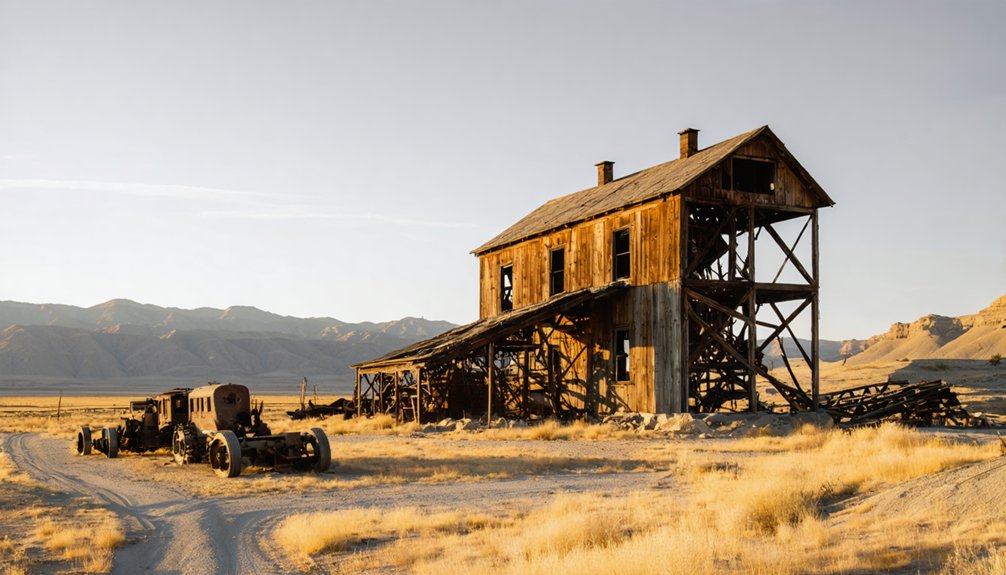
When Samuel Wilford Gebo established his coal mining operation north of Thermopolis in 1907, he created what would become Hot Springs County‘s most populous settlement—a town of over 2,000 residents that has since been entirely erased from the landscape.
You’ll find evidence of remarkable ethnic diversity in Gebo’s cemetery, where immigrants from sixteen nations rest. The town operated on a seasonal economy—summers brought mine closures due to extreme heat, prompting residents to camp in the Bighorn Mountains.
WWI demand drove prosperity until diesel replaced coal for locomotives and ships. Federal corruption investigations in 1912, Spanish Flu, and shifting energy markets sealed Gebo’s fate. Operations ceased permanently in 1938. Bulldozers obliterated the townsite in 1971, leaving only scattered foundations and maintained gravesites along a dirt road off U.S. 20.
Carbon: A Frontier Coal Hub That Rivaled Cheyenne
Carbon’s seven active mines produced 6,560 tons of coal in their first year of operation, employing experienced Lancashire miners who worked the dangerous underground shafts that powered Union Pacific’s expanding rail network.
By 1886, high demand kept the mines running at capacity, but the December 20, 1870 explosion at Carbon No. 1 Mine revealed the deadly cost of this productivity—victims were later buried in the town cemetery, their graves marked with coal from the very formations that claimed their lives.
You’ll find evidence of this tragedy in the material remains: sandstone foundations, hillside dugouts, and the cemetery where coal headstones serve as stark monuments to Wyoming’s first mining disaster.
Carbon’s Mining Operations Peak
By 1890, this frontier coal camp had swelled to 1,140 residents, positioning it as a genuine rival to Cheyenne in the territory’s coal economy. You’ll find three coal production factors that defined Carbon’s peak years:
- Seven active mines operated simultaneously during the late 1860s through 1880s, feeding Union Pacific locomotives crossing Wyoming
- No. 6 Mine opened in 1880 and extracted coal until complete exhaustion by 1890’s end
- Strategic railroad location provided direct access to transcontinental route despite challenging terrain
Carbon’s transportation challenges stemmed from its east-side Simpson Ridge placement, requiring extra locomotive power to conquer the steep grade. This monopolized operation supplied the coal that powered westward expansion, though the same geographic obstacles would ultimately doom the settlement.
Tragic Deaths Underground
The promise of steady wages in Carbon’s mines came with a lethal bargain that claimed workers through methane explosions, cave-ins, and equipment failures. Between 1868 and 1925, thirteen separate disasters killed five or more miners each, while countless individual deaths went unrecorded.
Union Pacific Coal Company’s “gouging” method prioritized immediate extraction over safety, allowing coal gas ignitions in poorly ventilated chambers where methane accumulated. You’ll find this pattern repeated throughout Wyoming’s coalfields—the catastrophic 1903 Hanna explosion killed 169 miners, followed by another 59 deaths in 1908. Rescue operations often arrived too late.
Mine bosses deflected blame onto workers rather than addressing systemic failures, leaving widows and orphaned children to bear the consequences of profit-driven negligence.
Lost Springs: From 200 Residents to Five in Three Decades
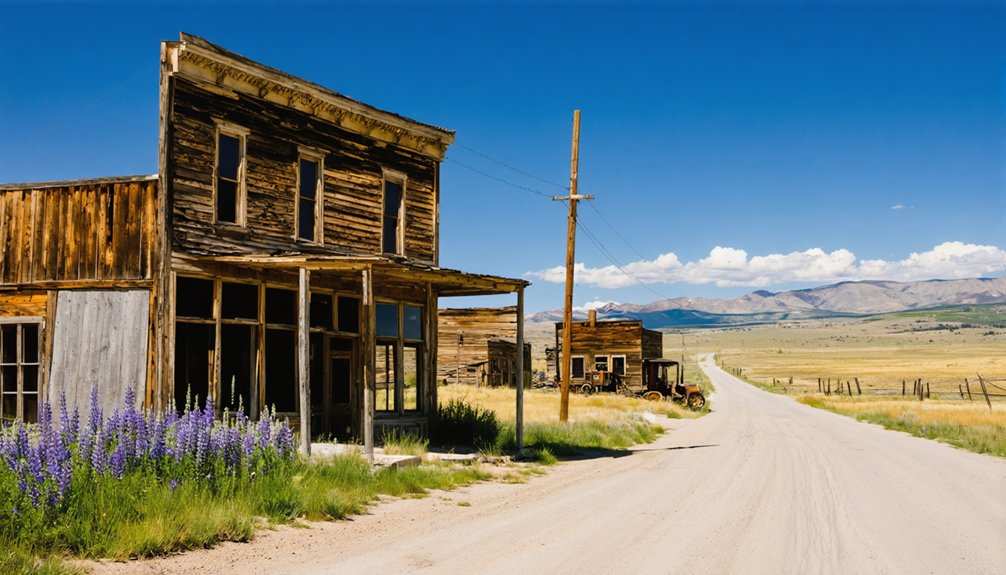
Mining activity breathed life into Lost Springs, and its absence sucked that life away with startling speed. The Rosin coal mine drew 207 residents by 1910, but when it closed in 1930, the town’s fate was sealed.
The mine gave Lost Springs its heartbeat in 1910, then flatlined the town twenty years later when the coal ran out.
You’ll see the brutal arithmetic of collapse in these numbers:
- 1910-1930: Population crashed from 207 to 66—a 68% loss in twenty years
- 1930-1950: Residents plummeted from 66 to just 9—an 86% decline
- 1950-1960: The final blow reduced 9 to 5—Lost Springs earned its designation as America’s smallest incorporated town
This wasn’t population resilience; it was demographic freefall. Without economic diversification beyond coal, Lost Springs couldn’t adapt. The town’s material remnants—empty buildings, abandoned lots—testify to mining’s double-edged promise: instant prosperity, then abandonment.
The Human Cost: Immigrant Miners and Mining Disasters
When coal companies needed bodies to work Wyoming’s most dangerous tunnels, they recruited from across the Pacific and throughout Europe, creating underground workforces where Polish, Chinese, Japanese, and Black miners labored side by side—yet rarely as equals.
You’ll find this deliberate ethnic mixing in Sheridan County’s camps, where mining town demographics reveal company strategy: divide workers by language and culture to prevent immigrant labor unrest. The tactic failed catastrophically at Rock Springs in 1885, where twenty-eight Chinese miners died when violence erupted. Companies forcibly removed Chinese workers from Almy that same day.
At Dietz, four hundred to eight hundred men worked depending on season—Poles, Europeans, and others whose bodies fueled America’s industrial expansion while their names disappeared into abandoned camps by 1937.
Wyoming’s Mining Legacy: 11.9 Billion Tons and Counting
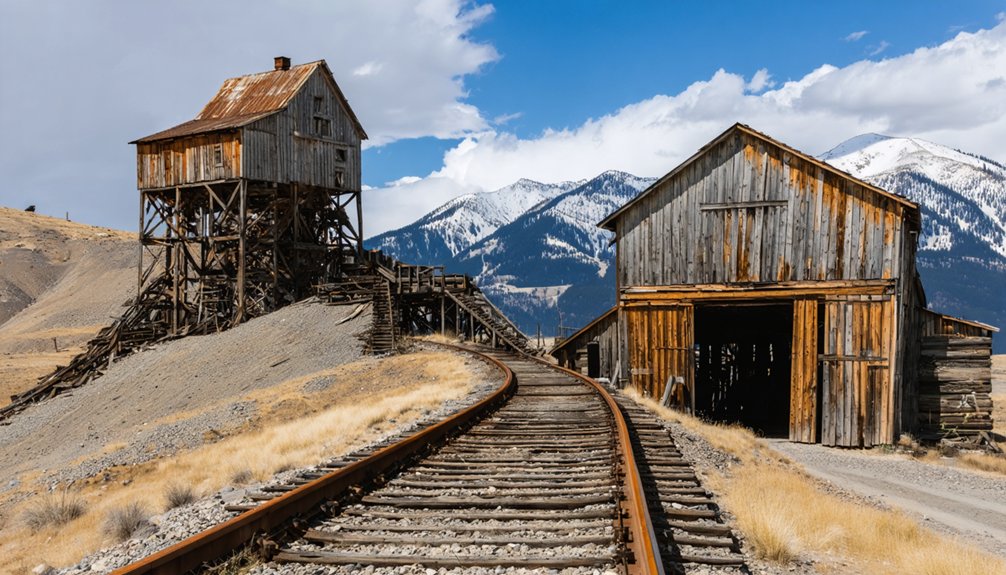
Between 1865 and 2022, Wyoming’s miners extracted 12.6 billion short tons of coal—enough to power every American household for nearly four decades. This extraction reshaped the land itself, leaving visible effects of mining on landscape across the Powder River Basin, where seams 60-80 feet thick created moonscape terrains.
You’ll find Wyoming’s industrial dominance extends beyond coal:
- Trona deposits: 127 billion tons in Sweetwater County, producing 90% of America’s soda ash
- Uranium legacy: 193 million pounds extracted—energy equivalent to 1.9 billion tons of coal
- Coal efficiency: 92% recovery factor with miners producing 23 tons per hour
Abandoned mining equipment now stands as monuments to this extraction economy, physical evidence of an industry that built Wyoming’s identity while transforming its wilderness into America’s energy warehouse.
Frequently Asked Questions
Can You Still Visit Any of Wyoming’s Mining Ghost Towns Today?
You’ll find several Wyoming mining ghost towns open for exploration. South Pass City offers self-guided tours through preserved buildings, showcasing historical preservation efforts. Miner’s Delight and Gebo let you freely wander authentic ruins, connecting directly with material evidence of frontier mining life.
What Happened to the Buildings After Mining Towns Were Abandoned?
You’ll find buildings met three fates: bulldozers demolished them (like Gebo in 1971), fires destroyed them (Carbon’s 1890 blaze), or building disrepair and natural reclamation claimed them—as Eadsville’s cabins collapsed and foundations crumbled into prairie silence.
Are There Any Museums Dedicated to Wyoming’s Mining History?
You’ll find four museums preserving Wyoming’s mining heritage through authentic artifacts and structures. They showcase the historical significance of mining museums while documenting preservation efforts for mining artifacts, from clothing to coal camp buildings across former mining regions.
How Did Mining Families Survive After the Mines Closed?
When mines shuttered, families watched their dreams crumble like slag heaps. You’d face economic hardships—plummeting home values, lost savings—forcing you to seek job opportunities sought elsewhere: healthcare, military service, anywhere offering independence from coal’s broken promises.
What Artifacts Remain in Wyoming’s Abandoned Mining Towns?
You’ll find mining equipment like iron machinery and ore buckets, plus prospectors’ tools including ceramic shards and metal bolts. Root cellars, trash pits, and cemeteries preserve material evidence of daily life in Wyoming’s abandoned settlements.
References
- https://sites.rootsweb.com/~wytttp/ghosttowns.htm
- https://nickswartz.substack.com/p/towns-that-went-boom-2-carbon-wy
- https://bighorndrifters.com/elementor-2633/
- https://www.wyohistory.org/encyclopedia/wyomings-first-coal-bust
- https://www.youtube.com/watch?v=pEBL3LOhEL8
- https://travelwyoming.com/blog/stories/post/wy-hidden-histories-pioneers-ghost-towns/
- https://westernmininghistory.com/map/
- https://www.blm.gov/visit/miners-delight
- https://www.wyohistory.org/encyclopedia/coal-business-wyoming
- https://en.wikipedia.org/wiki/Coal_mining_in_Wyoming