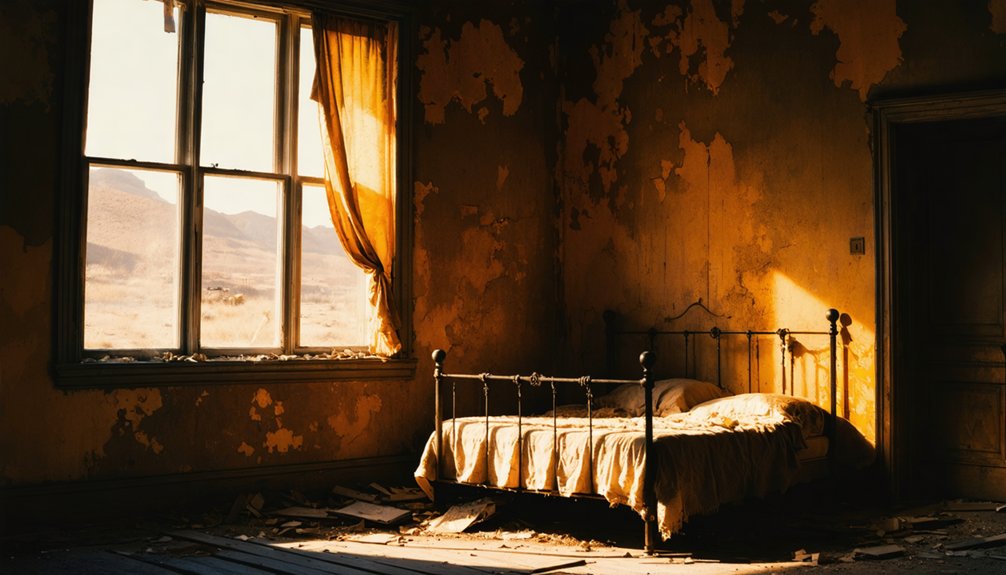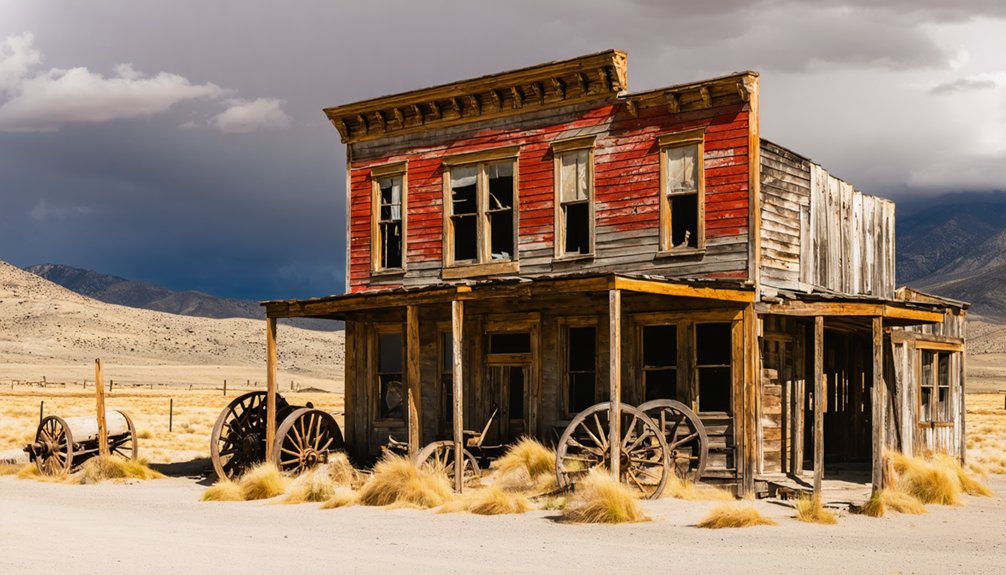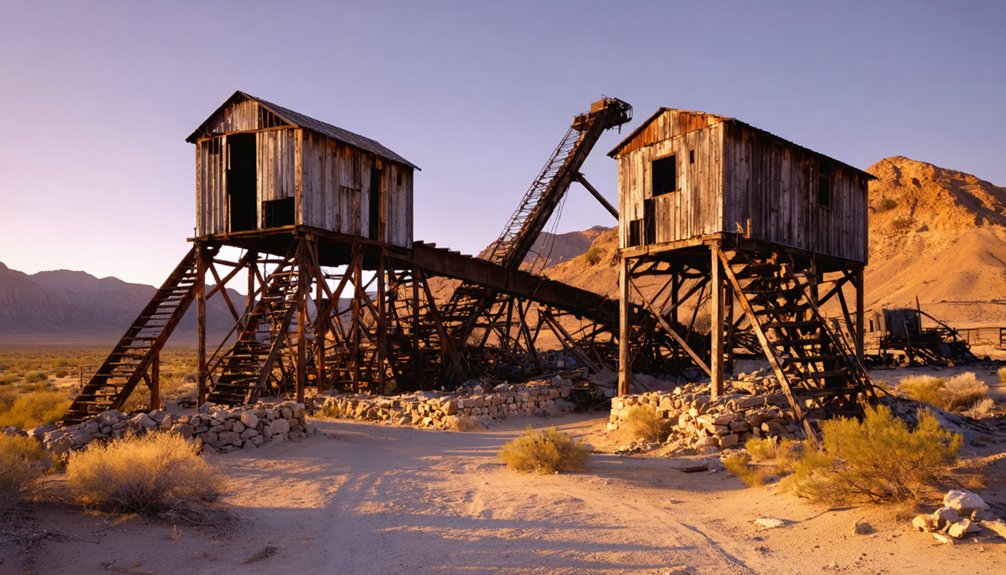
You’ll find several historic mining ghost towns within 90 miles of Las Vegas, with Nelson and Goodsprings being the closest options. Nelson’s Techatticup Mine operated from 1861-1945 and produced $10 million in precious metals, while Goodsprings—Nevada’s most mineralogically diverse district—generated $25 million from 1856-1957, peaking at 800 residents in 1916. Rhyolite and Calico offer additional exploration opportunities, with the former producing $1.4 million before its dramatic collapse. The following sections provide detailed information about accessibility, ideal visiting conditions, and what you’ll encounter at each location.
Key Takeaways
- Nelson, home to the historic Techatticup Mine, is one of the closest ghost towns, featuring Nevada’s longest-lived mining operation.
- Goodsprings operated from 1856 to 1957 and produced $25 million worth of diverse minerals including lead, zinc, and gold.
- The Pioneer Saloon in Goodsprings has been Nevada’s oldest continuously operating bar since 1913.
- Rhyolite showcases dramatic boom-and-bust architecture, with the Montgomery-Shoshone Mine producing over $1.4 million in precious metals.
- Calico preserves silver mining heritage with 500 mines that produced over $20 million in silver between 1881 and 1907.
Nelson: Southern Nevada’s Golden Legacy
Long before Las Vegas emerged as Nevada’s glittering centerpiece, the rugged canyons of Eldorado held the region’s earliest promise of mineral wealth. You’ll find Nelson’s origins trace to 1859’s gold and silver discoveries, with the Techatticup Mine commencing operations in 1861. This principal operation extracted approximately $10 million between 1864-1900, representing over half the canyon’s total production.
Nelson’s transportation infrastructure transformed dramatically when the railroad arrived in 1905, making the district accessible and profitable. However, Nelson’s social issues proved severe—with law enforcement 200 miles distant, lawlessness flourished through violent disputes and vigilante justice. The town’s namesake, Charles Nelson, fell victim to murder, sparking frontier retribution.
Today, you can explore this preserved ghost town, where fourteen restored buildings document southern Nevada’s tumultuous mining legacy. The Techatticup Mine remained operational until the early 1940s, making it one of the longest-running mines in the region. The site now serves as a museum and welcomes visitors for exploration, photography, and even weddings and film shoots.
Goodsprings: A Century of Mineral Riches
You’ll find Goodsprings represents Nevada’s most mineralogically diverse mining district, operating continuously from Mormon settlers’ 1856 discovery of ore deposits in faulted limestone through final closure in 1957.
The district’s evolution from abandoned silver-lead operations in 1868 to peak production in 1916—when 800 residents extracted over 85 million pounds of zinc during wartime boom—demonstrates how infrastructure development, particularly the 1911 Yellow Pine Railroad completion, transformed marginal deposits into a $25 million producer.
While operations fluctuated through mill fires and Depression-era debt, surviving landmarks including the operational Pioneer Saloon maintain physical connections to a century when Goodsprings mines yielded lead, zinc, gold, silver, copper, and eight additional commercial minerals. The district earned recognition as the oldest underground mine in Nevada, with initial workings established by Mormon settlers at Potosi in 1856. Named for cattleman Joseph Good, the community developed under A.G. Campbell’s leadership as mining operations expanded beyond the original Potosi site.
Early Mining Operations History
Goodsprings emerged from modest beginnings when ore deposits in faulted limestone, recognized since pre-1856, remained unworked until Mormon miners established Potosí in 1856—creating Nevada’s oldest underground mine.
You’ll find that mining community development accelerated after Joseph Good’s 1861 arrival, with A.G. Campbell transforming the springs into a ranching-mining settlement. Lead ore discoveries in 1886 sparked permanent habitation, while the Keystone gold mine‘s $600,000 production (1892-1906) drew over 200 residents by 1893.
The 1905 railroad completion to Jean quadrupled ore output, and the 1911 Yellow Pine Railroad drastically reduced transportation costs. During the wartime years of 1915-1918, Goodsprings reached its peak as Clark County’s largest mineral producer, extracting over 85 million pounds of zinc alongside millions of pounds of lead. The Yellow Pine Company consolidated area properties after its incorporation in 1901, establishing unified control over the district’s mining operations. However, the decline of mining operations began in the 1930s following devastating floods, a locomotive accident, and concentrator fire in 1929, culminating in complete cessation by World War II.
Rich Mineral Deposits Found
Beneath the rugged limestone formations of the Goodsprings Mining District lay an extraordinary mineral wealth that would ultimately yield $25 million in production value between 1856 and 1957. You’ll find Nevada’s greatest variety of valuable minerals concentrated here, with varied ore types including:
- Lead and zinc (primary production metals)
- Precious metals: gold, silver, platinum, and palladium
- Base metals: copper, nickel, and cobalt
- Strategic minerals: molybdenum, vanadium, and uranium
- Zinc-dominant carbonate replacement deposits of probable late Paleozoic age
The zinc production spotlight intensified after 1905, when a mining engineer recognized previously discarded material as high-grade zinc ore. Since 1907, Goodsprings became Nevada’s principal zinc source, with the Yellow Pine Mines alone contributing $31 million from 1892 to 1952—exceeding the district’s total recorded output. The district as a whole produced over $188.6 million worth of metals, with zinc accounting for 57.8% of total production, followed by lead at 17.5%, gold at 17%, silver at 4.6%, and copper at 2.9%. By the early 1900s, Goodsprings had transformed into a hotspot for mining, drawing dozens of miners, entrepreneurs, and families to the surrounding hills.
Pioneer Saloon and Landmarks
Standing resolute at 310 W Spring St since 1913, the Pioneer Saloon represents Nevada’s oldest continuously operating bar in the southern region, having weathered the Spanish Flu pandemic, two World Wars, the Great Depression, Prohibition, and more recent economic crises including COVID-19.
Businessman George Fayle constructed the establishment using stamped tin from Sears Roebuck Company, installing a cherry wood bar crafted by Brunswick in Maine during the late 1800s.
The venue earned Nevada historical landmark designation in 2007, preserving original walls, ceilings, and creaking floorboards. You’ll discover old timey memorabilia throughout, including bullet holes from past altercations and Clark Gable memorabilia commemorating his 1942 vigil following Carole Lombard’s fatal plane crash nearby.
Hauntings and folklore persist, with reports of disembodied voices and unexplained telephone rings attracting paranormal enthusiasts. Among the reported spirits is Paul Coski’s ghost, a miner killed in a deadly poker game at the turn of the 20th century, whose presence is said to be observed near card games. The saloon has been featured on paranormal television shows documenting these mysterious occurrences.
Rhyolite: The Boomtown That Rose and Fell in a Decade
Among the many ghost towns scattered across the Nevada desert, Rhyolite stands as perhaps the most dramatic example of boom-and-bust mining fever near Las Vegas. Following Frank “Shorty” Harris and Eddie Cross’s August 1904 gold discovery, this settlement exploded from a two-tent camp to 5,000 residents within six months.
By 1907, you’ll find evidence of remarkable infrastructure:
- Electricity and water mains
- Concrete sidewalks and telephone lines
- Stock exchange and opera house
- Hospital and school system
- Multiple newspapers and banks
The Montgomery-Shoshone Mine produced over $1,400,000, attracting steel magnate Charles M. Schwab’s $2-6 million purchase in 1906. However, the 1907 financial panic triggered rapid economic decline. Power infrastructure failure occurred in 1916, leaving only 24 residents by 1920—a complete collapse within a decade.
Calico: Preserved Silver Mining Heritage
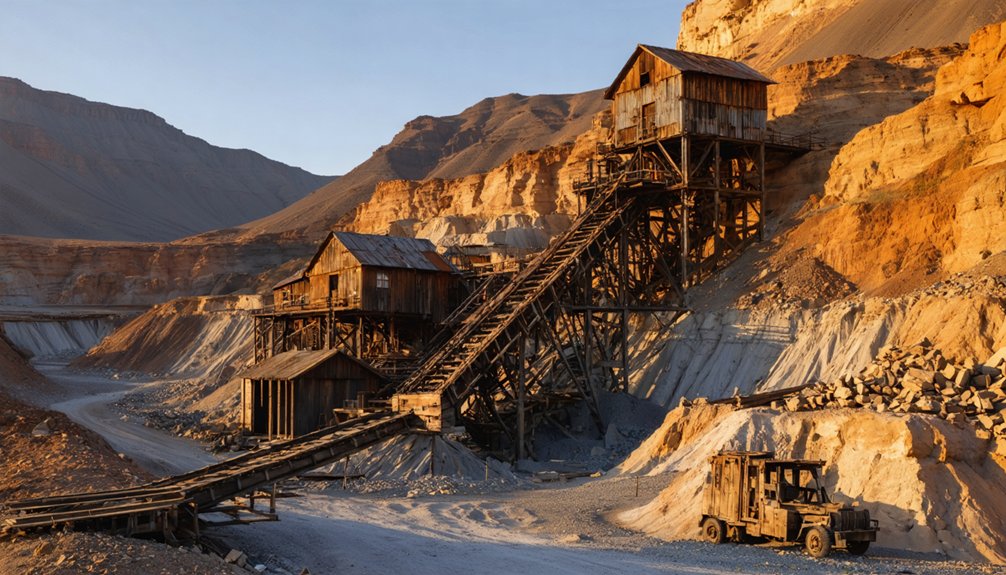
Unlike Rhyolite’s complete collapse, Calico transformed from abandonment to California’s premier preserved silver mining ghost town through deliberate restoration efforts. You’ll find Walter Knott purchased the site in 1951, architecturally restoring all but five original structures using historical photographs (California Historical Landmark No. 782, 1962).
The town’s significance stems from its substantial mining output: 500 mines produced over $20 million in silver and $9 million in borax between 1881–1907. At its peak, 3,500 citizens inhabited this Mojave Desert settlement, supporting 22 saloons and extensive commercial infrastructure.
Today’s San Bernardino County Regional Park offers museum exhibits documenting the Silver King Mine—California’s largest silver producer—alongside town restoration showcasing 1880s mining operations. Governor Schwarzenegger proclaimed it “California’s Silver Rush Ghost Town” in 2005.
Techatticup Mine: Eldorado Canyon’s Historic Treasure
Deep within Eldorado Canyon at 2,477 feet elevation, the Techatticup Mine operated as Nevada’s longest-lived and most productive mining operation from its 1863 opening until final closure in 1945. This site accounted for over half the district’s total output, yielding an estimated $10 million between 1864-1900 in gold, silver, copper, and lead.
The mine’s mining claims history reflects both prosperity and lawlessness:
- Claim disputes triggered violence exceeding Tombstone’s reputation
- Daily gunfights characterized peak operational periods
- Military post established in 1867 to impose order
- Haven for Civil War deserters avoiding authority
- Law enforcement systematically avoided the area
Modern restoration efforts by the Werly family since 1994 transformed the property into a tourist destination, offering 500-foot tunnel tours and preserving authentic structures including the stamp mill and bunkhouses.
Getting to the Ghost Towns From Las Vegas
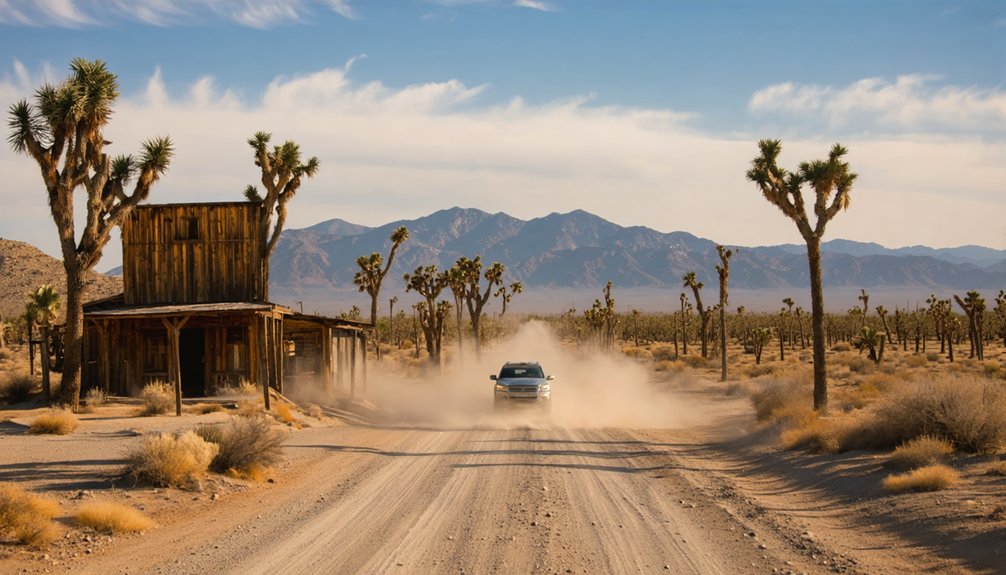
While Las Vegas serves primarily as an entertainment destination, its strategic location provides access to multiple historic mining ghost towns within a 45-minute to 2.5-hour driving radius.
For those seeking adventure, exploring abandoned places near Las Vegas can reveal fascinating remnants of the past. From decayed structures to forgotten artifacts, these locales tell the stories of those who once thrived there. Additionally, they offer unique opportunities for photography and discovery away from the city’s bright lights.
Transportation methods for reaching these sites require personal vehicles, as public transit doesn’t service remote locations. Logistical planning should account for Nelson and Goodsprings being closest at 45 miles and 45 minutes respectively, enabling same-day combined visits via I-15 S and US-95 N routes.
Rhyolite demands two hours along US-95 N to NV-374 S, positioning itself ideally for Death Valley excursions. Pioche represents the furthest destination at 2.5 hours via US-93 N to NV-321 N, though it offers lodging at the Overland Hotel & Saloon.
Goldfield sits midway between Las Vegas and Reno, requiring extended planning for its isolated location.
What to Expect When Visiting Mining Ghost Towns
Nevada’s mining ghost towns present visitors with authentic vestiges of the American West’s boom-and-bust mining era, ranging from completely abandoned settlements to partially inhabited communities that maintain historical character. Remote location access requires careful planning, as sites lack modern amenities.
Nevada’s ghost towns offer authentic glimpses into the Wild West’s mining heritage, from deserted ruins to living historic settlements requiring adventurous access.
You’ll encounter unique architectural remnants including Berlin’s preserved miner cabins with original furnishings, Rhyolite’s distinctive bottle house, and Belmont’s standing smokestack. Entry costs vary considerably:
- Nelson: $1 per person site access
- Rhyolite: Free entry
- Gold Point: No admission fees
- Berlin-Ichthyosaur State Park: Self-guided tours available
- Jarbidge: Free public access
Expect atmospheric conditions featuring abandoned structures, dusty streets, and dead silence. Exercise caution around open mine pits and deteriorating buildings. Photography opportunities abound throughout these historically important locations.
Best Times to Explore Nevada’s Desert Ghost Towns
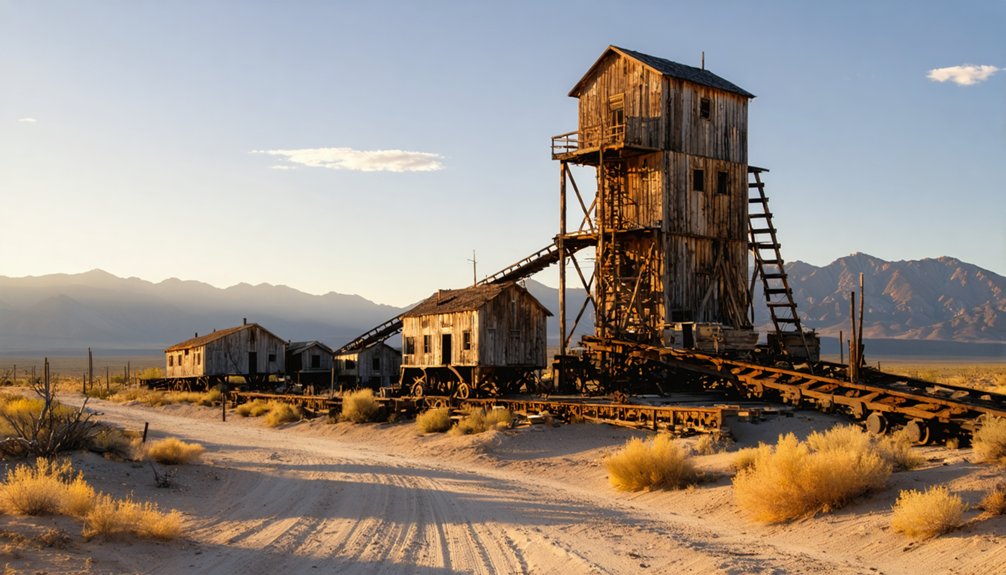
You’ll find Nevada’s desert ghost towns most accessible during spring and fall when temperatures remain moderate, typically ranging from 60-80°F, avoiding the extreme summer heat that frequently exceeds 110°F at midday (WeatherAvoidanceFactors).
Summer visits require strategic timing, as desert heat peaks year-round during midday hours, necessitating exploration during early morning or late afternoon windows to mitigate temperature extremes (WeatherAvoidanceFactors, IdealDailyTimes).
Winter offers reduced crowds and comfortable daytime temperatures, though shortened daylight hours between sunrise and sunset limit your exploration window at sites like Rhyolite (SeasonalExplorationWindows, IdealDailyTimes).
Seasonal Weather Considerations
Though Nevada’s desert climate appears consistently arid throughout the year, elevation-driven microclimates create dramatic temperature variations that directly impact ghost town accessibility and visitor comfort. Rapid weather shifts transform clear skies into total cloud coverage within hours, particularly when Sierra Nevada storm fronts push eastward. Cold night temperatures at higher elevations like Eureka (forecasted 32°F) contrast sharply with lower desert basins.
Consider these elevation-based conditions:
- Towne’s Pass (4,956 feet) requires jackets while Stovepipe Wells (16 miles lower) registers comfortable 69°F
- Snow accumulates above 4,000 feet, dusting desert ranges and altering exploration conditions
- Beatty (3,700 feet) experiences melting snow clumps from northern storms
- Mid-September through October offers ideal mild periods avoiding scorching heat
- Post-storm periods deliver brilliant skies with crisp, clear air across ghost town sites
Avoiding Extreme Desert Temperatures
Strategic timing proves equally important as seasonal planning when maximizing ghost town exploration success. You’ll find golden hour—occurring shortly after sunrise or before sunset—delivers ideal conditions for Mojave Desert sites like Rhyolite and Nelson, where soft light enhances textures while avoiding peak heat (Miller, 2019).
Early morning visits minimize midday exposure exceeding 110°F, reducing dehydration risk and supporting wildlife preservation through reduced disturbance during critical foraging periods (Desert Research Institute, 2021). Evening exploration between 5-7 PM provides comfortable temperatures for photography at Goldfield while limiting visitor impacts on temperature-sensitive ecosystems (Nevada Heritage Tourism Council, 2020).
Restrict site exposure to 2-3 hour blocks, carry one gallon water hourly, and utilize vehicle shade between locations like Goodsprings Pioneer Saloon to maintain safety without compromising your adventurous independence.
Frequently Asked Questions
Are Ghost Town Tours Suitable for Children and Families?
You’ll find ghost town tours are family-friendly, welcoming ages 5-100 with educational experiences highlighting historical significance. Tours offer family-friendly activities like guided walks, ATV rides, and gold mine exploration, though some require minimum ages of 3-7 years for safety.
Can I Bring My Pet Dog When Visiting These Ghost Towns?
Pet policies aren’t explicitly documented for these ghost towns, so you’ll need to contact each site directly. Before visiting, research pet-friendly accommodations and veterinary services nearby, as desert conditions present unique challenges for animals requiring responsible planning.
Do Any Ghost Towns Require Entrance Fees or Permits?
Yes, you’ll encounter entrance fees at several ghost towns. Nelson charges $1 for walking access, with $10 photography permits required. The Old Las Vegas Mormon Fort requires $3 entrance, while St. Thomas remains free without specific permitting requirements.
Are Overnight Camping Facilities Available Near the Ghost Towns?
You won’t find campgrounds near ghost towns like Nelson, Rhyolite, Goodsprings, or Goldfield. Ghost town camping options exist only through dispersed BLM camping on surrounding public lands, requiring you to bring self-sufficient equipment and practice leave-no-trace principles.
Which Ghost Towns Offer Guided Tours Versus Self-Guided Exploration?
Like time capsules awaiting interpretation, all four towns—Oatman, Chloride, El Dorado Canyon, and Nelson—offer guided tours emphasizing history preservation and cultural significance. You’ll find expert-led experiences prioritized over self-exploration, ensuring authentic heritage interpretation and safety.
References
- https://pinatravels.org/ghost-towns-near-las-vegas/
- https://savingplaces.org/stories/explore-wild-west-mining-history-in-nevada-ghost-towns
- https://www.youtube.com/watch?v=qDVJj8X8doE
- https://en.wikipedia.org/wiki/List_of_ghost_towns_in_Nevada
- https://www.revealedtravelguides.com/las-vegas-blog/ghost-towns-to-visit-near-las-vegas/
- https://nvtami.com/nevada-ghost-towns-map/
- https://theclio.com/entry/180300
- https://www.exploratography.com/blog-nv/eldorado-canyon-nelson-ghost-town-nevada
- https://special.library.unlv.edu/boomtown/counties/clark.php
- https://bouldercityreview.com/opinion/mine-areas-history-on-visit-to-nelson-49556/