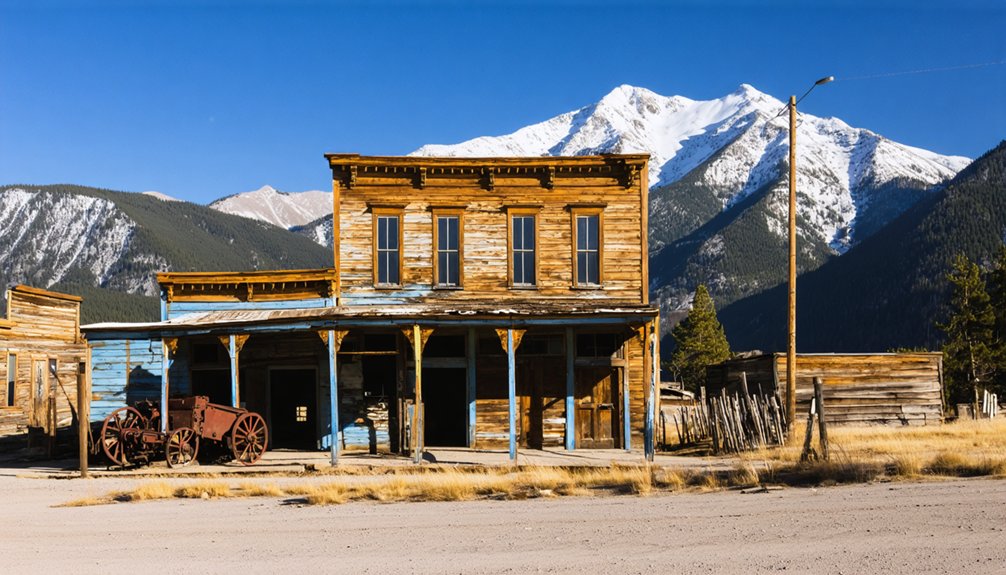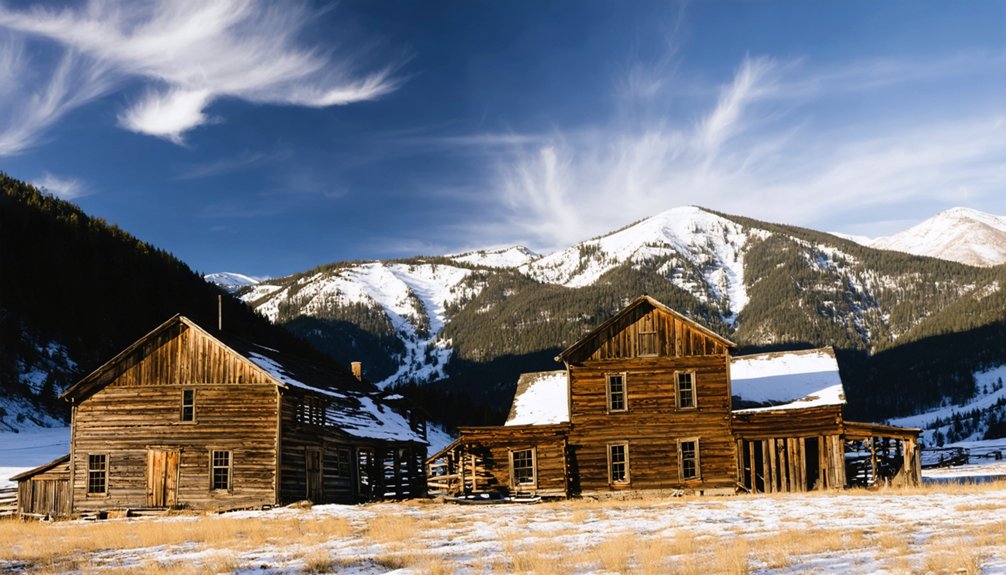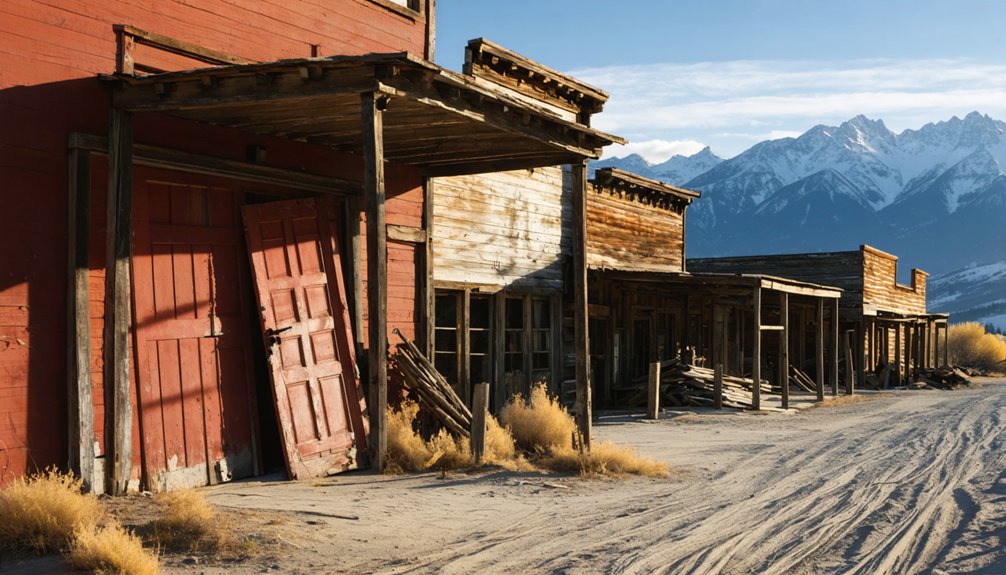
Montezuma isn’t actually a ghost town but a living community that’s survived since Colorado’s 1865 silver boom. Unlike neighboring settlements that disappeared after the 1893 silver crash, it diversified into gold, lead, and zinc production. Despite enduring six major fires, the town repeatedly rebuilt. Today, about 65 residents live among preserved 1880s structures including the original schoolhouse and general store. The town’s resilience tells a deeper story of adaptation and perseverance.
Key Takeaways
- Montezuma is not a true ghost town with approximately 65 full-time residents still living there today.
- Founded during the 1865 silver rush, Montezuma evolved from a tent settlement to a town with over 100 buildings.
- The town survived the 1893 silver crash by diversifying into gold, lead, and zinc production.
- Unlike many abandoned mining towns, Montezuma rebuilt after six major fires between 1903-1958.
- Several original 1880s structures remain standing, including the historic schoolhouse and general store.
From Silver Dreams to Mountain Hideaway: The Story of Montezuma
When prospectors discovered silver deposits near Argentine Pass in 1865, they inadvertently initiated the remarkable saga of Montezuma, a high-altitude mining settlement that would persevere through boom, bust, and transformation.
Named after the Aztec emperor, this remote tent community at 10,000 feet quickly evolved into a thriving town with over 100 buildings by 1884.
You’ll find the silver discovery marked Montezuma’s economic zenith when its population reached 800 residents. The town sits five miles west of what is now the Keystone ski resort. Mining legends emerged from operations like Belle, Blanche, and Saints John mines. Today, visitors can explore the original 1880s structures including the schoolhouse and general store that still stand as testament to the town’s rich history.
While the 1893 silver crash devastated many ghost towns, Montezuma displayed unusual resilience. Despite five major fires and economic hardships, it maintained continuous habitation, eventually transforming from industrial hub into the mountain hideaway of 65 residents counted in 2010.
Mining Boom and Town Development in Colorado’s High Country
Though silver traces had been found earlier, Colorado’s mining industry truly exploded in 1879 with Leadville’s significant silver discoveries, transforming the state’s high country into an economic powerhouse.
The U.S. government’s silver purchase program fueled this expansion, creating unprecedented wealth as mining techniques evolved to extract previously inaccessible ores. The Bland-Allison Act of 1878 was particularly influential in stimulating silver mining by mandating government silver purchases. The silver boom eventually ended with the Sherman Silver Purchase Act repeal in 1893, devastating mining communities throughout Colorado.
Three key economic impacts of Colorado’s mining boom:
- Rapid population growth transformed temporary camps into thriving towns with populations exceeding 10,000
- Development of extensive narrow-gauge railroad networks connected isolated mountain communities to larger markets
- Diversification beyond silver into gold, zinc, and molybdenum created economic resilience in some regions
You’ll find this boom wasn’t just about minerals—it fundamentally reshaped Colorado’s demographic landscape, establishing communities that would later define the state’s character.
Surviving the Silver Crash While Others Faded
Unlike countless mining settlements that vanished after the catastrophic silver crash of 1893, Montezuma demonstrated remarkable resilience through strategic diversification of its mineral production.
While neighboring towns became abandoned ruins, Montezuma’s mines shifted to extract gold, lead, and zinc alongside silver, producing an impressive 50,000 ounces of gold between 1881-1913.
This economic adaptation attracted continuous capital investment, enabling technological upgrades and ownership changes that sustained operations until 1936. The Caribou mine offered its last shot for gold extraction that promised sufficient wealth for miners to achieve financial independence.
The community’s resilience manifested through rebuilding after multiple fires and maintaining ancillary businesses that buffered mining fluctuations.
Geographic advantages from the mineral-rich Smuggler Lode and improved access via Loveland Pass further secured Montezuma’s survival. The town stands at an impressive 10,312 feet elevation, making it one of the highest mining settlements in Colorado.
Unlike typical boom-and-bust ghost towns, Montezuma maintained a stable population well into the modern era.
Rising From the Ashes: Montezuma’s Battle With Devastating Fires
Throughout its storied existence, Montezuma endured a relentless cycle of destruction and rebuilding as six major fires repeatedly threatened the town’s survival between 1903 and 1958.
The town’s architectural heritage suffered devastating losses, including the Summit House Hotel, historic Town Hall, and an 1880s general store.
When you visit Montezuma today, you’ll witness the remarkable fire recovery efforts that kept this town from becoming another abandoned mining settlement:
- Unlike neighboring ghost towns, Montezuma rebuilt after each major fire
- The town experienced renewed mining activity during World War II despite previous devastation
- Several original structures remain standing, defying the destruction that claimed most of the town’s historic buildings
One particularly significant blaze started in the kitchen of the Black hotel, likely originating from the chimney, and spread rapidly due to strong winds.
This resilience against recurring devastation distinguishes Montezuma from Colorado’s many vanished mining communities. The town’s close proximity to ski areas has contributed to a recent surge in real estate interest, breathing new life into this historic mining settlement.
Modern Mountain Living in a Historic Mining Settlement
Perched at an elevation exceeding 10,000 feet in Summit County, Colorado, Montezuma has transformed from a once-booming silver mining hub with over 700 residents into a distinctive mountain community where approximately 65 full-time residents now embrace high-altitude living amid historic remnants.
When you visit today, you’ll find a unique blend of preserved mining heritage and contemporary mountain lifestyle where sustainable living practices have necessarily evolved from the challenging alpine environment. Montezuma posed significant competition to Saints John because it offered a more hospitable environment for residents despite the high elevation.
The community’s engagement centers around their repurposed 1940s cabin town hall and grant-funded parks, creating social cohesion despite limited infrastructure. The town experienced renewed civic participation when residents re-established the charter in the 1980s after decades of minimal governance.
Outdoor enthusiasts thrive here with immediate access to wilderness trails, ghost towns, and historic sites.
Year-round residents navigate seasonal challenges while treasuring the freedom of mountain solitude and the authentic character that vanished long ago from more developed Colorado mountain towns.
Frequently Asked Questions
What Was Daily Life Like for Miners in Montezuma?
You’d endure grueling 10-12 hour shifts at high altitude, wielding heavy mining tools through dangerous underground conditions, following strict daily routines that offered little respite from physical hardship and constant danger.
How Did Women Contribute to Montezuma’s Development?
Women’s roles extended beyond domestic spheres; you’ll find they managed businesses, provided essential community support through stores, lodging, entertainment venues, and maintained social cohesion crucial to Montezuma’s development and sustainability.
What Indigenous Peoples Inhabited the Area Before Mining Began?
You’ll find that Ancestral Puebloans inhabited the area until the late 1200s, followed by Ute Tribes who established seasonal camps. Navajo peoples also influenced the region, along with Fremont and Arapaho Heritage.
Is There Paranormal Activity Reported in Montezuma?
Yes, you’ll find documented paranormal activity in abundance. Ghost sightings, eerie experiences, and EVP recordings create compelling evidence. Children’s voices, hovering spectral dogs, and mysterious mist formations challenge rational explanation.
How Accessible Is Montezuma During Winter Months?
You’ll find Montezuma quite accessible in winter months, as Montezuma Road remains paved and consistently plowed. Your 2WD vehicle suffices for traversing the road conditions, despite challenging winter weather beyond town boundaries.
References
- https://www.allsummitcounty.com/history_museums/montezuma_ghost_town.php
- https://forums.bmwmoa.org/threads/the-semi-ghost-town-of-montezuma.61244/
- https://coloradosghosttowns.com/Montezuma Colorado.html
- https://www.youtube.com/watch?v=gdxUcRnQRPg
- https://westernmininghistory.com/towns/colorado/montezuma/
- https://www.summitdaily.com/news/montezuma-mines-and-myths/
- https://summithistorical.org/landscapes/townsites/montezuma/
- https://en.wikipedia.org/wiki/Montezuma
- https://en.wikipedia.org/wiki/Colorado_Silver_Boom
- https://visitfourcorners.com/colorado-mining-history-made-the-state/