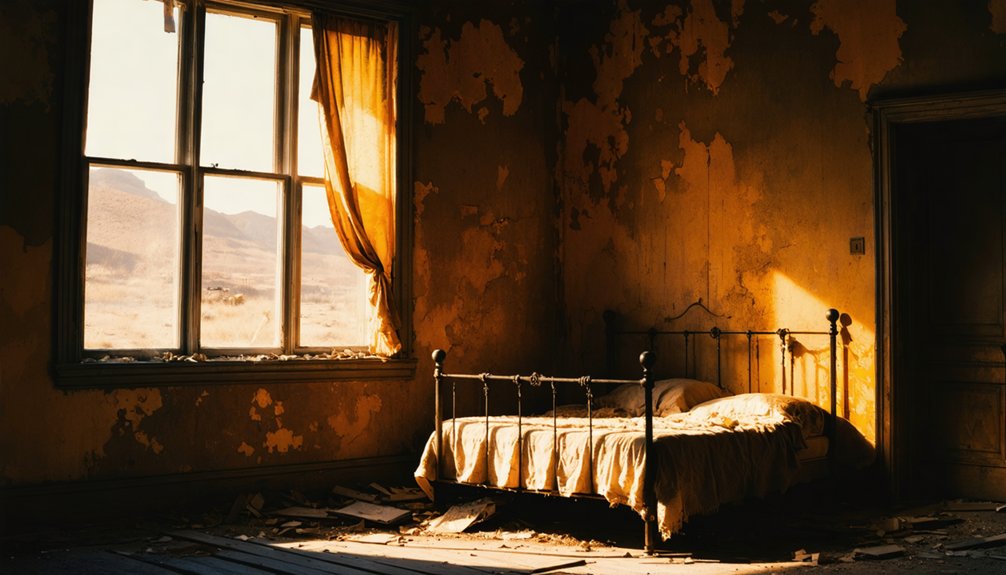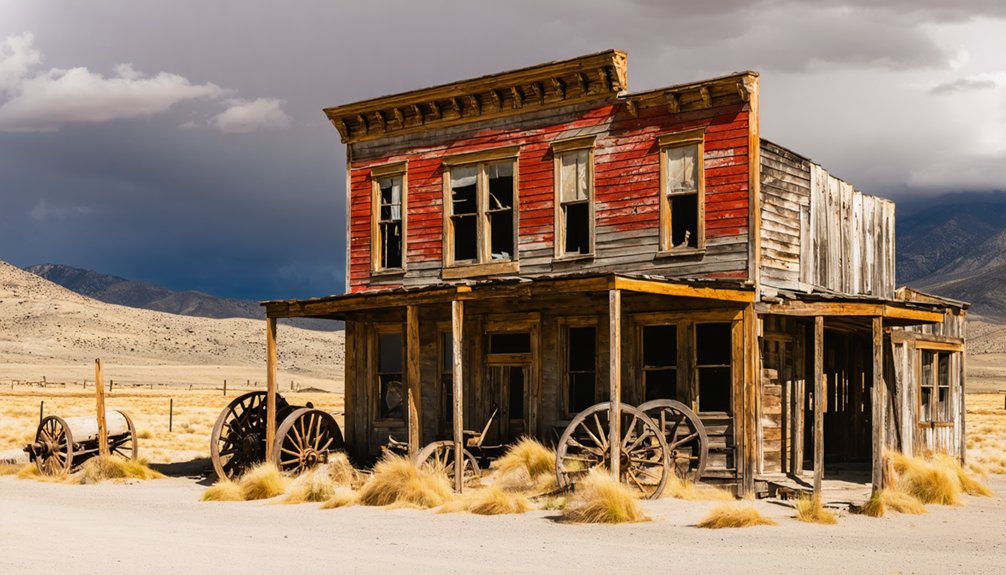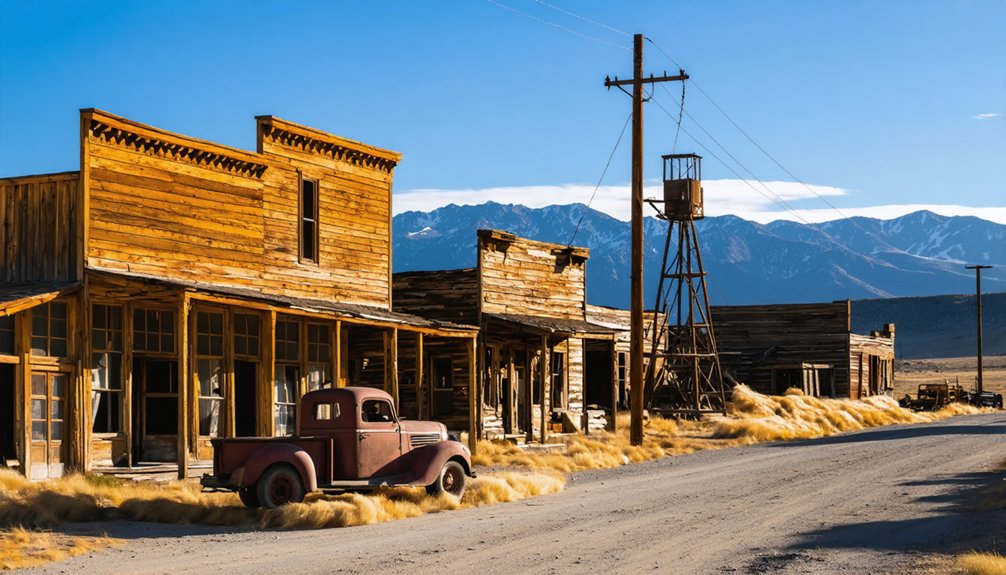
America’s most famous ghost towns include Bodie, California, preserved in “arrested decay” with 110-200 original structures; Virginia City, Nevada, which transformed from silver boomtown to tourist destination; Terlingua, Texas, known for mercury mining and chili cook-offs; Cahawba, Alabama’s abandoned first capital; Bannack, Montana, with its gold rush and vigilante history; and Kennicott, Alaska’s remote copper mining outpost. Each abandoned settlement tells a unique story of America’s boom-and-bust frontier past.
Key Takeaways
- Bodie, California preserves 110-200 original wooden structures in “arrested decay” as a National Historic Landmark since 1961.
- Virginia City, Nevada transformed from a booming mining town of 25,000 residents to a successful tourist destination.
- Terlingua, Texas evolved from a mercury mining hub to a cultural attraction famous for its annual chili cook-off.
- Cahawba, Alabama, once the state’s first capital, was abandoned by 1900 after devastating floods and Civil War damage.
- Bannack, Montana started as a gold rush boomtown of 10,000 people but declined after vigilante justice incidents in 1864.
Bodie, California: The Wild West Preserved in Time
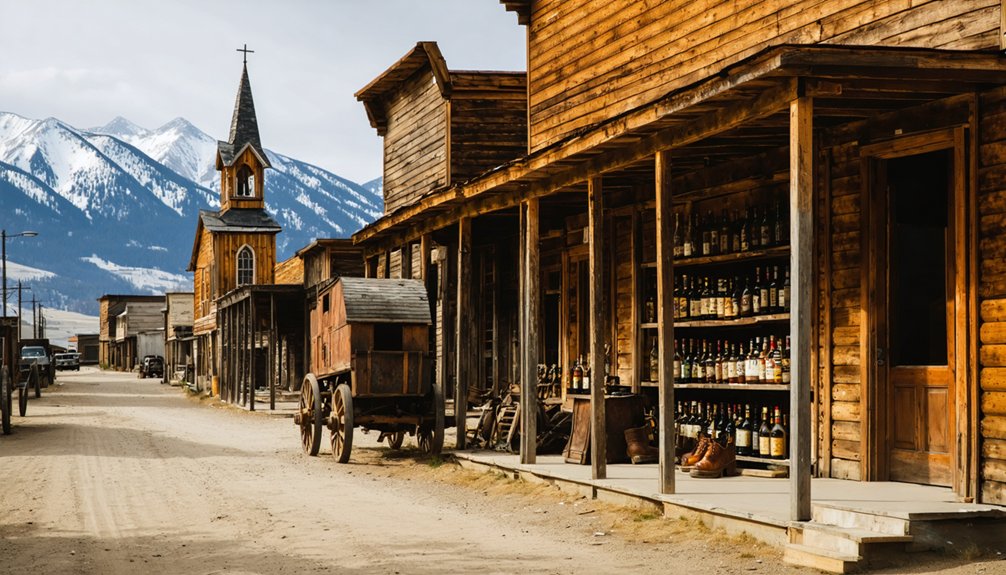
Nestled in the desolate high desert east of the Sierra Nevada Mountains, Bodie stands as America’s quintessential ghost town—a proof of the fleeting nature of gold rush prosperity. Founded in 1859 after W.S. Bodey’s gold discovery, this Wild West boomtown exploded from a few prospectors to 8,000 residents after an 1875 strike yielded $38 million in precious metals.
You’ll find Bodie maintained in “arrested decay” since becoming a National Historic Landmark in 1961. Walking among its 110-200 wooden structures—from saloons and brothels to the schoolhouse and general store—you’re experiencing authentic 19th-century mining life.
The town’s notorious reputation (“a bad man from Bodie”) lives on through preserved interiors still stocked with original goods. The California Department of Parks and Recreation carefully manages the site as Bodie State Historic Park. Unlike many commercialized ghost towns, Bodie offers an unfiltered window into America’s rugged past. This historic site serves as an important disambiguation resource for visitors seeking to understand the various places and meanings associated with the name Bodie.
Virginia City, Nevada: Silver Boom to Tourist Haven
While Bodie exemplifies a ghost town frozen in time, Virginia City represents the rare boomtown that survived its inevitable decline. Following the 1859 Comstock Lode discovery—the American West’s most valuable ore find—this settlement exploded from nothing to 25,000 residents within years.
Revolutionary mining technology, including square-set timbering and the Washoe process, allowed extraction at unprecedented depths exceeding 1,200 feet. When the “Big Bonanza” strike yielded $3 million monthly during the 1870s, Virginia City epitomized America’s mineral wealth frontier.
Virginia City showcased American mining ingenuity, where innovative techniques unlocked unprecedented wealth from the Nevada desert.
Unlike many abandoned settlements, this town pivoted after its 1880s mining collapse. The city that once financed the Union Army during the Civil War demonstrated remarkable resilience through economic diversification. Today, you’ll find exceptional ghost town preservation efforts that transformed Virginia City into a thriving tourist destination.
Historic buildings, mine tours, and cultural festivals celebrate its silver heritage while maintaining its frontier identity—a proof of adaptation rather than abandonment. The town’s successful transition was aided by the legalization of gambling in Nevada in 1931, which helped support its emerging tourist economy.
Terlingua, Texas: Mercury Mines to Chili Cook-offs
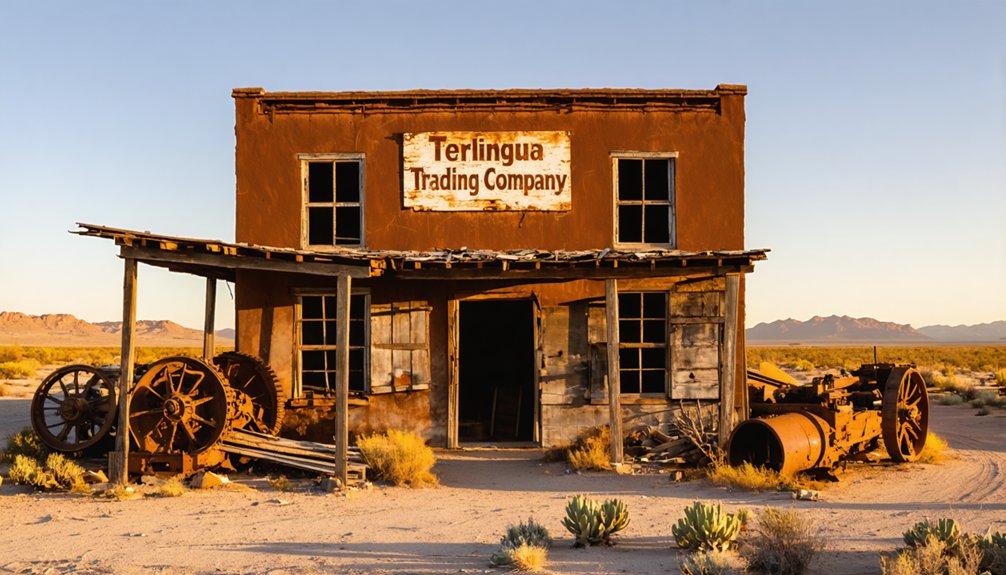
You’ll find Terlingua’s history defined by its booming cinnabar mining operations of the early 1900s, when the Chisos Mining Company transformed a small Mexican settlement into a thriving district with over 1,000 residents.
After its post-World War II decline into a true ghost town, Terlingua experienced an unexpected renaissance beginning in the late 1960s through tourism centered around its annual chili cook-off.
Today, the former company store operates as the Terlingua Trading Company while the Starlight Theatre serves as a restaurant, exemplifying how the town has cleverly preserved its mining heritage while establishing itself as the “Chili Capital of the World.” The town’s name derives from the Spanish “tres lenguas,” or three tongues, referencing its geographic location. The haunting Terlingua Cemetery, listed on the National Register of Historic Places, contains graves of early miners and stands as a poignant reminder of the town’s complex past.
Mining History Overview
Although now better known for its annual chili cook-off competitions, Terlingua‘s historical significance stems from its profound connection to mercury mining that transformed this remote Texas landscape into a bustling industrial center in the late 19th and early 20th centuries.
If you’d explored Terlingua during its heyday, you’d have witnessed the evolution from primitive mining techniques using burro-drawn carts to industrialized operations after Howard E. Perry founded the Chisos Mining Company in 1903. Before modern methods were adopted, miners relied on hand drilling and mucking, which made early extraction efforts labor-intensive and dangerous.
The discovery of rich cinnabar veins in 1914 coincided with World War I’s explosive demand for mercury, propelling Terlingua’s population to 2,000 residents.
You can trace the town’s decline to depleted ore, falling mercury prices, and the Chisos Company’s 1942 bankruptcy.
Despite brief revival attempts through the 1970s with government price guarantees, Terlingua’s mercury mining history effectively ended, leaving behind the ghost town you can explore today.
The town once boasted an impressive commercial district, with the Chisos Store becoming the largest retail establishment between Del Rio and El Paso, serving customers from a 100-mile radius.
Modern Revival Attractions
Terlingua’s transformation from an abandoned mercury mining outpost to a vibrant tourist destination represents one of the most remarkable ghost town revivals in the American Southwest.
You’ll find the Starlight Theatre—once a miners’ cinema, now a bustling Tex-Mex restaurant with live music—anchoring the town’s cultural experiences.
The ghost town seamlessly blends historical exploration with modern amenities, offering unique art galleries and distinctive accommodations amid stone ruins and weathered artifacts.
Weekend gatherings at The Porch provide social connection with spectacular views of distant mountain ranges.
For outdoor adventures, Terlingua serves as an ideal base camp for Big Bend National Park exploration, Rio Grande rafting, and internationally recognized stargazing.
Annual events like the famous chili cook-offs attract thousands, infusing economic significance into this once-forgotten corner of Texas.
Visitors can explore the authentic remains of the early 20th century town that was completely abandoned by 1946 following the decline of mining after World War I and the Great Depression.
Today, tourists can visit Ghost Town Texas located just steps away from local eateries, offering a glimpse into the area’s fascinating mining history.
Cahawba, Alabama: From State Capital to Forgotten Ruins
Once serving proudly as Alabama’s first permanent state capital in 1820, Cahawba transformed from a promising political center into one of America’s most haunting ghost towns.
Situated at the confluence of two rivers, this meticulously planned grid-system town fell victim to nature’s wrath through frequent flooding, which ultimately contributed to its capital relocation to Tuscaloosa in 1826.
Despite rebounding as a thriving cotton port in the 1840s-50s, Cahawba couldn’t withstand the triple blow of Civil War devastation, catastrophic flooding in 1865, and loss of county seat status to Selma.
By 1900, this once-bustling town stood abandoned.
Today, you’ll find Cahawba preserved as an archaeological park of significant historical importance, where scattered ruins tell the story of Alabama’s forgotten capital—a reflection of the fragile relationship between ambition and environmental reality.
Bannack, Montana: Gold Rush Legacy and Haunted History
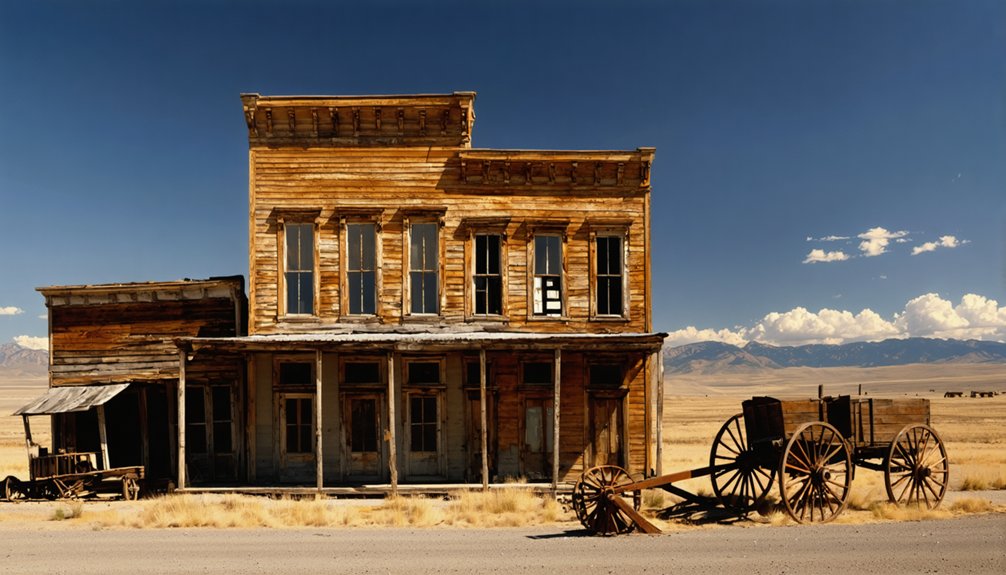
When enthusiastic gold seekers from Colorado established Bannack in 1862 near Grasshopper Creek, they unwittingly laid the foundation for what would become one of America’s most haunting and historically significant ghost towns.
Within a year, the population exploded to 10,000 as Montana’s first territorial capital emerged from the wilderness.
Bannack’s legacy is forever intertwined with Sheriff Henry Plummer‘s alleged criminal enterprise and the subsequent vigilante justice that saw him and 21 others hanged without trial in 1864.
This brutal frontier justice marks the town’s darkest chapter.
Kennicott, Alaska: Copper Mining Relic in America’s Last Frontier
Nestled in the rugged wilderness of Alaska’s Wrangell Mountains, Kennicott stands as one of America’s most remarkable copper mining relics, where extraordinary mineral wealth transformed an isolated glacier region into an industrial powerhouse.
The Kennecott history began in 1900 when prospectors discovered the purest copper ever found on Earth—ore containing up to 70% pure chalcocite.
In 1900, Alaska’s Wrangell Mountains revealed a geological treasure—copper ore of unprecedented purity waiting to transform America’s industrial landscape.
You’ll find this mining legacy preserved in three distinctive ways:
- The elaborate mill town where 300 workers processed phenomenal quantities of ore
- The remarkable 196-mile Copper River and Northwestern Railroad that connected this remote outpost to civilization
- The remains of a company town that paid premium wages while maintaining strict control over workers’ daily lives
This industrial marvel yielded 120,850,000 pounds of copper during its peak year alone.
Frequently Asked Questions
Are Ghost Towns Legally Protected From Modern Development?
You’ll find many ghost towns are legally protected based on their historical significance, though protection varies widely depending on ownership, designation status, and local ghost town preservation regulations.
Can Visitors Take Artifacts or Souvenirs From Ghost Towns?
No, you can’t legally take artifacts from ghost towns. Artifact preservation laws strictly prohibit removal, and souvenir regulations protect these historical sites regardless of whether they’re on public or private land.
What’s the Best Season to Visit America’s Ghost Towns?
You’ll find late spring to early fall ideal, with summer providing excellent accessibility and period activities, while autumn offers spectacular colors and fewer crowds for a more contemplative historical experience.
Do Any Ghost Towns Have Permanent Residents Today?
In an absolutely extraordinary twist, you’ll find permanent residents still inhabiting ghost town communities like Helena, Texas (200 people) and Centralia, Pennsylvania (fewer than five), despite environmental hazards and economic decline.
Are There Organized Tours Connecting Multiple Ghost Towns?
Few organized multi-ghost town tours exist. You’ll find primarily single-location experiences, though some regional excursions connect nearby sites, often emphasizing historic preservation rather than thorough ghost town circuit tours.
References
- https://whakestudios.com/us-ghost-towns/
- https://www.christywanders.com/2024/08/top-ghost-towns-for-history-buffs.html
- https://www.visittheusa.com/experience/5-us-ghost-towns-you-must-see
- https://www.geotab.com/ghost-towns/
- https://en.wikipedia.org/wiki/Lists_of_ghost_towns_in_the_United_States
- https://www.youtube.com/watch?v=Z69cNeuZGsA
- https://www.bodiehistory.com
- https://en.wikipedia.org/wiki/Bodie
- https://www.youtube.com/watch?v=2Foz-2R_mH8
- https://www.mammothres.com/blog/best-mammoth/spooky-story-bodie-ghost-town