You’ll find the world’s most haunted ghost towns scattered across continents, each harboring dark secrets and restless spirits. Pripyat’s radioactive ruins near Chernobyl whisper of nuclear catastrophe, while Namibia’s sand-swallowed Kolmanskop echoes with diamond miners’ ghosts. Japan’s Hashima Island stands as a concrete battleship where coal workers’ souls allegedly linger, and Cyprus’s Varosha remains frozen since 1974’s conflict. These forsaken places share tragic histories—mining disasters, wars, and supernatural phenomena that continue drawing paranormal investigators and brave visitors seeking encounters with the past’s lingering shadows.
Key Takeaways
- Pripyat, Ukraine remains frozen since 1986 Chernobyl disaster, with 50,000 residents evacuated and never returned to their abandoned homes.
- Kolmanskop, Namibia was a wealthy diamond town abandoned in 1928, now features German mansions slowly consumed by desert sands.
- Hashima Island, Japan housed 5,300 coal miners on 16 acres before complete abandonment in 1974, leaving crumbling concrete structures.
- Varosha, Cyprus became a militarized ghost town in 1974 when 10,000 Greek Cypriots fled, leaving luxury resorts to decay.
- These ghost towns share eerie characteristics: sudden abandonment, preserved remnants of daily life, and nature reclaiming man-made structures.
Kolmanskop: Desert Sands Reclaiming Namibia’s Diamond Legacy
In April 1908, railway worker Zacharia Lewala picked up a glittering stone near Lüderitz and handed it to his supervisor, August Stauch. That single discovery transformed Namibia’s Sperrgebiet into the world’s richest town.
You’d have found German mansions rising from desert sand, complete with a ballroom, casino, and southern Africa’s first X-ray machine—used to scan workers suspected of swallowing diamonds. The diamond mining operations produced five million carats before richer deposits lured everyone to Oranjemund in 1928.
Pripyat: Ukraine’s Frozen Nuclear Nightmare
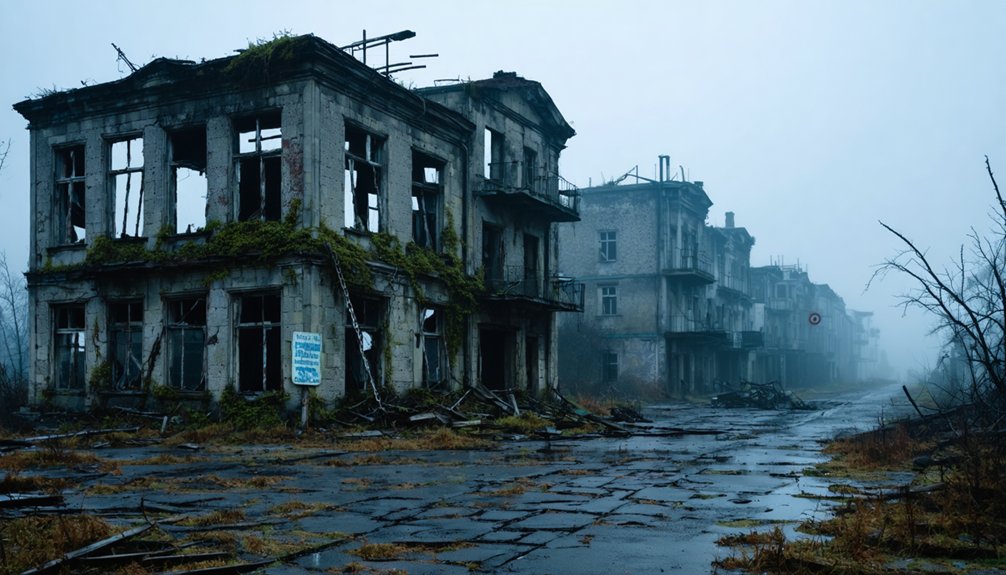
You’ll find children’s dolls scattered across schoolroom floors, frozen mid-lesson since April 26, 1986, when Reactor No. 4 exploded and showered Pripyat with invisible death. The city’s 50,000 residents were told they’d return in three days—they never did, leaving behind a perfectly preserved Soviet time capsule where gas masks litter kindergarten floors and an amusement park’s rusting Ferris wheel stands as a monument to May Day celebrations that never happened.
What makes Pripyat uniquely haunting isn’t just the radiation that still pulses through its empty streets, but the ordinary moments of life—breakfast dishes on tables, laundry hanging in closets—interrupted mid-breath and abandoned for nearly four decades.
Chernobyl’s 1986 Catastrophic Meltdown
When the emergency shutdown button slammed down at 1:23:40 AM on April 26, 1986, the operators of Reactor No. 4 expected a routine end to their safety test. Seven seconds later, their world exploded.
The 1,000-ton reactor roof launched skyward as power surged uncontrollably, ejecting radioactive fire into the night. Firefighters arrived within minutes, unknowingly walking into lethal radiation without protective gear. The engineer in charge insisted the core remained intact—he’d die from radiation poisoning still denying reality.
Soviet officials waited 36 hours before beginning the evacuation of surrounding villages, telling Pripyat’s residents they’d return soon. They never did. The liquidation of clean up personnel continued for months as 200,000 people abandoned their homes, creating Ukraine’s radioactive ghost town.
Preserved Soviet Era Remains
Stepping through Pripyat’s rusted gates transports you to February 1986, where Soviet propaganda posters still cling to peeling walls and children’s toys gather radioactive dust in silent kindergartens.
You’ll find hammer-and-sickle symbols marking decaying buildings throughout this atomgrad, designed to house workers from the nearby abandoned power plant. The unnatural preservation creates an eerie museum where empty hospital corridors and overgrown public spaces showcase mid-1980s Soviet life, untouched for decades.
Trees and vines reclaim this once-thriving city of 50,000, while liquidators’ desperate decontamination efforts left their own haunting marks. You’re witnessing what totalitarian control produces—a population evacuated in three hours, told they’d return in days, their belongings frozen in time within a 19-mile exclusion zone that stands as freedom’s antithesis.
Hashima Island: Japan’s Abandoned Battleship of Coal
Rising from the East China Sea like a concrete fortress frozen in time, Hashima Island cuts a haunting silhouette against the horizon just 10 miles off Nagasaki’s coast. You’d recognize its battleship-like profile immediately—hence the nickname “Gunkanjima.”
Mitsubishi’s mining operations here transformed a tiny outcrop into Japan’s most densely populated community, where 5,300 souls crammed onto just 16 acres by 1960. Living conditions pushed human endurance: miners descended kilometer-deep shafts into 30°C heat and 95% humidity, extracting coal that powered Japan’s industrial revolution. Above ground, concrete apartment towers and rooftop gardens defied typhoons.
When petroleum replaced coal in 1974, everyone vanished within three months. Today, crumbling concrete walls whisper stories of ambition, innovation, and the darker chapter of wartime forced labor.
Varosha: Cyprus’s Time Capsule From 1974
Along Cyprus’s sun-bleached coastline, Varosha stands frozen in August 1974—a Mediterranean playground where champagne glasses still gather dust on hotel bars and luxury cars rust in dealership showrooms. You’d have found Elizabeth Taylor sunbathing here during its heyday, when over 100 hotels served Europe’s elite along this “Las Vegas of the Mediterranean.”
Then Turkish troops rolled in, and 10,000 Greek Cypriots fled with only what they could carry. Today, these abandoned luxury resorts remain militarized no-man’s land, fenced off for nearly five decades. Nature’s reclaiming what humans left behind—vines strangle balconies, windows shatter, metal corrodes.
Recent reclamation of former tourist hub efforts allow limited tours, but you’ll need 10 billion euros to resurrect this ghost town’s glory.
Dhanushkodi: India’s Cyclone-Ravaged Peninsula
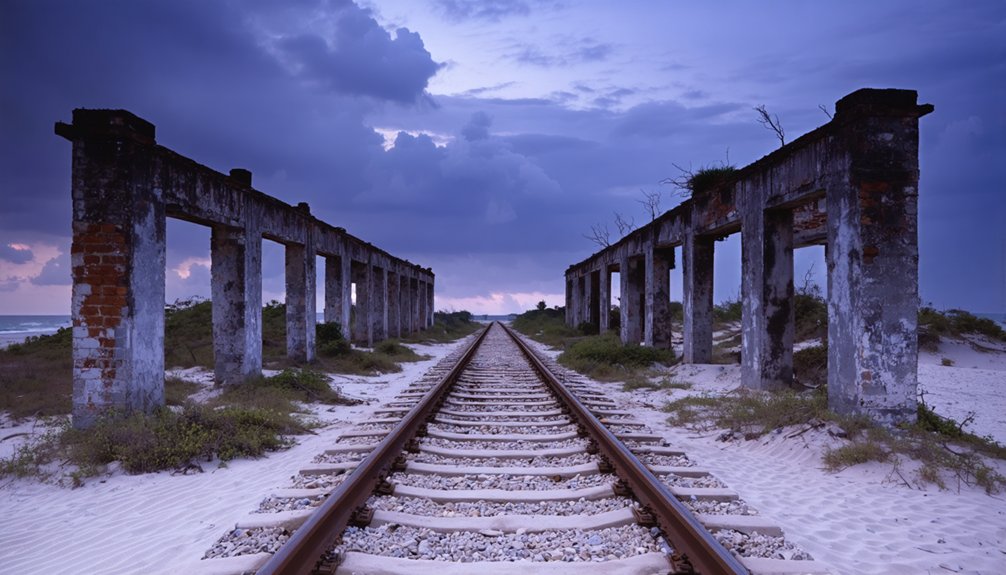
Where Varosha fell victim to human conflict, India’s Dhanushkodi met something far more primal—nature’s fury let loose in a single catastrophic night. On December 22, 1964, 270 km/hr winds and twenty-foot tidal waves swallowed this Tamil Nadu peninsula whole, killing over 1,800 souls. A passenger train carrying 115 people vanished beneath the surge—no survivors. Government relocation efforts followed swiftly; authorities declared the town uninhabitable, forcing residents to abandon their homes forever.
Yet Dhanushkodi’s mythological significance endures. You’ll find the Kothandaramaswamy Temple still standing—the sole structure that survived—where Lord Rama supposedly stood before crossing to Lanka. Today, dead corals cling to skeletal walls while tourists wander through ruins, drawn to this eerie confluence where the Bay of Bengal kisses the Indian Ocean, and legend meets devastation.
Humberstone: Chile’s Perfectly Preserved Nitrate Mining Settlement
Deep in Chile’s Atacama Desert, the world’s driest landscape has done something remarkable—it’s freeze-framed an entire industrial civilization in rust and wood. Humberstone stands as an embodiment, a manifestation, a representation of the resilience of nitrate industry that once drove empires to war.
You’ll walk through a 10-by-6-block grid where 3,700 souls lived under company control, paid in tokens that chained them to corporate stores. The 1930s labor protests here sparked movements that challenged exploitation across continents. Since UNESCO protection in 2005, preservation efforts have maintained this eerie snapshot—swimming pools, theaters, and homes abandoned overnight in 1960 when synthetic nitrates killed “white gold.”
What failed as scrap metal has succeeded as memory, reminding you that freedom’s often hardest-won in company towns.
The Eerie Allure of Abandoned Places Around the Globe
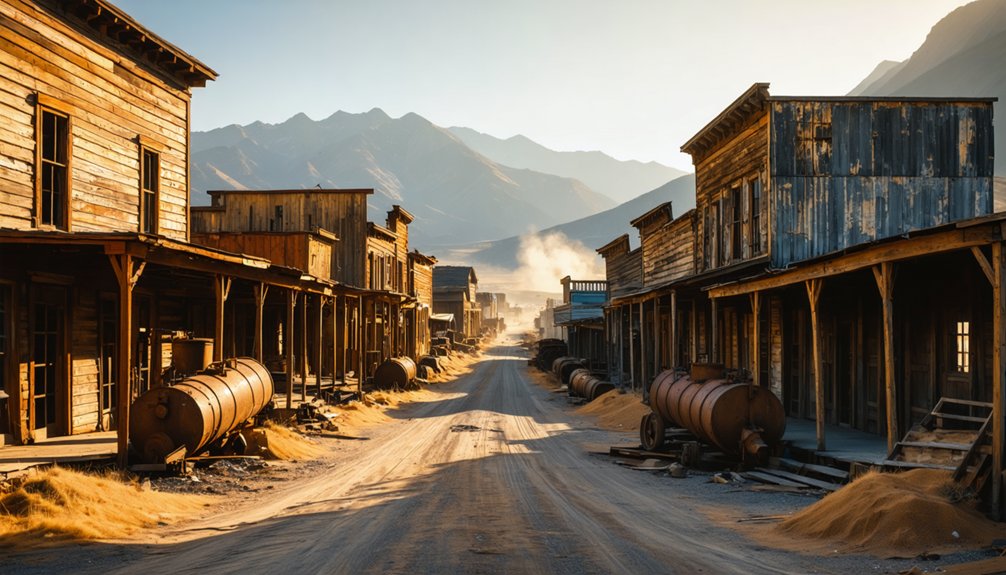
Abandoned places possess a gravitational pull that transcends mere curiosity—they’re portals into frozen moments where human ambition collided with forces beyond control. You’ll find Petra’s ancient stones humming with Bedouin tales of Djinns, while Leap Castle’s oubliette whispers of 150 souls who disappeared into darkness. The spiritual significance here isn’t manufactured—it’s etched into walls where real tragedy unfolded.
Environmental impact shaped these ghost towns as powerfully as human conflict: Chaitén’s volcanic fury, Craco’s relentless landslides, and Hashima’s exhausted coal veins all prove nature eventually reclaims her territory. What draws you isn’t morbid fascination—it’s recognition that these ruins mirror our own impermanence, reminding us that even our grandest structures become tomorrow’s archaeological mysteries.
In addition to the tales told by abandoned villages in South Africa, each desolate site echoes with whispers of its former life, where families once thrived and communities flourished. These remnants serve as poignant reminders of societal shifts, as industries rise and fall, often leaving behind untold stories of resilience and loss. Exploring these forgotten places invites reflection on both the past and the fragility of our present.
Frequently Asked Questions
What Safety Equipment Is Required When Visiting Radioactive Ghost Towns?
Like a shield against invisible threats, you’ll need protective gear requirements including disposable coveralls, impervious gloves, and closed shoes. Radiation monitoring devices—Geiger counters or survey meters—are essential for measuring exposure rates and ensuring you’re exploring safely.
Can You Legally Remove Artifacts or Souvenirs From Abandoned Towns?
You can’t legally remove artifacts from abandoned towns without considering ownership rights. Most “abandoned” sites remain protected under federal, state, or private ownership. Legal considerations include hefty fines and potential imprisonment for unauthorized removal.
Which Ghost Towns Offer Guided Tours Versus Self-Exploration Options?
You’ll find Edinburgh and Salem offer guided tours showcasing historical significance, while Craco and Kayaköy welcome self-guided tours through crumbling streets. Each experience lets you choose your adventure—structured storytelling or wandering freely through haunted ruins at your own pace.
What Are the Best Times of Year to Photograph These Locations?
Spring and autumn offer preferable lighting conditions with 70% clearer skies than summer. You’ll find ideal weather patterns in May’s snowmelt-enhanced waterfalls and October’s foliage, when fewer crowds grant you complete freedom to explore haunting ruins.
Do Any Former Residents Ever Return to Visit These Towns?
No former residents return to these abandoned places. You’ll find only tourists wandering empty streets—no visiting relatives seeking spiritual connections to their past homes. Military restrictions, political exchanges, and vast distances have permanently severed these communities from their original inhabitants.