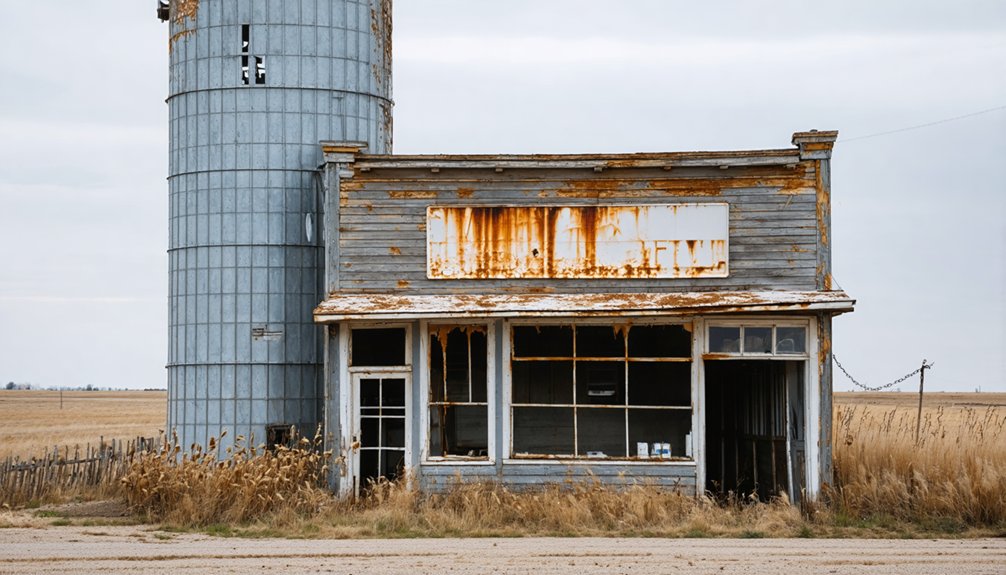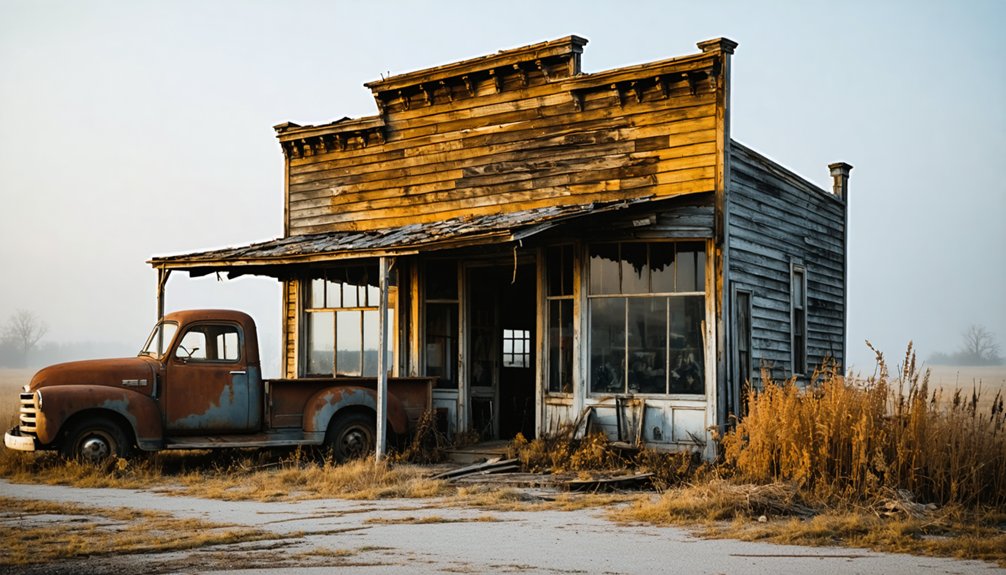
The Midwest harbors several notoriously haunted ghost towns, including Ardmore, South Dakota, where abandoned railroad tracks echo with spectral workers’ sounds and strange lights. Villisca, Iowa features the infamous Axe Murder House where eight victims met violent deaths in 1912. Stull Cemetery in Kansas allegedly houses a gateway to Hell, while Missouri State Penitentiary earned its reputation as “the bloodiest 47 acres in America.” These locations preserve both historical significance and supernatural phenomena waiting to be explored.
Key Takeaways
- Ardmore, South Dakota is a documented ghost town with abandoned railroad tracks where spectral railroad workers and unexplained lights are reported.
- Villisca, Iowa features the infamous Axe Murder House where eight people were killed in 1912, now a paranormal investigation hotspot.
- Stull, Kansas is home to a cemetery believed to contain a gateway to Hell that opens during specific celestial events.
- Mantorville, Minnesota, designated the “most haunted town in the Midwest per capita,” contains the historic Hubbell House with consistent unexplained phenomena.
- West Hills contains an abandoned orphanage with unmarked graves of 198 children whose disembodied voices and laughter echo through empty corridors.
Villisca: The Axe Murder House That Froze a Town in Time
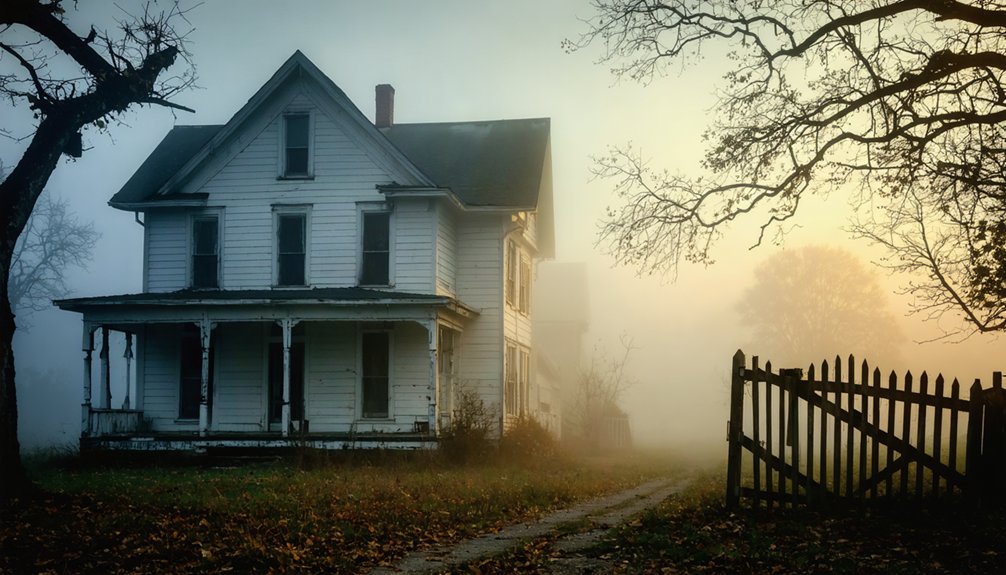
In the quiet town of Villisca, Iowa, a horrific crime occurred that would permanently alter the community’s identity and create an enduring historical landmark.
On June 9-10, 1912, an unknown assailant murdered eight people in their sleep with an axe—the Moore family and two young guests. The killer’s methodical approach—covering mirrors, hiding in the attic, and even preparing food afterward—deepens the Villisca mysteries that remain unsolved over a century later. Among the primary suspects was Reverend George Kelly, who confessed but later recanted his statement.
You can visit this time capsule today, as the house has been meticulously restored to its 1912 condition.
Without electricity or running water, it stands as both museum and paranormal hotspot. Many visitors report unexplained phenomena within its walls, making it one of America’s most significant sites of haunted history—a physical embodiment of unresolved justice frozen in time. Originally named “The Forks,” the town was later renamed to Villisca, which was falsely rumored to mean evil place after the murders occurred.
Ardmore, South Dakota: a Railroad Ghost Town With Permanent Residents
As you walk through Ardmore’s abandoned railroad tracks, you’ll encounter stories of ghostly railroad workers who allegedly continue their duties along the old Burlington line.
The collection of rusted vintage cars, slowly being reclaimed by prairie grass, serves as a physical timeline of the town’s gradual abandonment following steam locomotion’s decline. The town’s downfall was accelerated when residents left seeking areas with better water supplies. Founded in 1889 by settlers, Ardmore became officially abandoned in 2004 after decades of population decline.
If you listen carefully near the remaining water tower—once the town’s lifeline—locals claim you can still hear the final steam whistle that marked the end of Ardmore’s railroad prominence.
Ghostly Railroad Workers Remain
Though officially declared a ghost town in 2004, Ardmore’s reputation as haunted extends beyond its abandoned status to include spectral railroad workers who seemingly refuse to depart.
As you explore the deteriorating structures and abandoned railway infrastructure, you’ll likely experience the unsettling sensation of being watched—a common report among visitors encountering ghostly sightings near the tracks. Many travelers have documented this eerie feeling in TripAdvisor reviews that highlight the town’s unsettling ambiance.
The spectral presence manifests in several distinctive ways:
- Ethereal figures observed near the old railroad tracks at dusk
- Unexplained sounds of railway work echoing through empty buildings
- Sudden cold spots along the former Burlington rail line
- Strange lights moving along paths railroad workers once traveled
These phenomena connect directly to Ardmore’s identity as a railroad town, where the workers who once maintained this crucial transportation link appear unwilling to abandon their posts. The town’s decline was triggered when water supply from trains ceased, leading to the eventual abandonment of this once-thriving frontier settlement.
Rusted Cars Tell Stories
Dozens of rusted automobiles dot the landscape of Ardmore, South Dakota, each vehicle silently narrating the town’s gradual decline from frontier railroad hub to official ghost town.
These rusted relics sit amid frontier-style buildings established in 1889 when the New Burlington Railroad created this strategic refueling point.
You’ll find Ardmore one mile north of the Nebraska border along Highway 71, where abandoned memories persist despite technological progress.
When diesel engines replaced steam trains, the town lost its purpose, yet remarkably maintained residents until recently. As late as 2020, a single inhabitant remained among the decaying structures.
The town’s struggle with acidic water from Hat Creek made it ultimately impossible for a community to thrive long-term.
Despite its decline, the town maintained a remarkable reputation for resilience, having survived the Great Depression without any families requiring welfare assistance.
Photographers value this remote location for its authentic atmosphere—weathered buildings and oxidized vehicles creating a poignant tableau of a community that faded when progress rendered it obsolete.
Water Tower’s Final Whistle
The rusted water tower looming over Ardmore’s ghost town landscape stands as both sentinel and symbol of the town’s rise and fall. This silent structure tells the story of a community whose fate was inextricably tied to its railroad legacy and precarious water supply.
When steam engines powered the rail lines, Ardmore thrived as a strategic water stop.
You’ll understand the town’s decline when you consider:
- Steam locomotives delivered water to residents while refueling from the local creek
- The acidic creek water was unsuitable for human consumption
- Diesel engines eliminated the need for water stops by the mid-20th century
- Without railroad-supplied water, the population dwindled rapidly
The water tower now stands as a monument to Ardmore’s dependence on passing trains—the lifeline that, once severed, whispered the town’s final chapter.
The Haunting Remains of Quincy Mine in Michigan’s Copper Country
When visitors traverse the rugged Keweenaw Peninsula in Michigan’s Upper Peninsula, they encounter the imposing silhouette of Quincy Mine, a once-thriving copper operation that now stands as a symbol of industrial ambition and technological innovation.
Nicknamed “Old Reliable,” this National Historic Landmark operated from 1846 to 1945, producing over 726 million pounds of copper through groundbreaking mining techniques.
Today, its abandoned structures—including the 1908 shaft-rockhouse and 1918 hoist house—harbor a haunted history that attracts paranormal enthusiasts. Visitors regularly report shadowy figures, unexplained noises, and eerie sensations throughout the underground workings.
The mine’s reputation as one of Michigan’s most haunted locations stems from the dangerous conditions workers once faced. The Quincy Number 2 shaft was once considered the world’s longest mine shaft at 9,260 feet deep. The mine was unique for extracting copper in its pure metallic state, unlike most copper mines that process ore compounds. You’ll find the original smelting works among the oldest and best-preserved in the world.
Stull Cemetery: The Portal to Hell in Rural Kansas
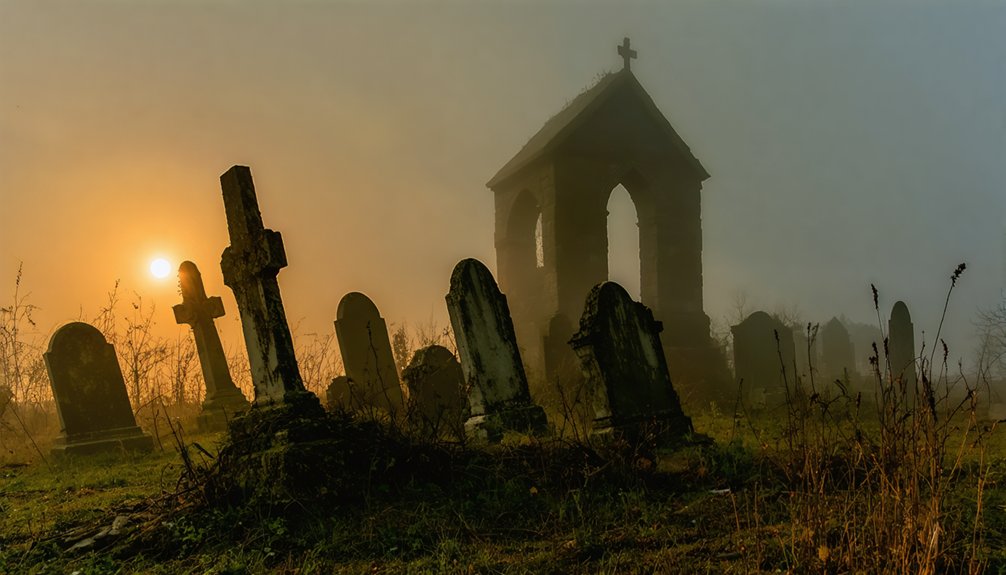
Hidden among the rolling prairies of eastern Kansas, Stull Cemetery stands as perhaps America’s most notorious burial ground, infamous for its purported connection to supernatural evil. Established in 1869, this cemetery became the epicenter of haunted legends after a 1974 university article catapulted its folklore into national consciousness.
The cemetery’s most persistent cemetery folklore includes:
- A supposed gateway to Hell that opens twice yearly—Halloween and Spring Equinox
- The grave of Satan’s child, allegedly born to a witch in the 1850s
- A mysterious vanishing staircase believed to serve as the portal’s entrance
- The “White Lady” ghost and reports of a red-eyed horned figure
Despite local residents consistently refuting these claims, Stull continues to draw hundreds of thrill-seekers annually, much to the dismay of caretakers protecting this historical burial ground.
Missouri State Penitentiary: Where 168 Years of Suffering Lingers
Standing as a somber indication to America’s darkest penal history, Missouri State Penitentiary earned its chilling nickname “the bloodiest 47 acres in America” through nearly two centuries of documented violence and suffering.
Opened in 1836 and operational until 2004, MSP’s prison history includes the infamous 1954 riot that left four inmates dead and caused $5 million in damages.
The facility housed notable criminals like James Earl Ray, MLK Jr.’s assassin who escaped in 1967, and executed 40 inmates in its gas chamber between 1937-1989.
Today, you can explore the penitentiary through public tours, witnessing firsthand the cells where thousands were confined.
Many visitors report paranormal experiences attributed to the 168 years of confinement, executions, and brutality that occurred within these now-silent stone walls.
Randolph County’s Forgotten Souls: An Asylum Lost to Time

Deep in rural Midwest America, the Randolph County Asylum sits as a decaying monument to society’s forgotten souls. Built in 1899 after a devastating fire consumed its predecessor, this 50,000-square-foot facility once housed the elderly, disabled, and orphaned under often deplorable conditions.
The asylum’s forgotten residents now manifest through:
- Spectral sightings in the vast, echoing hallways
- Unexplained sounds emanating from former patient rooms
- Distinctive smells that materialize without source
- Apparitions of women who spent their final days within these walls
The makeshift cemetery contains at least 51 individuals, including “Mo,” a Black man buried unclaimed behind the barns. Their unmarked graves reflect the institution’s troubled legacy—where financial struggles led to neglect, mistreatment, and eventually abandonment, transforming this once-vital institution into a hauntingly potent paranormal hotspot.
Atchison’s Sallie House: When a Child’s Spirit Never Leaves
You’ll find the Sallie House’s haunted legacy stems from a tragic failed appendectomy of a young girl in the early 1900s, whose spirit allegedly remains trapped within the residence’s walls.
Modern paranormal investigators consistently report equipment malfunctions, unexplained physical marks, and hostile encounters particularly directed toward male visitors.
The Pickman family’s documented experiences of violent supernatural outbursts in the 1990s cemented this Atchison home’s reputation as one of America’s most actively haunted locations, transforming it into a premier destination for scientific paranormal research.
Child Surgery Gone Wrong
The tragic case of Sallie, a six-year-old girl who died during an emergency appendicitis operation in the early 1900s, forms the cornerstone of the Sallie House hauntings in Atchison, Kansas.
This childhood trauma occurred in Dr. Charles Finney’s home practice—a common medical reality before Atchison had a proper hospital.
What made this surgical nightmare particularly haunting:
- Sallie died before anesthesia fully took effect, meaning she felt the procedure
- The child didn’t understand the doctor’s intentions, creating fear and confusion
- Her emergency treatment occurred in a home rather than a proper medical facility
- The traumatic circumstances created what paranormal experts believe is an anxious, sometimes hostile energy
You’ll find her presence manifests through unexplained scratches, electrical disturbances, object movement, and cold spots that continue to affect visitors today.
Paranormal Investigation Hotspot
When you visit, you’ll encounter a property where investigators consistently report a range of paranormal phenomena: physical attacks, electrical anomalies, object displacement, and unexplained audio recordings.
The house gained its reputation after the Pickman family experienced violent manifestations in the 1990s, including Tony’s documented scratches and burns.
Multiple research teams have confirmed the presence of several entities beyond young Sallie, including an older female spirit and a potentially malevolent basement entity.
This convergence of consistent phenomena across decades of investigation has established the Sallie House as a cornerstone case study in paranormal research.
The Rotating Cells of Squirrel Cage Jail: Trapped in Time
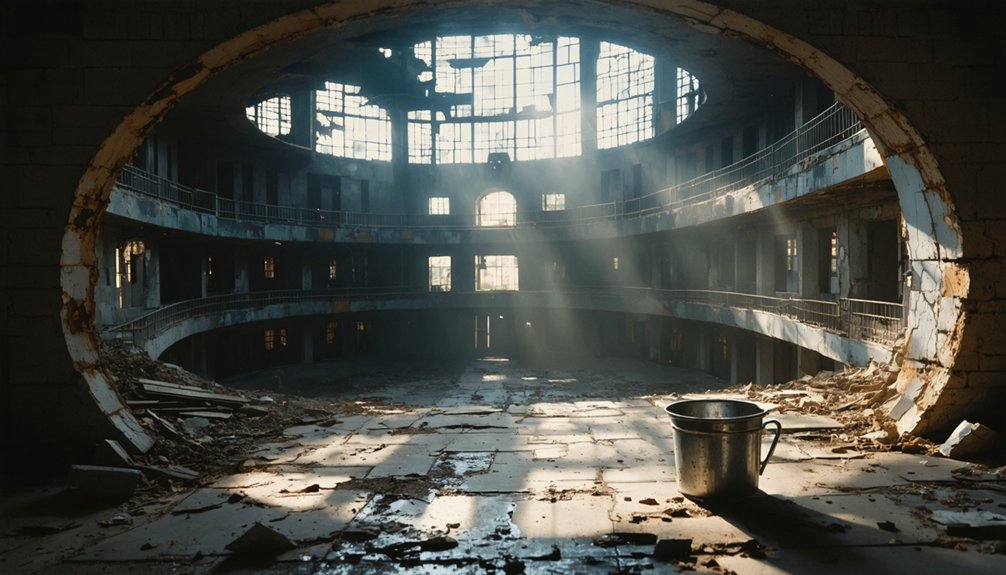
Hidden within the unassuming landscape of Council Bluffs, Iowa, stands an architectural marvel that once represented the pinnacle of nineteenth-century incarceration technology: the Squirrel Cage Jail.
Built in 1885, this three-story rotary jail confined inmates in pie-shaped cells within a revolving cage, operated by a hand-crank mechanism.
You’ll encounter evidence of the jail’s haunted reputation through:
- Ghostly sightings of former inmates pacing the narrow confines
- Eerie whispers echoing through the rotating structure
- Unexplained footsteps in empty corridors
- Self-opening doors that defy explanation
After 89 years of operation, the facility closed in 1969 due to safety concerns, but its paranormal legacy persists.
Now a National Historic Landmark, the museum preserves prisoner carvings and signatures—physical remnants of those who yearned for freedom within its rotating walls.
West Hills Orphanage: Echoes of Children in Empty Halls
As you walk through West Hills Orphanage‘s abandoned corridors, the tragic deaths of countless children who perished from neglect, disease, and mistreatment between 1886 and 1945 continue to manifest in unexplained laughter, footsteps, and moving objects.
The property’s playground, where thousands of orphaned and abandoned children once sought brief moments of joy amid institutional hardship, now serves as a focal point for paranormal encounters including temperature drops and disembodied voices.
Unmarked graves scattered throughout the grounds tell silent stories of forgotten children whose spirits remain restless, contributing to the site’s reputation as one of the Midwest’s most haunted historic locations.
As visitors explore this eerie landscape, they are often reminded of the ghost towns of the great plains, where similar tales of abandonment and sorrow echo in the winds. Each deserted building stands as a testament to the lives once lived and the communities that have vanished from existence. These remnants of the past beckon adventurers and historians alike, ensuring that their stories are not forgotten.
Tragic Deaths, Haunting Legacies
The decaying walls of West Hills Orphanage in Owatonna, Minnesota still resonate with the tragic legacies of the 10,000 children who passed through its doors between 1886 and 1945.
As you walk through the restored campus, you’ll encounter haunting memories preserved by the Minnesota State Public School Orphanage Museum.
Most disturbing reports include:
- Newborns perishing in boxes, left without proper care
- Physical abuse by caretakers, including beatings with bats
- Children sold into labor exploitation
- Paranormal phenomena centered around “Lily,” a girl who died in the early 1900s
The former hospital building remains particularly active with unexplained phenomena.
Underground tunnels beneath the campus create an oppressive atmosphere where visitors often experience sudden temperature drops and disembodied children’s laughter echoing through empty corridors.
Ghostly Children’s Playground
Visitors wandering through the desolate grounds of West Hills Orphanage often report an unsettling phenomenon that defies rational explanation: the laughter of children where no children exist.
This former institution, which housed over 10,635 orphaned youth between 1886 and 1945, carries the psychic imprints of profound suffering.
The abandoned playground, once filled with living children, now hosts apparitions that interact with toys and generate inexplicable cold spots.
Beneath the campus, sealed underground tunnels harbor shadowy figures and disembodied voices. Most disturbing are accounts of the ghostly laughter echoing across the grounds where 198 children died, many from infectious diseases and accidents.
The museum now preserves their memory while discouraging ghost hunting, though the ethereal presence of children like “Lily” continues to manifest for those sensitive to such phenomena.
Forgotten Graves Speak
Beyond the echoes of laughter in abandoned playgrounds, West Hills Orphanage harbors an even more profound connection to its departed residents through its forgotten cemetery. Here, the silent whispers of nearly 11,000 children who passed through these halls between 1886 and 1945 seem to linger among the headstones.
When you visit this hallowed ground, you’ll encounter forgotten stories that manifest in four distinct ways:
- Apparitions of half-figures with dark hair appearing near grave markers
- Unexplained sounds emanating from underground tunnels connecting to the cemetery
- Physical sensations of heaviness and imbalance, particularly near children’s graves
- Objects moving inexplicably, especially items placed as memorial offerings
The cemetery stands as a tribute to those whose lives were cut short—children sold for labor, subjected to abuse, and ultimately forgotten by society.
Hubbell House: When Phantom Scents Tell Tales of the Past
When phantom aromas waft through the historic corridors of Hubbell House, they often carry tales spanning nearly two centuries of Midwestern history.
This three-story stone landmark, established in 1854 and rebuilt in 1856, holds a haunted history few Mantorville structures can rival.
You’ll find this former stagecoach stop along the Zumbro River has hosted presidents Grant and Eisenhower, along with celebrities from Mickey Mantle to Roy Rogers.
Despite ownership changing from the Pappas family to Powers Ventures in 2020, the spectral encounters continue unabated. Staff consistently report unexplained phenomena throughout all operational periods.
Dr. Hawk Horvath’s ghost tours feature this prominent structure in what Christopher Larsen designated “the most haunted town in the Midwest per capita” in 2023.
Frequently Asked Questions
Do Children Experience More Paranormal Activity Than Adults at These Sites?
Your childlike curiosity and heightened sensitivity often make you more receptive to paranormal phenomena at these locations. Evidence suggests children frequently report more encounters due to their unfiltered perceptual capabilities.
What’s the Best Ghost-Hunting Equipment to Bring to Midwest Haunted Locations?
You’ll need EMF detectors to measure electromagnetic fluctuations, digital voice recorders for EVPs, infrared cameras for darkness, spirit boxes for communication, and thermal imaging cameras to detect temperature anomalies during Midwest investigations.
Are There Specific Times of Year When Paranormal Activity Increases?
Paranormal activity typically increases during fall (especially Halloween), winter solstice, and anniversary dates of tragedies. You’ll observe distinct seasonal patterns and lunar phases influencing supernatural manifestations across haunted locations year-round.
How Do Local Residents Feel About Living Near These Haunted Sites?
Local perspectives vary considerably. You’ll find residents experiencing mixed emotions—apprehension toward paranormal claims yet pride in community beliefs that strengthen local identity through tourism and cultural heritage preservation.
Can Visiting These Locations Cause Spiritual Attachments to Follow You Home?
While some claim spiritual energy can attach to susceptible visitors, there’s no scientific evidence confirming ghostly influences follow you home. Your emotional state and beliefs primarily determine your post-visit experiences.
References
- https://www.cbsnews.com/chicago/news/five-creepy-historical-sites-in-the-midwest/
- https://www.travelawaits.com/2702819/most-haunted-places-midwest/
- https://thetravelingwildflower.com/hauntedplacestovisit/
- https://khak.com/creepiest-abandoned-places-midwest-tours/
- https://leisuregrouptravel.com/spooky-experiences-await-in-the-midwest/
- https://www.atlasobscura.com/lists/abandoned-places-midwest
- https://www.youtube.com/watch?v=lfj6aeZEVJY
- https://en.wikipedia.org/wiki/Lists_of_ghost_towns_in_the_United_States
- https://en.wikipedia.org/wiki/Villisca_axe_murders
- https://www.legis.iowa.gov/docs/publications/TB/663533.pdf